What Is SEO in Digital Marketing: 2026 Guide
What Is SEO in Digital Marketing: 2026 Guide

TL;DR:
- SEO improves a website's rankings in organic search results to attract relevant traffic naturally.
- It relies on technical performance, content quality, and authority signals to influence search engine rankings.
SEO, or Search Engine Optimization, is the practice of improving a website's position in organic search results to attract relevant traffic without paying for ads. Understanding what is SEO in digital marketing is the first step every business owner needs to take before spending a dollar on any other channel. Search engines like Google use complex algorithms, including signals like Google's Largest Contentful Paint metric, to decide which pages rank at the top. Amigolabz works with business owners across New Jersey and Nevada who consistently underestimate how much free, qualified traffic a well-optimized site can generate. Getting SEO right is not optional for growth in 2026. It is the foundation everything else builds on.
How does SEO work in digital marketing?
SEO works by influencing how search engines discover, evaluate, and rank your website. Search engines process queries by crawling the web, indexing the content they find, and then ranking pages based on relevance and quality. Each stage matters. If your site blocks crawlers or loads too slowly, it never reaches the ranking stage at all.

Keywords and search intent are the core of the ranking process. A keyword is the phrase a person types into Google. Search intent is the reason behind that phrase. A page targeting "buy running shoes" needs to show a product page, not a blog post. Mismatching content to intent is one of the most common reasons pages fail to rank, even when the technical setup is perfect.
The difference between organic SEO and paid search (SEM) is significant. SEO drives long-term growth through unpaid rankings, while SEM uses paid ads like Google Ads for immediate visibility. Both have a place in a full digital marketing plan, but they serve different goals and timelines.
The traffic stakes are real. The first organic result on Google receives 27.6% of all clicks for a given query. That means the top spot captures more than a quarter of all available traffic before anyone else gets a chance. Dropping from position one to position two cuts that share dramatically.
Technical SEO underpins everything. Site speed, mobile friendliness, and clean site architecture all affect whether Google ranks your pages. A slow site does not just frustrate visitors. It signals to Google that your page delivers a poor experience, which directly lowers your ranking potential.
Pro Tip: Use Google Search Console to check which pages Google has indexed and which ones it cannot crawl. Fixing crawl errors is one of the fastest ways to recover lost rankings.
What are the main types of SEO?
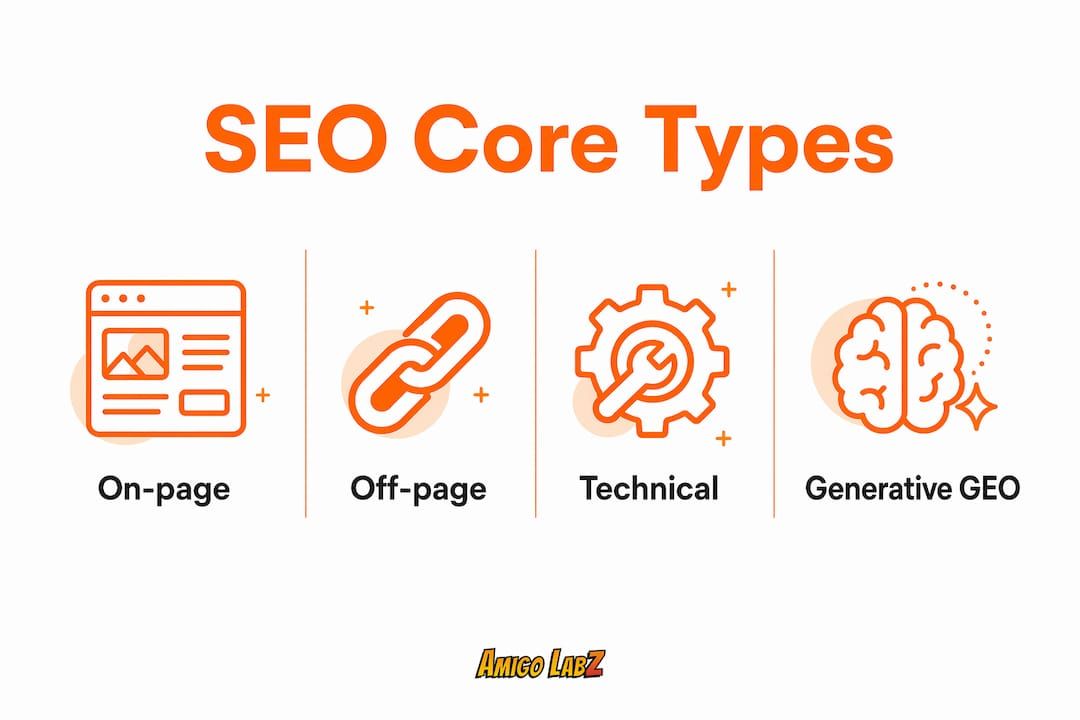
SEO aligns technical and content optimization with user experience across three core categories: on-page, off-page, and technical. Each type addresses a different part of how search engines evaluate your site. A gap in any one area limits the effectiveness of the other two.
On-page SEO
On-page SEO covers everything you control directly on your web pages. This includes title tags, meta descriptions, header structure, and the actual content on the page. Keyword placement matters here, but so does the quality and depth of what you write. A page that answers a question thoroughly outperforms a page that just repeats a keyword.
Off-page SEO
Off-page SEO builds your site's authority in the eyes of search engines. Backlinks from credible websites are the primary signal. When a respected publication links to your page, Google treats it as a vote of confidence. Social proof and brand mentions also contribute, though backlinks carry the most weight.
Technical SEO
Technical SEO ensures search engines can access and understand your site. This covers page speed, mobile responsiveness, structured data, and site architecture. For a deeper look at how these types work together, the types of SEO guide from Amigolabz breaks down each category with practical examples.
Generative Engine Optimization in 2026
A fourth category is emerging fast. Generative Engine Optimization (GEO) focuses on making your content visible inside AI-driven search overviews from tools like Google's AI Mode and Perplexity. These systems pull answers directly from web pages, so content structure and factual density now affect visibility in ways that traditional SEO alone does not cover.
| SEO type | Primary focus | Key tactic |
|---|---|---|
| On-page | Content and metadata | Keyword placement, answer-first formatting |
| Off-page | Authority and trust | Backlink acquisition, brand mentions |
| Technical | Site performance | Page speed, crawlability, mobile design |
| GEO | AI search visibility | Topical clusters, structured answers |
Pro Tip: Do not treat these types as separate projects. A strong backlink profile cannot save a page with thin content, and great content cannot rank if the site architecture blocks Google from finding it.
Why is SEO important for business growth?
SEO is essential for attracting customers organically, placing your business in front of people who are already searching for what you offer. That is a fundamentally different dynamic than paid advertising, where you interrupt someone who was not looking for you. Organic traffic converts at a higher rate because the intent is already there.
The cost argument for SEO is strong over time. Paid ads stop the moment you stop paying. A well-ranked page continues to drive traffic for months or years without additional spend. The upfront investment in content and technical work pays compounding returns, which paid campaigns rarely do.
SEO also builds brand trust in a way that ads cannot replicate. Ranking at the top of Google signals authority. Most people trust organic results more than sponsored listings because they assume Google has vetted the quality. That perception directly affects click-through rates and conversion.
The business case for SEO gets even stronger when you consider its integration with other channels:
- Content marketing: SEO-optimized content drives organic traffic and gives your social media team material to share.
- Email marketing: Blog posts that rank well can be repurposed into newsletters, extending their value.
- Paid search: Organic rankings reduce your cost-per-click on Google Ads by improving your Quality Score.
- Local marketing: Local SEO puts your business on the map for nearby customers searching on mobile.
For a full breakdown of why this matters for your specific situation, the why SEO matters resource from Amigolabz covers the business case in detail.
What are the SEO best practices for 2026?
SEO best practices in 2026 center on content depth, technical performance, and AI visibility. The tactics that worked three years ago, like targeting isolated keywords with standalone pages, are now significantly less effective. Search engines and AI systems reward sites that demonstrate genuine expertise across a topic.
-
Build topical clusters. Topical clusters of 5 or more interconnected pages earn 3.2 times more citations from AI systems than standalone pages. This means writing a pillar page on a broad topic and supporting it with detailed sub-pages that link back to it. The structure signals depth of knowledge to both Google and AI search tools.
-
Hit the LCP threshold. The Largest Contentful Paint threshold was tightened to 2.0 seconds as of march 2026. LCP measures how quickly the main content of a page loads. Pages that miss this threshold lose ranking ground to faster competitors, regardless of content quality.
-
Use answer-first formatting. Answer-first content structure increases the likelihood of being cited by AI-driven search overviews. Lead every section with a direct, factually dense sentence that answers the question in the heading. Expand with evidence and examples in the sentences that follow.
-
Avoid over-relying on deprecated tactics. FAQ rich results, for example, have been significantly reduced in Google's search display. Spending time building elaborate FAQ schema for every page is a lower-priority task compared to content depth and speed.
-
Monitor and adapt continuously. SEO is not a one-time project. Algorithm updates, competitor activity, and shifts in search behavior all require ongoing attention. Set a monthly review of your rankings, traffic, and technical health.
Pro Tip: Start with your small business SEO strategy by auditing your five most important pages first. Fix their speed, sharpen their content, and build two or three supporting pages around each one before expanding further.
Key takeaways
SEO in digital marketing is a long-term investment in organic visibility that requires technical performance, content depth, and authority building to deliver sustained business growth.
| Point | Details |
|---|---|
| First result dominates traffic | The top organic Google result captures 27.6% of clicks, making ranking position critical. |
| Three core SEO types | On-page, off-page, and technical SEO must all be addressed for rankings to hold. |
| Speed is now a ranking threshold | Google's LCP standard tightened to 2.0 seconds in 2026, making page speed non-negotiable. |
| Topical clusters outperform single pages | Groups of 5+ interconnected pages earn 3.2x more AI citations than standalone content. |
| SEO compounds where ads do not | Organic rankings continue driving traffic long after the initial content investment. |
SEO is a long game, and that is exactly why it wins
Working with business owners across New Jersey and Nevada, I see the same pattern repeat itself. A business invests heavily in Google Ads, gets immediate traffic, then pulls back on spend and watches the leads disappear overnight. SEO does not work that way. A page that earns a top ranking keeps delivering traffic whether you are actively spending or not.
The part most people miss is that SEO and paid search are not competitors. They are partners. Paid ads tell you which keywords convert before you commit months of content work to them. Organic rankings then take over those keywords at zero marginal cost. The businesses that grow fastest use both channels together, not one instead of the other.
The rise of AI-driven search in 2026 has added a new layer that I find genuinely exciting. Answer-first formatting and topical clusters are not just SEO tactics anymore. They are the way you get cited inside AI overviews that millions of people see before they even click a link. The businesses that adapt their content structure now will have a significant head start over those who wait.
My honest advice: stop treating SEO as a technical checkbox and start treating it as your most durable marketing asset. The businesses I see winning in search are not the ones with the biggest budgets. They are the ones that publish consistently, fix their technical issues promptly, and build content that actually answers what their customers are asking.
— John
How Amigolabz helps you grow with SEO
Amigolabz works with business owners across New Jersey and the rest of the country to build organic visibility that lasts. The team focuses on the full picture: technical health, content strategy, and the authority signals that move rankings.

If you are ready to stop guessing and start ranking, the SEO services at Amigolabz are built for businesses that want real, measurable results. For businesses that want to pair organic growth with paid visibility, Google Ads management and social media support are also available. Book a call with the team to map out a plan that fits your goals and your market.
FAQ
What is SEO in digital marketing?
SEO, or Search Engine Optimization, is the process of improving a website's organic rankings in search engines like Google to attract relevant traffic without paying for ads. It covers technical performance, content quality, and external authority signals.
How long does SEO take to show results?
SEO typically takes 3–6 months to show measurable ranking improvements, depending on competition and the current state of your site. New sites in competitive markets can take longer.
What is the difference between SEO and SEM?
SEO focuses on organic rankings for long-term growth, while SEM uses paid ads for immediate visibility. Both can work together for the best overall results.
Why does page speed matter for SEO?
Google's Largest Contentful Paint threshold is now 2.0 seconds. Pages that load slower than this threshold lose ranking ground to faster competitors, regardless of content quality.
What is a topical cluster in SEO?
A topical cluster is a group of interconnected pages built around one broad subject, with a pillar page supported by detailed sub-pages. Clusters of 5 or more pages earn 3.2 times more AI citations than standalone pages.
Recommended