One Channel First: Internet Marketing for Small Businesses in 90 Days
One Channel First: Internet Marketing for Small Businesses in 90 Days

Internet marketing splits into a handful of core channels: search engine optimization, paid search, content, social media, email, affiliate and influencer marketing, mobile/SMS, and display or video advertising, all tracked through analytics. Most small businesses should not try to run all of them. Start with search engine optimization for sustainable growth, add one paid channel like pay per click advertising for faster visibility, and layer in email marketing to keep the customers you already earned.
TL;DR:
- Local SEO is often the quickest way for service businesses to outrank competitors with sloppy listings, especially when their Google Business Profile is claimed and accurate.
- Paid search campaigns with a modest budget of $300 to $500 over a few weeks can provide valuable insights into keyword costs and conversion rates before larger investment.
- Content marketing, including blog posts and videos, supports SEO and social, and should focus on answering customer questions with a consistent publishing schedule.
- Starting with one or two channels and testing them thoroughly helps small businesses avoid weak results from spreading limited budgets across all options prematurely.
- Proper website audits and analytics setup must be completed first, as foundational data is essential for making informed decisions on where to allocate marketing resources.
What Is Internet Marketing, and What Are the Types That Matter?
Internet marketing covers any promotion that happens through channels delivered over the internet, which is a narrower category than "digital marketing," a term that can also include things like digital billboards or in-store screens that never touch the web. Smart Insights draws this distinction clearly, and it matters because it keeps this guide focused on channels you can actually launch from a laptop: your website, search engines, social platforms, email, and mobile devices.
Most guides settle on a similar list of channel types, and WVU's breakdown of digital marketing types lines up closely with what follows here: SEO, paid search, content, social, email, affiliate and influencer work, mobile, and display or video advertising. Each one solves a different problem. Some build long-term visibility. Others generate leads this week. The trick is matching the channel to what your business actually needs right now, not chasing every option at once.
Search Engine Optimization (SEO)
SEO is the practice of earning free, organic placement in search results, and it splits into three working parts: on-page (your content and keywords), technical (site speed, mobile-friendliness, crawlability), and off-page (backlinks and reputation signals). It's slower than paid ads, but it compounds. A blog post ranking well in month eight can still bring leads in year three.
Common tactics for small businesses include:
- Keyword research to find what your customers actually type into Google
- On-page content optimization (titles, headers, internal links)
- Technical cleanup like fixing broken links and improving page speed
- Local SEO: claiming your Google Business Profile and building local citations
Pro Tip: Local SEO is often the fastest win for a service business. A plumber or landscaper with a claimed, accurate Google Business Profile frequently outranks competitors with bigger budgets but sloppier listings.
To measure progress, track organic traffic, keyword rankings, and leads from search. For a deeper walkthrough, see this beginner's guide to SEO in digital marketing.
Search Engine Marketing and Paid Search (SEM / PPC)
Paid search puts your business at the top of results immediately, through an auction where you bid on keywords and pay per click. Unlike SEO, results show up the day you launch, which makes SEM the go-to for promotions, seasonal offers, or filling a slow week.
Ad formats worth knowing:
- Text ads on Google or Bing tied to specific search terms
- Shopping ads for retail and e-commerce inventory
- Local service ads for contractors and home service providers
Budgeting doesn't require a big spend to start. A test of $300 to $500 over two to three weeks, aimed at a tight set of keywords, tells you a lot about cost per click and conversion rate before you commit more. Set up conversion tracking before you launch, not after. Without it, you're just buying clicks and guessing at results.
Pro Tip: Send paid traffic to a dedicated landing page, never your homepage. A page built around one offer converts far better than a general site.
Content Marketing
Content is the engine behind SEO, social, and email. It gives search engines something to rank, gives social platforms something to share, and gives your email list a reason to open your messages. Without it, the other channels run on fumes.
Formats worth building out:
- Blog posts answering specific customer questions
- Short videos demonstrating a service or product
- Downloadable guides or checklists
- An FAQ page addressing common objections
Plan content around topic clusters: one pillar page on a broad subject, supported by several narrower posts linking back to it. Repurpose one long piece into three or four shorter ones for social and email instead of starting from scratch each time.
A workable starter calendar is two blog posts a month, one repurposed into a social series and one into an email. Track organic traffic, time on page, and how many leads a given piece generates over 90 days.
Social Media Marketing
Organic social builds a following slowly through consistent posting; paid social buys reach instantly through targeted ads. Both matter, but they solve different problems. Organic builds trust over months. Paid social gets a specific offer in front of a specific audience this week.
Platform choice depends on your audience:
- Instagram and TikTok for visual, younger-skewing audiences
- Facebook for local community engagement and older demographics
- LinkedIn for B2B services and professional audiences
A car detailer probably gets more mileage from before-and-after photos on Instagram than from LinkedIn posts. A moving company might find its best leads through Facebook community groups and local group ads.
Start with a posting cadence of three to four times a week, then test a small paid boost, around $50 to $100, on your best-performing organic post. Track engagement rate, follower growth, and click-throughs to your site. Amigolabz's social media marketing ideas for small businesses is a solid reference for content that doesn't feel forced.
Email Marketing and Marketing Automation
Email is the one channel you fully own. Social platforms can change their algorithm overnight and bury your reach; your email list stays yours regardless. It's also consistently one of the highest-return channels available to small businesses, according to Adobe's overview of online marketing benefits, because the audience already opted in.
Core automated flows to set up:
- A welcome series for new subscribers or customers
- Cart or booking recovery for abandoned checkouts
- A regular newsletter to stay top of mind
Segment your list by purchase history or engagement level so a first-time customer doesn't get the same message as a five-year regular.
Pro Tip: Your welcome email usually gets the highest open rate you'll ever see from a subscriber. Use it to set expectations, not just to say hello.
Start with one opt-in offer, one automated welcome flow, and track opens, clicks, and conversions monthly. Amigolabz's guide to email marketing for small business growth covers the setup in more detail.
Affiliate and Influencer Marketing
Affiliate marketing pays a commission when someone else's promotion leads to a sale, tracked through unique links or codes. Influencer marketing pays (in cash or product) for a creator to feature your business to their audience. They overlap, but the goals differ: affiliates are performance based, influencers are often about reach and trust.
Key distinctions to know:
- Affiliates are usually paid per sale or lead; influencers may be paid flat fees
- Micro-influencers with a few thousand highly engaged local followers often outperform bigger names for local service businesses
- FTC disclosure rules require influencers to clearly state paid or gifted partnerships
Measure affiliate performance through tracked links and conversion rate. Measure influencer performance through engagement rate and referral traffic, not just follower count.
A reasonable pilot for a local business is partnering with two or three micro-influencers in your area for a product trade or small fee, then tracking the referral traffic each one generates. Amigolabz's piece on influencer marketing benefits for business growth walks through the setup.
Mobile Marketing and SMS
Mobile marketing includes SMS texts, in-app messages, and push notifications, and it gets read fast. Text messages routinely get opened within minutes, which makes SMS ideal for time-sensitive messages.
Where it works best:
- Appointment reminders for service businesses (dramatically cuts no-shows)
- Local, time-limited promotions ("20% off today only")
- High-priority updates customers actually want, like order-ready alerts
Compliance is not optional here. You need explicit opt-in consent before texting anyone, a clear opt-out method in every message, and a sensible frequency, no one wants five texts a week from a landscaper.
A safe starter test: collect phone numbers through a sign-up incentive, send one SMS campaign for an existing promotion, and track redemption rate against your opt-in list size.
Display Advertising, Programmatic, and Video Ads
Display and video ads build awareness; search ads capture demand that already exists. Someone searching "emergency plumber near me" is ready to act. Someone scrolling and seeing your banner ad is not, yet, but they'll remember your name later.
Formats to know, as outlined in Simplilearn's rundown of digital marketing formats:
- Static or animated banner ads placed across a network of websites
- Programmatic ads, bought automatically through real-time bidding based on audience data
- Video ads on platforms like YouTube or within social feeds
These channels fit best for brand awareness campaigns and retargeting, showing ads to people who already visited your site but didn't convert. A landscaper running a spring campaign might use retargeting to bring back visitors who browsed services but never booked.
Start small: a $200 to $300 retargeting test aimed only at recent site visitors usually outperforms a broad awareness campaign on the same budget.
Analytics, Measurement, and Attribution
None of these channels mean much without measurement. Google Analytics tracks what happens on your site, Google Search Console tracks how you show up in search, and ad platform pixels (Meta, Google Ads) track what happens after someone clicks an ad.
What to watch per channel:
- SEO: organic traffic, keyword rankings, leads from organic search
- Paid search: cost per click, conversion rate, cost per acquisition
- Social: engagement rate, follower growth, referral traffic
- Email: open rate, click rate, conversions per send
Attribution gets complicated once you run several channels at once, since a customer might see a social ad, later click a search ad, then convert from an email three days after. Don't chase perfect attribution as a small business. Focus on directional signals instead: which channel drove the traffic that eventually converted.
Pro Tip: Tag every campaign link with UTM parameters before you launch. Without them, your analytics can't tell you which channel actually deserves credit.
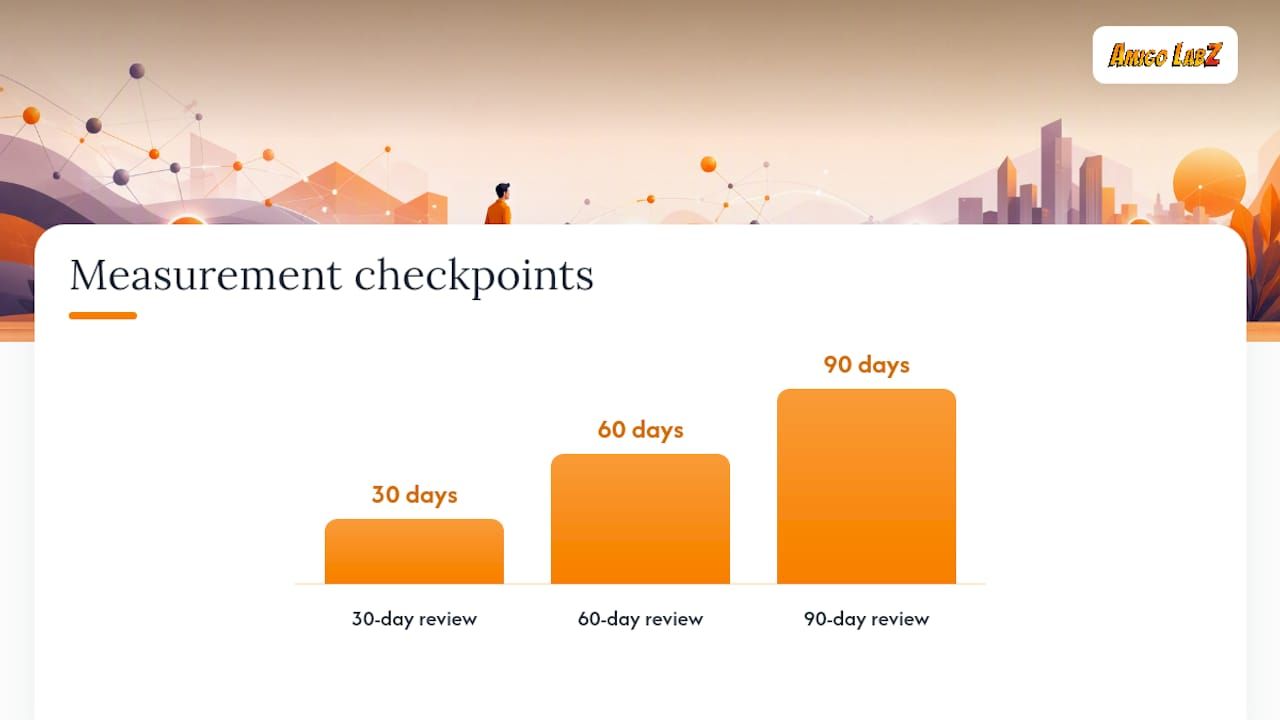
Set a specific goal, tag your links, and check conversions at the 30, 60, and 90 day marks rather than judging a channel after one week.
How to Choose Which Internet Marketing Channels to Start With
Choosing channels comes down to four questions: what's your goal (awareness, leads, or sales), how fast do you need results, what's your budget, and where does your audience already spend time?
- Define the goal first. If you need leads next week, paid search or paid social beats SEO every time, since organic rankings take months to build. If you're building for the next three years, SEO and content are worth the patience.
- Match the channel to your audience's habits. A B2B consultant probably gets more from LinkedIn and email than from TikTok. A moving company likely gets more from local SEO and Facebook than from influencer partnerships.
- Budget realistically, not evenly. Splitting a small budget across six channels usually means none of them get enough spend or attention to show a real signal. Marketing professionals commonly advise small businesses to master one or two channels before expanding, rather than running a thin campaign everywhere at once.
- Design a real test, not a guess. A 30 to 90 day test needs a defined budget, one clear KPI (leads, clicks, or sales), and a checkpoint date to review results before deciding whether to continue.
Pro Tip: If you're not sure where to start, pick the channel that fixes your biggest current bottleneck. If nobody finds you, that's SEO. If people find you but don't convert, that's your website and conversion rate optimization. If they buy once and never come back, that's email.
The most common mistake among small business owners is spreading a limited budget across every channel listed here at once. A landscaper trying to run SEO, PPC, social, email, and influencer outreach simultaneously on a small monthly budget will likely see weak results everywhere instead of strong results somewhere. Pick one growth channel and one retention channel, then expand once both are working.
Getting Started: A 90-Day Playbook for a Small Business
A time-boxed plan keeps this from turning into an endless to-do list. Here's a reasonable sequence:
- Weeks 1 to 2: Audit your website and Google Business Profile. Fix obvious technical issues (slow load times, broken forms, missing contact information).
- Weeks 3 to 4: Set up analytics and conversion tracking properly, before you spend a dollar on ads. Build one dedicated landing page for your primary offer.
- Weeks 5 to 8: Publish three blog posts targeting real customer questions. Launch a small paid search test, $300 to $500, on your highest-intent keywords.
- Weeks 9 to 10: Build one email automation flow (welcome series or booking follow-up) and start collecting opt-ins.
- Weeks 11 to 12: Review everything. Check organic traffic movement, paid search conversion rate, and email open rates.
At the 30-day mark, you should have tracking live and a landing page published. At 60 days, you should have real paid search data and early content published. At 90 days, you'll have enough data to decide whether to double down on SEO, shift more budget to paid search, or expand into social. Don't judge SEO at 30 days. It's the slowest channel to show movement, and that's normal.
An Agency's Take on Sequencing These Channels
Foundations first, always. Before touching ads or social campaigns, get your website solid and your tracking accurate. Every client conversation we've had that skipped this step ended up re-doing work later, at higher cost, because decisions got made on bad data.
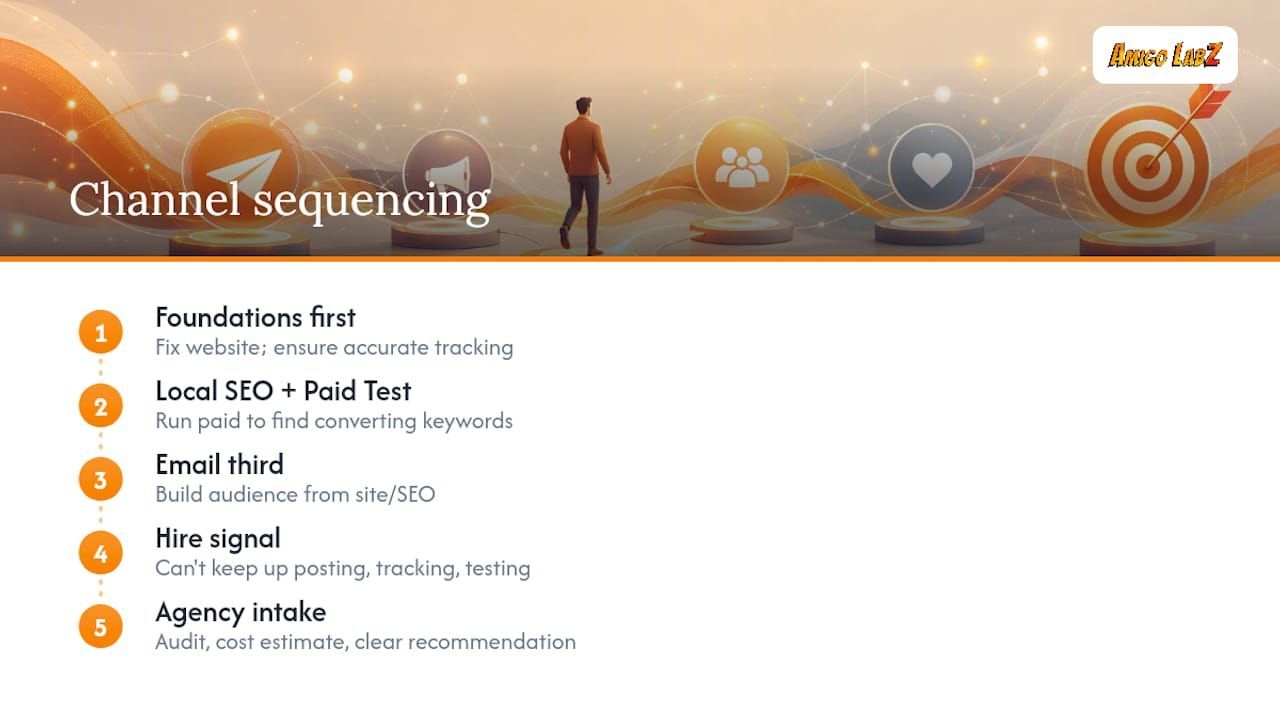
After that, we typically sequence local SEO and one paid search test together, since they reinforce each other: paid search brings quick data on which keywords actually convert, and that data sharpens the SEO content strategy. Email comes third, not because it matters less, but because it needs an audience to build from first.
The pattern holds across industries, whether it's a women's wellness practice, a moving company, or a car detailer. Hiring an agency makes sense once you've outgrown DIY bandwidth, not before. If you can't keep up with posting, tracking, and testing on your own, that's the signal. A good initial engagement should start with an honest audit of what's working, a ballpark on cost, and a specific recommendation, not a sales pitch dressed as a strategy call.
— John
How Amigolabz Can Help You Choose the Right Channels
Running all of this alone, on top of actually operating your business, is where most owners lose momentum. The alternative to guessing your way through six different platforms is having one team handle your website, SEO, paid search, and social, so priorities get set based on what your business actually needs, not on which channel is trendy this quarter.

A discovery call can start with a quick audit of your current site and marketing setup, followed by a straightforward recommendation on where your budget will do the most, along with a pricing ballpark before you commit to anything. If your website needs work, Amigolabz's tailored website and marketing services cover design, SEO, PPC, and social management under one roof, which keeps your channels working together instead of competing for attention. Book a call to get a straight answer on which one or two channels make sense for your business first.
Sources
FAQ
What Are the 7 Types of Digital Marketing?
Beginner guides commonly group internet marketing into seven types: SEO, content marketing, social media, email, paid advertising, affiliate and influencer marketing, and mobile marketing.
What Are the 4 Major Types of Digital Marketing?
When narrowed to the biggest categories, most guides point to SEO, content marketing, social media marketing, and paid advertising (SEM/PPC and display) as the four core pillars.
What Are the 6 I's of Internet Marketing?
Definitions of this framework vary significantly across sources and no single canonical version dominates, so it's worth treating it loosely rather than as a fixed standard.
What Are the 5 Types of Network Marketing?
Network marketing (direct sales through personal networks) is a different model from internet marketing entirely, and it's not one of the digital channels covered in this guide.
Which Internet Marketing Channel Should a Small Business Start With?
Start with SEO for long-term, low-cost visibility, add one paid search test for faster leads, and layer in email marketing once you have traffic worth capturing and retaining.
Recommended