Marketing SEO for Small Businesses: 2026 Guide
Marketing SEO for Small Businesses: 2026 Guide

TL;DR:
- Marketing SEO involves optimizing your website to increase search engine rankings and attract more customers. It requires focusing on content, site structure, authority, and local visibility while adapting to AI-driven search features. Consistent effort in on-page, off-page, and technical SEO offers small businesses long-term growth and brand trust.
Marketing SEO is defined as the practice of optimizing your website's content, structure, and authority so search engines rank it higher and more potential customers find you. The industry term is search engine optimization, and it sits at the core of what is digital marketing for most small businesses today. Organic search drives 53.3% of all website traffic, with 90.55% of that traffic coming from Google Search, Images, and Maps. That single fact explains why SEO is not optional for any business that wants to grow online. Amigolabz works with small and medium-sized businesses every day to build exactly this kind of visibility.
What is marketing SEO and how does it work?
Search engines like Google use automated programs called crawlers to scan every page on the web. Those crawlers read your content, follow your links, and store information about your site in a massive index. When someone searches for a product or service you offer, Google's algorithm pulls from that index and ranks pages based on hundreds of signals.
The most important ranking signals fall into three categories: relevance, authority, and user experience. Relevance means your content directly answers what the searcher typed. Authority means other credible websites link to yours, signaling that you are a trusted source. User experience covers page speed, mobile usability, and how easy your site is to navigate.
SEO has also evolved with AI-powered search. Google's AI Overviews now summarize answers directly on the results page. E-E-A-T signals — Experience, Expertise, Authoritativeness, and Trustworthiness — directly influence whether your content appears in those AI-generated answers. For a small business, this means writing content that demonstrates real knowledge, not just keyword repetition.
Local SEO adds another layer for businesses with a physical location or a service area. Google Maps rankings, your Google Business Profile, and location-specific keywords all feed into local visibility. A plumber in Newark and a bakery in Las Vegas both benefit from local SEO, even though their industries are completely different.
Pro Tip: Set up Google Search Console before you do anything else. It shows you exactly which search queries bring visitors to your site, which pages Google has indexed, and where technical problems exist. It is free and takes about 15 minutes to configure.
What are the key components of marketing SEO?
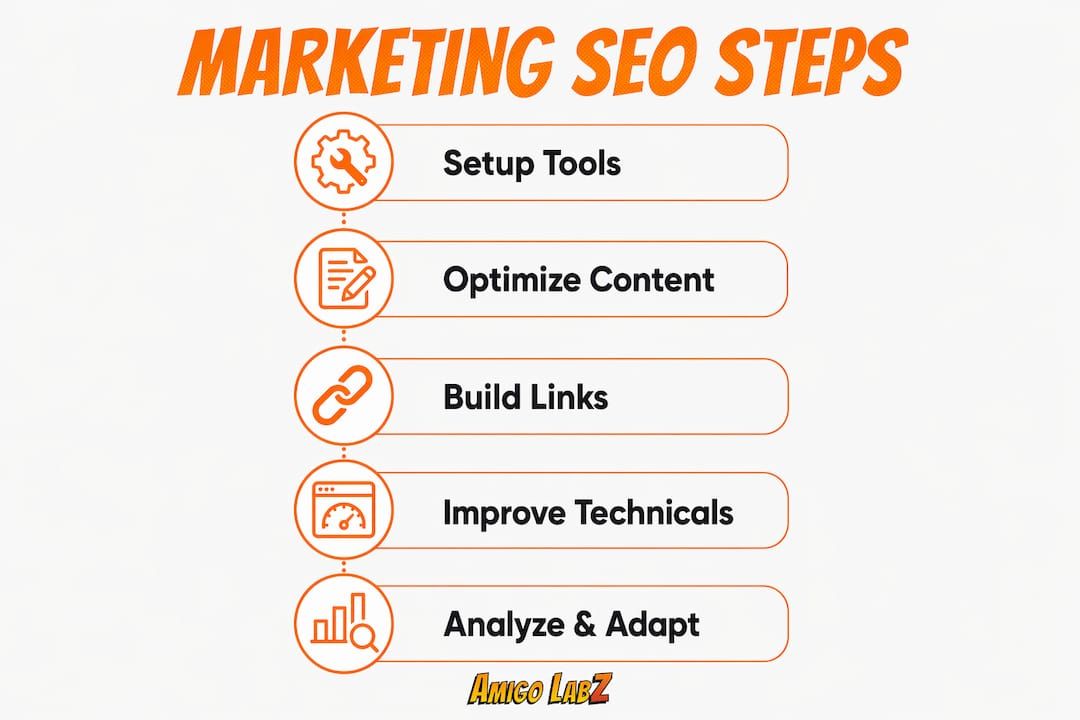
SEO breaks into three main types, each with a distinct role. Understanding all three helps you avoid the common mistake of focusing on one while ignoring the others.
On-page SEO
On-page SEO covers everything visible on your website. This includes your page titles, meta descriptions, heading structure (H1, H2, H3), body content, image alt text, and URL structure. Each page should target a specific keyword phrase and answer the searcher's question better than competing pages. Content quality matters more than length. A focused 600-word page that fully answers one question outperforms a bloated 2,000-word page that wanders.

Off-page SEO
Off-page SEO builds your site's authority through external signals. The most powerful signal is backlinks: links from other websites pointing to yours. A link from a local news outlet, an industry association, or a well-known blog tells Google that your site is credible. Online reviews on Google, Yelp, and industry directories also contribute to off-page authority, especially for local businesses.
Technical SEO
Technical SEO covers crawlability and mobile usability. Good content is ineffective if search engines cannot properly crawl or index your site. Common technical issues include slow page load times, broken links, duplicate content, and pages that are not mobile-friendly. Many small businesses invest heavily in content but skip technical audits entirely. That is a costly mistake.
| SEO Type | Primary Focus | Key Actions |
|---|---|---|
| On-page SEO | Content and page structure | Keywords, meta tags, headings, content quality |
| Off-page SEO | Authority and reputation | Backlinks, reviews, citations |
| Technical SEO | Site health and crawlability | Page speed, mobile usability, indexing |
| Local SEO | Geographic visibility | Google Business Profile, local keywords |
The types of SEO in digital marketing work together as a system. Weakness in any one area limits the results you get from the others.
What are the real benefits of SEO for small businesses?
The most direct benefit of SEO is free, recurring traffic. Unlike paid ads that stop the moment your budget runs out, organic search traffic compounds over time. A well-optimized page can bring in visitors for months or years without additional spending. That is the kind of return that paid advertising cannot replicate.
The traffic quality is also higher. Someone who searches "emergency HVAC repair near me" is ready to call. Paid ads can reach that person, but so can a well-ranked organic result. SEO favors relevance and quality over budget size, which means a small business with strong content can outrank a larger competitor spending heavily on ads.
"Being cited in AI Overviews builds brand recall and trust even without website visits." This is the new reality of zero-click SEO, where your brand gains exposure through AI summaries before a user ever clicks a link.
Only 0.63% of Google users click results on page two. That means 99 out of 100 searchers never scroll past the first page. Ranking on page one is not a vanity metric. It is the difference between being found and being invisible.
SEO also builds long-term brand trust. When your business consistently appears in search results for relevant topics, customers begin to associate your name with authority in your field. That trust is hard to buy and easy to lose if you neglect your online presence.
How do you get started with marketing SEO?
Getting started does not require a large budget or a technical background. It requires a clear process and consistent effort.
-
Conduct keyword research. Use Google Keyword Planner or Google Search Console to find the exact phrases your potential customers type. Focus on specific, intent-driven phrases like "best accountant for small business in Reno" rather than broad terms like "accountant."
-
Audit your website's technical health. Check for broken links, slow load times, and mobile usability issues. Google Analytics and Search Console are free tools that surface these problems quickly. Fix the most critical issues before creating new content.
-
Set up your Google Business Profile. For any business with a local customer base, this is non-negotiable. A complete, verified profile improves your visibility in Google Maps and local search results.
-
Create content that answers real questions. Write pages and blog posts that directly address what your customers search for. Use the keyword research from step one to guide your topics. Blog posts that answer specific questions consistently attract qualified visitors over time.
-
Build your off-page authority. Ask satisfied customers to leave Google reviews. Reach out to local directories, industry associations, and relevant websites for backlinks. Even a handful of quality links from credible sources moves the needle.
-
Track and adjust. SEO is not a one-time task. Review your Search Console data monthly. Identify which pages rank and which ones need improvement. Consistent iteration is what separates businesses that grow through SEO from those that stall.
Pro Tip: Do not try to fix everything at once. Prioritize technical issues first, then content gaps, then link building. A broken site with great content still ranks poorly.
Key Takeaways
Marketing SEO is the most cost-effective long-term channel for small businesses to attract qualified customers, and it rewards consistent effort over time.
| Point | Details |
|---|---|
| SEO drives the majority of web traffic | Organic search accounts for 53.3% of all website traffic, mostly from Google. |
| First-page ranking is critical | Only 0.63% of searchers click past page one, making visibility non-negotiable. |
| Three types work as a system | On-page, off-page, and technical SEO must all be maintained to see results. |
| E-E-A-T shapes AI search visibility | Experience, Expertise, Authoritativeness, and Trustworthiness signals now influence AI-generated answers. |
| Small budgets can compete | SEO rewards content quality and site health over ad spend, leveling the playing field. |
SEO in 2026 is not what most small business owners think it is
Most business owners I talk to still think of SEO as a checklist. Add keywords, get a few links, wait for traffic. That mental model is about five years out of date.
The shift I watch most closely right now is the rise of zero-click results. AI Overviews and featured snippets now answer many searches directly on the results page. Users get what they need without clicking anything. That sounds like bad news for traffic, but it is actually an opportunity. If your content is the source Google cites in those summaries, your brand gets seen by thousands of people who never visit your site. That is free brand exposure at scale.
The businesses that win at SEO in 2026 are the ones that treat it as a trust-building exercise, not a traffic hack. E-E-A-T principles are becoming the standard for what ranks, what gets cited by AI tools, and what customers actually trust. Writing content that demonstrates real experience, not just keyword density, is the single biggest shift small businesses need to make.
The other thing I see constantly is businesses that skip technical SEO because it feels intimidating. A site that loads slowly on mobile or has pages Google cannot index will not rank, regardless of how good the content is. Technical health is the foundation. Everything else builds on top of it.
SEO is also becoming integral for visibility in AI-powered platforms like voice assistants and chatbots. The businesses that build authority now will be the ones those platforms recommend later. Start building that foundation before your competitors do.
— John
How Amigolabz helps small businesses grow through SEO
Small business owners often know they need SEO but are not sure where to start or how to make it work within a real budget.

Amigolabz is a digital marketing agency with locations in New Jersey and Nevada, and we work with small and medium-sized businesses across the country. Our team focuses on identifying the specific SEO opportunities that move the needle for your business, whether that is local search visibility, content strategy, or technical site health. We build real relationships with business owners and create plans that fit your goals and your budget. If you are ready to improve your search rankings and attract more customers, explore our SEO services or browse our full range of digital marketing solutions to find the right starting point.
FAQ
What is the SEO marketing definition in simple terms?
SEO marketing is the practice of improving your website so it ranks higher in search engine results and attracts more visitors without paid advertising. It combines content quality, site structure, and external authority signals to increase organic visibility.
How does SEO differ from traditional marketing?
Traditional marketing pushes messages to audiences through ads, flyers, or TV spots. SEO pulls customers in by making your business visible when they are already searching for what you offer, which typically produces higher-intent leads.
How long does it take to see results from SEO?
Most businesses see measurable improvements in organic traffic within three to six months of consistent effort. Competitive markets may take longer, but the results compound over time unlike paid advertising.
What is the most important first step for a small business starting SEO?
Set up Google Search Console and Google Business Profile before anything else. These free tools give you the data you need to make informed decisions and establish your local search presence immediately.
Does SEO still matter with AI-powered search in 2026?
SEO matters more than ever. E-E-A-T signals now influence visibility in AI-generated answers, and zero-click SEO strategies that secure featured snippets and AI Overview citations build brand recognition beyond traditional click-through metrics.
Recommended