What Is an SEO Expert? A Clear Guide for Beginners
What Is an SEO Expert? A Clear Guide for Beginners

TL;DR:
- An SEO expert enhances website visibility through technical health, content relevance, and authority building. Different roles like specialists, managers, and agencies serve distinct needs with specific tasks and tools. Success relies on understanding the business, ongoing collaboration, and a clear focus on measurable outcomes rather than rankings alone.
An SEO expert is a professional who improves a website's visibility in organic search results so that the right people find it at the right moment. According to Google's SEO Starter Guide, the work comes down to helping search engines understand your content and helping users find and evaluate your site. That sounds simple. The execution is not.
Here is what a skilled SEO professional actually delivers:
- Technical health: A site that search engines can crawl, index, and render without errors
- Content strategy: Pages that match what real searchers want and answer it better than competing pages
- Measurable growth: More organic sessions, higher rankings for revenue-relevant queries, and conversions that tie back to search traffic
Pro Tip: If you are here to decide whether to hire someone or learn SEO yourself, skip ahead to the hiring checklist and timeline sections. They are built around Google's own guidance and will save you from the most common mistakes.
What does an SEO expert actually do, and how do the roles differ?
The title "SEO expert" covers a wide range of actual jobs. Understanding the differences matters whether you are hiring or planning a career path.
An SEO specialist handles execution: keyword research, on-page edits, technical fixes, and reporting. An SEO manager owns strategy and coordinates a team of specialists or writers. An SEO consultant typically works project-by-project or in an advisory capacity, diagnosing problems and recommending solutions without necessarily implementing them. An SEO agency brings all of those functions under one roof, usually serving multiple clients simultaneously.

| Role | Primary Focus | Typical Output | Best For |
|---|---|---|---|
| SEO Specialist | Hands-on execution | Optimized pages, audit fixes, monthly reports | Startups, small teams needing daily work |
| SEO Manager | Strategy + team oversight | Roadmaps, editorial calendars, team KPIs | Mid-size companies with in-house staff |
| SEO Consultant | Diagnosis + recommendations | Audit reports, strategy decks, training | Businesses that need direction, not execution |
| SEO Agency | Full-service delivery | End-to-end campaigns, content, links, reporting | Companies outsourcing the entire function |
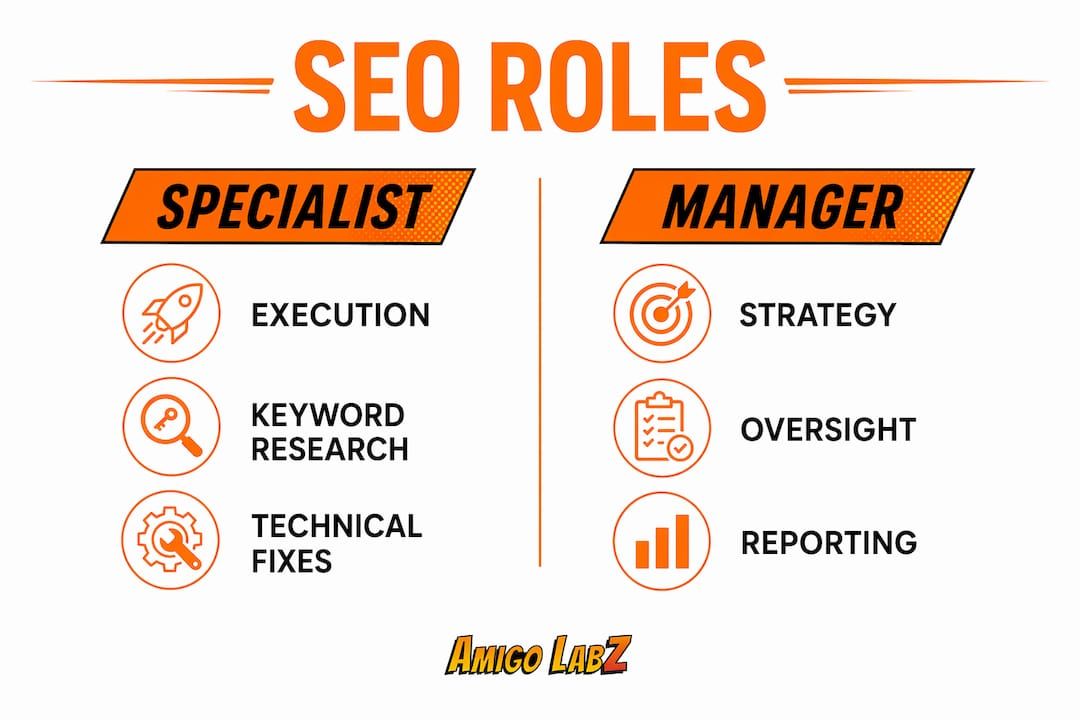
A solo founder with a five-page site probably needs a specialist or a consultant, not an agency retainer. A growing e-commerce brand with hundreds of product pages needs ongoing execution, which points toward an agency or an in-house manager. Matching the role to the actual need is where most hiring decisions go wrong.
What are the core day-to-day responsibilities of an SEO specialist?
The day-to-day tasks of an SEO specialist are more varied than most people expect. Here is what the work actually looks like week to week:
- Keyword research: Identifying queries with real search demand and commercial intent, then mapping them to specific pages. Example: discovering that "best running shoes for flat feet" converts better than "running shoes" and building a dedicated page around it.
- On-page optimization: Adjusting title tags, meta descriptions, header structure, and internal links so each page clearly signals its topic to search engines.
- Technical audits: Scanning for crawl errors, broken links, slow load times, and indexing problems that prevent pages from ranking. Example: finding that a misconfigured robots.txt file is blocking an entire product category from Google's index.
- Content planning: Working with writers or writing directly to produce pages that match search intent and outperform existing results.
- Backlink analysis: Evaluating which sites link to your domain, identifying gaps versus competitors, and building a strategy to earn authoritative links.
- Tracking and reporting: Pulling data from Google Search Console, GA4, and audit tools to show what is working, what is not, and what to prioritize next.
Pro Tip: Batch small technical fixes into one sprint rather than addressing them one at a time. A crawl error, a missing alt tag, and a redirect chain each take minutes to fix individually but hours to context-switch between. Block one afternoon per month for technical cleanup and protect your strategic time for content and links.
How do technical, on-page, and off-page SEO differ?
Every SEO project involves three distinct work areas. A good specialist knows which one to prioritize first, because throwing content at a technically broken site is wasted effort.

Technical SEO is about the infrastructure: making sure search engines can access, crawl, and index your pages without friction. On-page SEO is about relevance: ensuring each page clearly communicates its topic through content, structure, and metadata. Off-page SEO is about authority: building the external signals (primarily backlinks) that tell search engines your site is trustworthy and worth ranking.
| Area | Primary Goal | Common Tasks | Who Typically Handles It |
|---|---|---|---|
| Technical SEO | Crawlability and indexability | Site speed, Core Web Vitals, schema markup, XML sitemaps, redirect chains | SEO specialist or developer |
| On-Page SEO | Relevance and content quality | Title tags, headers, keyword placement, internal linking, content depth | SEO specialist or content strategist |
| Off-Page SEO | Domain authority and trust | Link building, digital PR, brand mentions, local citations | SEO specialist or link-building team |
Where an expert starts depends on the site's condition. A brand-new site needs technical foundations first. An established site with solid infrastructure but thin content needs on-page work. A site that ranks on page two for competitive terms but cannot break through likely needs off-page authority. Diagnosing the bottleneck before spending budget is one of the clearest signs of an experienced SEO.
Which tools do SEO experts use, and what metrics do they track?
Tools are how SEO work becomes measurable. Every specialist has a core stack, and the best ones know exactly which tool answers which question.
Core tools:
- Google Search Console: The primary source for impressions, clicks, average position, index coverage, and Core Web Vitals. Free, and directly connected to Google's data.
- Google Analytics (GA4): Tracks organic sessions, user behavior, conversions, and how search traffic compares to other channels.
- SEMrush: Keyword research, competitor gap analysis, backlink auditing, and site health scoring. One of the most widely used paid platforms in the industry.
- Screaming Frog: Desktop crawler for technical audits, identifying broken links, duplicate content, and redirect chains.
- Ahrefs: Backlink analysis and keyword tracking, particularly strong for competitive research.
Key metrics an SEO tracks:
| Metric | What It Measures | Best Tool |
|---|---|---|
| Impressions | How often your pages appear in search results | Google Search Console |
| Clicks and CTR | How many searchers click through and at what rate | Google Search Console |
| Organic sessions | Visits from unpaid search traffic | GA4 |
| Conversions | Goal completions (purchases, leads, sign-ups) from organic | GA4 |
| Crawl errors | Pages Google cannot access or index | Google Search Console |
| Core Web Vitals | Page speed and user experience scores | Google Search Console / PageSpeed Insights |
| Index coverage | Which pages are indexed vs. excluded | Google Search Console |
| Domain authority | Relative link strength vs. competitors | SEMrush / Ahrefs |
One thing worth knowing: third-party tools cannot access Google's internal ranking data and cannot guarantee ranking outcomes. SEMrush and Ahrefs provide their own estimates, which are useful for direction but should never be treated as ground truth. Google Search Console is the only tool with direct data from Google itself.
What skills and qualifications make an effective SEO professional?
Technical knowledge alone does not make someone a strong SEO. The role requires a specific combination of analytical thinking, communication, and creative judgment.
Core skill categories:
- Technical literacy: Understanding HTML, CSS, and basic JavaScript well enough to identify what is breaking and communicate fixes to developers. You do not need to code, but you need to read code.
- Analytics and data interpretation: Knowing what a metric means and, more importantly, what it does not mean. Organic sessions going up while conversions go flat is a signal, not a win.
- Content strategy: Understanding search intent deeply enough to brief writers or write pages that outperform existing results, not just match them.
- Link-building judgment: Distinguishing between links that build real authority and links that create risk. Cheap link schemes still get sites penalized.
- A/B testing and experimentation: Running title tag tests, content structure experiments, and CTA variations to improve click-through and conversion rates.
- Communication: Translating SEO findings into business language for stakeholders who do not care about crawl budgets.
On certifications: Google Search Central's documentation and the Search Essentials are the most credible free resources available. Google Analytics and GA4 certifications from Google's own Skillshop are worth having. Many paid course certifications look impressive on a resume but carry little weight with experienced hiring managers. What matters more is a portfolio showing measurable outcomes.
Pro Tip: If you are hiring, ask for a sample audit before anything else. If you are learning, build a personal site and optimize it from scratch. Both approaches reveal real skill faster than any certification.
When should you hire an SEO, and how do you evaluate candidates?
Google Search Central advises hiring an SEO when SEO work begins pulling you away from your core business operations. Think of it the same way you would think about outsourcing bookkeeping: when the time cost exceeds the value of doing it yourself, it is time to bring in a professional.
Hiring checklist:
- Request sample audit reports from previous clients
- Ask for read-only access to their own or a client's Search Console (to see how they work with data)
- Check references from businesses in a similar industry or size
- Verify that their recommendations align with Google's Search Essentials
- Confirm they document their methodology and can explain the rationale behind each recommendation
Interview questions worth asking:
- "Walk me through how you would audit this site for the first time."
- "What would you prioritize in the first 90 days and why?"
- "How do you measure success beyond rankings?"
- "Can you show me a case where your work moved a metric that mattered to the business?"
Red flags to watch for:
- Guaranteed rankings. Google explicitly warns that no one can guarantee a specific position in search results.
- "Secret methods" or proprietary techniques they cannot explain. Legitimate SEO is documented and defensible.
- Focus on vanity metrics (raw traffic, keyword positions) with no connection to conversions or revenue.
- Unsolicited cold-call pitches promising dramatic results with no knowledge of your site.
On budget: SEO costs vary depending on scope, market, and provider type. A freelance specialist may charge modest monthly fees for small sites, while a full-service agency handling competitive national campaigns typically charges significantly more. Set a realistic budget before you start conversations, and be skeptical of anyone who quotes a price before understanding your site.
What do SEO pricing models look like?
SEO is sold in a few standard structures, each with different risk and flexibility profiles.
| Model | Typical Range | Best For |
|---|---|---|
| Hourly | Varies by experience and market | One-time audits, consulting calls, specific fixes |
| Monthly retainer | A few hundred to several thousand dollars/month | Ongoing campaigns needing consistent execution |
| Fixed project | Varies by scope | Site migrations, one-time audits, content sprints |
| Performance-based hybrid | Base fee plus results-tied bonus | Clients who want shared risk with the provider |
Factors that push cost up: large site with significant technical debt, highly competitive industry, content production included in scope, and geographic market (national vs. local). A local service business in a mid-size city costs far less to rank than a SaaS company competing nationally for high-volume terms.
For small business SEO, a monthly retainer with a clear scope of deliverables is usually the most transparent structure. Avoid open-ended hourly arrangements for ongoing work unless you have a clear way to track what hours were spent on.
How long does SEO take to show results?
Realistic expectations are one of the most valuable things an honest SEO professional gives a client. Here is how the timeline actually breaks down:
Technical fixes can show measurable improvements in weeks. Fixing a broken sitemap, resolving crawl errors, or correcting a noindex tag on a key page can produce visible changes in Google Search Console within days of Google's next crawl.
Content and on-page work require longer time to impact rankings. A new page targeting informational keywords might rank in a moderate timeframe on an established site, whereas targeting competitive purchase-intent keywords on newer domains can take substantially longer.
Major authority and competitive gains often require many months of consistent work. This longer timeline can be a source of client frustration and challenges in SEO relationships. The work is happening; the results are compounding slowly.
Milestones to watch in sequence:
- Indexing: Are your key pages appearing in Google's index?
- Impressions: Are those pages showing up in search results, even at low positions?
- Clicks: Are impressions converting to clicks as rankings improve?
- Conversions: Is organic traffic producing leads, purchases, or sign-ups?
Leading indicators (impressions, crawl coverage, indexed pages) tell you the work is working before the lagging metrics (revenue, conversions) catch up. An SEO who only reports on rankings is giving you an incomplete picture.
How do you become an SEO specialist?
The path into SEO is more accessible than most technical careers, but it requires genuine hands-on practice. Reading about it is not enough.
Step-by-step learning path:
- Start with Google's own documentation. The Search Essentials and SEO Starter Guide are free, authoritative, and written by the people who build the algorithm.
- Learn HTML and GA4 basics. You do not need to be a developer, but understanding how a page is structured and how to read a GA4 report is non-negotiable.
- Build a practice site. Pick a niche you know, build a simple site, and optimize it from scratch. This is where real learning happens.
- Get hands-on with the tools. Use the free tier of Google Search Console on your practice site. Try SEMrush's free trial for keyword research. Run a Screaming Frog crawl.
- Study analytics and reporting. Learn to build a basic dashboard in GA4 that shows organic sessions, goal completions, and landing page performance.
- Build a portfolio with documented results. Screenshots of ranking improvements, traffic growth charts, and before/after audit comparisons are what hiring managers and clients actually want to see.
Useful resources for beginners:
- Google Search Central documentation (free, primary source)
- Google Skillshop for GA4 and Google Ads certifications (free)
- SEMrush Academy (free courses tied to the platform)
- Active communities like Reddit's r/SEO for real-world questions
- Long-tail keyword tactics for building early traffic on a new site
For early projects, volunteer to audit a local business's site or a nonprofit's web presence. Document the before state, implement changes, and track the after. That single case study, done well, is worth more than a stack of certificates.
How does a full-service SEO agency approach a new client?
The agency process is where the abstract role of "SEO expert" becomes concrete. Here is how a structured engagement typically unfolds.
Discovery: The agency meets with the client to understand business goals, revenue model, target audience, and competitive context. SEO strategy that is not connected to business goals is just activity.
Audit: A full technical, on-page, and off-page audit identifies what is working, what is broken, and what is missing. This covers crawl health, content gaps, backlink profile, and Core Web Vitals.
Prioritization: Not everything in an audit can be fixed at once. A good agency ranks findings by impact and effort, then builds a phased roadmap. Quick technical wins come first; content and authority work follows.
Implementation: The agency executes or coordinates execution with the client's team. Clients should expect regular access to their own Search Console data, written recommendations they can verify, and a clear explanation of why each task is being done.
Measurement: Monthly or biweekly reporting ties work back to the metrics that matter: organic sessions, conversions, and revenue from search, not just rankings.
Transparency is not optional in a good agency relationship. Clients should receive documented recommendations, read-only access to their own analytics from day one, and the ability to verify every strategy recommendation against Google's published guidance. If an agency cannot explain why they are doing something, that is a problem worth addressing before the contract is signed.
At Amigolabz, this process is how every client engagement starts: with a clear audit, a documented roadmap, and reporting that connects SEO work to business outcomes rather than vanity metrics.
Key Takeaways
An SEO expert improves organic visibility by combining technical site health, content relevance, and off-page authority into a measurable, long-term growth strategy.
| Point | Details |
|---|---|
| Role clarity matters | Specialist, manager, consultant, and agency roles serve different needs; match the role to your actual situation. |
| Three work areas | Technical, on-page, and off-page SEO each address a different ranking factor; diagnose the bottleneck before spending budget. |
| Tools and metrics | Google Search Console and GA4 are the primary data sources; SEMrush and Ahrefs support research and competitive analysis. |
| Hiring red flags | Guaranteed rankings and secret methods are disqualifying; ask for audit samples and verify methodology against Google's Search Essentials. |
| Amigolabz | Amigolabz offers full-service SEO with documented audits, transparent reporting, and a process tied to business outcomes, not just rankings. |
The part most SEO guides skip
There is a version of SEO advice that sounds authoritative but misses the most important variable: whether the person doing the work actually understands your business.
Rankings are a proxy. They are a useful proxy, but they are not the goal. The goal is revenue, leads, or whatever conversion your business runs on. An SEO who optimizes for rankings without understanding your conversion funnel can drive a lot of traffic that does nothing for you. Organic sessions from people who will never buy are not a win; they are noise.
The second thing most guides understate is how much the client's involvement matters. SEO is not a service you hand off and ignore. The best results come from clients who share business context, flag when a keyword does not match how their customers actually talk, and push back when a report is full of metrics that do not connect to revenue. That collaboration is not a nice-to-have. It is what separates a campaign that compounds over time from one that flatlines after the first few months.
If you are evaluating an SEO agency or specialist, the most revealing question is not "what results have you gotten?" It is "how do you decide what to work on next?" The answer tells you whether they are running a real strategy or just executing a checklist.
Amigolabz helps businesses grow through search, not just rank
Most businesses that come to Amigolabz have already tried SEO in some form. They have had a freelancer, run some content, or signed up for a tool. What they have not had is a clear connection between the work being done and the revenue coming in.

Amigolabz is a full-service digital marketing agency with locations in New Jersey and Nevada, working with businesses across the country. The SEO work starts with a documented audit, moves into a prioritized roadmap, and reports on the metrics that actually matter to your business. No guaranteed rankings, no black-box methods. Just transparent work tied to real outcomes.
If you are ready to see what your site is leaving on the table, request an SEO audit and get a clear picture of where you stand before committing to anything.
Useful sources
| Resource | What It Covers |
|---|---|
| Google SEO Starter Guide | Google's own foundational guide to how SEO works and what best practices look like |
| Do You Need an SEO? — Google Search Central | Official guidance on when to hire, what to look for, and red flags to avoid |
| Third-Party SEO Tools — Google Search Central | Google's position on tool-based guarantees and how to evaluate third-party advice |
| What Do SEO Experts Do? — Amigolabz | Agency-produced guide to SEO tasks and business impact for owners |
| Local SEO Step-by-Step Guide | Practical local SEO tactics for small businesses deciding whether to DIY or hire |
FAQ
What does an SEO expert actually do?
An SEO expert improves a website's visibility in organic search results by handling keyword research, technical audits, on-page optimization, content strategy, link building, and performance reporting. The goal is to connect the right searchers to the right pages and turn that traffic into business outcomes.
Is SEO a good career in 2026?
SEO remains a strong career path because organic search continues to be a primary way people discover businesses, products, and information. The role rewards analytical thinking, writing ability, and technical curiosity, and it spans industries from e-commerce to healthcare to local services.
How much should you pay an SEO expert?
Costs vary widely depending on scope and provider type. Freelance specialists may charge a few hundred dollars a month for small sites; full-service agencies working on competitive national campaigns can run several thousand dollars monthly. Get a clear scope of deliverables before comparing prices.
Is SEO high-paying as a profession?
Experienced SEO professionals, particularly those who can connect their work to revenue metrics, command competitive salaries and consulting rates. Specialists with strong analytics skills and a documented track record of results tend to earn at the higher end of the range.
How long before SEO shows real results?
Technical fixes can produce measurable changes in weeks. Content and on-page improvements typically take a few months to gain traction. Competitive authority gains and major traffic growth usually require several months of consistent work, as Search Engine Journal's coverage of Google's guidance confirms.
Recommended