Search Engine Optimization in Digital Marketing: A Beginner's Guide
Search Engine Optimization in Digital Marketing: A Beginner's Guide

Search engine optimization (SEO) is the practice of improving a website's content, technical setup, and authority so it appears higher in organic (unpaid) search results. Unlike paid ads, which stop the moment you cut the budget, SEO compounds over time. A page that earns a top ranking keeps pulling in traffic for months or years. Tools like Google Search Console, Google Analytics (GA4), and Bing Webmaster Tools give you the data to measure every step of that progress. Amigolabz helps businesses across the U.S. build exactly this kind of long-term visibility.
- SEO drives organic traffic without paying per click
- It builds credibility: ranking on page one signals authority to searchers
- It works across every stage of the funnel, from awareness to purchase
- It doubles as market research by revealing what customers actually search for
Pro Tip: Set up Google Search Console before you change anything on your site. It shows which pages Google already indexes and which ones it can't find, giving you a baseline before any optimization work begins.
What is search engine optimization in digital marketing?
SEO sits inside the broader set of digital marketing strategies alongside paid search, email, social media, and content marketing. Its specific job is organic visibility: getting your pages to appear when someone searches for a topic you cover, without paying for each click.
The scope breaks into three layers. On-page work covers the content itself, including keyword placement, title tags, headings, and internal links. Technical setup covers what search engines see when they crawl your site: site speed, mobile responsiveness, crawlability, and structured data. Off-page authority covers signals from the wider web, primarily backlinks from other sites pointing to yours.
"SEO's goal is to appear on the first page for the most relevant keywords to your audience — it's both a visibility and credibility channel." — Digital Marketing Institute
Paid search (SEM/PPC) and SEO target the same search results page but work differently. Paid ads appear instantly and cost money every time someone clicks. SEO takes longer to build but costs nothing per click once you rank. Google handles the vast majority of U.S. search volume, so most SEO work focuses on Google's guidelines, though Bing holds a meaningful share of desktop traffic and rewards the same fundamentals.
How do search engines crawl, index, and rank your pages?
Understanding the mechanics makes every optimization decision feel less arbitrary. Search engines follow a four-stage process before any page appears in results.
- Crawling. A bot (Googlebot, Bingbot) follows links across the web and downloads page content. If your pages aren't linked or are blocked by a robots.txt file, crawlers may never find them.
- Rendering. The crawler processes JavaScript and CSS to see the page the way a browser would. Pages that rely heavily on client-side JavaScript can be slow to render, which delays indexing.
- Indexing. Rendered pages get stored in the search engine's index. A page must be indexed before it can rank for anything.
- Ranking. The engine scores indexed pages against hundreds of signals and returns the most relevant results for each query.
User intent is the filter the ranking algorithm applies last. Queries fall into three buckets: informational ("how does SEO work"), commercial ("best SEO agency near me"), and transactional ("hire an SEO agency"). A page optimized for the wrong intent type will struggle to rank even with perfect technical setup, because the engine reads engagement signals and sees that searchers aren't satisfied.
What are the main types of SEO and when does each matter?
The four core types of SEO each handle a different layer of visibility. They also depend on each other in a specific order.
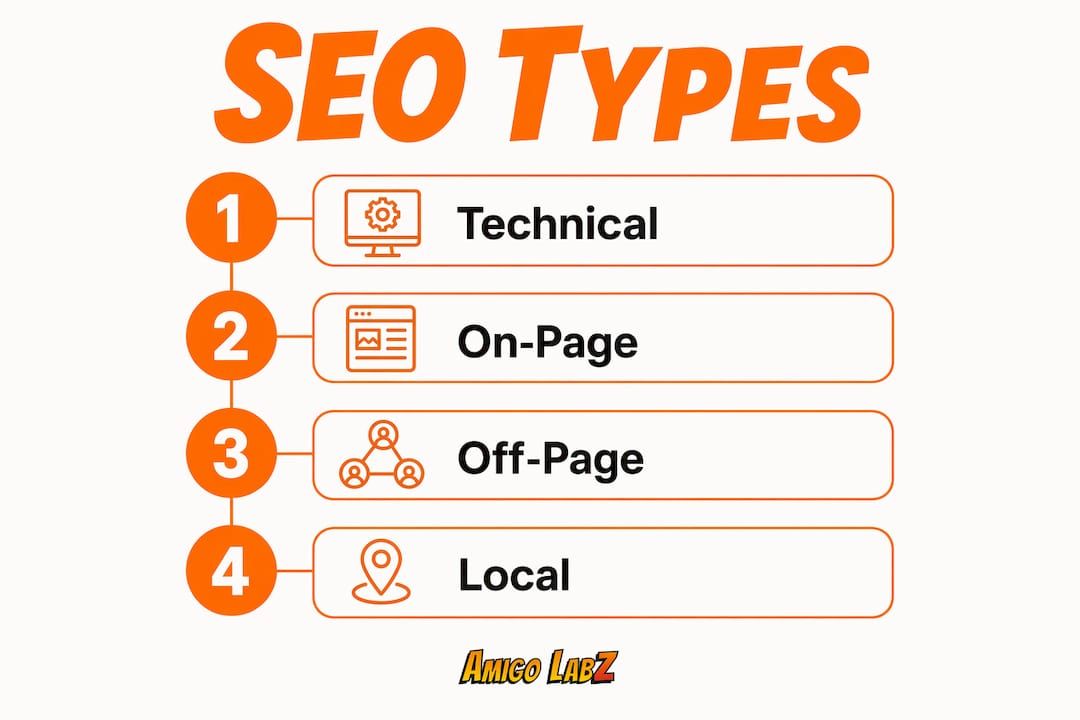
| Type | What it covers | When to prioritize |
|---|---|---|
| Technical SEO | Crawlability, indexing, site speed, mobile, structured data | Always first — nothing else works if crawlers can't access pages |
| On-page SEO | Content quality, keyword targeting, title tags, headings, internal links | After technical is clean; drives relevance signals |
| Off-page SEO | Backlinks, brand mentions, digital PR | After on-page is solid; builds domain authority |
| Local SEO | Google Business Profile, local citations, location pages | Any business serving a geographic area |
The dependency chain matters. Fix technical issues first. If Googlebot can't crawl and index your pages, the best content in the world won't rank. Once crawlability is confirmed, on-page optimization makes pages relevant to specific queries. Off-page authority then amplifies that relevance across competitive keywords.
- Technical SEO is the priority for new sites, recently redesigned sites, and any site that has seen a sudden traffic drop.
- On-page SEO is where e-commerce and content sites spend most of their ongoing effort, matching product pages and articles to buyer intent.
- Off-page SEO matters most in competitive niches where many sites cover the same topics.
- Local SEO is non-negotiable for brick-and-mortar businesses, service-area businesses, and any brand that wants to appear in Google's map pack.
What ranking factors should you focus on first?
SEO optimization covers dozens of signals, but four categories drive the majority of results for most sites.

Content relevance and quality. A page needs to match what the searcher actually wants, not just contain the keyword. Write for the intent behind the query. Action step: check your top five pages in Google Search Console and confirm each one's title tag and H1 heading clearly reflect the query it ranks for.
Backlinks and authority. Links from other reputable sites act as votes of confidence. One link from a well-regarded industry publication outweighs dozens from low-quality directories. Action step: identify one or two sites in your space that accept guest contributions and pitch a useful, specific article.
Technical health. Core Web Vitals and mobile-friendliness are now standard ranking considerations. A page that loads slowly or breaks on a phone loses rankings and users simultaneously. Action step: run your homepage through Google's PageSpeed Insights and fix the top two issues it flags.
User experience. Bounce rate, time on page, and click-through rate from search results all feed back into ranking signals. If users land on your page and immediately leave, the engine interprets that as a relevance failure.
Structured data and rich results are worth adding once the basics are in place. Schema markup can earn featured snippets, star ratings, and FAQ dropdowns directly in search results, which lifts click-through rates without requiring a higher ranking position.
Pro Tip: Before building backlinks, confirm your site has no crawl errors in Google Search Console's Coverage report. Earning links to pages Google can't index is wasted effort.
A step-by-step SEO starter checklist
This sequence is designed so each step builds on the last. Skipping ahead typically wastes time.
- Run a site audit (Week 1–2). Open Google Search Console and check the Coverage report for indexing errors. Fix any "Excluded" or "Error" pages before anything else.
- Check Core Web Vitals (Week 1–2). Use PageSpeed Insights or the Core Web Vitals report in Search Console. Identify the single slowest page and address the top flagged issue.
- Do keyword research (Week 2–3). Use Google's free Keyword Planner or the Search Console Queries report to find the terms your audience actually types. Group them by intent.
- Fix on-page elements (Week 3–4). Update title tags, meta descriptions, and H1 headings on your five most-visited pages. Each should reflect the primary query intent for that page.
- Build a content plan (Month 2). Identify three to five topics your site doesn't yet cover that match high-intent queries. Publish one thorough piece per topic.
- Start link building (Month 2–3+). Reach out to industry directories, local business associations, and relevant publications. One quality link per month compounds meaningfully over a year.
Technical fixes and on-page changes often produce measurable ranking shifts within 2–8 weeks. Off-page authority work, meaning link acquisition and brand mentions, typically takes 3–6 months before it visibly moves competitive keywords. New sites with no existing authority should plan for a 6–12 month runway before organic traffic becomes a reliable channel. Set up these tools before you make significant changes, so you have a baseline to compare against.
- Google Search Console shows which queries trigger your pages, how often they appear (impressions), how often users click (CTR), and which pages have indexing or crawl issues. It's free and takes about 15 minutes to verify your site.
- Google Analytics (GA4) tracks what users do after they arrive: which pages they visit, how long they stay, and whether they complete a goal (form submission, purchase, phone call). Connect it to Search Console for a full picture.
- Bing Webmaster Tools mirrors Search Console's functionality for Bing's index. Worth setting up since Bing represents a real slice of U.S. desktop search traffic.
- A rank-tracking tool (free options include Google Search Console's average position data; paid tools like Semrush or Ahrefs offer more granularity) lets you monitor keyword positions over time.
Primary KPIs to track: organic traffic volume, average keyword position, impressions and CTR, conversions from organic sessions, and Core Web Vitals scores. Check them monthly at minimum. Quarterly reviews let you spot trends that weekly noise can obscure.
How long does SEO take, and what does it cost in the U.S.?
Realistic expectations prevent the most common SEO mistake: abandoning the work before it compounds.
| Approach | Typical U.S. cost range | What you get | Trade-off |
|---|---|---|---|
| DIY | — | Full control, slow execution | Time-intensive; steep learning curve |
| Freelancer | — | Focused execution on specific tasks | Variable quality; limited strategy |
| Agency | — | Full-service strategy, execution, reporting | Higher cost; requires clear scope |
Technical fixes and on-page changes often produce measurable ranking shifts within 2–8 weeks. Off-page authority work, meaning link acquisition and brand mentions, typically takes 3–6 months before it visibly moves competitive keywords. New sites with no existing authority should plan for a 6–12 month runway before organic traffic becomes a reliable channel.
Budget priority: spend first on technical fixes and targeted content improvements. These have the highest ROI because they remove barriers that are actively suppressing rankings you could already be earning. For small business SEO investment guidance, the clearest signal is whether your site has indexing errors. If it does, no amount of content or link building will fix the underlying problem.
Pro Tip: Ask any agency or freelancer to show you their first deliverable: a crawl report with prioritized fixes. If they lead with content or links before confirming your site is fully indexed, that's a red flag.
Why SEO is also your best market research tool
Most people think of SEO purely as a traffic channel. The smarter frame is that query analysis reveals exactly what your customers are asking, in their own words, before they ever contact you.
Here's a compact workflow that turns search data into content strategy:
- Extract queries. Pull the Queries report from Google Search Console. Sort by impressions. These are the real phrases your audience types.
- Group by intent. Separate informational queries ("how to…", "what is…") from commercial ones ("best…", "near me") and transactional ones ("buy…", "hire…").
- Create targeted content. Build one page per intent cluster. Informational content builds trust early; commercial content captures buyers closer to a decision.
- Measure conversion signals. In GA4, set up goal events for form submissions, calls, or purchases. Track which organic pages drive those events, not just traffic.
The result is a content calendar built on actual customer demand rather than guesswork. Pages that match real queries at the right intent stage convert at higher rates because they answer the exact question the visitor had when they clicked.
Pro Tip: Filter your Search Console queries to show only those with 100+ impressions and a CTR below 3%. Those are pages Google is already showing to searchers but that aren't compelling enough to click. Rewriting the title tag and meta description on those pages is the fastest conversion win in SEO.
SEO vs. paid search: which one should you use?
The honest answer is both, but the mix depends on your timeline and budget.
- Cost model. SEO requires upfront time and content investment; paid search (Google Ads, Bing Ads) charges per click and stops delivering the moment you pause spend.
- Speed. Paid search delivers traffic on day one. SEO typically takes weeks to months for meaningful organic movement.
- Targeting control. Paid search lets you target specific demographics, devices, and times of day with precision. SEO targets intent through content but offers less demographic control.
- Compounding value. A well-ranked organic page keeps earning traffic for years. A paused ad campaign earns nothing.
The practical recommendation: use paid search for immediate demand capture while SEO builds. When budget is limited, prioritize technical fixes and high-intent pages first, then layer in paid ads for your most competitive keywords while organic rankings climb.
Synergy is real. Paid search data reveals which keywords convert at the highest rate, which you can then target with organic content. High-converting organic pages make strong landing pages for ad campaigns because they're already proven to satisfy searcher intent.
Key Takeaways
SEO works when technical access, relevant content, and external authority compound together in the right order: technical first, then on-page, then off-page.
| Point | Details |
|---|---|
| Technical SEO comes first | Crawl errors block all other SEO gains; fix indexing issues before content or links. |
| Results take time | On-page fixes move in 2–8 weeks; authority-building takes 3–6 months or longer. For new sites, organic traffic typically becomes reliable after 6–12 months. |
| Measure before you change | Set up Google Search Console and GA4 first to establish a baseline. |
| SEO is market research | Query data reveals customer language and intent, shaping content that converts. |
| Amigolabz can accelerate the process | Amigolabz provides SEO services, analytics setup, and site audits for U.S. businesses. |
Why most beginners get SEO backwards
Here's what I see consistently: businesses spend months publishing content before they've confirmed Google can actually index their site. The content is good. The keyword research is solid. But the Coverage report in Search Console shows a significant share of pages excluded, and nobody noticed.
The dependency order isn't a suggestion. Technical SEO is the foundation. On-page optimization is the structure. Off-page authority is the roof. You can't skip to the roof.
The second thing people underestimate is the market research angle. Query data from Search Console is one of the most honest signals a business owner can access. It shows exactly what customers want, in their exact words, ranked by volume. Most businesses collect that data and never look at it. The ones that do use it to write content that answers real questions, which builds trust before a prospect ever fills out a contact form.
SEO is not a quick fix. But it's also not as complicated as the industry sometimes makes it sound. Verify your site is indexed, match your content to what people actually search for, earn a few quality links, and measure the results. That's the whole game at the beginner level.
Amigolabz helps you build real organic visibility
Ranking on page one is worth more than most paid channels over a 12-month horizon, but getting there requires the right sequence of fixes. Amigolabz works with businesses across the U.S. from its offices in New Jersey and Nevada, handling the full SEO workflow: technical audits, on-page optimization, content strategy, and analytics setup so you can see exactly what's working.

The starting point for most clients is a site audit that identifies the single biggest barrier to ranking. Whether that's a crawlability issue, thin content, or a site that breaks on mobile, fixing the primary bottleneck first delivers faster results than spreading effort across every tactic at once. Amigolabz also handles website design for businesses that need a technical rebuild alongside their SEO work, and offers Google Ads management for clients who want paid traffic while organic rankings build.
Ready to find out what's holding your site back? Request a site audit and get a clear picture of where to start.
Useful sources
These are the primary resources referenced in this guide and the best places to continue learning.
- Google SEO Starter Guide — Google's own documentation covering crawling, indexing, and on-page fundamentals. Use it as a checklist after your first audit.
- Google Search Console Help — The official setup guide for Search Console. Start here to verify your site and pull your first Coverage and Queries reports.
- Mailchimp SEO Glossary — A clean, beginner-friendly definition of SEO with practical notes on structured data and rich results.
- LivePlan: Benefits of SEO for Small Business — Covers Core Web Vitals, mobile-friendliness, and the market-research framing of SEO for small business owners.
- CompareSEO: The Four Types of SEO — Explains the dependency order and how to identify which type to fix first using a simple audit sequence.
FAQ
What is SEO in digital marketing?
SEO (search engine optimization) is the process of improving a website's content, technical setup, and authority so it ranks higher in organic search results. It's a core digital marketing channel because it drives traffic without paying per click.
What are the four types of SEO?
The four types are technical SEO (crawlability and site health), on-page SEO (content and keyword relevance), off-page SEO (backlinks and authority), and local SEO (geographic visibility). They work in that order: technical issues must be resolved before the other types deliver full results.
How long does SEO take to show results?
On-page and technical changes typically produce measurable shifts within 2–8 weeks. Building off-page authority through backlinks usually takes 3–6 months or longer before competitive rankings move. New sites should expect 6–12 months before organic traffic becomes consistent.
Why is SEO important for a business?
SEO puts your business in front of people actively searching for what you offer, without paying for each visit. Over time it builds credibility, compounds traffic, and costs less per acquisition than most paid channels.
Can Amigolabz help with SEO for my business?
Yes. Amigolabz provides SEO services for businesses across the U.S., including site audits, on-page optimization, and analytics setup, with offices in New Jersey and Nevada.
Recommended