How to Improve Website Traffic: A Fast, Repeatable System
How to Improve Website Traffic: A Fast, Repeatable System

The highest-leverage move is combining three channels: fix what already ranks in search, push one distribution channel (paid or a creator partnership) to generate an immediate spike, and capture repeat visits through email or on-site calls to action. Businesses that mix demand capture, distribution, and retention build a repeatable traffic system instead of chasing one channel that stalls the moment algorithms shift.
Here's what to do in the next three days:
- Check Search Console for pages with high impressions but weak click-through rate. Those are your fastest wins.
- Publish one targeted social post that links to a dedicated landing page, tagged with UTM parameters so you can trace the traffic.
- Add a newsletter signup to your single highest-traffic page.
Pro Tip: Watch clicks, click-through rate, sessions, and bounce rate for the first 7 to 30 days. A rising click-through rate on a page you just refreshed is the earliest sign the fix worked, often before ranking positions even move.
Key Takeaways
Combining search fixes, one distribution channel, and one retention mechanism produces faster and more durable traffic growth than relying on any single tactic alone.
| Point | Details |
|---|---|
| Refresh before you publish | Rewriting titles and intros on pages with high impressions and low clicks often beats new content. |
| Run one distribution test fast | A paid social test or creator partnership can produce visible traffic within one to two weeks. |
| Capture visitors before they leave | Add email signups matched to page intent so one visit can turn into repeat traffic. |
| Track quality, not just volume | Watch conversion rate and customer acquisition cost by channel, not just total sessions. |
| Pilot the system with Amigolabz | Amigolabz's 90-day pilot audits your top pages and executes one paid test or refresh to prove the approach before a longer engagement. |
How to Improve Website Traffic in the Next 30 to 90 Days
Speed matters more than volume when you're starting from close to zero. Here are ten tactics ordered by how fast they typically pay off.
- Refresh your top three underperforming pages (fast). Rewrite titles and opening paragraphs on pages with impressions but low clicks.
- Publish one paid social test (fast). Run three creative variations to a matching landing page.
- Add exit-intent or scroll-based newsletter signups (fast). Capture visitors before they leave.
- Repurpose your best post into five pieces (fast). One long post becomes social posts, an email, and a short video.
- Fix broken internal links and orphaned pages (fast). A quick crawl audit catches this in an afternoon.
- Send one dedicated email pointing to a refreshed page (medium). Owned traffic you control.
- Pitch three guest posts to niche sites in your industry (medium). Slow to land, fast once published.
- Test a small creator or influencer partnership (medium). Even a micro-influencer swap can move the needle.
- Build a topic cluster around your best-performing page (long). New supporting content that funnels links inward.
- Improve Core Web Vitals on your slowest template (long). Technical fixes compound across every page using that template.
A practical week-by-week plan: in week one, run the Search Console audit and fix the two worst-performing pages. In month one, layer in the paid test and the first repurposing cycle. By month three, you should have a content cluster forming and at least one live partnership.
- Week 1: Audit, fix top pages, launch one paid test.
- Month 1: Repurpose your best content, launch email capture, pitch guest posts.
- Months 2 to 3: Build the topic cluster, formalize a creator partnership, review Core Web Vitals.
If you're a team of one or two, pick two or three items from this list, not all ten. Refreshing existing pages and running one paid test almost always deliver the best return for the least effort.
Content Marketing Tactics That Compound Instead of Fade
Start by auditing what you already have, not by brainstorming new topics. Pull your Search Console data and sort by impressions. Pages that show up often in search but get few clicks are sitting on demand you're not capturing. Rewriting the title, tightening the opening paragraph, and adding a stronger meta description on those pages tends to produce a faster lift than publishing something new, according to case studies on republishing existing content.
Match the content format to the channel and the goal. A how-to post written for search intent needs clear headers and a direct answer near the top. A founder or authority post built for LinkedIn works better as a narrative with a point of view. Short-form video for TikTok or YouTube Shorts needs a hook in the first three seconds and a single clear takeaway, since attention drops off fast and online video consumption continues to dominate how people discover new brands.
Repurposing is where most small teams leave value on the table. One long-form post can become:
- Three social posts, each pulling a different angle or stat from the piece.
- One email that summarizes the takeaway and links back to the full post.
- One short video script built around the strongest point in the piece.
- One guest post pitch built from a supporting section you didn't fully cover.
Test two or three headline variations before committing to one, especially on pages you're actively promoting. A headline that tests well on social won't always be the one that ranks best in search, so don't assume one version has to do both jobs.
Pro Tip: Before writing anything new, spend 20 minutes in Search Console filtering for pages ranking positions 5 through 15. Those are your closest wins. A small on-page fix can push them onto page one faster than a brand-new post ever could.
Promotion is not optional; treat it as part of the content process, not an afterthought. Guest posting on niche sites, sharing in relevant online communities, and pitching creators who already talk to your audience all extend a piece's reach past your own subscriber list. Every promotional link should point to a dedicated landing page with UTM tracking attached, so you know exactly which push produced which visits. Skipping this step is the most common reason good content quietly underperforms.
SEO Fundamentals That Move Organic Traffic
Search still sends more referral traffic than any single social platform, and top organic results capture the largest share of clicks across nearly every industry. That's the core argument for treating SEO as infrastructure, not a one-time project.
Keyword research works best when you group queries by intent rather than volume alone. A query like "best plumber near me" signals someone ready to book; a query like "why is my faucet leaking" signals someone still researching. Build separate pages for each intent instead of trying to serve both with one page, and map your existing URLs against that structure before publishing anything new.
Your on-page checklist should include:
- Rewriting titles and first paragraphs to match what the searcher actually wants, not just to include a keyword.
- Adding schema markup where it applies, especially for local businesses, reviews, and FAQs.
- Writing meta descriptions that state a benefit, not a summary.
- Aligning your URL and headings with the page's actual topic.
- Linking internally from high-traffic pages to your conversion pages.
Technical health matters just as much as the words on the page. Core Web Vitals, mobile-first usability, and crawl errors all affect whether Google indexes and ranks a page at all. Run a crawl audit quarterly, check for orphaned pages, confirm your canonical tags point where they should, and keep your sitemap current. A page that ranks well on desktop but loads slowly on mobile is losing visitors before they read a word, and Amigolabz's SEO best practices guide walks through the technical side in more depth.
Speed fixes that consistently help:
- Compress and lazy-load images instead of serving full-resolution files.
- Enable caching so returning visitors get near-instant load times.
- Cut third-party scripts you're not actively using, especially old tracking pixels.
- Use a content delivery network if you serve visitors across multiple regions.
Pro Tip: Run your slowest-loading page through a speed test, then fix that one template first. Most sites run on repeated templates, so one fix often improves load time across dozens of pages at once.
Social Media and Community Tactics for Referral Traffic
Not every platform deserves equal investment. Pick based on where your audience actually spends time and what format that platform rewards. Pinterest works for evergreen visual content with long shelf life. LinkedIn works for B2B audiences who respond to authority and direct experience. Short-form video platforms reward hooks and pacing over polish, and that gap in expectations is exactly why so many small businesses waste budget on content built for the wrong platform.
Short-form video that actually drives clicks follows a simple structure: a hook in the first second, a clear value statement by the three-second mark, and a direct call to action pointing to a dedicated landing page, not your homepage. Repurpose the same core message across platforms, but adjust pacing and captions for each one rather than posting an identical clip everywhere.

Communities like Reddit, Discord, and Facebook Groups can send real traffic, but only if you show up as a participant first. Answer questions, share genuine expertise, and only link to your own content when it's the most relevant answer available, not every time you post. Get caught spamming links and most communities will ban you outright, and the reputational damage often follows you to other groups in the same niche.
When working with creators or influencers, define measurable outcomes upfront:
- Confirm expected impressions and click-through estimates before the post goes live.
- Get whitelisting rights if you plan to boost their content with paid spend.
- Agree on a specific, trackable link placement, not a vague mention.
- Set a follow-up check-in to review actual performance against the estimate.
Paid Acquisition Channels for Reliable Traffic
Paid traffic buys you speed while your organic work compounds in the background. Search ads capture people who already know what they want, which makes them the most reliable channel for converting intent into visits. Paid social works better for building awareness and amplifying creator content you've already tested organically. Retargeting brings back visitors who left without converting, often at a lower cost than any channel aimed at new audiences.
Budget guidance depends heavily on your industry, so treat any number as a starting range to test against, not a fixed target. Start with a small daily budget split across three creative variations, then shift spend toward whichever variation shows the strongest click-through rate within the first week. The goal early on isn't maximum reach, it's gathering enough signal to know which message resonates before you scale spend behind it.
A campaign-test checklist worth running before every launch:
- Build three distinct creative angles, not three minor variations of the same idea.
- Match every ad to a landing page built specifically for that offer.
- Tag every link with UTM parameters so attribution is clean from day one.
- Set up conversion events before launch, not after you notice traffic without results.
- Define a scaling rule in advance: if cost per click-through drops below your target after 3 to 5 days of consistent spend, increase budget on that creative.
Understanding the difference between organic and paid search shapes how you allocate budget in the first place. Paid gives you immediate, controllable placement, while organic requires patience but keeps producing traffic long after you stop actively working on a page. Most businesses need both running at once, not one instead of the other.
Email Marketing to Turn Visitors Into Repeat Traffic
A visitor who leaves without giving you their email is a visitor you likely never see again. Email remains one of the highest-return owned channels precisely because a strong lead magnet paired with a welcome sequence reliably brings people back to your site.
Match the lead magnet to the page's intent. A how-to page earns a checklist. A pricing page earns a calculator or estimate tool. A service page earns a short case study showing real results. Generic "sign up for our newsletter" offers convert far worse than something specific to what the visitor was already looking at.
A simple welcome sequence that works for most small businesses:
- Immediate value email: Deliver the lead magnet right away, no delay, no extra steps.
- Proof email: Share a quick result, review, or example that builds confidence in what you offer.
- Next-step CTA email: Ask directly for the action you want, whether that's booking a call or making a purchase.
- Re-engagement email: Send this two to three weeks later to subscribers who haven't opened anything, with a fresh angle or offer.
Use your newsletter as a distribution channel too. When you refresh a page or publish a new video, send one dedicated email pointing to it rather than burying the link in a roundup. Amigolabz's email marketing guide breaks down sequence timing in more detail for businesses building this from scratch.
Backlinks and Outreach That Actually Earn Links
Links follow value, not persistence. Content built around unique data, a genuine case study, a free tool, or a comparison resource earns links because it gives other sites something worth citing. A generic blog post rarely does, no matter how many people you email about it.
When reaching out, personalize the first line to show you've actually looked at the site you're pitching, state the specific value you're offering, and follow up once, politely, if you don't hear back within a week. A blunt outreach subject line like "Quick resource for your [topic] page" tends to outperform anything that sounds like a mass template.
Prioritize opportunities using a simple relevance-versus-effort filter:
- High relevance, low effort: Local business directories, industry associations, and partner site swaps.
- High relevance, higher effort: Guest posts on niche sites your actual customers read.
- Lower relevance, save for later: General "resource roundup" sites that accept almost anyone.
Pro Tip: Start with the low-effort, high-relevance opportunities first. A handful of local directory and partner links won't move rankings dramatically on their own, but they build the kind of link profile that makes bigger outreach asks land better later.
Analytics and Conversion Optimization
Traffic that doesn't convert is a vanity number. Set up Search Console, GA4 or your preferred analytics platform, and a consistent UTM naming convention before you scale any channel. Consider server-side event tracking if you're running paid ads, since browser-based tracking increasingly undercounts real conversions.
| KPI | What it tells you |
|---|---|
| Sessions | Overall volume of visits across all channels |
| Organic sessions | Visits earned through unpaid search |
| Click-through rate | How compelling your titles and descriptions are in search results |
| Qualified leads | Visitors who took a meaningful action, not just a pageview |
| Conversion rate | Percentage of visitors completing your target action |
| Customer acquisition cost | Total spend divided by new customers by channel |
A few conversion fixes tend to produce outsized returns relative to effort:
- Strengthen your above-the-fold call to action so the next step is obvious immediately.
- Cut form fields down to only what you truly need to follow up.
- Add proof elements like reviews, client logos, or specific results near your CTA.
- Fix page speed issues, since slow-loading pages lose visitors before they ever see your offer.
Getting this measurement layer right matters more than most businesses realize, and understanding visitor intelligence helps you see patterns raw session counts hide entirely. Amigolabz's conversion optimization guide covers testing methodology in more depth if you want to go further.
Realistic Timeline and Budget Expectations
Month one is mostly setup and quick wins: page refreshes, your first paid test, and email capture live on your top pages. Expect early signal, not dramatic traffic growth yet. Months two and three usually show the first real movement, especially on refreshed pages and any paid campaign you've had time to optimize. Months four through six are when compounding SEO work and a growing content cluster start producing traffic that doesn't require constant new spend to sustain.
Budget scales with ambition, not just company size. A low scenario might mean a few hundred dollars a month in paid testing plus internal time spent on refreshes. A medium scenario adds a modest ongoing content and outreach budget. A high scenario layers in agency support or a dedicated in-house hire managing multiple channels simultaneously.
The trade-off to plan around: paid spend gets you visitors this week, but it stops the moment you stop paying. Organic and content work takes longer to show up but keeps producing traffic without ongoing spend. Most businesses get the best results blending a small, consistent paid budget with steady organic investment, rather than betting everything on one or the other.
Choosing Your First Moves Based on Business Type
A B2B software company with low current traffic should prioritize one strong piece of authority content per month, paired with LinkedIn distribution and a modest search ad test for high-intent keywords. A local service business with some existing search visibility gets the fastest return from refreshing pages that already rank, adding local schema, and running a small paid social test aimed at their service area. An ecommerce site with product pages should focus first on fixing page speed and product descriptions, then layer in retargeting ads for cart abandoners.
Use impact against effort to sort your options:
- High impact, low effort: Page refreshes, email capture on top pages, fixing broken internal links.
- High impact, higher effort: Building a topic cluster, launching a sustained paid program, formal creator partnerships.
- Lower impact for now: New content on unproven topics, platforms your audience doesn't actually use.
If you're a solo owner or a small team of two or three, handle refreshes and email in-house since they require judgment about your own business, not specialized skill. Consider outsourcing technical SEO audits and paid campaign management, where mistakes are costly and expertise compounds faster than trial and error.
When It's Time to Bring In an Agency
Three signals usually mean it's time for outside help: you don't have the internal bandwidth to execute consistently, you need to scale faster than your current team can manage, or you've run tests for a few months with real effort and still aren't seeing return.
A productive agency engagement typically starts with an audit, moves into a prioritized roadmap, and runs a 90-day pilot with a clear reporting cadence, not an open-ended retainer with vague promises.
Before signing with anyone, ask about their process for prioritization, what deliverables you'll actually receive, and how they measure success beyond vanity metrics like impressions. Watch for red flags: agencies that guarantee specific rankings, refuse to share reporting access, or can't explain their process in plain language.
- Ask what a typical 90-day pilot includes and what "success" looks like at the end of it.
- Ask how often you'll get reports and whether you'll have direct access to your own analytics.
- Ask what happens if early tests underperform, since that answer reveals how honest the engagement will be.
What Actually Moves the Needle for Small Businesses
Across client work, one pattern shows up more than any other: refresh before you publish. Businesses that audit and fix their existing pages before writing anything new almost always see faster movement than businesses that keep adding volume to a site with underlying problems.
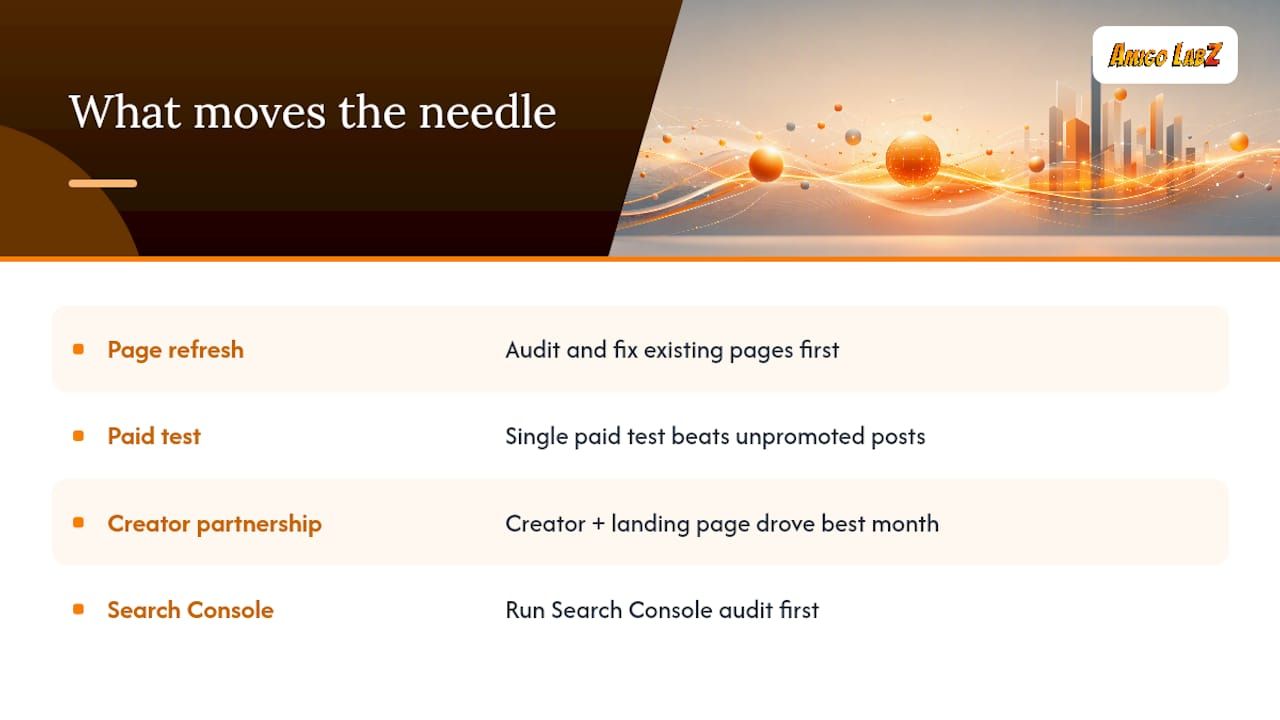
Distribution beats volume, too. A single well-placed paid test or creator partnership routinely outperforms a month of unpromoted blog posts, because visibility, not word count, is usually the actual bottleneck.
Two patterns repeat often: a local service business that stalled for months finally moved after refreshing three pages and adding local schema, and a small ecommerce brand saw its best traffic month ever from one creator partnership paired with a matching landing page. Neither took a large budget, both took focus.
If you're starting today, run your Search Console audit first. That's the highest-signal, lowest-cost move available to you.
How Amigolabz Turns This Into a 90-Day Plan
Reading a checklist is one thing. Executing all ten tactics correctly, in the right order, while running your business, is another. Amigolabz offers a low-risk pilot built specifically around this framework: a 30 to 90 day audit, a prioritized fix list, and one paid test or content refresh executed for you, not just recommended.

The pilot includes:
- A full audit of your top pages using Search Console and analytics data, flagged by impact.
- A prioritized roadmap covering the two or three fixes likely to move the needle fastest for your business.
- Execution of one high-impact item, either a Google Ads test, a Facebook Ads spike, or a content refresh on your best-performing page.
- Clear reporting on sessions, click-through rate, and lead quality so you see exactly what changed.
Businesses in New Jersey and Nevada work with Amigolabz because the pilot is scoped, priced upfront, and built to prove value before asking for a longer commitment. If your site needs technical work first, the SEO services team handles that as part of the same engagement. Ready to see where your traffic gaps actually are? Book a call and get your audit scheduled this week.
Sources
FAQ
How do I boost my website traffic quickly?
Start by refreshing your highest-impression, lowest-click pages in Search Console, then run one small paid test to a dedicated landing page. Both can show measurable movement within one to two weeks.
How can I get 1,000 visitors to my website?
Combine a search fix on your best existing page, one paid or creator-driven distribution push, and an email capture to bring visitors back. Reaching four-figure traffic usually takes a blend of these channels rather than one alone.
How can I increase traffic without relying only on SEO?
Paid social, email marketing, and creator partnerships all drive near-term traffic without waiting on search rankings to shift. Pairing any of these with a matching landing page improves results further.
Does SEO increase website traffic?
Yes. Search continues to drive the largest share of referral traffic for most businesses, and refreshing pages that already rank tends to produce faster gains than starting from scratch.
Should I hire an agency or handle this in-house?
If your team lacks bandwidth, needs faster scaling, or has tested consistently without results, a scoped pilot with an agency like Amigolabz can prioritize fixes and execute them alongside your team.
Recommended