How to Bring Your Website to the Top of Google in 2026
How to Bring Your Website to the Top of Google in 2026

Getting your website to the top of Google comes down to three things working together: a technically sound site, content that genuinely helps people, and enough earned trust signals to outrank competitors for your target terms. Google's own Search Essentials confirm this isn't a trick or a hack. It's the baseline. Miss one pillar and the other two can't fully compensate.
Here's the honest verdict: local visibility gains (think Map Pack rankings) often show up in 30 to 90 days once you fix your Google Business Profile and build recent reviews. Ranking a new page in the top 10 for competitive organic terms usually takes several months. Cracking the top 3 against established competitors can take longer, depending on domain authority and how crowded your niche is.
That timeline isn't a sales pitch. It's just how search works.
Fast wins available now: Google Business Profile completion, fixing crawl errors, cleaning up title tags. Sustained work required for: competitive keyword rankings, backlink authority, content depth across your site.
- Technical fundamentals: crawlability, indexability, page speed, mobile rendering
- People-first content: real expertise, clear structure, answers before fluff
- Earned authority: backlinks and brand mentions from sites Google already trusts
Key Takeaways
Ranking at the top of Google requires fixing technical fundamentals first, then building people-first content, then earning authority through relevant backlinks and local signals.
| Point | Details |
|---|---|
| Technical health comes first | Fix Search Console errors and Core Web Vitals before investing in content or links. |
| Content must serve people, not algorithms | Follow E-E-A-T principles: real authorship, original examples, and answer-first structure. |
| Local SEO moves fastest | Complete Google Business Profile optimization typically shows results in 30 to 90 days. |
| Backlink quality beats quantity | A handful of relevant local or industry links outperforms bulk directory submissions. |
| Amigo Labz supports the full playbook | Amigolabz offers audits, 90-day plans, and ongoing SEO and Google Ads management for businesses in New Jersey and Nevada. |
How Do I Bring My Website to the Top of Google Fast?
You won't out-think Google's algorithm with a single trick, but you can run through a checklist and see measurable movement within weeks. Here's the order that matters most when your time is limited.
- Check your index status.
Search
site:yourdomain.comin Google and compare the results to your actual page count. Big gaps mean pages aren't getting crawled. - Fix your title tags.
Template:
[Primary Keyword] | [Secondary Benefit] – [Brand Name]. Keep it under 60 characters. - Write a real meta description.
Template:
[Action verb] + [what you offer] + [location or benefit].Aim for 150 to 160 characters. - Confirm one H1 per page. No page should have zero or multiple H1 tags. This is one of the most common on-page errors small business sites make.
- Claim and complete your Google Business Profile if you serve local customers. Add categories, hours, photos, and services.
- Request three to five recent reviews from happy customers this week.
- Send one outreach email to a supplier, partner, or local organization asking for a link back to your site.
Pro Tip: If you only have two hours this week, spend them on Google Search Console coverage errors and your Google Business Profile. Those two moves produce the fastest visible change for the least effort.
What Technical Fixes Does Google Actually Require?
Content and links can't rescue a site Google can't crawl or render properly. Technical SEO is the floor, not the ceiling, and skipping it is the single most common reason small business sites stall in rankings.
Start with crawlability. Log into Google Search Console and check the Coverage report. Pages marked "Excluded" or "Error" aren't competing for anything, no matter how good the content is. Confirm your XML sitemap is submitted and your robots.txt file isn't accidentally blocking CSS, JavaScript, or entire folders you actually want indexed. Google's SEO Starter Guide notes that most pages are actually discovered through links, so submitting a sitemap helps, but building real internal and external links speeds up discovery more.
Core Web Vitals come next. These are the specific performance metrics Google uses to judge page experience:
| Metric | What It Measures | Target |
|---|---|---|
| LCP (Largest Contentful Paint) | How fast the main content loads | Under several seconds |
| INP (Interaction to Next Paint) | How responsive the page feels when clicked or tapped | Under a few hundred milliseconds |
| CLS (Cumulative Layout Shift) | How much elements jump around while loading | Under low threshold values |
These thresholds aren't arbitrary. Google built them around real user frustration points, like a page that shifts right as you're about to tap a button. Test your site in PageSpeed Insights and Lighthouse (built into Chrome DevTools) to see where you stand.
Mobile-first indexing means Google mostly uses the mobile version of your site to decide rankings, even for desktop searches. Run your homepage through Google's Mobile-Friendly Test. If your site relies heavily on JavaScript to render content, verify that Google can actually see that content, not just a blank loading screen.
A few more non-negotiables: HTTPS across the entire site, correct canonical tags so Google doesn't index duplicate versions of the same page, and basic structured data (schema markup) for things like business hours, reviews, or articles. Watch for common crawl blockers too, like accidentally disallowing your own images folder or leaving broken 404 and 500 error pages unfixed for months.
Pro Tip: When you're staring at ten technical issues at once, fix indexing errors first, then Core Web Vitals, then everything else. A page that isn't indexed can't rank no matter how fast it loads.
For a deeper walkthrough of these mechanics, SEO in marketing covers crawlability and technical requirements in more depth.
What Makes Content Actually Rank on Google?
Google's ranking systems are built to reward people-first content, meaning pages created to genuinely help a reader, not pages stuffed with keywords to game the algorithm. That distinction shapes everything from how you research topics to how you structure a paragraph.
Start with keyword mapping. Use Google Keyword Planner to find search volume, then look at autocomplete suggestions and the "People Also Ask" boxes for real phrasing customers use. The goal is matching one primary keyword to one page. Trying to rank a single page for five unrelated terms usually means it ranks for none of them well. Long-tail, intent-specific phrases (like "emergency plumber same day New Jersey" instead of just "plumber") tend to convert better and face less competition, a workflow DreamHost's small business guide recommends for exactly this reason.
E-E-A-T (Experience, Expertise, Authoritativeness, Trustworthiness) isn't abstract theory. It shows up in concrete signals: author bylines with real names, original photos instead of stock images, first-party data or case examples, and citations to credible sources when you make a claim. If you're a moving company, show photos from an actual job. If you're a wellness practice, cite the credentials of the person writing the health content.
On-page mechanics matter just as much:
- Title tags under 60 characters, front-loaded with the primary keyword
- One H1 per page that states the topic clearly
- Descriptive H2 and H3 subheadings, ideally phrased as questions readers actually type
- Meta descriptions that summarize the page's value in under 160 characters
- Alt text on every image describing what's actually shown
- Clean, readable URLs (
/plumbing-repair-nj, not/page?id=4471)
Structure each section to lead with the answer, then explain. A heading like "How Much Does Local SEO Cost?" followed immediately by a direct dollar range performs better than three paragraphs of preamble before the number shows up. This also helps AI-driven search tools extract accurate snippets from your page.
Pro Tip: Your top ten pages by traffic deserve a content refresh every six to nine months. Update stats, add new examples, and re-check for broken links. Stale top performers lose rank slowly, then all at once.
For outline templates and heading structures by page type, marketing SEO for small businesses breaks down service pages versus informational articles in detail.
How Do Backlinks Help You Rank Higher?
Backlinks work as trust signals, but the number of links matters far less than where they come from. Ten links from local news sites and industry associations will outperform two hundred from spammy directories every time.
For small and medium businesses, the realistic link sources are closer than you'd think:
- Local newspapers and news sites covering community business openings or milestones
- Industry associations or trade groups you already belong to
- Supplier and partner websites that list clients or vendors
- Chamber of commerce and local business directories
- Guest posts on niche blogs relevant to your industry
- Customer testimonials that link back from the client's own site
An effective outreach pitch is short, specific, and useful to the person receiving it. State exactly what you're asking for, why it benefits their audience too, and skip the generic template language. Follow up once after a week if you hear nothing. Don't follow up a third time.
Watch for red flags that can trigger a Google penalty rather than a ranking boost: paid link networks, link farms, and any scheme promising "500 backlinks for $50." These schemes violate Google's spam policies and can tank a site that was otherwise doing everything right.
In your first 90 days, the highest-return moves are usually the lowest effort: ask three existing suppliers for a link, submit to two or three legitimate local directories, and pitch one local news outlet about something newsworthy your business is doing.
What Local SEO Steps Move the Needle Fastest?
If your business serves a specific city or region, local SEO often moves faster than general organic rankings. A fully optimized Google Business Profile is the single biggest lever here.

Claim your profile if you haven't, then fill in every field: correct categories, complete service list, current hours, verified location, and real photos of your business, not stock images. Incomplete profiles routinely lose Map Pack placement to competitors with less impressive websites but stronger local signals.
Reviews carry real weight too. Ask happy customers directly, right after a completed job or purchase, when the experience is fresh. Respond to every review, positive or negative, within a few days. And keep your business name, address, and phone number (NAP) identical across every directory listing. Inconsistent NAP data confuses Google about which business is really yours.
Local content also earns links naturally: city-specific service pages, roundups of local events you sponsor, or partner spotlights featuring other businesses in your area. These pieces tend to get shared and linked by the very organizations they mention.
- Complete every Google Business Profile field, including services and photos
- Request reviews consistently, not in occasional bursts
- Keep NAP data identical across every listing and directory
- Publish city-specific or neighborhood-specific content pages
Expect visible movement in the Map Pack within 60 to 90 days if your profile was previously incomplete. That's faster than almost any other lever in this guide. For a step-by-step walkthrough, ranking first on Google Maps covers the process in more detail.
How Do You Track Whether Your SEO Is Working?
You need four tools and a handful of numbers you check on a schedule, not just when something feels wrong.
Google Search Console shows impressions, clicks, click-through rate, and average position for every query you're already ranking for. PageSpeed Insights and Lighthouse track your Core Web Vitals over time. GA4 (or your analytics platform of choice) connects traffic to actual conversions, like form fills or calls. A rank tracker rounds things out by showing keyword position changes week over week.
| Cadence | What to Review |
|---|---|
| Weekly | Search Console errors, crawl issues, indexing status |
| Monthly | Keyword rankings, organic traffic, conversion trends |
| Quarterly | Overall strategy, content gaps, competitor movement |
- Track impressions and clicks together, not clicks alone, to catch ranking drops early
- Watch Core Web Vitals monthly since site changes can quietly break page speed
- Tie organic traffic to actual leads or sales, not just visits
How Much Does It Cost to Rank on Google?
Costs and timelines vary by how much ground you're covering and how competitive your market is, but the general pattern holds across most small businesses.
Local Google Business Profile wins typically show up in 30 to 90 days. New content usually takes 3 to 6 months to reach the top 10 for its target keyword. Competing for the top 3 spots against established players in your industry often takes 6 to 18 months.
- DIY approach: Mostly your time, plus tool costs (keyword research tools, rank trackers) typically running $50 to $300 a month
- Freelance support: One-off technical audits or content sprints, often priced per project rather than monthly
- Agency managed services: Ongoing monthly engagements that bundle technical work, content, and link building together
Whichever path you choose, prioritize spend in order: fix technical blockers first, since content and links can't rescue a site Google can't properly crawl or render. Content investment comes next, then sustained outreach for links.
What SEO Mistakes Actually Hurt Your Rankings?
Some mistakes just waste time. Others actively damage your standing with Google, and the two get confused constantly.
The time-wasters include duplicate content across multiple pages, thin pages with barely any real information, incorrect canonical tags pointing Google to the wrong version of a page, robots.txt files accidentally blocking important resources, and ignoring how your site renders on mobile devices.
The penalty-risking mistakes are more serious: paid link schemes, automatically generated content built purely to manipulate rankings, and fake or incentivized reviews. Google's spam policies exist specifically to catch these patterns, and getting caught can mean a manual action that tanks your visibility for months.
Google's own guidance is direct on this point: content should be created for people first, not to manipulate search rankings. Any use of automation, including AI, to generate content primarily for ranking manipulation violates Search Essentials, regardless of the tool used to produce it.
- Duplicate or thin content across multiple pages
- Blocked resources in robots.txt that prevent proper rendering
- Fake reviews or incentivized review schemes
- Paid backlink networks or link farms
What Does a 90-Day SEO Plan Actually Look Like?
A realistic plan breaks into four two-week blocks, each with a clear deliverable and a way to know it's actually done.
Weeks 1 to 2: Technical triage. Audit Search Console coverage, confirm your sitemap is submitted and accurate, check robots.txt for accidental blocks, and run Core Web Vitals tests across your top five pages. Deliverable: a prioritized list of technical fixes, sorted by severity. Done means every "Error" status in Search Console has a plan attached to it.
Weeks 3 to 6: Content prioritization. Rewrite title tags and H1s on your top-traffic pages, restructure them to answer the main question first, and publish one or two new high-value pages targeting keywords you've mapped out. Deliverable: updated on-page elements across priority pages, plus new published content. Done means each updated page has one clear keyword target and a single, correct H1.
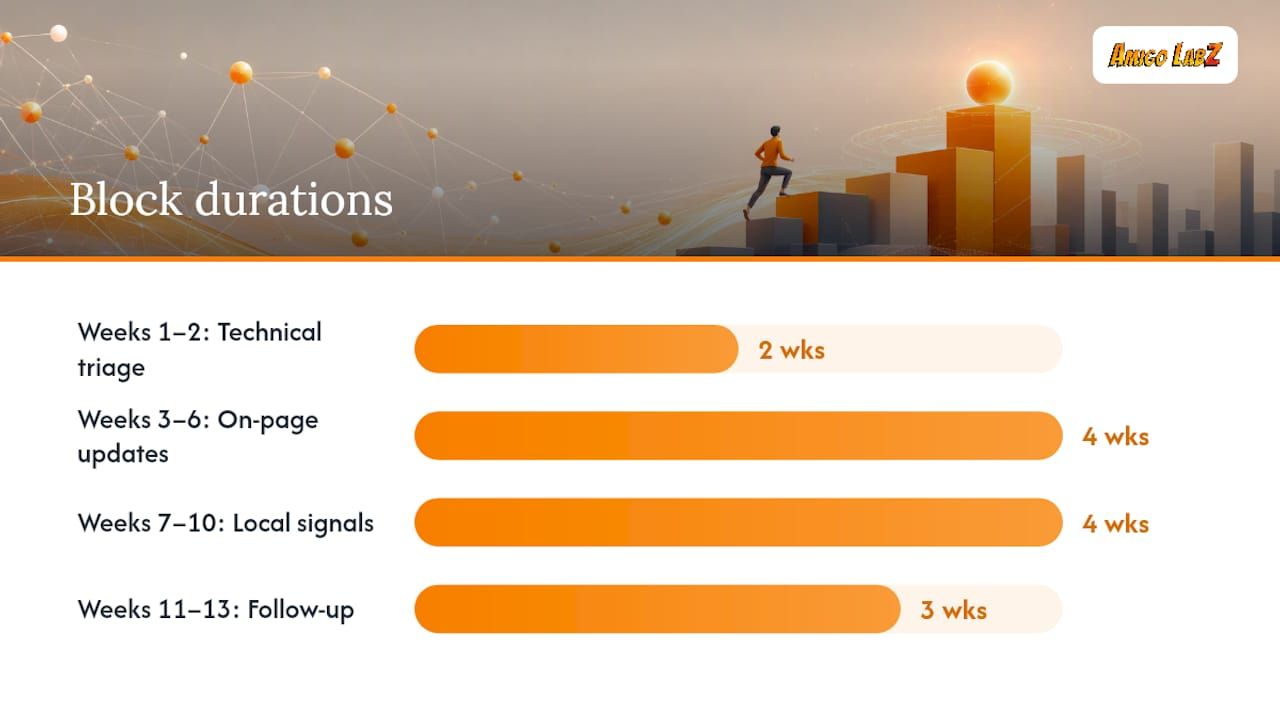
Weeks 7 to 10: Local signals and outreach. Fully complete your Google Business Profile, start a consistent review request habit, and send three targeted outreach asks to suppliers, partners, or local publications. Deliverable: a complete GBP listing and three outreach emails sent with responses tracked. Done means your profile has zero incomplete fields.
Weeks 11 to 13: Follow-up and iteration. Chase outreach responses, recheck Core Web Vitals to confirm your fixes held, review which pages gained rank, and plan your next content batch based on what's working. Deliverable: a short report showing ranking movement and a content plan for the next quarter.
- Weeks 1 to 2: technical triage and error prioritization
- Weeks 3 to 6: on-page updates and new content publication
- Weeks 7 to 10: local optimization and outreach execution
- Weeks 11 to 13: follow-up, measurement, and next-quarter planning
Pro Tip: Keep a simple before-and-after screenshot of your Search Console coverage report at the start and end of each two-week block. Seeing the error count drop is the easiest way to keep a small team motivated through a 90-day push.
When Should You DIY vs. Hire an Agency?
Basic technical fixes, a complete Google Business Profile, and small content updates sit squarely in DIY territory for most owners with a few hours a week to spare. You don't need an agency to fix a broken title tag or request reviews from happy customers.
The calculation changes once you need sustained link-building campaigns, a large technical migration (like moving platforms or consolidating domains), or content published consistently enough to matter, which is usually more volume than a solo owner can sustain alongside running the actual business.
If you're evaluating an agency, ask direct questions: What's their reporting cadence? Can they show a real case history, not just testimonials? Is pricing transparent, or does it balloon after month one? A good agency partner should feel like a handoff, not a black box. You should still understand what's happening to your site and why.
Get Expert Help Ranking Your Website on Google
Running through a 90-day plan solo is doable, but it eats hours a lean team usually doesn't have to spare, especially when technical fixes, content production, and outreach all need attention in the same week. Amigolabz works with small and medium businesses across New Jersey and Nevada the same way this guide is structured: start with a full audit, build a 90-day action plan, then move into ongoing optimization once the fundamentals are solid.

That includes SEO services covering technical fixes and content strategy, Google Business Profile optimization for local visibility, and Google Ads for businesses that want paid visibility running alongside organic growth. If your site has technical issues you can't diagnose, or you simply don't have the bandwidth to run outreach and content updates every week, book a call and get a straight assessment of where your site stands right now.
Sources
FAQ
How Long Does It Take to Rank on Google?
Local Google Business Profile improvements often show results in 30 to 90 days, while new content typically takes 3 to 6 months to reach the top 10 and 6 to 18 months to reach the top 3 for competitive terms.
What Is the Fastest Way to Improve Google Rankings?
Completing your Google Business Profile and fixing Search Console indexing errors produce the fastest visible movement, usually within weeks rather than months.
Do I Need Backlinks to Rank on Google?
Yes, but quality matters far more than quantity. A few links from local news sites, industry associations, or partners outperform hundreds of low-quality directory links.
Can I Improve My SEO Without Hiring an Agency?
Basic technical fixes, Google Business Profile completion, and small content updates are manageable in-house. Amigolabz typically steps in when businesses need sustained link-building, large technical projects, or consistent content production.
What Are Core Web Vitals and Why Do They Matter?
Core Web Vitals measure loading speed (LCP), responsiveness (INP), and visual stability (CLS). Google uses these metrics as ranking signals tied directly to real user experience.
Recommended