Drive Traffic to Your Website: A 2026 Small Business Plan
Drive Traffic to Your Website: A 2026 Small Business Plan

Pick three channels, one search, one owned, one paid or social, and run a disciplined 90-day experiment before you touch a fourth. That's the whole strategy in one sentence, and it's the difference between businesses that grow traffic steadily and ones that burn a year chasing every tactic on a marketing blog. Trying to run SEO, paid ads, five social platforms, and an email program all at once with a two-person team doesn't produce faster results. It produces mediocre results across the board, because nothing gets the attention it needs to actually work.
Here's your immediate checklist, the six moves that matter before anything else:
- Publish one page targeted at a specific, low-competition search term your customers actually type into Google.
- Check your Largest Contentful Paint score in Google PageSpeed Insights and fix it if it's slower than 2.5 seconds.
- Install Google Analytics 4 and verify Google Search Console so you can see where visitors come from.
- Build one lead magnet, a checklist, template, or short guide, tied to your best-performing page.
- Launch a small paid test, $10 to $20 a day, on the one platform where your audience already spends time.
- Claim and fully complete your Google Business Profile if you serve customers locally.
Week one looks unglamorous: you're setting up tracking, fixing broken things, and publishing content that won't rank for a while. Week twelve looks different. You'll have real data on which channel is pulling weight, a small list of email subscribers, and at least one page showing up in search results for terms you didn't rank for before. That gap between quiet setup and visible traction is normal, and skipping the setup phase to chase quick wins is the single most common reason small business traffic plans fail.
| Point | Details |
|---|---|
| Focus beats breadth | Running three channels well outperforms running seven channels poorly. |
| Technical fixes come first | A slow site undermines every other traffic tactic you run afterward. |
| Tracking before tactics | Set up GA4 and Search Console before spending on content or ads. |
| Paid and organic serve different jobs | Paid tests validate demand fast; organic compounds but takes longer. |
Key Takeaways
Driving traffic to your website in 2026 works best when you commit to three or four channels, fix technical foundations first, and measure engagement rather than raw visitor counts.
| Point | Details |
|---|---|
| Pick 3 to 4 channels | Match channels to where your audience already spends attention, not to trends. |
| Fix technical basics first | Address Core Web Vitals and mobile usability before scaling content or ads. |
| Run a real 90-day test | Give each experiment a full 90 days before deciding to scale or cut it. |
| Measure engagement, not just visits | Track pages per session and conversion rate, since traffic without engagement means little. |
| Amigolabz builds the full engine | Amigo Labz combines SEO, Google Ads, and social media management around a single 90-day plan. |
Early wins, your first indexed pages and initial ad clicks, typically show up in weeks one through four. Months two and three bring the real test: rankings starting to move, email subscribers accumulating, and enough data to see which channel is actually converting. By month four and beyond, the channels that proved themselves deserve more budget and effort, while anything that hasn't produced a measurable result after a fair 90-day run should be cut rather than extended on hope alone.
How to Choose the Channels That Will Drive Traffic to Your Website
Not every channel deserves your time, and figuring that out before you start saves months of wasted effort. The right three or four channels come from matching where your audience already spends attention against how much effort each channel demands, not from copying whatever a competitor happens to be doing. Agencies that work across many small business accounts consistently land on the same recommendation: pick three to four channels that fit your audience instead of spreading thin across every possible tactic.
Ask three questions about each candidate channel. Does your audience already use it, or would you be trying to build a new habit? How much production effort does it take to show up consistently, a blog post versus a daily video, for instance? And does it lead somewhere specific, a page, a form, a product, rather than a vague "brand awareness" goal you can't measure?
A local service business, a plumber or a dentist, usually gets more from Google Business Profile optimization, local SEO, and a small Google Ads budget than from building a TikTok following. A B2B software company selling to other businesses often does better with LinkedIn content and search-driven blog posts than with Instagram Reels. Match the channel to the buyer, not to what's trending.
A 90-day template you can actually run
Structure the experiment in three phases, each roughly 30 days, rather than treating 90 days as one long undefined push. A phased 90-day approach that separates technical setup, content publishing, and authority building gives new and growing sites their best shot at early indexed impressions and measurable organic growth by months three through six.
Days 1 through 30 handle the foundation: fix site speed, install tracking, publish your first two or three targeted pages, and launch your paid test. Days 31 through 60 focus on volume, more content, more social posts, iterating your paid creative based on early data. Days 61 through 90 shift to authority, outreach for backlinks, expanding what's working, cutting what isn't.
Set a minimal budget per channel before you start. A realistic split for a small business might be $300 to $600 a month on paid tests, a few hours a week on content, and no more than $200 a month on any tools beyond your analytics stack. Launching without a budget cap is how experiments quietly turn into permanent spending with no clear return.
Pro Tip: Write down the one metric that will tell you a channel is working before you launch it, not after. If you can't name that metric in one sentence, you're not ready to spend money or time on that channel yet.
SEO Tactics That Compound Traffic Over Time
Organic search rewards patience in a way paid channels never will. Paid traffic vanishes the moment you stop paying, but organic strategies take longer to build and compound over time, which is exactly why the businesses that stick with SEO for six to twelve months tend to pull ahead of ones that treat it as a quick fix.
Start with the boring stuff, because none of the exciting tactics matter if a search engine can't crawl your site properly. Confirm your pages are indexed in Google Search Console, submit an XML sitemap, and check that your site renders cleanly on mobile devices. Core Web Vitals and basic schema markup are foundational technical inputs, not optional polish, and fixing crawlability issues before writing another blog post is one of the highest-return moves available to a small site.
On-page work should prioritize long-tail keywords over broad, competitive terms. A new plumbing site trying to rank for "plumber" is wasting effort; a page targeting "emergency water heater repair cost in [your city]" has a real shot within months. Once you've picked your term, run what agencies call an Answer Audit: identify the top questions people ask about that topic, then restructure your page so a clear, concise answer sits directly under each heading. This same structure that helps human readers scan a page faster is also what gets pulled into AI-generated search answers.
Backlinks still matter, but small businesses don't need a national PR campaign to earn them. Reach out to niche industry directories, local business associations, and adjacent businesses for simple link exchanges or guest posts. Digital PR, getting quoted in a local news story or industry roundup, does more for a small site's authority than a dozen low-quality directory submissions.
Local SEO deserves its own line item if you serve customers in a specific area. Optimizing your Google Business Profile and getting listed in relevant directories increases visibility because many local searches start in map apps, not a traditional search bar. Respond to every review, positive or negative, and keep your hours and service list current. A profile that looks abandoned signals the same thing to customers that it does to Google: this business isn't paying attention.
- Fix technical crawlability and Core Web Vitals before publishing new content.
- Target long-tail, specific search terms instead of broad, competitive ones.
- Run an Answer Audit on your top pages to structure clear answers under headings.
- Build backlinks through niche directories, guest posts, and local partnerships.
- Optimize your Google Business Profile and manage reviews actively.
Pro Tip: Use Google Keyword Planner to find search volume for long-tail phrases before you write a single word. A term with 40 monthly searches and low competition often converts better than a 2,000-search term you'll never rank for.
What Content Formats Actually Move Traffic
Content marketing works when you treat it as a system, not a series of one-off blog posts. The pillar-and-cluster model remains the most efficient structure for small sites: one comprehensive pillar page covering a broad topic, surrounded by several narrower cluster posts that link back to it and to each other. Publishing targeted long-tail content organized into topic clusters helps new domains gain early traction on searches that would otherwise take years to rank for individually.
Repurposing stretches your production time much further than writing from scratch every time. A single long-form article can become a short video walkthrough, three or four short clips for social platforms, a newsletter section, and two or three standalone social posts, all without new research.
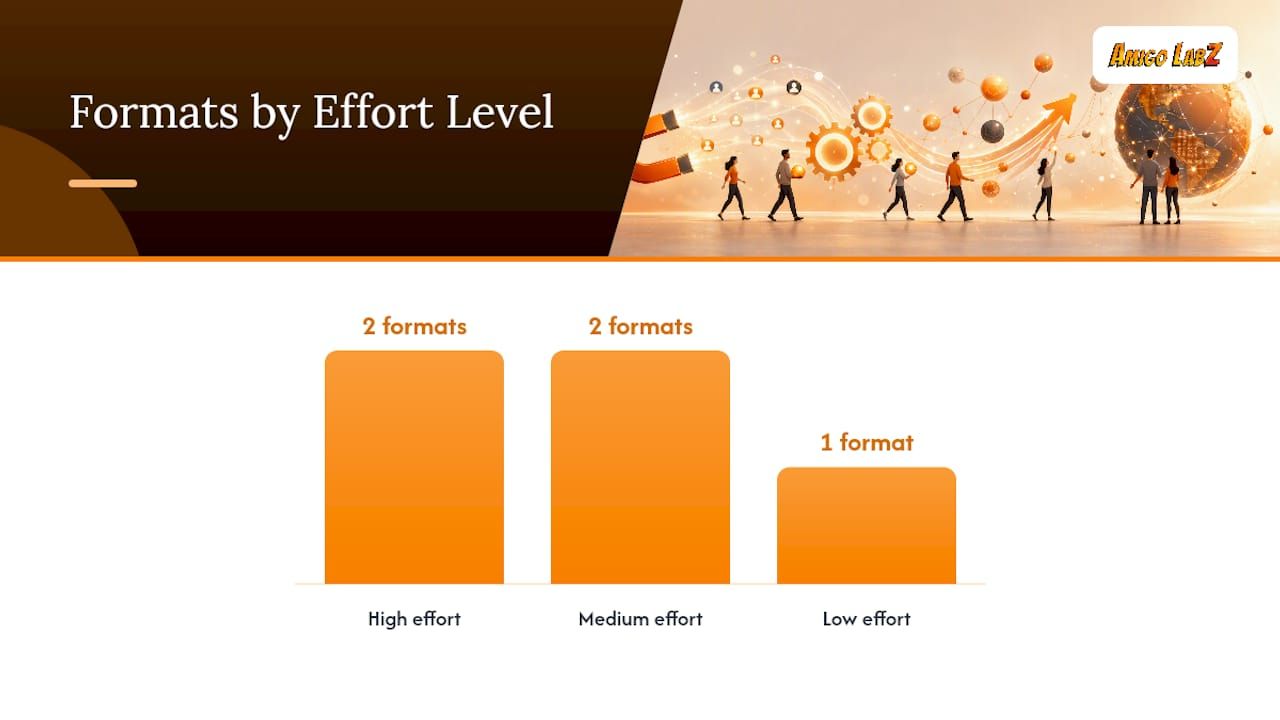
| Content Format | Best Use Case | Repurposing Path | Effort Level |
|---|---|---|---|
| Pillar page | Broad topic authority, internal linking hub | Source for video scripts and cluster topics | High, one-time |
| Cluster blog post | Long-tail keyword targeting | Newsletter feature, social carousel | Medium |
| Short video (60 to 90 seconds) | Social discovery, engagement | Clips for multiple platforms | Medium |
| Podcast or webinar | Authority building, thought leadership | Blog transcript, quote graphics, audio clips | High, recurring |
| Newsletter | Owned audience nurture | Blog teaser, social announcement | Low |
Set a realistic editorial cadence rather than an aspirational one. One pillar page a month with two supporting cluster posts, repurposed into weekly social content and a biweekly newsletter, is sustainable for a small team. Publishing daily and burning out by week three helps nobody.
Structure every piece for AI-readiness while you're at it, since that's no longer a separate task from good SEO. Keep answers short and direct under each heading, use schema markup where it applies, and refresh older content regularly. Pages that load faster and get updated more recently are cited more often by AI-driven search features, which means your six-month-old blog post might be quietly losing visibility simply because you haven't touched it.
Which Social Platforms Are Worth Your Time
Picking a social platform because your competitor is on it is how most small businesses waste a year of content effort. The better filter is audience match first, content fit second, and resource cost third. A platform where your ideal customer scrolls for twenty minutes a day but you can only produce content sporadically will underperform a platform with a smaller audience where you can post consistently.
| Platform Type | Best For | Content Fit | Resource Cost |
|---|---|---|---|
| Short-form video (Reels, TikTok, Shorts) | Consumer brands, visual products | High production frequency needed | Medium to high |
| Professional network (LinkedIn) | B2B services, thought leadership | Text posts, industry commentary | Low to medium |
| Community forums (Reddit, niche groups) | Trust building, product feedback | Genuine participation, not ads | Low, high time |
| Visual discovery (Pinterest) | Home, food, design, retail products | Evergreen pins linking to site | Medium |
Organic tactics that actually move traffic tend to share one trait: they send people somewhere specific. A short-form clip that ends with "check the link in bio for the full guide" outperforms one that just entertains and stops. User-generated content, customers tagging your business or sharing their own results, does more for credibility than anything you could write yourself, so make it easy for happy customers to tag you and then repost what they share.
A one-week content blueprint for a service business might look like this: Monday, a behind-the-scenes clip of your process; Wednesday, a customer question answered in a short video; Friday, a link-driven post pointing to a new blog article; and one community reply or comment thread engagement daily, five minutes, not an hour. Don't post inconsistently for two weeks and then vanish for a month. That pattern trains the algorithm, and your audience, to stop expecting you.
When Paid Ads Make Sense and When They Don't
Paid channels earn their place when you need traffic now, not in three months. Paid campaigns can generate traffic within hours of launching, but that traffic disappears the moment you stop spending, which makes paid a validation tool as much as a growth engine. Use it to test whether a landing page converts, whether a message resonates, or whether a new product has real demand, before you sink months into organic content for something that might not work.
| Budget Range (Monthly) | Best Channel Fit | Primary Use | Expected Timeline |
|---|---|---|---|
| $300 to $600 | Search ads, narrow keyword set | Validate demand for one offer | Results visible in days |
| $300 to $600 | Search plus retargeting | Capture warm visitors who didn't convert | 2 to 4 weeks to optimize |
| $300 to $600 | Search, social, retargeting mix | Scale a proven landing page | 4 weeks to stabilize |
Before you spend a dollar, confirm the landing page actually matches the ad. Sending paid traffic to your homepage instead of a page built around the specific offer in the ad is the fastest way to burn a budget with nothing to show for it. Set up UTM parameters on every campaign link and confirm GA4 is tracking the right conversion events, form submissions, purchases, calls, before launch, not after you've already spent the first week's budget blind.
Retargeting deserves particular attention for small budgets because it targets people who already showed interest. Someone who visited your pricing page and left is a warmer prospect than a cold audience, and retargeting ads to that group typically cost less per click while converting at a higher rate. Once a campaign proves itself, a search ad delivering conversions at a cost you can sustain, scale the budget gradually rather than doubling it overnight, since sudden spend increases often confuse the ad platform's optimization and temporarily raise costs.
Turning Visitors Into an Audience You Own
Every visitor who leaves without giving you their email is a visitor you have to win back from scratch next time. Building an owned audience, primarily email, is the one channel where you're not renting attention from an algorithm that can change its rules tomorrow.
Lead magnets work best when they're tied directly to the page a visitor is already on, not a generic "subscribe to our newsletter" box. A visitor reading about kitchen renovation costs is far more likely to hand over an email address for a downloadable cost calculator than for a vague promise of "tips and updates."
- Offer a checklist or template that solves the exact problem the page is about.
- Keep the opt-in form short, name and email only, never more than two fields.
- Deliver the lead magnet instantly and follow with a short welcome sequence.
- Segment new subscribers by which page or offer brought them in.
- Track open rate, click rate, and return visits driven by email, not just subscriber count.
A simple welcome flow covers four emails over roughly two weeks: a welcome message delivering the lead magnet immediately, a value email a few days later sharing a related tip or resource, an engagement email asking a question or inviting a reply, and a soft conversion email introducing your product or service. Businesses that skip straight to a sales pitch in email one see far more unsubscribes than ones that build trust first.
Segmentation doesn't need to be complicated for a small list. Splitting subscribers by the page or offer that brought them in, and by whether they've purchased before, covers most of what a small business needs. Any commercial email you send must comply with the CAN-SPAM Act's rules on opt-outs and sender identification, which means every email needs a working unsubscribe link and your real business address, not just good intentions.
Building Referral Traffic Through Partnerships and Listings
Referral traffic tends to convert better than cold search traffic because someone else has already vouched for you. A guest post outreach template doesn't need to be elaborate: identify five to ten sites in your industry that publish guest content, read two of their recent posts so your pitch references something specific, and propose a topic that fills a gap they haven't covered.
| Referral Source | Setup Effort | Ongoing Admin | Best For |
|---|---|---|---|
| Guest posts | Medium, one pitch at a time | Low, occasional follow-up | Authority and backlinks |
| Niche directories | Low, one-time submission | Very low, occasional updates | Local and industry visibility |
| Local partnerships | Medium, relationship building | Low, periodic check-ins | Community trust, referral leads |
| Affiliate programs | Medium, needs tracking setup | Medium, commission management | Product-based businesses |
Directory listings still generate meaningful traffic for local businesses, particularly when paired with a strong Google Business Profile. Beyond Google, check industry-specific directories, chamber of commerce listings, and local news business roundups. Tag every outbound partnership link with a UTM parameter so you can see in GA4 exactly which partner or directory is sending real visitors, not just link mentions that never get clicked.
Affiliate arrangements work well for product-based small businesses that can offer a straightforward commission without heavy administrative overhead.
Site Speed and Mobile Experience That Keep Visitors Around
A visitor who bounces because your site loads slowly never gets the chance to be impressed by your content, your offer, or your design. Three Core Web Vitals metrics matter most: Largest Contentful Paint should land under 2.5 seconds, Interaction to Next Paint should stay under 200 milliseconds, and Cumulative Layout Shift should stay below 0.1. Run your site through Google PageSpeed Insights or Lighthouse to see exactly where you stand and which specific fixes it recommends.

Pages loading in under two seconds get cited by AI search features up to 40% more often than slower pages , according to research on AI-driven search visibility. That's not a minor technical detail anymore. It's a direct traffic lever, since AI-generated answer boxes are increasingly where searchers see your brand before they ever click through.
Mobile experience deserves the same scrutiny, since most traffic to a small business site now arrives on a phone. Run through this checklist:
- Navigation menu collapses cleanly and every link is tappable without zooming.
- Forms use appropriate input types (a numeric keypad for phone numbers, for instance).
- Primary call-to-action buttons stay visible without excessive scrolling.
- Text remains readable without pinching to zoom on any page.
- Images and videos don't slow page load on a standard mobile connection.
Schema markup rounds out the technical priorities, and it's simpler to implement than most small business owners assume. Organization, Article, FAQ, and LocalBusiness schema help search engines and AI systems understand exactly what your page is about, which improves both traditional search visibility and your odds of being pulled into an AI-generated answer.
| Technical Element | Target Threshold | Tool to Check |
|---|---|---|
| Largest Contentful Paint (LCP) | Under 2.5 seconds | Google PageSpeed Insights / Lighthouse |
| Interaction to Next Paint (INP) | Under 200 milliseconds | Google PageSpeed Insights |
| Cumulative Layout Shift (CLS) | Below 0.1 | Google PageSpeed Insights |
| Schema markup present | Organization, Article, FAQ, LocalBusiness | Google's Rich Results Test |
How to Measure Whether Your Traffic Strategy Is Working
Traffic that doesn't engage anyone is a number on a dashboard, not a business result. Engagement metrics, dwell time, engagement rate, pages per session, and scroll depth, tell you whether visitors actually found value, which matters far more than a raw visitor count that includes people who left in three seconds.
Start by checking Sessions by referrer in GA4 weekly. This single report tells you which channel, organic search, paid, social, email, or direct, is actually sending people to your site, and it's the fastest way to catch a channel that looks busy but isn't converting.
| Metric | What It Tells You | Check Frequency |
|---|---|---|
| Sessions by referrer | Which channel drives visitors | Weekly |
| Engagement rate | Whether visitors interact beyond landing | Weekly |
| Pages per session | Content and navigation effectiveness | Monthly |
| Conversion rate by channel | Which channel produces real business results | Monthly |
| Cost per conversion (paid channels) | Whether ad spend is sustainable | Weekly during active campaigns |
A minimal dashboard doesn't need expensive software. A single spreadsheet or a GA4 custom report tracking impressions, clicks, engagement rate, pages per session, and conversion rate by channel gives a small business owner everything needed to decide where to put next month's effort. Review it weekly during active experiments and monthly once a channel stabilizes. If a channel hasn't produced a measurable conversion after a full 90-day cycle despite reasonable effort, that's your signal to cut it, not extend it another quarter hoping it turns around.
Why Agencies Recommend the Answer Audit Method for 2026
The single biggest shift in how traffic gets built in 2026 isn't a new platform or algorithm update. It's that search itself has split into two experiences, the traditional results page and AI-generated answer summaries, and content that isn't structured for the second one is invisible to a growing share of searches.
An Answer Audit works through a page or topic systematically. First, list the actual questions people ask about that topic, pulled from Google Keyword Planner, Search Console query data, or straight from customer emails. Second, check whether your existing content answers each question directly within the first sentence or two under a relevant heading, not buried three paragraphs deep after a long introduction. Third, rewrite any section that makes a reader hunt for the answer.
- Pull your top 10 to 15 search queries from Google Search Console for pages already getting some traffic.
- Check each corresponding page for a direct, concise answer under a clear heading, not a wandering intro.
- Rewrite any weak sections so the answer appears in the first sentence, then expand with detail below it.
- Add relevant schema markup, FAQ or Article, to reinforce the page's structure for search engines.
- Recheck the page's ranking and any AI citation visibility 30 to 45 days after the update.
Sequencing matters as much as the tactics themselves. The 90-day playbook approach that works best for new and growing sites moves through technical foundations first, indexing, speed, mobile readiness, then targeted content built around real search queries, and finally authority building through backlinks and Answer Audits on your best-performing pages. Skipping straight to authority building before your technical foundation is solid wastes the outreach effort, since a slow, poorly indexed site won't hold onto the rankings those backlinks are supposed to earn.
Pro Tip: Run a free AEO audit on your top three pages before you rewrite anything. It flags exactly which sections are too vague or buried for an AI system to cite confidently.
The Tools and Monthly Checklist That Keep Momentum Going
A small traffic engine needs a small, specific toolkit, not a subscription to every marketing platform advertised in your inbox. Here's what actually earns its place for a small business team:
- Keyword research : Google Keyword Planner for search volume and competition data on long-tail terms.
- Technical auditing : Google PageSpeed Insights and Lighthouse for Core Web Vitals and speed diagnostics.
- Analytics : Google Analytics 4 paired with Google Search Console for traffic, referrer, and query data.
- Local visibility : Google Business Profile for map presence, reviews, and local search results.
- Content optimization : an AI content readiness audit to check whether your pages are structured for AI citation.
- Email : any platform with automated welcome sequences and CAN-SPAM compliant opt-out handling.
- Social scheduling : a native scheduler or third-party tool to maintain a consistent posting cadence without daily manual work.
Use each one for a specific job rather than trying to make one tool do everything. Keyword Planner tells you what to write about. PageSpeed Insights tells you what's broken. GA4 and Search Console tell you what's working. Google Business Profile keeps your local presence current. Nothing here requires an enterprise budget.
| Monthly Task | Why It Matters | Time Estimate |
|---|---|---|
| Refresh two to three older pages | Fresh content gets cited more often by AI search | 2 to 3 hours |
| Run a Core Web Vitals check | Catch speed regressions before they hurt rankings | 30 minutes |
| Send five to ten outreach emails | Build backlinks and referral partnerships steadily | 1 to 2 hours |
| Review channel performance dashboard | Decide what to scale, pause, or cut | 1 hour |
| Update Google Business Profile posts and photos | Keep local presence active and current | 30 minutes |
Run this checklist on the same day every month, the first Monday, for instance, so it doesn't quietly slip when things get busy. A traffic engine that gets maintained monthly outperforms one that gets an intense burst of attention once a quarter followed by silence.
What I've Learned Watching Small Businesses Chase Traffic
The mistake I see most often isn't picking the wrong channel. It's picking too many of them at once. A business owner reads that video content is hot, that email is dying, that SEO takes too long, and that paid ads are the only fast option, all in the same week, and ends up launching four half-committed efforts instead of one focused experiment that actually gets a fair test.
Ignoring site speed and mobile usability is the second-most expensive mistake, and it's the one that quietly undermines every other tactic. A business can nail its SEO strategy, earn a decent ranking, and still lose most of that traffic because the page takes six seconds to load on a phone. That's not a content problem or a channel problem. It's a foundation problem, and no amount of clever marketing fixes it after the fact.
The third mistake is treating traffic as the finish line rather than the starting point. A spike in visitors from a viral social post feels great for a day and means nothing if none of those visitors convert, return, or remember your business a week later. Traffic without engagement is a vanity metric, and the businesses that grow steadily are the ones watching pages per session and conversion rate, not just the total visitor count in their weekly report.
If there's one piece of advice worth acting on today, it's this: pick one experiment, run it for the full 90 days without abandoning it at week three when results look slow, and measure it honestly before deciding what comes next. That discipline matters more than any single tactic in this article.
How Amigo Labz Helps You Turn a Plan Into Consistent Traffic
Running a focused 90-day experiment sounds simple on paper, but most small business owners are also running the business, which leaves little time for keyword research, technical audits, and campaign tracking on top of everything else. Amigolabz builds and manages that traffic engine directly, so you get the strategy from this guide executed by people who do it daily instead of squeezed in after hours.

A working relationship with Amigolabz typically starts with a straightforward audit of where your site stands today: technical health, current rankings, and channel performance, followed by a 90-day plan built around the three or four channels that actually fit your audience. From there, the team handles execution: SEO services to build the content engine and fix technical gaps, Google Ads management for fast demand capture while organic builds, and social media management to keep a consistent posting cadence without it falling on your own to-do list. If paid social fits your audience, the team also runs Facebook Ads campaigns built around the same landing pages and tracking setup covered in this guide.
Book a free discovery call to walk through where your traffic currently comes from and which three channels make the most sense for your business. There's no pressure and no long pitch, just a real look at your current numbers and a plan for the next 90 days. Schedule that call here.
Recommended Reading and Tools for Going Deeper
The sources behind this guide are worth bookmarking if you want to go further on any single tactic covered above.
- A 90-Day SEO Playbook for AI-Driven Search Visibility, for a deeper look at Answer Audits and structuring content for AI citation.
- SEO for Small Business Websites: 2026 Guide, for local SEO, Google Business Profile, and technical priorities.
- 26 Proven Ways to Drive Traffic to Your Website, for a broader look at the paid versus organic tradeoff.
- Website Engagement: Traffic Is Meaningless Without It, for the engagement metrics that matter more than visitor count.
- SEO for Startups & New Websites: The 90-Day Playbook, for the phased sequencing model used throughout this guide.
For a walkthrough of foundational tactics specific to smaller sites, Amigolabz's guide on SEO best practices for small business owners covers many of the technical checklist items in more depth. If you'd rather talk through your specific situation, the Amigo Labz contact page is the fastest way to get a direct answer.
Sources
FAQ
How do you drive traffic to your website?
Pick three to four channels that match where your audience already spends time, fix technical issues like page speed first, then run each channel as a 90-day experiment before deciding what to scale.
What does it mean to drive traffic to your website?
It means getting people to visit your site through search engines, social media, paid ads, email, or referrals, though visits only matter if visitors engage with the content and take an action once they arrive.
How can I drive traffic to my website for free?
Focus on organic SEO with long-tail keywords, optimize your Google Business Profile if you serve local customers, publish consistent content, and engage authentically in relevant online communities and social platforms.
How do you redirect or divert traffic to a specific page on your website?
Use targeted UTM links in campaigns, internal linking from high-traffic pages, and paid ad landing pages built specifically around one offer, then confirm the routing works correctly in Google Analytics 4 before scaling it.
How long does it take to see real results from these strategies?
Paid channels can show traffic within hours, but organic strategies typically need two to three months for early signals and four to six months for measurable, compounding growth, based on the phased 90-day playbook approach.
Recommended