SEO Content: A Beginner's Guide to Ranking in 2026
SEO Content: A Beginner's Guide to Ranking in 2026

SEO content is any content created to rank in search engines by matching what real people are actually searching for. The goal is not to trick an algorithm but to answer a specific question better than anyone else on the first page. If you're starting from scratch, do this first: identify the search intent behind your target query (informational, commercial, or transactional), then write a brief direct-answer block right under your first question heading. That single habit, backed by Google Search Central guidance on people-first content, separates pages that rank from pages that sit idle. Amigolabz builds every client content project around this principle.
Why does SEO content matter for your business?
Organic search is one of the few marketing channels that compounds. A paid ad stops the moment you cut the budget. A well-optimized blog post or landing page keeps pulling in qualified visitors for months, sometimes years, without additional spend. That compounding effect is what makes SEO content strategies worth the upfront investment.
Intent alignment is what turns traffic into results. When your content matches exactly what a searcher wants, bounce rates drop, time-on-page rises, and conversion rates follow. A visitor who lands on a page that answers their specific question is far more likely to sign up, buy, or call than one who stumbled in from a vaguely related keyword.
The business metrics worth tracking:
- Organic sessions: raw volume of non-paid visits from search
- Click-through rate (CTR): how often your page earns the click after appearing in results
- Goal completions: form fills, purchases, phone calls tied to organic entry
- Assisted conversions: organic visits that contributed to a sale even when another channel closed it
Google's SEO Starter Guide makes clear that technical site health is a prerequisite, not a substitute for content quality. You need both. But content is what drives presence in search once the technical floor is in place.
What types of SEO content should you create?

Different queries call for different formats. A searcher typing "how to write a meta description" wants a tutorial, not a product page. A searcher typing "buy SEO audit" wants a service page with pricing and a contact form. Matching the format to the intent is as important as matching the words.
| Content Type | Primary Intent | Best Used When |
|---|---|---|
| Blog post / guide | Informational | Explaining a concept, answering a how-to question |
| Landing page | Transactional / commercial | Driving sign-ups, purchases, or service inquiries |
| Product page | Transactional | Selling a specific item or package |
| FAQ page | Informational / navigational | Answering common questions at scale |
| Interactive tool | Informational / commercial | Calculators, quizzes, assessments |
| Video content | Informational | Tutorials, demonstrations, reviews |
| Glossary / definition page | Informational | Capturing "what is X" queries |
The choice between a long-form blog post and a landing page usually comes down to one question: is the searcher trying to learn, or trying to buy? A landing page built around an informational query will struggle to rank because SERP analysis consistently shows that top results mirror the format users expect. Check the first five results for your target query before you decide on a format.
FAQs and glossary pages are underused. They capture high-volume, low-competition queries at scale and feed featured snippets directly. If your site has a knowledge base or resource section, structured FAQ content is often the fastest path to new organic impressions.
How do you create SEO content that actually ranks?
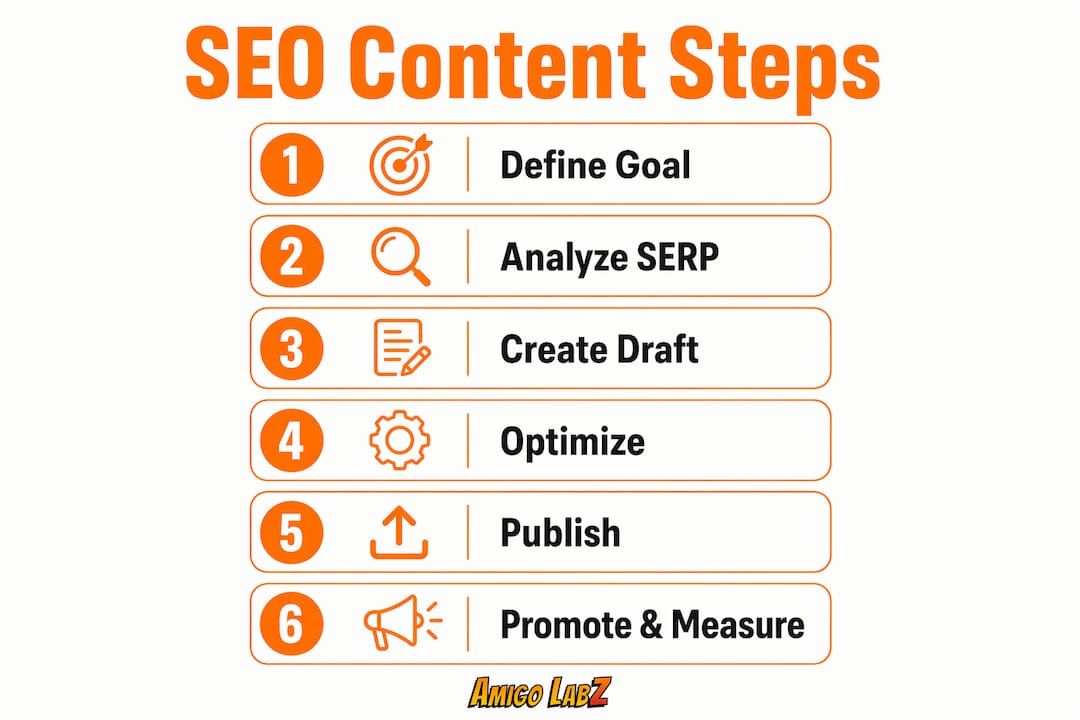
The workflow below is repeatable. Use it for every new piece of content, whether it's a 300-word FAQ answer or a 2,000-word guide.
Step 1: Define the core question and business goal
Start with the question, not the keyword. What does this piece need to answer? What should the reader do after reading it? Write those two things down before you open a keyword tool. Keywords are inputs to intent analysis, not the starting point.
Step 2: Analyze the SERP

Search your target query and study the top five results. Note the content format (guide, list, tool, video), the angle (beginner vs. advanced, broad vs. specific), and any gaps the top pages leave open. That gap is your opportunity.
Step 3: Write a content brief
A brief takes 20 minutes and saves hours of revision. Include:
- Target query and intent classification
- Audience (who is reading and what they already know)
- Content type and approximate depth
- Key questions the piece must answer
- Internal links to include
- On-page targets: title tag, meta description, primary H2s
Step 4: Write with a direct-answer block first
Under each question-style H2, place a brief self-contained answer before expanding. This structure improves featured-snippet eligibility and AI-citation chances. The rest of the section can go deeper, but the answer must stand alone in those first few sentences.
Pro Tip: Use semantic HTML and a strict heading hierarchy (H1 → H2 → H3, no skipping levels). Citation-extraction engines score pages with clean heading structures significantly higher, which matters as AI overviews pull more traffic from the top of the SERP.
Step 5: On-page SEO checklist
- Title tag: primary keyword near the front, moderate length
- Meta description: includes a benefit and a soft CTA
- H1: one per page, matches or closely mirrors the title tag
- H2s: cover the main subtopics; use natural question phrasing where possible
- Keyword placement: appears in the first 100 words, at least one H2, and the meta description
- Internal links: 2–4 contextual links to related pages on your site
- Images: descriptive alt text, compressed for speed
- Structured data: FAQ schema for FAQ sections, Article schema for guides
Step 6: Publish, promote, and measure
Publishing is not the finish line. Share the piece through social channels, add internal links from existing high-traffic pages, and reach out to sites that cover the same topic for potential link placements. For cross-channel amplification, even a small paid social push on a new post can accelerate early engagement signals.
Watch these KPIs in Google Search Console and Google Analytics: impressions, average position, CTR, organic sessions, and goal completions. Set a calendar reminder to revisit the piece at 90 days. If average position is between 5 and 15, a targeted update often moves it into the top three.
Topical completeness, not raw word count, is what moves rankings. Concise pages that fully answer a query outperform padded long-form content. Write until the question is answered, then stop.
How do you build an SEO content strategy?
One great post is not a strategy. A strategy is a system for producing, organizing, and updating content so that every piece serves a measurable business goal.
Set goals tied to real outcomes
Vague goals produce vague results. Instead of "increase organic traffic," set a target like "grow organic sessions to the services section by 30% in six months" or "rank in the top five for three high-intent queries in our primary service area." Attach each goal to a KPI you can pull from Search Console or Analytics weekly.
Build topic clusters
Group your content into themes that map to the buyer journey. A cluster typically has one pillar page (broad, authoritative) and several supporting posts (specific, linked back to the pillar). This structure signals topical authority to search engines and keeps users moving through your site. For a small business SEO approach, three to five clusters covering your core services is usually enough to start.
Audit before you create
Before writing anything new, run a content audit. Identify pages that rank between positions 5 and 20 (update candidates), pages that cannibalize each other for the same query (merge or redirect), and pages with no impressions in 12 months (remove or consolidate). Quick wins from existing content almost always outperform the ROI of publishing something new.
Build an editorial calendar
Prioritize by impact times effort. A post targeting a high-volume, low-competition query with a clear conversion path gets scheduled first. A post targeting a broad, competitive query with no direct business outcome goes to the bottom of the list. Map out one to two months of content at a time, assign owners, and set publish dates. Consistency matters more than volume.
What mistakes kill SEO content before it ranks?
Most content fails for the same handful of reasons. Knowing them upfront saves months of wasted effort.
- Starting with a keyword list: Keywords tell you what people search, not what they need. Start with the question; use the keyword to confirm demand.
- Writing for search engines first: Google's people-first guidance is explicit. Content designed to manipulate rankings rather than serve readers tends to underperform after algorithm updates.
- Padding word count: Length is not a ranking factor. A 600-word page that fully answers a query will outrank a 3,000-word page that circles the same point repeatedly.
- Ignoring UX and speed: Slow load times and cluttered layouts increase bounce rates, which signals to search engines that users didn't find what they came for. Google Search Essentials covers the technical floor every page needs to meet.
- Skipping heading hierarchy: Jumping from H2 to H4 or using headings as decorative labels rather than structural signals hurts both readability and citation extraction.
- Generic experience claims: Saying "our team has years of experience" adds nothing. Verifiable proof points, documented projects, and specific outcomes are what demonstrate real expertise under Google's E-E-A-T framework.
Pro Tip: When you want to show "experience" credibly, link to a documented project, a case study with real numbers, or a first-party test. Generic claims of expertise are invisible to both readers and ranking systems. Specificity is the proof.
Search intent classification into informational, navigational, commercial, and transactional categories is the single most reliable corrective for most of these mistakes. When you know the intent, the right format, angle, and depth become obvious.
Key Takeaways
SEO content works when it matches what real people are searching for, answers their question completely, and gives search engines a clean structure to read and cite.
| Point | Details |
|---|---|
| Intent comes first | Classify every query as informational, navigational, commercial, or transactional before writing a word. |
| Direct-answer blocks win | Place a 40–60 word self-contained answer under each question H2 to improve featured-snippet and AI-citation chances. |
| Topical depth beats length | Concise pages that fully cover a query outperform padded long-form content. |
| Audit before you create | Update pages ranking positions 5–20 before publishing anything new; existing content is your fastest win. |
| Amigolabz applies this system | Amigolabz builds intent-first content strategies for businesses across the U.S., from brief to measurement. |
A perspective on what most guides get wrong
Most SEO content guides spend 80% of their space on tactics and almost none on the decision that actually determines whether a piece will rank: choosing the right format for the right intent before writing a single word.
The format-intent mismatch is the most common reason a well-written, technically clean page sits at position 18 and never moves. A business owner writes a thorough, honest blog post targeting a transactional query. The SERP is full of landing pages with pricing tables and contact forms. The blog post never had a chance, regardless of how good the writing was.
The second thing most guides understate is how much the update cycle matters. Publishing is maybe 60% of the work. The other 40% is returning to pages at 90-day intervals, checking where they landed, and making targeted improvements based on what Search Console actually shows. Content that sits untouched for 18 months decays. The pages that hold top-three positions are almost always the ones someone is actively maintaining.
The third overlooked point: experience signals are not optional anymore. Vague authority claims ("we're experts in X") do nothing. Documented projects, named outcomes, and specific client contexts are what separate a page that demonstrates expertise from one that merely claims it. That gap is widening as AI-generated content floods the SERP with plausible-sounding but unverifiable claims.
Amigolabz can build your SEO content system
Most businesses understand they need SEO content. The gap is between knowing that and having a repeatable system that produces it consistently, measures it honestly, and updates it before it decays.

Amigolabz works with businesses across the country, from New Jersey to Nevada, to build exactly that: an intent-first content strategy, a production workflow, and a measurement setup that connects organic traffic to real business outcomes. The work starts with a content audit and a brief for your highest-priority queries, not a generic package. If you want to see where your current content stands and what the fastest path to ranking looks like for your specific situation, book a call or review the full SEO services offering to see what a typical engagement covers.
Useful sources and further reading
The sources below are the ones worth bookmarking. Each covers a distinct piece of the SEO content picture.
| Source | What it covers | Why it helps |
|---|---|---|
| Creating helpful, people-first content — Google Search Central | Google's official guidance on what makes content rank-worthy | The primary authority on content quality signals |
| SEO Starter Guide — Google Search Central | Technical prerequisites and foundational SEO practices | Covers the technical floor every site needs before content work pays off |
| Google Search Essentials | Spam policies and eligibility requirements for Google Search | Explains what can get a page demoted or excluded entirely |
| What Is Search Intent? — Ahrefs | The 3Cs framework: content type, format, and angle | Best practical guide to intent classification for content planning |
| Search Intent in SEO — Search Engine Land | SERP analysis methods and format-matching techniques | Useful for the pre-write SERP research step |
| SEO — MDN Web Docs | Technical definition of SEO and semantic HTML guidance | Authoritative reference for developers and content creators on markup |
| SEO content that ranks in 2026 — DPOM | Topical coverage vs. word count; experience signals | Practical 2026 framework for concise, credible content |
| Complete guide to SEO content writing 2026 — SEOAuthori | Direct-answer blocks, heading hierarchies, and brief-first planning | Detailed writing workflow with structural best practices |
When evaluating any SEO source, check whether it cites Google's own documentation or relies solely on correlation studies. Primary sources from Google Search Central carry the most weight; third-party guides are most useful when they explain the why behind a tactic, not just the tactic itself.
FAQ
What is the meaning of SEO content?
SEO content is any written, visual, or interactive material created to rank in search engines by matching the intent behind a specific query. It prioritizes answering real user questions over manipulating ranking signals.
What does SEO content look like in practice?
A how-to blog post, a service landing page, a glossary definition, or an FAQ section can all be SEO content. The defining feature is that the format and topic are chosen based on what searchers are looking for, not what the brand wants to say.
What are some SEO content writing examples?
A 600-word FAQ page targeting "how to write a meta description," a guide targeting "what is SEO content," and a product landing page targeting "SEO services New Jersey" are all examples. Each matches a specific intent with the right format.
How does Amigolabz approach SEO content strategy?
Amigolabz starts every engagement with a content audit and intent analysis before producing a single piece of content, connecting each topic to a measurable business goal rather than a keyword list.
How often should SEO content be updated?
Revisit pages at 90-day intervals after publishing. Pages ranking between positions 5 and 20 in Google Search Console are the highest-priority update candidates and often move significantly with targeted improvements.
Recommended