What Do SEO Experts Do? A Business Owner's Guide
What Do SEO Experts Do? A Business Owner's Guide

TL;DR:
- SEO experts optimize websites by enhancing technical health, content, and link profiles to increase organic traffic and revenue. The role has shifted from focusing solely on rankings to emphasizing measurable business outcomes like leads and sales, driven by AI and complex algorithms. Successful SEO requires collaboration across teams, ongoing performance analysis, and early integration into website development.
SEO experts are professionals who improve a website's organic search visibility through technical audits, content development, and performance analysis to drive qualified traffic and business growth. The term "SEO specialist" is the standard industry label, though titles like SEO analyst, SEO consultant, and SEO professional all describe the same core function. Understanding what SEO experts do is the first step toward making a smart hiring decision or building an effective internal team. Their work goes far beyond placing keywords on a page. It spans technical infrastructure, content strategy, data interpretation, and increasingly, AI-powered search optimization.
What do SEO experts do every day?
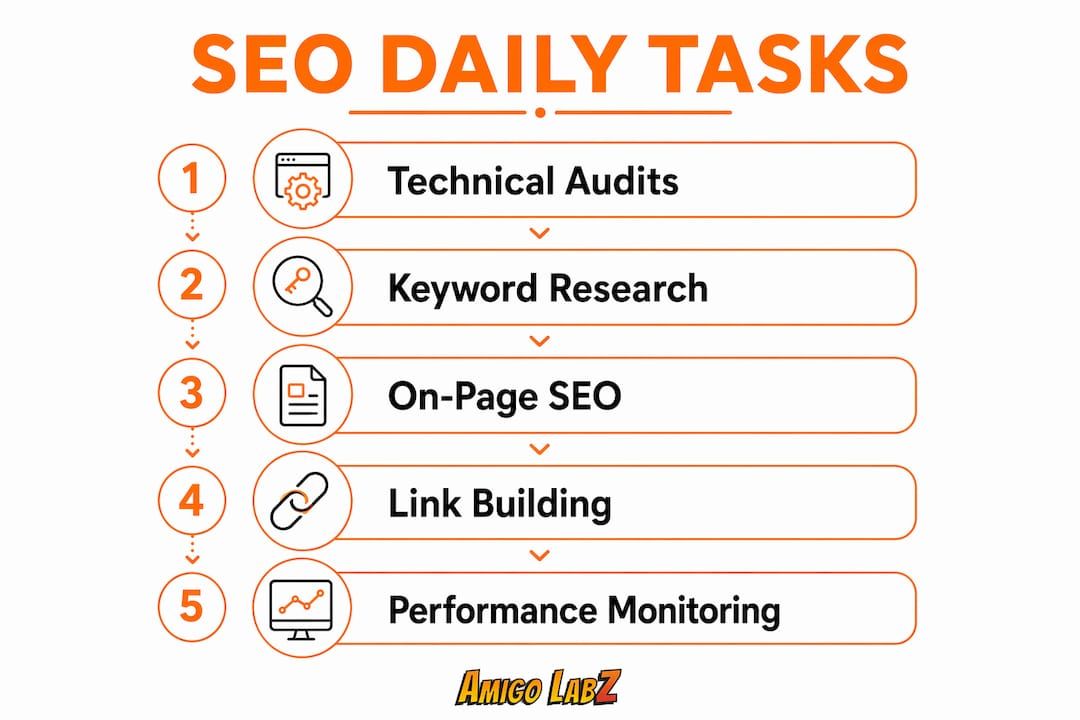
SEO experts perform a defined set of daily and weekly tasks that keep a website healthy, visible, and competitive. Daily duties include audits, keyword research, on-page and technical optimization, link-building, performance monitoring, and content collaboration. Each task connects directly to search rankings and, ultimately, to business revenue.

Technical audits and site health
Technical SEO is the foundation of everything else. An SEO expert runs crawl audits using tools like Screaming Frog or Sitebulb to find broken links, duplicate content, and indexing errors. They also monitor Core Web Vitals in Google Search Console, since page speed and layout stability directly affect rankings. Fixing a single crawl error can unlock pages that Google has been ignoring for months.
Keyword research and content strategy
Keyword research is not a one-time task. SEO specialists continuously identify search terms that match what real buyers type into Google, then map those terms to specific pages or content gaps. They use tools like Ahrefs, Semrush, and Google Keyword Planner to measure search volume, competition, and intent. The goal is not traffic for its own sake. It is traffic from people who are ready to buy, call, or convert.
On-page optimization and schema markup
On-page work covers title tags, meta descriptions, header structure, internal linking, and image alt text. SEO experts also implement schema markup, which is structured data that helps Google display rich results like star ratings, FAQs, and product prices directly in search results. Schema markup and metadata management are standard parts of the daily task list for experienced specialists. Rich results increase click-through rates without requiring a higher ranking position.
Link building and outreach
Backlinks remain one of Google's strongest ranking signals. SEO experts build links through ethical outreach, digital PR, guest posting, and content partnerships. They avoid paid link schemes, which violate Google's guidelines and can trigger manual penalties. Quality matters far more than quantity. A single link from a respected industry publication outperforms dozens of low-authority directory links.
Pro Tip: Ask any SEO candidate to show you a link-building report from a past client. The sources, anchor text, and domain authority scores tell you immediately whether their approach is sustainable or risky.
Performance monitoring and reporting
SEO experts track rankings, organic traffic, conversion rates, and crawl health on a regular schedule. They use Google Search Console for indexing data and GA4 for user behavior analysis. Performance monitoring with GA4 and Search Console is not optional. It is how specialists prove their work is producing results and where they find the next opportunity to improve.
How has the SEO expert role evolved in 2026?
The role of SEO professionals has shifted from chasing keyword rankings to driving business outcomes like qualified traffic, lead generation, and sustainable revenue growth. That shift changes what you should expect from an SEO hire or agency partner.
"A well-structured SEO strategy aligns technical structure, content quality, and domain authority to meet both search engine and user needs." — MediaPlus, 2026
Three forces are driving this evolution:
- AI-powered search. Google's Search Generative Experience and AI Overviews now answer many queries directly on the results page. SEO experts must optimize for featured snippets, entity-based search, and semantic relevance, not just exact-match keywords.
- Outcome accountability. Clients and employers now expect SEO specialists to report on leads, sales, and revenue, not just traffic and rankings. SEO strategies and techniques must connect to the metrics that matter to the business.
- Algorithm complexity. Google updates its ranking systems hundreds of times per year. SEO specialists combine data science, content strategy, and technical skills to keep pace with AI and complex ranking signals. Continuous learning is not optional. It is the job.
The practical result is that modern SEO is a hybrid role. It requires analytical thinking to interpret data, creative judgment to develop content, and communication skills to explain technical decisions to non-technical stakeholders. A specialist who only knows how to build links or write meta descriptions is operating with a partial skill set.
What separates the best SEO professionals from the rest?
The difference between a good SEO expert and a great one shows up in how they work with other teams, not just how they handle search engines. Integrating SEO from the planning phase prevents costly retroactive fixes and supports organic growth. Most businesses bring SEO in too late, after the website is built and the content is published.
Strong SEO professionals do the following:
- Collaborate with developers early. They review site architecture, URL structures, and page templates before launch, not after. A URL structure changed post-launch can wipe out years of ranking equity.
- Work alongside content teams. They brief writers on target keywords, content depth, and internal linking requirements. Content produced without SEO input often misses ranking opportunities entirely.
- Coordinate with UX and design. Page layout affects dwell time and bounce rate, both of which signal quality to Google. SEO experts flag design choices that hurt user experience.
- Align with paid media teams. Organic and paid search data inform each other. High-converting paid keywords often reveal organic content gaps, and vice versa.
- Communicate results in business terms. The best specialists translate "we improved crawl coverage by 40%" into "Google can now find and rank 40% more of your product pages."
Pro Tip: When evaluating an SEO professional, ask them to explain a past technical recommendation in plain language. If they cannot do it clearly, they will struggle to get internal buy-in for the changes that actually move rankings.
SEO experts manage ongoing performance roadmaps and communicate SEO plans to non-technical stakeholders as a core part of the job. That communication skill is what turns a technically sound strategy into one that actually gets implemented.
How do businesses benefit from working with SEO experts?
An SEO expert's work leads to increased organic traffic, improved user experience, generation of leads and sales, and support for long-term business goals. Those outcomes are measurable, which makes SEO one of the few marketing channels where you can directly tie activity to revenue.
Here is what you can realistically expect when working with a qualified SEO specialist:
- Increased organic traffic from people actively searching for your products or services
- Better user experience through faster load times, cleaner site structure, and mobile optimization
- More qualified leads because SEO targets high-intent search queries, not broad audiences
- Long-term visibility that compounds over time, unlike paid ads that stop the moment you stop spending
- Competitive intelligence through ongoing analysis of what rival businesses rank for and why
Google recommends asking potential SEO hires specific questions before hiring. Google's recommended questions include asking about their process, past success stories, how they measure results, and how they communicate recommendations to clients. Those four questions alone will filter out most underqualified candidates.
| What to evaluate | What strong SEO experts deliver |
|---|---|
| Technical skills | Crawl audits, Core Web Vitals fixes, schema markup |
| Content strategy | Keyword-mapped content briefs and gap analysis |
| Link building | Ethical outreach with measurable domain authority growth |
| Reporting | GA4 and Search Console dashboards tied to business KPIs |
| Communication | Plain-language explanations of technical decisions |
Why SEO matters for your business becomes clearest when you compare organic traffic costs to paid alternatives. Organic rankings do not charge per click. The investment goes into the specialist's time and tools, and the results accumulate rather than disappear.
Key Takeaways
SEO experts drive business growth by combining technical site health, content strategy, link building, and AI-aware optimization into a single, measurable discipline.
| Point | Details |
|---|---|
| Core daily tasks | Audits, keyword research, on-page fixes, link building, and GA4 reporting are standard weekly work. |
| Role has evolved | SEO specialists now report on leads and revenue, not just rankings and traffic. |
| Early integration matters | Bringing SEO into planning before launch prevents expensive retroactive fixes. |
| Collaboration is required | Effective SEO experts work with dev, content, UX, and paid media teams. |
| Hiring questions matter | Ask candidates about process, case studies, measurement methods, and communication style. |
What I have learned after years of watching SEO done right and wrong
Most business owners think SEO is a one-time project. They hire someone to "fix the website," get a report full of green checkmarks, and assume the work is done. That misunderstanding costs them months of lost ranking opportunity.
The specialists who consistently produce results treat SEO as a continuous system, not a checklist. They are in Google Search Console every week. They are reviewing content performance every month. They are adjusting link-building targets as competitors shift. The work never stops because Google never stops changing.
The other thing I see businesses get wrong is waiting too long to involve SEO. A developer builds a site without SEO input, a content team publishes 80 articles without keyword mapping, and then an SEO expert is brought in to "clean it up." That retroactive work is expensive and slow. Early SEO integration in website development avoids that trap entirely.
My honest advice: treat your SEO specialist the same way you treat your accountant. You would not build a business without financial oversight from day one. Organic search deserves the same respect. The businesses that win in search are the ones that made SEO a core function, not an afterthought.
— John
Amigolabz SEO services built for business owners
Amigolabz works with business owners across New Jersey and Nevada who want real results from search, not just reports. The team handles technical audits, content strategy, schema markup, and AI-aware optimization as part of a full-service approach designed for small and mid-sized businesses.

If you want to know exactly where your site stands and what it would take to rank above your competitors, the right starting point is a direct conversation. Amigolabz offers professional SEO services built around your specific business goals, not generic templates. You can also book a strategy call to get a clear picture of what an expert-led SEO plan would look like for your business.
FAQ
What do SEO experts do on a daily basis?
SEO experts run technical audits, conduct keyword research, optimize on-page elements, build backlinks, and monitor performance using tools like Google Search Console and GA4. These tasks repeat on a weekly and monthly cycle to maintain and improve organic rankings.
How is an SEO expert different from an SEO analyst?
An SEO analyst focuses primarily on data interpretation and reporting, while an SEO expert typically handles the full scope of strategy, execution, and cross-team collaboration. In practice, many job titles overlap depending on the organization.
What questions should I ask before hiring an SEO expert?
Google recommends asking about their process, past success stories, how they measure results, and how they communicate recommendations. These four questions reveal both technical competence and communication ability.
How long does it take to see results from SEO?
Most businesses see measurable organic traffic improvements within three to six months of consistent SEO work, though competitive markets can take longer. Results compound over time, which is why early and sustained investment outperforms short-term campaigns.
How much does an SEO expert typically earn?
Typical SEO expert salaries average around $85,000 a year, though compensation varies with experience, specialization, and market demand. Senior specialists working in competitive industries or agency leadership roles often earn significantly more.
Recommended