Unlock AI for your website: practical steps for small businesses
Unlock AI for your website: practical steps for small businesses

TL;DR:
- Most small businesses lack proper systems rather than effort, missing opportunities AI tools can optimize. Ensuring technical eligibility, accurate local signals, and measurable goals are essential before AI implementation for effective results. Consistently measuring performance and avoiding common pitfalls maximize AI's benefits in website growth and engagement.
You've invested real time and money into digital marketing, yet your website still isn't pulling its weight. Traffic feels flat, conversions are thin, and every new tactic seems to promise more than it delivers. Here's the thing: most small business owners in New Jersey and Nevada aren't missing effort. They're missing the right systems. AI tools have moved well beyond buzzword territory and into practical territory, giving you the ability to personalize content, speed up workflows, and finally see measurable results from your website. This guide walks you through exactly how to get there, no computer science degree required.
Table of Contents
- What you need before using AI for your website
- Step-by-step: Implementing AI workflows for content and engagement
- Verifying results: AI and website performance metrics
- Troubleshooting and common mistakes to avoid
- Our take: Why local business signals matter more than state-specific AI strategies
- Next steps: Unlocking advanced AI solutions for your website
- Frequently asked questions
Key Takeaways
| Point | Details |
|---|---|
| Technical eligibility first | Your website must meet Google's technical requirements to unlock AI-powered visibility. |
| Thoughtful AI content | Avoid mass page generation and focus on structured, original content for best results. |
| Workflow clarity | Map clear business goals, segment audiences, personalize content, and measure outcomes. |
| Performance measurement | Monitor Core Web Vitals and conversion metrics to ensure improvements from AI. |
| Local signals matter | Accurate business information and local relevance drive real gains for New Jersey and Nevada businesses. |
What you need before using AI for your website
Having set the stage for why AI matters, let's clarify what you'll need to get started. Jumping straight into AI tools without laying the groundwork is like installing a high-end sound system in a car with a broken engine. The foundation has to be solid first.
Technical eligibility comes first. Pages must be indexed and eligible for Google's AI features, meaning they must meet the same technical standards as regular Google Search. If your pages are blocked by a robots.txt file, suppressed through meta tags, or riddled with crawl errors, no AI tool in the world will help you show up in AI Overviews or AI Mode. Run a quick check through Google Search Console before anything else.
Keep your local business information accurate. For small businesses in New Jersey and Nevada, this means your name, address, phone number, and hours must be consistent everywhere: your website, Google Business Profile, Yelp, and any directory listings. Inconsistent information confuses both users and AI systems that pull local data to answer search queries.
Here's a quick comparison of the tools you'll want to have in place before you dive deeper:
| Tool | Purpose | Cost tier |
|---|---|---|
| Google Search Console | Index monitoring and crawl errors | Free |
| Google Analytics 4 | Conversion and engagement tracking | Free |
| Google Business Profile | Local signal accuracy | Free |
| AI marketing platform | Content, ads, personalization | Paid or freemium |
| Core Web Vitals report | Page speed and performance | Free |
Set up analytics before you touch AI. You can't measure what you haven't defined. Before running any AI-driven campaigns or content updates, establish your conversion goals in Google Analytics 4. Are you tracking form submissions? Phone call clicks? Product purchases? Without this in place, you'll have no way to know whether your AI implementation is actually moving the needle.
When it comes to choosing the right tools, explore proven AI marketing tools that are purpose-built for performance and compatibility, rather than grabbing whatever sounds trendy. You'll also want a solid content creation checklist to ensure your existing pages meet quality standards before AI optimization begins.
Here are the core prerequisites as a quick checklist:
- No blocked or suppressed pages in Google Search Console
- Accurate business name, address, and phone number across all listings
- Google Analytics 4 installed with at least one conversion event set up
- Existing pages reviewed for thin content or duplicate issues
- Internal linking structure reviewed for clarity (good SEO linking tips apply here)
Pro Tip: Run a free Core Web Vitals report through Google's PageSpeed Insights before introducing any AI tool. If your site already loads slowly or has layout shift issues, fix those first. AI won't compensate for a slow, unstable page.
Step-by-step: Implementing AI workflows for content and engagement
With the right tools and technical eligibility, it's time to execute AI strategies step by step. The biggest mistake most small business owners make here is trying to do everything at once. Start focused, then expand.
Step 1: Define your goal before touching any tool. A clear goal drives everything else. Are you trying to reduce bounce rate on your service pages? Increase quote requests by 20%? Grow email signups? AI works best when it's solving a specific, measurable problem, not acting as a general fix-all.

Step 2: Define your audience segments. Not everyone who visits your website is the same. A New Jersey restaurant owner looking for catering leads has different needs than a Nevada contractor seeking commercial bids. Your audience segmentation advice should reflect real behavioral differences, such as traffic source, device type, page history, or geographic location.
Step 3: Map signals to content variations. This is where AI starts earning its keep. Once you know your segments, you can use AI tools to serve different content, headlines, or calls to action based on who's visiting. A returning visitor from a paid ad deserves a different message than a first-time organic search visitor.
Step 4: Measure outcomes and refine. The AI adaptive content workflow works best when you treat it as a cycle: goals, segments, signals, measurement, then repeat. Don't set up your AI-personalized content and forget about it. Check your data weekly, adjust underperforming variations, and scale what works.
"The difference between businesses that win with AI and those that don't usually comes down to one thing: they treated it as a process, not a product."
Implementing AI chatbots for engagement. Adding a chatbot to your website can significantly improve engagement, but only if it's set up thoughtfully. Generic "How can I help you?" prompts are nearly worthless. Instead, personalize the opening message based on what page the visitor is on. Someone on your pricing page should get a different greeting than someone reading your blog. Track resolution rate, response time, and how often the bot hands off to a human.
Here's a quick data table showing what good chatbot performance looks like versus average:
| Metric | Average performance | Strong performance |
|---|---|---|
| Resolution rate | 40-50% | 70%+ |
| First response time | Under 10 seconds | Under 3 seconds |
| Handover rate | 30-40% | Under 20% |
| User satisfaction score | 3.2/5 | 4.2/5+ |
On AI-generated content, be intentional. Generative AI content must follow Google Search Essentials and avoid scaled-content abuse, which means publishing dozens of near-identical pages just to capture search traffic. That approach burns trust with both Google and real visitors. Instead, use AI to assist your writing process: draft outlines, refine headlines, check tone consistency, and generate variation ideas. Then add your real expertise and local knowledge on top.
Check out proven content promotion strategies to amplify the AI-assisted content you do create. And if social media is part of your mix, integrating social media management alongside your AI content workflow creates a much stronger overall presence.
Also explore AI ad personalization strategies that tie your website content directly to your paid campaigns for a more unified experience.
Pro Tip: Don't mass-generate blog posts hoping for SEO wins. Write one well-researched, AI-assisted article that genuinely helps your target customer, and it will outperform ten thin, automated posts every time.
Verifying results: AI and website performance metrics
Once you've implemented your AI workflows, you'll need to track and verify what's working and what isn't. Guessing is not a strategy.
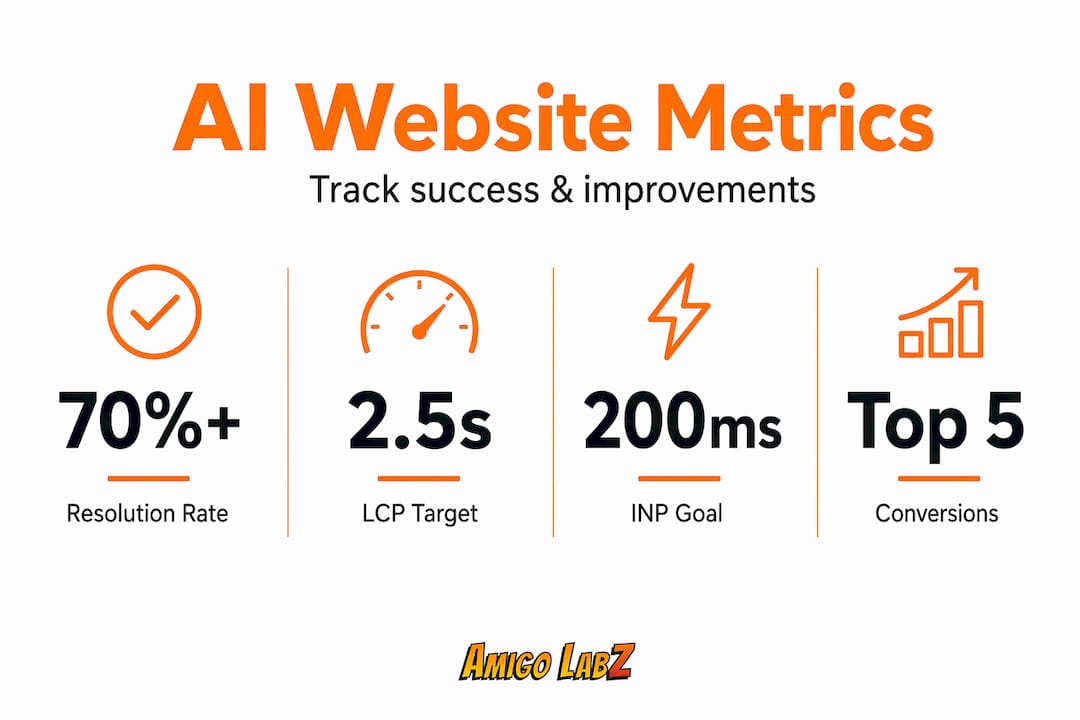
Core Web Vitals are your starting line. For mobile users (which is the majority of your traffic), target these thresholds: Largest Contentful Paint (LCP) under 2.5 seconds, Interaction to Next Paint (INP) under 200 milliseconds, and Cumulative Layout Shift (CLS) under 0.1. These aren't just technical vanity metrics. Research consistently shows that every second of load time delay reduces conversion rates significantly.
Here's how to think about the metrics that matter most after an AI implementation:
| Metric | What it measures | Tool to use |
|---|---|---|
| LCP | How fast main content loads | Google Search Console |
| INP | Responsiveness to user interaction | PageSpeed Insights |
| CLS | Visual stability of the page | Chrome UX Report |
| Bounce rate change | Engagement improvement | Google Analytics 4 |
| Conversion rate change | Revenue or lead impact | Google Analytics 4 |
| Chatbot resolution rate | AI support effectiveness | Chatbot platform dashboard |
Set a measurement window before you draw conclusions. Give AI-driven changes at least four weeks before evaluating results. Less than that and you're reading noise, not data. Seasonal fluctuations, traffic spikes from unrelated campaigns, or even Google algorithm updates can all skew short-term numbers.
Use the website data analytics methods your business already has access to, and layer AI-specific metrics on top. Think of it as adding a new dashboard, not replacing your existing one.
Also revisit your SEO optimization tips periodically. As AI changes how search results are presented, strong internal linking and anchor text practices become even more important for ensuring your pages stay visible.
For paid campaigns, look at AI performance metrics that track not just clicks but actual engagement quality and downstream conversions.
Pro Tip: Create a simple monthly reporting template that tracks Core Web Vitals, top 5 converting pages, and chatbot resolution rate side by side. This single habit will tell you more about your AI results than any single tool dashboard alone.
Troubleshooting and common mistakes to avoid
With performance verified, let's address the most common pitfalls and ensure continued success. Even well-intentioned AI implementations go wrong when small businesses fall into predictable traps.
Mistake 1: Treating AI as a content factory. The biggest risk Google has called out explicitly is scaled content abuse, which means generating large volumes of pages primarily to manipulate search rankings rather than serve users. The nuance here matters: using AI for editing, structured planning, and targeted personalization is not the problem. Cranking out 200 nearly identical service pages is. Use AI as a productivity layer, not a content machine.
Mistake 2: Ignoring local signals. Your New Jersey or Nevada location is an asset, not just a detail. If your website copy doesn't reference your actual service area, your Google Business Profile is outdated, or your local schema markup is missing, AI tools will have less to work with when matching you to local searches. Accurate, current local signals are how you win in AI-driven search results for your region.
Mistake 3: The "set it and forget it" approach. AI workflows require ongoing attention. An AI chatbot that resolved 65% of queries in January might drop to 40% by March as customer questions evolve. Ad personalization that worked during a holiday promotion won't necessarily hold up in the off-season. Build a review cycle into your calendar, at least monthly.
Mistake 4: Skipping the quality check on AI-generated content. Even excellent AI writing tools produce content that sounds generic if you don't add your own voice, local expertise, and specific service details. Use your checklist for content creation as a final quality gate before publishing anything AI-assisted.
For ad campaigns, specific AI ad creation tips can help you avoid wasted spend while maximizing the relevance of your messaging.
"The businesses that thrive with AI are the ones that treat it as a thinking tool, not a replacement for thinking."
Mistake 5: Not having a human handover plan for chatbots. If your AI chatbot can't answer a question, it must be able to smoothly pass the conversation to a real person or a clear next step. Visitors who get stuck in a loop with a bot that can't help them will leave frustrated and unlikely to return. Set a clear trigger point for human escalation.
Our take: Why local business signals matter more than state-specific AI strategies
Here's a perspective you won't find in most generic AI marketing guides: the idea that New Jersey businesses need a completely different AI strategy than Nevada businesses is largely a myth. We've worked with small business owners in both states, and the variables that actually drive results are not state-specific. They're signal-specific.
What separates the businesses that see real gains from AI implementation versus those that don't is almost never geography. It's whether their local signals are accurate, whether their pages are technically eligible for AI features, and whether they're measuring conversion outcomes instead of vanity metrics.
The real competitive advantage for any local business is consistency. Consistent business information across all platforms. Consistent quality in AI-assisted content. Consistent measurement cycles. The businesses we see struggling most are the ones chasing AI hype, buying into the idea that the next tool or the next feature will solve their growth problem without doing the foundational work first.
Strong audience segmentation insights paired with accurate local data will outperform a sophisticated AI stack sitting on top of a poorly structured, inconsistently listed local business. Every single time. Start local, stay consistent, and measure everything.
Next steps: Unlocking advanced AI solutions for your website
Ready to take your AI-driven website to the next level? Here's how to get specialized help.
Everything we've covered in this guide, from technical eligibility to chatbot personalization to Core Web Vitals, requires consistent effort and the right expertise. You don't have to figure it all out alone.

At Amigo Labz, we work with small business owners across New Jersey and Nevada to build AI-ready digital marketing strategies grounded in real data and local insight. Whether you need stronger SEO services to improve your search visibility, targeted Google Ads services that leverage AI personalization, or simply a clear plan for where to start, we can help. The fastest way to move forward is to book a call with experts who understand both the tools and the local markets you're operating in. Let's build something that actually works.
Frequently asked questions
Do small businesses need separate AI strategies for New Jersey vs Nevada?
No. Local signals and technical SEO eligibility are the real differentiators, not state-specific AI tactics. Focus on accurate location data, consistent business listings, and conversion measurement regardless of which state you operate in.
How can I stay compliant with Google when using AI-generated content?
Follow Google Search Essentials and avoid scaled-content abuse, which means never generating many pages primarily to manipulate rankings. Every AI-assisted page should deliver genuine, unique value to your actual audience.
What's the best way to personalize AI chatbots for my website?
Personalize the opening message based on page context and set a clear handover point for complex questions. Track resolution rate and response time consistently to identify where your bot needs improvement.
What are the key website performance metrics to track after implementing AI?
For mobile, target these Core Web Vitals: LCP under 2.5 seconds, INP under 200 milliseconds, and CLS under 0.1. Monitor conversion rate changes alongside these technical metrics to see the full business impact.
Can AI help with both website and ad performance?
Yes. AI marketing tools can simultaneously optimize your website content strategy and your ad targeting, creating a more unified experience that improves both engagement and conversions across channels.
Recommended