Search Engine Ranking Company: How to Hire One That Delivers
Search Engine Ranking Company: How to Hire One That Delivers

TL;DR:
- A search engine ranking company improves website visibility in organic search results to generate scalable, revenue-driven traffic. They provide technical SEO, on-page optimization, content strategy, link building, and local SEO, among other services. Hiring requires clear evaluation of process, transparency, and a focus on business outcomes rather than rankings alone.
A search engine ranking company is an SEO agency that improves where your website appears in organic search results on Google and other search engines. If you need scalable traffic tied to real revenue and you don't have the in-house expertise or bandwidth to build it, hiring one now makes sense.
Two signals that make the decision urgent: you're launching a new product or location and need visibility fast, or your site recently went through a redesign and rankings dropped. Either situation calls for outside help immediately.
What does a search engine ranking company actually do?
The industry term is "SEO agency," and the service list is wider than most business owners expect. Here's what a credible firm should deliver, not just pitch:
- Technical SEO: Crawl audits, Core Web Vitals fixes, site speed, mobile usability, and indexation. Deliverable: a prioritized fix list with severity ratings.
- On-page SEO: Title tags, meta descriptions, header structure, internal linking, and keyword placement. Deliverable: revised page templates and an optimization log.
- Content strategy and production: Topic research, content briefs, and published articles or landing pages. Deliverable: a content calendar tied to keyword clusters.
- Link acquisition: Earning backlinks from authoritative sites through outreach, digital PR, or partnerships. Deliverable: a monthly link report with domain authority and anchor text.
- Local SEO and Google Business optimization: Profile completeness, review strategy, citation building, and map-pack ranking. Deliverable: a local search audit and monthly profile report.
- Analytics and reporting: Google Analytics 4, Search Console, and conversion tracking setup. Deliverable: monthly dashboard tied to business goals.
- AI and AEO optimization: Structuring content so it surfaces in ChatGPT, Perplexity, and Google's AI overview. Deliverable: a citation-tracking report showing brand mentions in AI answers.
Pro Tip: A credible agency bundles at least technical SEO, on-page work, and reporting into every engagement. If a proposal only mentions "keyword research and content," that's a partial service, not a full SEO program.
Who actually needs to hire an SEO agency?
Not every business is ready. The profiles where hiring pays off fastest:
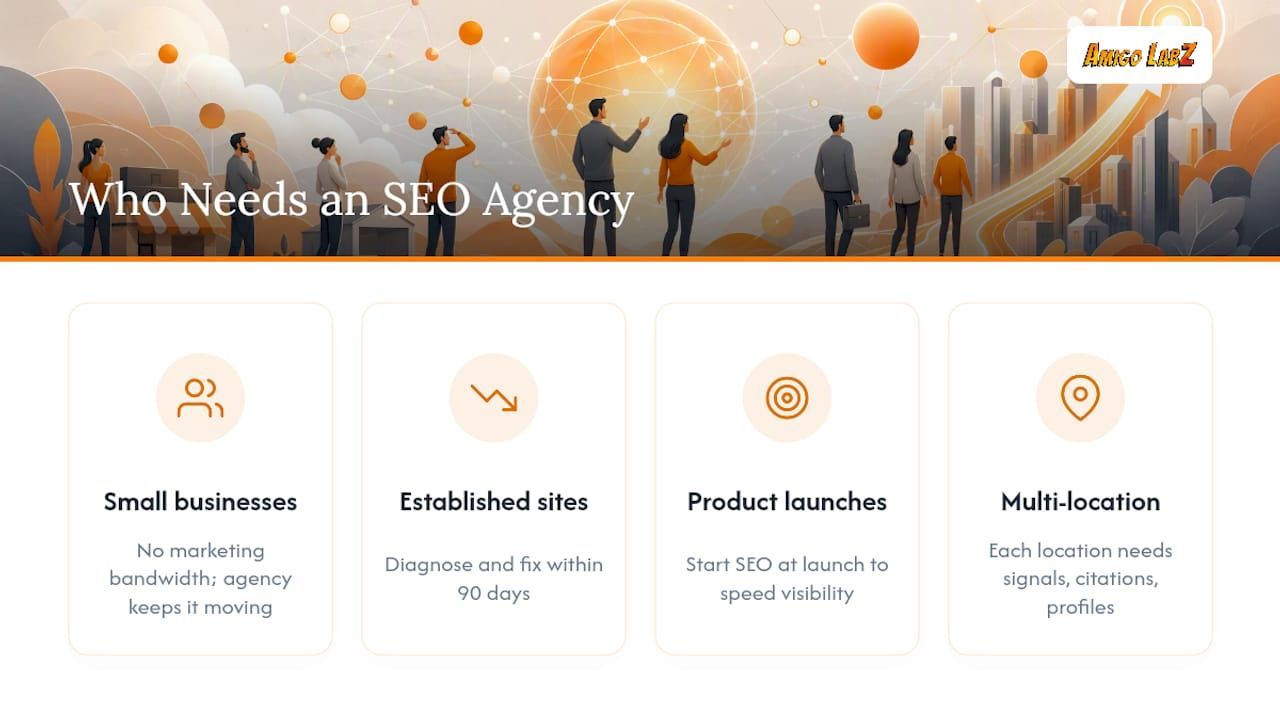
Small businesses without marketing bandwidth. If you're running operations and sales yourself, SEO falls off the list every week. An agency keeps it moving without your daily attention.
Established sites with poor organic traffic. You have content, but Google isn't sending visitors. That's usually a technical or authority problem an agency can diagnose and fix within the first 90 days.
Companies launching new products or markets. Organic visibility takes time to build. Starting SEO at launch, not six months after, compresses the timeline to meaningful traffic.
Multi-location businesses. Ranking in multiple cities requires a local SEO strategy that goes beyond a single homepage. Each location needs its own signals, citations, and profile management.
Common goals agencies solve: growing qualified organic sessions, generating local leads, improving branded visibility in AI-generated answers, and capturing more SERP real estate for high-intent pages. If your goal is brand awareness through paid ads alone, SEO may not be your first move. But if you want compounding traffic that doesn't disappear when you stop paying per click, SEO in digital marketing is the longer play that builds equity.
How do you choose the right SEO agency?
Use this framework on every intro call and in any RFP.
Evaluation criteria
- Staffing model: Who actually does the work? In-house specialists or outsourced contractors? Ask for names and LinkedIn profiles.
- Auditable case studies: Can they show before/after organic traffic data for a client in your industry? Screenshots from Search Console beat PDF decks.
- Documented process: Do they follow an audit → roadmap → execution → measurement cycle, or do they start writing content on day one without a diagnosis?
- AI and AEO experience: Ask for a live demo showing how they track a client's brand in ChatGPT or Perplexity. Agencies that only describe a framework without showing one often haven't done it.
- Link-building ethics: Do they use private blog networks or link farms? Any hesitation here is a red flag.
- Reporting and SLAs: Monthly dashboards minimum. Quarterly strategic reviews. Access to your own Search Console and GA4 at all times.
- Contract flexibility: Month-to-month, 6-month, or 12-month? What's the cancellation notice period?
Questions to ask on the first call
- "Who on your team will handle my account day-to-day?"
- "Can you show me a Search Console screenshot from a client you've grown organically?"
- "What does your first 90 days look like, specifically?"
- "How do you handle link building, and can I see your outreach process?"
- "How do you report on AI search visibility?"
- "What's your cancellation policy?"
A focused 45-minute call with ten sharp questions reveals more than a two-hour discovery session with a generic questionnaire.
Red flags
- Guarantees of a #1 ranking on Google. Google itself warns that no one can guarantee rankings, and any firm claiming otherwise is either lying or planning to use tactics that will eventually penalize your site.
- Vague answers about who does the work.
- No access to your own analytics or Search Console.
- Reporting that only shows keyword positions with no conversion data.
How are SEO results measured and when do you see them?
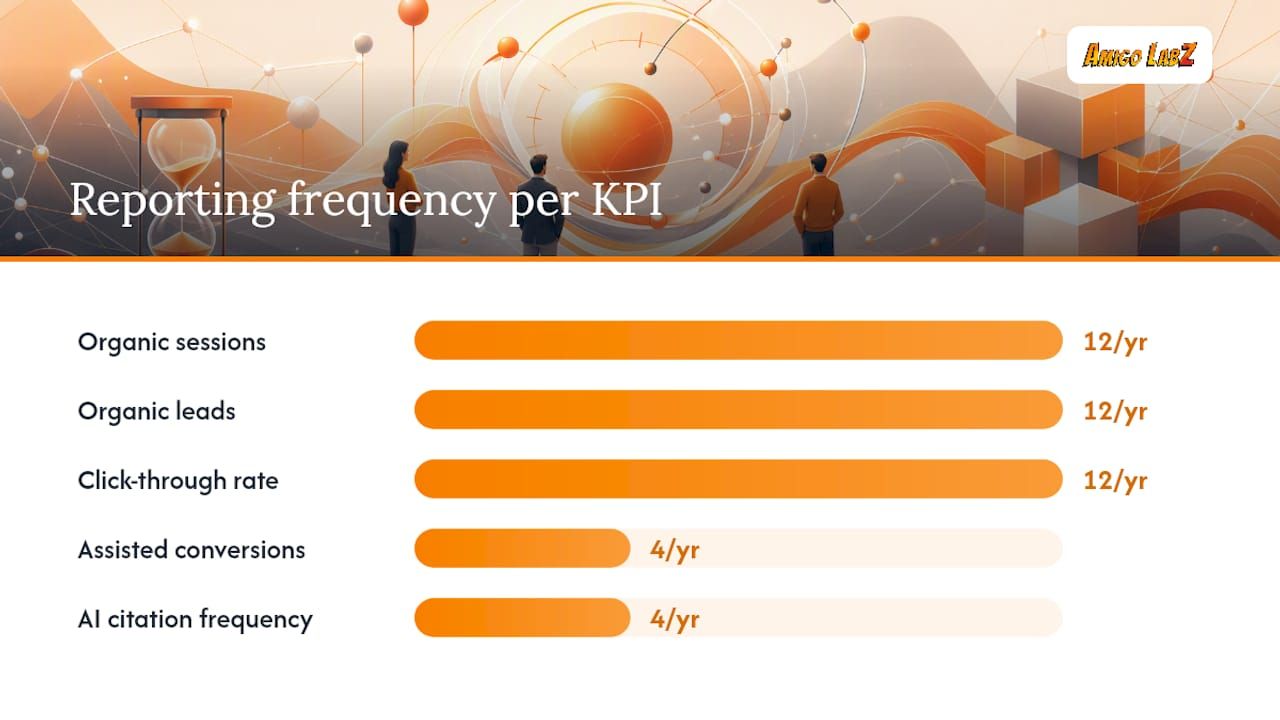
Rankings are a supporting metric, not the primary one. The KPIs that actually matter:
| KPI | What it measures | Reporting cadence |
|---|---|---|
| Organic sessions | Total visits from unpaid search | Monthly |
| Organic leads / conversions | Form fills, calls, purchases from organic | Monthly |
| Assisted conversions | Organic's role in multi-touch paths | Quarterly |
| Click-through rate | % of impressions that become clicks | Monthly |
| Keyword trend movement | Direction of target keyword clusters | Monthly |
| AI citation frequency | Brand mentions in AI-generated answers | Quarterly |
Reporting that only lists keyword positions is data theater. The right agencies tie organic sessions and keyword trends directly to conversion events, whether that's a contact form, a phone call, or a purchase. Google's own guidance reinforces this: measure what moves the business, not just what moves the rank.
On timelines: technical fixes can show crawl improvements within weeks. Meaningful traffic changes typically appear within a few months. Competitive keyword rankings in a saturated market can take longer to materialize. Any agency promising faster results without a clear technical reason is setting you up for disappointment.
What does SEO pricing look like for US businesses?
Three main models:
- Monthly retainer: The most common structure. Covers ongoing technical maintenance, content production, link building, and reporting. Ranges vary widely based on competition, site size, and scope.
- Fixed-price project: A one-time technical audit, site migration support, or content sprint. Good for businesses with a specific problem, not ongoing growth goals.
- Hourly consulting: Useful for in-house teams that need strategic guidance. Rates vary by experience level.
- Performance-based fees: Some agencies charge a base retainer plus a bonus tied to traffic or lead growth. Sounds attractive, but read the attribution methodology carefully before agreeing.
Cost drivers that push prices up: high-competition keywords, a technically broken site, heavy content needs, aggressive link acquisition targets, and national versus local focus. A local campaign for a single-location business costs less than a national e-commerce SEO program.
Pro Tip: When comparing retainer proposals, ask each agency to itemize hours by service category (technical, content, links, reporting). Two agencies at the same monthly price can deliver very different work volumes. Transparent pricing tiers reduce this mismatch before the contract is signed.
What should the first 90 days look like?
A competent agency moves through a predictable sequence:
- Days 1–14 (audit and access): Grant Search Console, GA4, and CMS access. The agency delivers a technical crawl report, Core Web Vitals assessment, canonicalization review, content gap analysis, and Google Business profile check.
- Days 15–30 (quick wins): Fix critical crawl errors, redirect chains, and missing meta tags. These changes cost little effort but can recover lost indexation fast.
- Days 31–60 (content prioritization): Identify the 5–10 pages with the highest traffic potential and lowest optimization effort. Revise them before creating anything new.
- Days 61–90 (link triage and roadmap review): Identify link opportunities, launch the first outreach campaign, and present a 6-month roadmap with milestones tied to business goals.
Check the roadmap against the SEO best practices for small business owners your agency references. If their roadmap doesn't include a technical baseline before content production, push back.
Why Amigolabz is a qualified option
Amigolabz is a digital marketing agency with offices in New Jersey and Nevada, serving businesses across the United States. The team focuses on creative, relationship-driven strategies that connect SEO work to real business outcomes.
Services aligned with what buyers in this guide need:
- Organic SEO (technical, on-page, content)
- Google Business optimization and local SEO
- Content strategy and production
- Paid search and social support for integrated campaigns
John, the author of Amigolabz's published guides including the Google Maps ranking guide, brings hands-on local search expertise to client engagements. The agency publishes its methodology openly, which means you can evaluate the approach before the first call.
How to hire an SEO agency in the next two weeks
- Define your goals and baselines. Pull your current organic sessions, top-10 keywords, and conversion rate from GA4 and Search Console before any call.
- Shortlist three to five agencies. Use the evaluation criteria above. Include at least one boutique agency and one firm with published case studies in your industry.
- Run a 45-minute interview. Use the ten questions from Section 4. Take notes on who answered directly versus who deflected.
- Request a mini-audit. Ask each agency to review your homepage and one priority page and return three specific observations. This separates agencies that actually looked at your site from those who sent a template proposal.
- Score responses using the decision matrix. Rate each agency on staffing clarity, proof quality, process rigor, AI capability, and contract flexibility. Weight proof and process highest.
- Negotiate onboarding and exit terms. Get the cancellation notice period in writing. Confirm you retain ownership of all content, links, and data if you leave.
Sample message to request a mini-audit: "Before we move forward, could your team review our homepage and one service page and share three specific observations about our current SEO? We're looking for a concrete read on where we stand, not a general overview."
What contract terms should you expect?
Most agencies offer 6-month or 12-month agreements, with a 30-day cancellation notice after the initial term. Month-to-month arrangements exist but usually carry a price premium, since the agency takes on more risk.
Key terms to negotiate: data ownership (you own all Search Console data, content, and backlinks regardless of who built them), reporting access (you should have live dashboard access, not just monthly PDFs), and scope-change clauses (what happens if you need to add a location or a new service line mid-contract).
Exit strategy matters more than most buyers realize. If an agency built links using a proprietary network or holds your Google Business profile under their account, leaving becomes expensive. Confirm before signing that all assets stay with you.
How to align your business goals with your agency's strategy
The most common mismatch: a business wants leads, and the agency optimizes for traffic. Those aren't the same thing, and a high-traffic page that converts at 0.2% is less valuable than a lower-traffic page that converts at 4%.
Before the engagement starts, map your top three revenue goals to specific pages and keyword clusters. If your goal is local leads from New Jersey, the agency's strategy should center on local landing pages, Google Business optimization, and map-pack rankings, not broad informational content. If your goal is national e-commerce sales, the strategy shifts to category pages, product schema, and link acquisition from industry publishers.
Revisit this alignment at every quarterly review. Markets shift, products change, and an SEO strategy that was right at month one may need recalibration at month six.
What are the real risks of hiring an SEO agency?
Black hat tactics. Some agencies use link schemes, keyword stuffing, or cloaked content to manufacture short-term ranking gains. Google's algorithms catch these, and the penalties can take months to recover from. Ask directly about link-building methods and verify with a backlink audit after the first 60 days.
Ranking guarantees. No legitimate agency guarantees a #1 position. Google's own documentation states this plainly. A guarantee is either a sign of inexperience or a signal that the agency plans to use tactics that won't hold.
Dependency without knowledge transfer. If your agency never explains what they're doing or why, you're building a dependency that makes switching costly. Good agencies document their work and share reasoning, so your team learns alongside them.
Misaligned KPIs. An agency that reports only on keyword positions is measuring the wrong thing. Insist on conversion-linked reporting from day one.
This article is general information, not professional legal or financial advice. Confirm contract terms and any regulatory considerations with a qualified professional.
Key Takeaways
Hiring the right search engine optimization firm requires matching your revenue goals to an agency's documented process, not just their pitch deck.
| Point | Details |
|---|---|
| Hire when growth is revenue-linked | SEO agencies deliver compounding organic traffic; hire when you need scalable leads, not just brand awareness. |
| Insist on business-outcome KPIs | Reject reporting that only lists keyword positions; require organic leads and conversion events in every dashboard. |
| Use the 10-question framework | A 45-minute call with ten focused questions reveals more about an agency's real capability than any proposal document. |
| Watch for ranking guarantees | No legitimate agency guarantees a #1 position; a guarantee signals either inexperience or black hat risk. |
| Amigolabz as a vetted option | Amigolabz serves US businesses from New Jersey and Nevada with documented SEO, local search, and Google Business services. |
What most hiring guides get wrong about SEO agencies
The conventional advice is to check reviews, compare prices, and ask for case studies. That's fine as far as it goes, but it misses the thing that actually predicts whether an engagement succeeds: whether the agency reports on what moves your business or what moves a spreadsheet.
Keyword position reports feel satisfying. They're concrete, they change week to week, and they give everyone something to point at in a meeting. But a page ranking #4 for a term that drives zero conversions is not a win. An agency that knows this will push back when you ask them to chase a vanity keyword. One that doesn't will happily rank you for terms that never produce a lead.
The other thing most guides underweight: AI search visibility. ChatGPT, Perplexity, and Google's AI Overviews are now a real part of how buyers discover businesses. An agency that can't show you how your brand appears in those surfaces, or can't demonstrate a live query, is operating with a blind spot that will cost you citations you don't even know you're missing.
Hire for process rigor and honest reporting. The rankings follow.
Amigolabz offers a direct path from audit to ranking growth
If you've read this far, you already know what to look for. Amigolabz brings that same standard to every client engagement: a full technical audit before any recommendations, reporting tied to leads and conversions rather than raw positions, and a team that explains the work rather than hiding behind jargon.

From New Jersey to Nevada and businesses across the US, Amigolabz handles organic SEO, Google Business optimization, local search, content strategy, and paid support when the campaign calls for it. The discovery call starts with audit highlights specific to your site, not a generic deck.
Book a call with Amigolabz and get a concrete read on where your rankings stand and what it would take to move them.
Further reading and sources
- Do You Need an SEO? Tips for Hiring an SEO | Google Search Central — Google's own guidance on what legitimate SEO services look like, what to watch out for, and why guarantees are a red flag.
- How to rank first on Google Maps and dominate local search — Amigolabz — Step-by-step local SEO guidance from the Amigolabz team, useful for multi-location businesses evaluating local search strategies.
- SEO Best Practices for Small Business Owners in 2026 — Amigolabz — Practical tactics and realistic timelines for small businesses building organic visibility.
- Search Engine Ranking: Why It Drives Brand Growth — An external perspective on how search visibility compounds into brand equity over time.
- SEO Best Practices List for Local Businesses in 2026 — A local SEO checklist that complements the multi-location guidance in this article.
FAQ
What does a search engine ranking company do?
It improves your website's position in organic search results through technical fixes, content optimization, link building, and local SEO. The goal is qualified traffic that converts, not just higher positions.
How long does it take to see results from an SEO agency?
Technical fixes can show crawl improvements within weeks. Meaningful traffic changes typically appear within a few months. Competitive keyword rankings in a saturated market can take longer to materialize.
What red flags should I watch for when hiring an SEO agency?
Guaranteed #1 rankings, vague answers about who does the work, no access to your own analytics, and reporting that only shows keyword positions with no conversion data.
How much does hiring an SEO agency cost in the US?
Pricing varies by scope, competition level, and service mix. Monthly retainers, fixed-price projects, and performance-based models are the three most common structures. Ask agencies to itemize hours by service category to compare proposals accurately.
Can Amigolabz help with both local and national SEO?
Yes. Amigolabz serves businesses across the US from offices in New Jersey and Nevada, covering organic SEO, Google Business optimization, local search, and content strategy for both single-location and multi-location businesses.
Recommended