How to Rank Higher on Google in 2026
How to Rank Higher on Google in 2026

TL;DR:
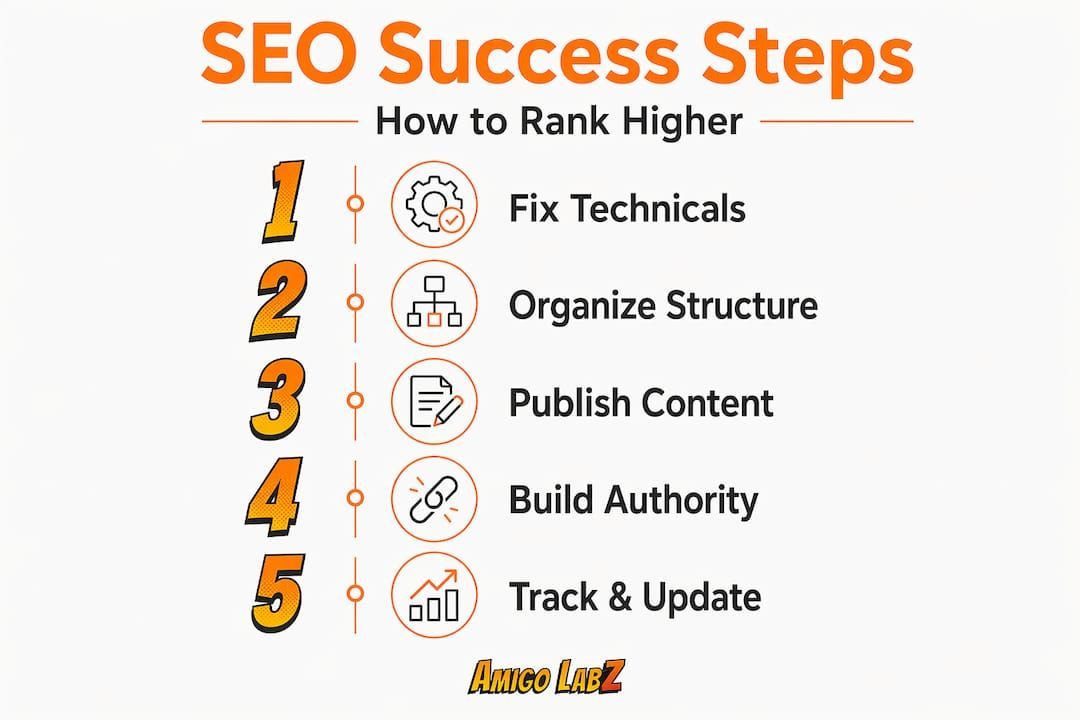
- Improving Google rankings in 2026 requires a solid technical foundation, targeted content, and off-site authority building. Small businesses should focus on fixing crawlability, site speed, and mobile optimization before creating user-focused content and earning quality backlinks. Continuous tracking and refinement of SEO efforts are essential for sustainable search visibility and long-term success.
If you've built a solid website but still can't seem to rank higher on Google, you're not alone. Most small business owners put real effort into their online presence, then watch competitors with weaker products sit above them in search results. The gap usually isn't effort. It's strategy. This guide breaks down exactly what it takes to improve Google rankings in 2026, from technical groundwork to content and off-site authority, so you can stop guessing and start seeing real traction.
Table of Contents
- Key takeaways
- How to rank higher on Google: the foundation you need first
- On-site content strategies that actually move rankings
- Off-site authority: what happens beyond your website
- Monitoring and refining your SEO performance
- My honest take on what actually works
- Ready to get serious about your Google rankings?
- FAQ
Key takeaways
| Point | Details |
|---|---|
| Fix your technical foundation first | Crawlability, site speed, and mobile optimization must be in place before content work pays off. |
| Create content that matches intent | Write pages that answer exactly what your audience is searching for, not what you assume they want. |
| Build off-site authority steadily | Reviews, citations, and brand mentions signal trust to Google and compound over time. |
| Track the right metrics | Monitor rankings, crawl errors, and engagement signals to know what's working and what to fix. |
| Treat SEO as ongoing investment | Consistent iteration beats one-time optimization every time for sustainable search visibility. |
How to rank higher on Google: the foundation you need first
Before you touch a single piece of content, your site needs to be technically sound. Google cannot rank what it cannot properly read and index. Technical SEO ensures that your pages are efficiently crawled, rendered, and indexed. If there are barriers at this stage, no amount of keyword work will move the needle.
Here's what to audit and fix before anything else:
- Crawlability: Make sure your robots.txt file isn't accidentally blocking important pages. Use Google Search Console to check for crawl errors and see which pages Google has successfully indexed.
- Site speed: Pages that load slowly get abandoned. Google uses Core Web Vitals as a direct ranking signal, so a slow site actively hurts your position.
- Mobile optimization: More than half of all searches happen on mobile devices. Your site must display correctly and function well on every screen size.
- Secure connections: HTTPS is a basic requirement. An unsecured site signals risk to both users and Google.
- Site structure and internal linking: A logical hierarchy helps Google understand what your site is about and which pages matter most. Internal linking supports site architecture and improves crawl coverage of your most important pages.
- Duplicate and thin content: Multiple pages covering the same topic dilute your authority. Consolidate where possible and remove low-value pages that add nothing for users.
- Google Business Profile: If you serve local customers, a complete and accurate Google Business Profile is one of the fastest ways to gain visibility in local search results.
Pro Tip: Run a free crawl using Google Search Console before making any content changes. Fixing indexing and speed issues first means your new content improvements actually get seen.
A clean, well-organized site also benefits from structured data, which helps Google understand your content at a deeper level and can unlock rich results in search. Google's own guidance confirms that content must be crawlable and trustworthy to benefit from its generative AI search features, meaning the technical layer matters more than ever in 2026.

On-site content strategies that actually move rankings
Once your technical house is in order, content is where rankings are won or lost. The most common mistake small business owners make is writing content about what they want to say rather than what their customers are actually searching for. Google has gotten extremely good at detecting the difference.
Follow this process to build content that performs:
- Start with keyword research based on intent. Use tools like Google's own search suggestions, People Also Ask, and free tools to identify what your audience types when they need your product or service. Focus on phrases with clear buying or information intent.
- Write for your specific customer. Generic content ranks poorly and converts even worse. Be specific about who you help, what problem you solve, and what makes your answer trustworthy.
- Use clear headings that describe each section. Google can rank individual passages within a page, so descriptive subheadings give your content multiple opportunities to appear in search results.
- Build topical authority with content clusters. Instead of writing one page on a broad topic, build a hub page linked to several detailed supporting pages. A hub-and-spoke architecture signals depth of expertise and increases your overall ranking potential across related searches.
- Optimize your title tags and meta descriptions. Your title tag tells Google and users exactly what the page covers. Keep it under 60 characters, include your target keyword naturally, and write something that earns the click.
- Avoid thin or duplicate pages. Creating dozens of nearly identical pages to capture every variation of a question does more harm than good. Comprehensive pages optimized for user intent outperform collections of thin content every time.
Pro Tip: After publishing any new page, check if your content directly answers the question someone would type into Google. If it takes more than two sentences to get to the actual answer, tighten it up. User satisfaction signals like bounce rate and return-to-SERP behavior affect your rankings.
Google's own guidelines are clear that people-first, expert-led content takes priority, and that AI systems understand multiple topics on a single well-structured page. You don't need to create separate pages for every AI-driven question variant. You need one thorough, trustworthy page per topic.
Off-site authority: what happens beyond your website
Ranking higher on Google isn't just about what's on your site. What the rest of the internet says about you carries serious weight. Off-site signals tell Google how trustworthy, relevant, and prominent your business is. For small businesses especially, this layer can make or break local and organic rankings.
Here's where to focus your off-site efforts:
- Earn quality backlinks. A link from a respected local news site or a relevant industry blog carries far more ranking power than dozens of links from random directories. Balanced anchor text strategies and high relevance of referring sites matter more than volume. Focus on earning links through genuine relationships, guest contributions, and creating content others want to reference.
- Build consistent local citations. Your business name, address, and phone number (NAP) should appear identically across every listing, including Google, Yelp, and industry directories. Inconsistent information confuses both Google and potential customers. Google Maps rankings rely on relevance, distance, and prominence, with citations playing a direct role in prominence.
- Collect and manage reviews actively. Ask satisfied customers to leave honest reviews. Respond to every review, positive or negative. Review volume and recency signal to Google that your business is active and credible.
- Grow brand mentions across platforms. Being referenced on forums, podcasts, social media, and community websites builds perceived authority even without a direct link. Brand mentions across forums and social media strengthen AI-driven search authority and visibility.
For local businesses, the fastest path to ranking improvements often comes through optimizing prominence factors like reviews and citations, before any major content overhaul. Check out Amigolabz's local search strategies for a deeper look at dominating Google Maps results in your area.
Monitoring and refining your SEO performance
Implementing strategies without tracking results is like running a business without looking at your numbers. You need to know what's working, what's stalling, and what needs attention. The good news is that regular SEO audits and performance tracking make troubleshooting and refinement far more effective.
Here are the key metrics and how to use them:
| Metric | What it tells you | Where to track it |
|---|---|---|
| Keyword rankings | Which pages are gaining or losing position | Google Search Console |
| Organic traffic | How many visitors arrive through search | Google Analytics |
| Core Web Vitals | Site speed and user experience quality | Google Search Console |
| Crawl errors | Pages Google cannot access or index | Google Search Console |
| Engagement rate | How users interact with your content | Google Analytics |
| Backlink growth | Whether your authority is increasing | Free tools like Ahrefs Webmaster |
The most common mistakes business owners make at this stage are overoptimizing (stuffing keywords after seeing early traction), ignoring crawl errors that silently block pages, and neglecting to update older content that has drifted out of date. Google rewards freshness and continued relevance.
Pro Tip: Set a recurring monthly calendar reminder to review your top-performing pages. Update statistics, add new examples, and fix any broken links. Content maintenance is one of the highest-return activities in SEO and almost no one does it consistently.
Treat your SEO performance like a continuous development process: measure, learn, adjust, and repeat. This compounding approach is how small businesses build durable search visibility that larger competitors struggle to displace.
My honest take on what actually works
I've worked with enough small business owners to know that most SEO frustration comes from the same place: someone told them a shortcut existed, they chased it, and six months later nothing moved. In my experience, the businesses that win in search are the ones that commit to fundamentals before anything else.
The noise around AI search features is real, but I've found it changes less than people think. What Google's AI systems do is reward the same things a knowledgeable customer would reward: clear information, genuine expertise, a trustworthy site, and a real business with a real reputation. The businesses I've seen climb rankings consistently are not chasing algorithm updates. They fix their technical issues, write content their actual customers need, and build relationships that generate reviews and links naturally.
One thing that surprises most business owners I talk with: reviews and citations often produce faster local ranking results than any content work. If you're local and you haven't locked down your Google Business Profile and started a review strategy, that's your first move. Not blog posts. Not backlinks.
SEO is not a campaign. It's an ongoing part of running a competitive business in 2026. The 9 signs your website needs SEO are usually visible long before rankings tank. Catch them early and you avoid expensive recovery work later.
— John
Ready to get serious about your Google rankings?
If this guide gave you clarity on where to start, you're already ahead of most businesses still guessing their way through SEO. At Amigolabz, we work directly with small and medium-sized businesses across New Jersey, Nevada, and beyond to build search visibility that actually drives revenue. We don't do cookie-cutter packages. We build strategies around your specific market, customers, and goals.

Our team handles everything from professional SEO services and Google Business Profile optimization to Google Ads management and social media management. Whether you need to fix a technical problem, build content authority, or get more local reviews, we've got the experience to move things forward. Book a call and let's talk about what your business specifically needs to rank higher and get found by the right customers.
FAQ
What is the fastest way to rank higher on Google?
For local businesses, completing your Google Business Profile and building consistent reviews and citations often produces the fastest ranking gains. Fixing critical technical issues like crawl errors and site speed comes next, before any content work.
How long does it take to improve Google rankings?
Most businesses see measurable movement within three to six months of consistent SEO effort, though competitive markets can take longer. Technical fixes and local profile optimization can show results faster than organic content ranking.
Do backlinks still matter for Google rankings in 2026?
Yes, but quality matters far more than quantity. A single link from a relevant, trusted site in your industry carries more weight than dozens of low-quality directory links. Focus on earning links through real relationships and valuable content.
How does Google rank local businesses?
Google Maps rankings rely on three factors: relevance to the search, distance from the searcher, and prominence, which includes reviews, citations, and overall online presence. Optimizing all three gives local businesses the strongest position.
Can I rank higher on Google without hiring an agency?
Yes, especially for technical basics and content improvements. However, consistent SEO requires time, tools, and ongoing attention that most business owners can't maintain alongside running their operations. A local SEO checklist is a good starting point for doing foundational work yourself.
Recommended