Generate Website Traffic: A Prioritized 90-Day Playbook
Generate Website Traffic: A Prioritized 90-Day Playbook

The fastest reliable path to more visitors combines search-focused content, one paid channel, an email capture loop, and a handful of technical fixes. Do those four things in the right order and you will see measurable gains within 30 days and compounding returns by day 90.
Your 30/90-day plan in one paragraph: In the first 30 days, fix your slowest pages, publish two pillar posts targeting buyer-intent keywords, set up Google Search Console and a basic analytics dashboard, and launch a simple lead-capture form. By day 60, add a weekly email to your growing list, start one paid channel (Google Search or Meta, depending on your funnel stage), and begin a guest-posting outreach sequence. By day 90, you should have a content cluster of at least six posts, a retargeting audience large enough to run ads against, and enough data to kill underperforming tactics and double down on what works.
Channel priority at a glance:
| Channel | Impact | Effort | Time to Results |
|---|---|---|---|
| SEO + content | High | Medium | 60–180 days |
| Email / owned list | High | Low | 14–30 days |
| Paid search (Google) | High | Medium | 7–14 days |
| Social (organic) | Medium | Medium | 30–60 days |
| Paid social (Meta) | Medium | Medium | 7 days |
| PR / link building | High (long-term) | High | 60 days |
Your first 7 days:
- Audit site speed with Google PageSpeed Insights and fix the top two issues flagged.
- Identify your three highest-potential keyword clusters using Google Search Console's Performance report (filter by queries you rank on pages 2–3).
- Install or verify Google Analytics 4 with at least one conversion event firing correctly.
Key Takeaways
The fastest path to sustainable traffic combines technical fixes, buyer-intent content, email capture, and one paid channel, executed in that order within a structured 30/60/90-day plan.
| Point | Details |
|---|---|
| Fix technical issues first | Site speed, mobile usability, and crawl errors undermine every other tactic; address them in week 1. |
| Content clusters beat random posts | Pillar pages paired with cluster posts build topical authority and multiply your keyword surface area. |
| Email is your highest-ROI owned channel | Capturing visitors into a list converts one-time traffic into repeat visits and measurable revenue. |
| Paid ads amplify what already works | Launch paid campaigns only after conversion tracking is live and your landing page converts organically. |
| Amigolabz delivers the full plan | Amigolabz audits, prioritizes, and executes SEO, paid, and content strategies for U.S. businesses. |
What goals and audience do you need to define first?
Skipping this step is the single most common reason traffic campaigns stall. You can drive thousands of visitors and still see zero business impact if you attract the wrong people or measure the wrong things.
Start by naming your primary business goal: leads, product sales, newsletter signups, or direct revenue. Each goal maps to a different traffic KPI. A lead-gen site cares about form completions per session. An e-commerce store watches revenue per visitor. A content publisher tracks pages per session and return visit rate. Tying your traffic goal to a business outcome keeps you from chasing raw pageview counts that mean nothing to your bottom line.
Next, sketch 1–3 audience personas and tag each with an intent stage:
- Informational: "How does X work?" — needs educational content, blog posts, explainers.
- Commercial: "Best X for Y situation" — needs comparison content, case studies, reviews.
- Transactional: "Buy X" or "hire X agency" — needs landing pages, pricing, clear CTAs.
Most sites underinvest in commercial-intent content and wonder why organic traffic doesn't convert. Matching content type to intent stage fixes that gap faster than any technical tweak.
Set SMART benchmarks for 30, 60, and 90 days. By day 60, aim for a measurable email list growth rate. By day 90, you want a cost-per-acquisition number from at least one paid channel. The SBA recommends reviewing your marketing plan at least annually to compare costs against revenue, but for a new traffic campaign, monthly check-ins are the minimum.
Pro Tip: Track "pages per session on your top landing pages" separately from sitewide averages. A visitor who reads three related posts is far more likely to convert than one who bounces after one. That metric tells you whether your content cluster is working before the conversion data catches up.
How does content strategy actually generate website traffic?
Content is the engine. Everything else, SEO, social, email, paid, amplifies what your content does. The SBA notes that businesses with blogs tend to get 3–4x more traffic than those without, and the mechanism is straightforward: more indexed pages, more keyword surface area, more entry points.
Build topic clusters, not random posts
A topic cluster pairs one long-form pillar page (2,000+ words covering a broad topic) with 4–8 shorter cluster posts that each target a specific subtopic. The pillar links to every cluster post; every cluster post links back to the pillar. This structure signals topical authority to Google and keeps visitors moving through your site.
Pick clusters based on buyer intent, not just search volume. A cluster around "small business accounting software" serves commercial-intent readers. A cluster around "how to read a balance sheet" serves informational readers. Both are valuable, but they attract different people at different stages.
Content formats that reliably pull traffic
- How-to guides targeting "how to [do specific task]" queries. These rank well, earn featured snippets, and get shared.
- Original data posts (surveys, aggregated industry stats, proprietary benchmarks). These attract backlinks naturally because other writers need something to cite.
- Comparison posts ("X vs. Y for [use case]"). High commercial intent, strong conversion rates.
- Free tools and checklists (downloadable templates, calculators). These generate email signups and repeat visits.
- Case studies with specific results. They build trust and rank for "proof"-stage queries.
Prioritize educational content over promotional content. Readers engage with posts that answer specific questions; they skip posts that read like brochures. This is a consistent pattern the SBA's own content guidance reinforces.
Editorial cadence and repurposing
Consistency beats volume. Two well-researched posts per month outperform eight thin ones. Set a calendar and protect it. Once a post is live, run it through a repurposing matrix:
- Social posts: pull 3–5 key insights and post one per week across your active channels.
- Email newsletter: summarize the post with a link in your next send.
- Guest contribution: pitch a condensed version to a relevant publication with a backlink to the original.
- Short-form video or audio clip: record a 60-second summary for LinkedIn or Instagram Reels.
Pro Tip: Run a "content refresh" experiment before publishing anything new. Find your posts ranking on page 2 for a target keyword, update them with new data and a stronger internal link structure, and resubmit them to Google Search Console for indexing. Refreshed posts often reach page 1 within 2–4 weeks, faster than a brand-new post.
Which SEO fixes move the needle fastest?
Advanced SEO is not about stuffing keywords into headings. It is about technical performance, buyer-intent alignment, and data-driven prioritization. The checklist below is ordered by expected impact, not alphabetically.
Keyword research that actually matters
Focus on three filters when evaluating keywords: search intent match, realistic ranking difficulty for your domain authority, and commercial value. Tools like Google Search Console (free), Ahrefs, and Semrush all work. The non-obvious move is to filter Search Console by queries where you already rank in positions 8–20. Those are your fastest wins: you have some authority, you just need better on-page optimization.
On-page checklist
- Title tags: include the primary keyword near the front, keep under 60 characters.
- H1: one per page, matches the title intent but doesn't have to be identical.
- Meta description: 150–160 characters, include a benefit and a soft CTA.
- Schema markup: add FAQ schema to Q&A posts, HowTo schema to guides, and Article schema to blog posts. These increase snippet eligibility.
- Internal links: every new post should link to at least two existing posts and receive at least one link from an existing post. This is the fastest way to pass authority through your site.
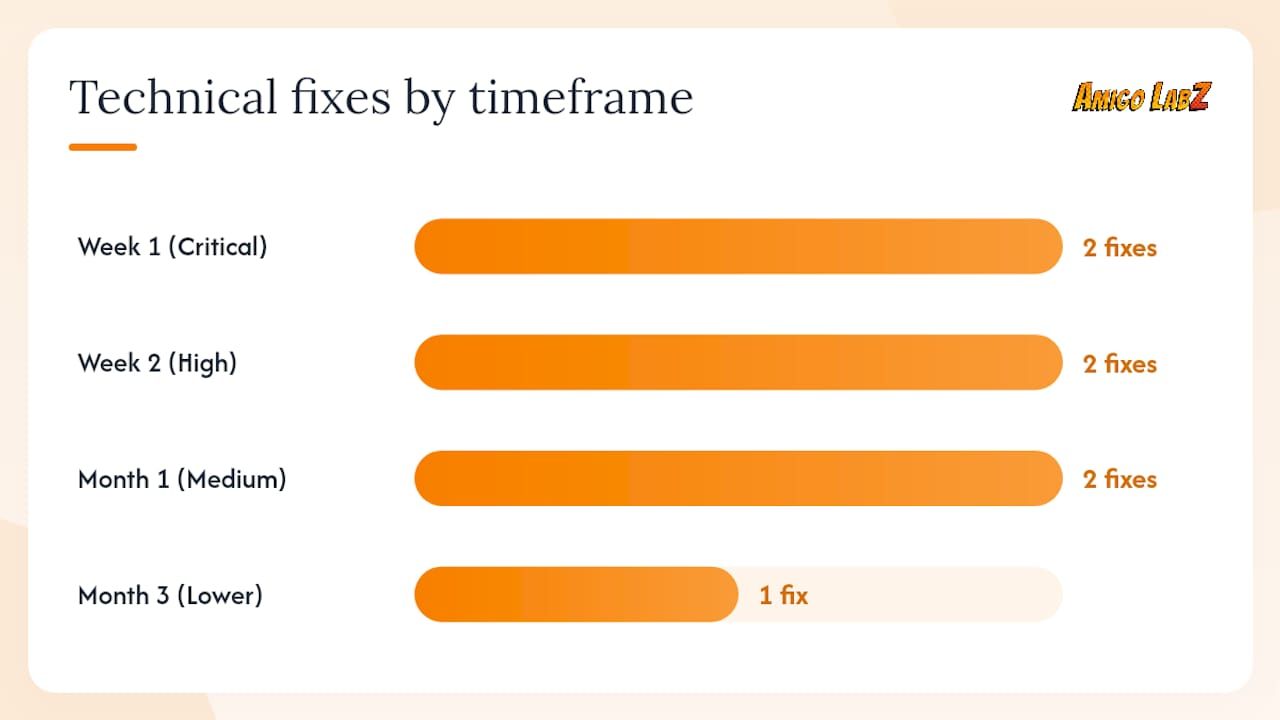
Technical priorities by week
| Priority | Fix | When |
|---|---|---|
| Critical | Core Web Vitals (LCP, CLS, FID) | Week 1 |
| Critical | Mobile usability errors in Search Console | Week 1 |
| High | Broken internal links | Week 2 |
| High | XML sitemap submitted and clean | Week 2 |
| Medium | Canonical tags on duplicate content | Month 1 |
| Medium | Structured data validation | Month 1 |
| Lower | Log file analysis for crawl budget | Month 3 |
Mobile performance is not optional: a substantial and increasing portion of all web traffic arrives via mobile devices, and Google's mobile-first indexing means your mobile experience directly determines your rankings. Fix mobile usability errors before anything else.
Pro Tip: Pull your server logs and look for pages Googlebot visits frequently but that receive zero organic traffic. These are often pages with thin content or duplicate parameters that are eating your crawl budget. Blocking them via robots.txt or consolidating them with canonicals can free up crawl capacity for your best content, sometimes producing ranking improvements within weeks.
For a deeper look at on-site technical improvements, the Amigolabz guide to website optimization covers the full checklist for SMBs.
How do social and communities drive referral traffic?
Organic social rarely drives massive direct traffic on its own. What it does is amplify content reach, build an audience that returns, and generate the social signals and shares that indirectly support SEO. The channels worth your time depend on your niche.
Channel fit by niche:
- LinkedIn: B2B, professional services, SaaS, consulting. Long-form posts and carousels perform well.
- X (formerly Twitter): tech, media, finance, and any niche with active practitioners. Threads and data posts get traction.
- Facebook Groups: local businesses, consumer products, hobbyist communities. Engagement is high when you participate genuinely.
- Reddit: almost every niche has an active subreddit. The rule is to contribute value for weeks before sharing your own content. Spam gets you banned; genuine participation builds real referral traffic.
- Niche forums and communities: Slack groups, Discord servers, and industry-specific forums often have smaller but highly targeted audiences. A single well-placed answer in the right forum can drive more qualified traffic than a week of generic social posts.
Influencer and micro-influencer outreach
Micro-influencers (10,000–100,000 followers in a specific niche) typically deliver better engagement rates and lower cost-per-click than macro-influencers. The ROI check is simple: ask for their average story or post reach, divide your expected cost by that reach, and compare it to your paid social CPM. If the influencer rate is cheaper per thousand impressions and the audience is more targeted, it is worth testing.

For a niche-specific example of how channel tactics like social and directories work in practice, the Fitness Flow guide to gym lead generation shows how vertical-specific campaigns combine community and referral strategies effectively.
A 4-week amplification schedule for one pillar post
- Week 1: Publish the post. Share a native summary on LinkedIn and X. Email your list with a teaser and link.
- Week 2: Pull three specific insights from the post and publish each as a standalone social post on different days.
- Week 3: Pitch a condensed version as a guest contribution to one relevant publication. Engage with any comments or shares from weeks 1–2.
- Week 4: Reach out to 5–10 people quoted or mentioned in the post and ask if they'd share it. Repurpose the post into a short video or audio clip.
How do email and owned audiences turn visits into repeat traffic?
Email is the highest-ROI owned channel most sites underuse. A visitor who joins your list is worth far more than one who bounces and never returns. The goal is to capture that first visit and convert it into a relationship.
Lead capture placement that works
- Exit-intent popup: triggers when the cursor moves toward the browser bar. Converts well without interrupting the reading experience.
- Inline content upgrade: a downloadable checklist or template embedded mid-post, relevant to that specific post's topic. These convert at higher rates than generic newsletter offers because the offer matches the reader's current interest.
- Sticky header or footer bar: low friction, always visible, good for general newsletter signups.
- Gated content: a full guide, template pack, or tool available only after an email signup. Best for high-value, research-heavy content.
Welcome sequence template
- Email 1 (immediate): Deliver the promised resource. One sentence about what to expect from future emails. No pitch.
- Email 2 (day 3): Share your single most useful piece of existing content. Frame it as "most people who signed up found this helpful."
- Email 3 (day 7): Address the #1 question your audience has. Answer it fully. Soft mention of how you help.
- Email 4 (day 14): Social proof or a short case study. Clear CTA to book a call, start a trial, or make a purchase.
Newsletter vs. drip: use a newsletter for audiences that benefit from regular updates (news, trends, weekly tips). Use a drip sequence for audiences that need to be educated before they buy. Most sites need both: a drip for new subscribers and a weekly or biweekly newsletter for the engaged list.
The single highest-impact variable is usually the subject line's specificity. "3 fixes that doubled our organic traffic in 60 days" consistently outperforms "Tips to grow your traffic."*
When should you invest in paid channels?
Paid traffic is predictable and fast. It is also the first thing to cut when budgets tighten, which is why it should complement organic growth, not replace it. The right time to start paid is when you have a working landing page with a clear offer and at least one conversion event firing in your analytics.
Google Search vs. paid social
Google Search ads capture existing demand: someone types a query and your ad appears. This works best when people are actively searching for what you sell. Paid social (Meta, LinkedIn) creates demand: you interrupt someone's feed with an offer they weren't looking for. Use search ads for transactional and commercial-intent traffic; use social ads for awareness and top-of-funnel lead generation.
Budget ranges and expected early KPIs (U.S. benchmarks):
Remarketing playbook
Remarketing targets people who already visited your site. These audiences convert at higher rates than cold traffic because they already know you. Structure your remarketing funnel in three layers:
- Layer 1: All site visitors in the last 30 days. Show a brand awareness or content ad.
- Layer 2: Visitors who viewed a specific product or service page. Show a direct offer or testimonial ad.
- Layer 3: Cart abandoners or form starters. Show a specific objection-handling ad with a clear next step.
Campaign launch checklist
- Conversion tracking verified before spending a dollar.
- Ad copy reviewed for compliance with FTC truth-in-advertising standards, which apply to all digital channels including native ads and sponsored content.
- Disclosures placed close to the triggering claim per FTC .com Disclosures guidance, which requires disclosures to be clear, conspicuous, and directly adjacent to the claim they qualify.
- Negative keyword list built before launch (for search campaigns).
- Budget caps set at the campaign level, not just the account level.
For managed Google Ads campaigns, Amigolabz handles campaign structure, audience targeting, and compliance review as part of its paid search service.
How do link building and PR drive referral traffic?
A backlink from a relevant, high-traffic site does two things: it sends direct referral visitors and it signals authority to Google, which improves your organic rankings over time. The tactics below are ordered by ROI for most U.S. small and mid-size sites.
Tactics by priority:
- Guest contributions: write a useful post for a publication your audience reads. Include one contextual link to your site. This is the most reliable link-building tactic for sites with limited domain authority.
- Expert roundups: pitch yourself as a source to journalists and bloggers compiling "expert opinion" posts. HARO (now Connectively) and Qwoted connect sources with journalists daily.
- Resource page links:
find pages in your niche that list "useful resources" and pitch your best content for inclusion. Search Google for
[your topic] + "useful resources"or"recommended links". - Partnerships and co-marketing: co-author a piece with a complementary business. Both parties promote it, both earn a link, and both reach a new audience.
Outreach template structure
A high-reply outreach email has four elements: a specific compliment about their work (one sentence, not generic), a clear reason why your content is relevant to their audience, the specific ask (a link, a guest post pitch, a quote request), and a single easy next step. Keep it under 150 words.
Prioritization matrix
| Tactic | Traffic Potential | Link Difficulty | Time Cost |
|---|---|---|---|
| Guest contributions | High | Medium | High |
| Expert roundups | Medium | Low | Low |
| Resource page links | Medium | Low | Medium |
| Co-marketing / partnerships | High | Low | Medium |
Measure referral traffic in Google Analytics 4 under Acquisition > Traffic Acquisition, filtered by "Referral." When a tactic produces consistent referral clicks and the linked page's organic ranking improves over 60–90 days, continue. When referral traffic is flat and rankings don't move, shift the outreach budget to a different tactic.
How do you measure traffic and turn it into business outcomes?
Traffic without measurement is just noise. Trade, tracking total visitors, session duration, referral sources, and conversions to drive strategic decisions. That framing is exactly right: your analytics setup should answer business questions, not just report pageviews.
Essential analytics setup
- Google Analytics 4: configure at least three conversion events (form submission, phone click, purchase or trial start).
- UTM parameters: tag every link in emails, social posts, and paid ads with consistent UTM source, medium, and campaign values. Without UTMs, GA4 misattributes traffic and your channel data is unreliable.
- Google Search Console: link to GA4 and check weekly for coverage errors, manual actions, and query performance.
- Heatmapping tool (Hotjar or Microsoft Clarity, both free tiers available): install on your top landing pages to see where visitors drop off.
KPI dashboard (track weekly)
- Organic sessions (from Search Console and GA4)
- Conversion rate by channel
- Cost per acquisition (paid channels)
- Email list growth rate
- Pages per session on pillar content
- Return visitor rate
A/B testing framework
Pick one hypothesis, one page, one variable. Change the headline, the CTA button text, or the hero image. Run the test until you reach statistical significance (most tools flag this automatically). A sample size of at least 200 conversions per variant is a reasonable floor before drawing conclusions.
For conversion optimization strategies specific to New Jersey and Nevada markets, the Amigolabz blog covers proven approaches with regional context.
What timelines and costs should you realistically expect?
Traffic growth is not linear. The first 30 days are mostly setup and early signals. The real compounding starts around day 60 and accelerates through month 6.
30/60/90-day milestones:
- Day 30: Technical fixes complete, two pillar posts published, GA4 and Search Console configured, email capture live, one paid campaign running.
- Day 60: Email list growing, first guest post published, paid campaign optimized based on early data, content cluster at four posts.
- Day 90: Six-post content cluster complete, retargeting audience active, first link-building results visible in Search Console, monthly analytics review completed.
Regulatory notes: The SBA recommends reviewing your marketing plan at least annually to verify that costs are generating positive ROI. For paid campaigns, the FTC requires that all advertising claims be truthful and that disclosures appear close to the claims they qualify. Review your ad copy against FTC online advertising guidance before launch, and check that any sponsored content or affiliate relationships are clearly labeled.
Mobile performance affects both your rankings and your conversion rate. With a significant share of web traffic arriving via mobile devices, a site that loads slowly on a phone is losing visitors before they ever read a word.
Your 30/60/90-day action checklist
This is the operational layer. Each task has a suggested owner, a time estimate, and a clear acceptance criterion so your team knows when it is done.
Days 1–30: Foundation
- Audit site speed (Owner: developer or in-house; 2 hours). Run Google PageSpeed Insights on your five highest-traffic pages. Done when: LCP under 2.5 seconds on mobile for each page.
- Configure GA4 with conversion events (Owner: developer or agency; 3 hours). Done when: at least three events fire correctly in the GA4 DebugView.
- Submit XML sitemap to Search Console (Owner: in-house; 30 minutes). Done when: sitemap shows "Success" status with no errors.
- Publish pillar post #1 (Owner: content lead; 8–12 hours). Done when: post is indexed, has schema markup, and links to two existing posts.
- Install email capture form (Owner: in-house or developer; 2 hours). Done when: form submits correctly and triggers welcome email #1.
- Launch one paid campaign (Owner: in-house or agency; 4 hours). Done when: campaign is live, conversion tracking is verified, and FTC disclosure language is in place.
Days 31–60: Build
- Publish cluster posts #2 and #3 (Owner: content lead; 8 hours each). Done when: both posts are indexed and internally linked to the pillar.
- Send first newsletter (Owner: marketing lead; 3 hours). Done when: email sent, open rate and click rate recorded.
- Submit first guest post pitch (Owner: marketing lead; 2 hours). Done when: pitch sent to at least three publications.
- Optimize paid campaign based on first 30 days of data (Owner: in-house or agency; 2 hours). Done when: cost per conversion is documented and at least one underperforming ad set is paused.
- Set up retargeting audience (Owner: paid media lead; 1 hour). Done when: audience is building in Meta or Google Ads with at least 100 users.
Days 61–90: Optimize and scale
- Publish cluster posts #4, #5, and #6 (Owner: content lead; 8 hours each). Done when: cluster is complete, all posts interlink, pillar is updated with new links.
- Run first A/B test on top landing page (Owner: marketing lead; 2 hours setup). Done when: test is live with a documented hypothesis and a defined end date.
- Review analytics and kill or scale tactics (Owner: marketing lead; 2 hours). Done when: written summary of what is working, what is not, and next 30-day priorities.
- Conduct monthly marketing plan review (Owner: business owner or agency; 1 hour). Done when: costs are compared against traffic and conversion benchmarks per SBA guidance.
Amigolabz applies this exact sequence in client engagements, starting with an audit that surfaces the highest-impact fixes, then building a prioritized roadmap before any execution begins. The checklist above reflects that process, adapted for in-house teams.
What most traffic strategies get wrong
The most common mistake is treating traffic as the goal. It is not. Traffic is a proxy for something else: leads, sales, signups, revenue. Sites that chase raw visitor counts end up with high-traffic, low-conversion pages that look good in a dashboard and do nothing for the business.
The second mistake is inconsistent publishing. A site that publishes eight posts in January and nothing in February and March sends a signal to Google that the site is not actively maintained. Consistent cadence, even at low volume, outperforms bursts followed by silence. The SBA's own guidance on low-cost traffic tactics puts consistent publishing at the top of the list for a reason.
The third mistake is ignoring technical debt. A site with slow load times, broken internal links, and crawl errors is like a store with a broken front door. You can run all the ads you want, but the experience kills conversions before they happen. Fix the foundation before scaling spend.
When budgets are small, the priority order is: fix technical issues first (free, high-impact), then publish content targeting buyer-intent keywords (low cost, compounding returns), then add email capture (low cost, owned channel). Paid ads come last, not because they don't work, but because they amplify what is already working. Spending on ads before your landing page converts is burning money.
The one piece of advice that applies to almost every site: pick two channels and go deep before adding a third. Spreading effort across six channels at once produces mediocre results on all of them. Depth beats breadth, especially in the first 90 days.
Amigolabz helps you execute this plan without starting from scratch
Most businesses know what they need to do. The gap is execution: the time, the expertise, and the consistency to run SEO, paid ads, email, and content in parallel without dropping any of them.
Amigolabz is a digital marketing agency with offices in New Jersey and Nevada, built specifically to close that gap for business owners who want results without managing five vendors. The engagement starts with an audit that identifies your highest-impact opportunities, then moves to a prioritized roadmap, and then to execution across the channels that fit your goals and budget.

Services include SEO and organic growth, Google Ads management, Facebook Ads, social media management, and full website and marketing solutions. Every engagement is built around the same 30/60/90 framework described in this article, with clear milestones and measurable KPIs from day one.
Ready to stop planning and start seeing traffic? Book a call with Amigolabz and walk away from the first conversation with a prioritized list of your top three opportunities.
Sources
The following U.S. government and industry sources support the guidance in this article:
FAQ
How long does it take to generate website traffic from SEO?
Most sites see measurable organic traffic gains within 60–180 days of consistent content publishing and technical optimization. Early wins from refreshing existing content can appear in 2–4 weeks.
What is the cheapest way to increase website visits?
Blogging with buyer-intent content and building an email list are the lowest-cost tactics with the highest long-term return.
When should I start running paid ads to drive more visitors?
Start paid ads only after your conversion tracking is verified and your landing page converts at an acceptable rate organically. Paid traffic amplifies what already works; it does not fix a broken funnel.
How do I know which traffic generation strategies are working?
Use Google Analytics 4 and Search Console to track organic sessions, conversion rate by channel, and cost per acquisition. Trade.gov recommends treating analytics as a business dashboard and reviewing it regularly to guide decisions.
Do FTC rules apply to my website's marketing content?
Yes. FTC truth-in-advertising standards apply to all digital marketing, including blog posts, social ads, native content, and reviews. Disclosures must be clear, conspicuous, and placed close to the claim they qualify.
Recommended