Boost your website conversions with proven strategies
Boost your website conversions with proven strategies
TL;DR:
- Focusing on conversion rate optimization can significantly boost leads without increasing traffic.
- Simplify forms, improve CTA clarity, and speed up mobile sites to enhance user actions.
- Continuous testing and data-driven adjustments lead to sustained website performance improvements.
More website traffic sounds like the obvious answer when your business needs more leads. But here's the uncomfortable truth: traffic without conversion is just noise. Small business owners in New Jersey and Nevada are pouring money into ads and SEO only to watch visitors leave without taking action. The real opportunity isn't always getting more people to your site. It's making your site work harder for the people already on it. This guide gives you concrete, evidence-backed strategies to turn more of your existing visitors into real customers.
Table of Contents
- What is site conversion optimization?
- Key drivers of conversion: The evidence-backed essentials
- Practical steps to optimize your website today
- Common mistakes and pitfalls in conversion optimization
- What most small businesses miss about conversion optimization
- How expert help propels your conversion results
- Frequently asked questions
Key Takeaways
| Point | Details |
|---|---|
| Prioritize conversions over traffic | Optimizing your website to convert visitors is more effective than only increasing site traffic. |
| Simplify forms for better results | Three-field forms see the highest completion rates for small businesses. |
| Speed and mobile matter most | Fast, mobile-friendly sites boost conversions by up to 30%. |
| Use specific CTAs | Clear, action-oriented CTA language dramatically increases response rates. |
| Continuous improvement wins | Regular testing and small tweaks drive long-term gains in conversion rates. |
What is site conversion optimization?
Having introduced why conversion, not just traffic, matters, let's clarify exactly what site conversion optimization means for your business.
Site conversion optimization (also called CRO, or Conversion Rate Optimization) is the process of improving your website so that a higher percentage of visitors take a specific action. That action might be filling out a quote request form, signing up for your newsletter, making a purchase, or calling your business. The "conversion" is whatever meaningful step moves a visitor closer to becoming your customer.
Here's why this matters so much for small businesses: you don't need to double your traffic to double your leads. If your site currently converts at 1% and you optimize it to 2%, you've doubled your results without spending an extra dollar on ads or SEO. As research confirms, site conversion optimization can increase lead generation and sales without additional traffic investment. That's a powerful advantage for businesses operating with lean budgets.
Common types of conversions on small business websites include:
- Submitting a contact or quote request form
- Clicking a phone number or email link
- Signing up for an email list or newsletter
- Making a direct online purchase
- Downloading a free resource or guide
- Scheduling an appointment or booking a service
"Conversion optimization treats your existing audience as an asset, not just a number. It focuses on what your visitors actually need and removes friction between curiosity and commitment."
Improving your online presence is the first step, but turning that presence into action is the real goal. Every one of the conversions listed above represents a business relationship beginning. CRO is about clearing the path so more of those relationships can start.
Key drivers of conversion: The evidence-backed essentials
Now that you know what conversion optimization is, let's get into the specific tactics that produce real results. These aren't hunches. They're backed by data from thousands of business websites.
Form fields: Less is more
One of the single biggest conversion killers is an overly long form. Every extra field you ask a visitor to complete creates friction, and friction kills momentum. Research shows that reducing form fields and optimizing CTAs can significantly improve conversions. The optimal number of form fields for most small business websites is three: typically name, contact information (email or phone), and a brief message.

CTA language: Specificity wins
Generic button text like "Submit" or "Click Here" leaves visitors cold. Action-oriented language that spells out exactly what the visitor gets performs dramatically better. A button that says "Get My Free Quote" or "Schedule My Consultation" tells the visitor exactly what happens next and why it benefits them.
Pro Tip: Use first-person language in your CTAs. "Get My Free Estimate" consistently outperforms "Get a Free Estimate" because it feels more personal and directly relevant to the reader.
Page speed: Every second counts
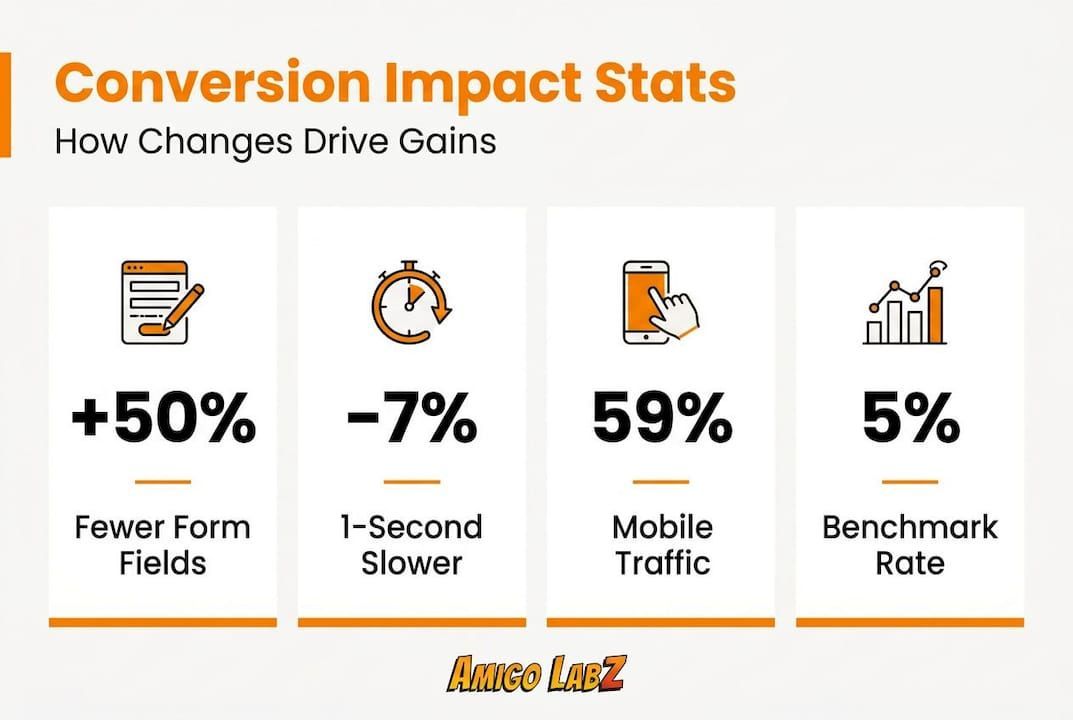
A slow website is a leaky bucket. You can fill it all day, but you'll keep losing leads. A 1-second delay in page load can reduce conversions by 7%. For a small business generating 200 leads per month, that's 14 lost leads every single month just from a slightly slow site.
Mobile design: The majority of your visitors
Mobile traffic is no longer the future. It's the present. With over 59% of traffic coming from mobile devices, your website has to perform flawlessly on a small screen. That means readable text without zooming, buttons large enough to tap, and forms that don't frustrate users.
Here's a snapshot of how these elements impact conversion rates:
| Optimization factor | Typical impact on conversions |
|---|---|
| Reducing form fields to 3 | Up to 50% more completions |
| Specific CTA language | 20-30% increase |
| 1-second faster page load | 7% boost per second |
| Mobile-friendly design | 15-30% improvement |
| Sticky CTA on mobile | 10-25% lift |
Every dollar you invest in your Google Ads campaigns or Facebook Ads strategies produces a stronger return when your site is optimized to convert the traffic those campaigns send you. Conversion optimization and paid advertising are a powerful combination because one amplifies the results of the other.
Practical steps to optimize your website today
With the essentials in mind, here's a practical checklist you can follow to start transforming your website's performance right away.
-
Audit your forms. Go through every form on your site and count the fields. If any form has more than five fields, cut it down. Ask yourself: what is the minimum information I need to follow up with this person? Start there. Remove anything else until you are at three or four fields maximum.
-
Rewrite your CTAs. Look at every button and link on your site. Replace vague text with specific, benefit-driven language. Instead of "Contact Us," write "Get a Free Quote Today." Instead of "Learn More," write "See How It Works." This small change can produce measurable results quickly.
-
Test your page speed. Use Google's free PageSpeed Insights tool to check your site's load time on both desktop and mobile. Address any issues it flags, especially oversized images, unused scripts, and server response time. Research confirms that fast-loading, mobile-optimized sites see 15 to 30% better conversions than slower alternatives.
-
Check your mobile usability. Open your website on your phone and try to complete every action a customer might take: fill out a contact form, find your phone number, click your main CTA. If anything feels awkward, fix it. Pay special attention to mobile optimization because this is where most local businesses lose potential customers.
-
Use analytics to track what's working. Before you make changes, set up conversion tracking in Google Analytics or a similar tool. This lets you measure whether each change actually improved results. Resources on data analytics for business growth can help you understand how to read and act on that data intelligently.
-
Improve your trust signals. Add customer reviews, testimonials, ratings, or case studies near your CTAs. A visitor who is on the fence about contacting you may be pushed toward action by a single compelling review from someone in a similar situation.
-
Position your CTA above the fold. Your most important call to action should be visible without scrolling. On mobile, this is especially critical. Visitors decide in seconds whether to stay on your page, and a visible CTA gives them something to do immediately.
Pro Tip: Change only one element at a time when testing. If you rewrite your CTA and redesign your form in the same week, you won't know which change drove any improvement. Isolate variables to understand what actually works. Using content promotion strategies alongside these site improvements gives you more data points to work with, too.
Common mistakes and pitfalls in conversion optimization
Even with the right strategies, it's easy to fall into traps that undermine your results. Here's what to watch out for so you don't waste time or momentum.
Common mistakes small business owners make with conversion optimization:
- Too many form fields. This is the most consistent conversion killer. Every extra question you ask creates hesitation. Visitors won't fill out a long form for a business they don't yet trust.
- Generic CTAs. "Submit" and "Send" tell visitors nothing about what they're getting. Specificity is the difference between a click and a bounce.
- Slow page loads. A beautiful website that takes six seconds to load will lose most of its visitors before they even see it. Speed is not optional.
- Ignoring above-fold placement. If visitors have to scroll down to find your main CTA, many of them simply won't. Research shows that above-the-fold and sticky CTAs are often neglected but can lift mobile conversions by 15 to 30%.
- Forgetting mobile users. A site that looks great on a desktop but is clunky on a phone is actively driving away the majority of your potential leads.
"The most expensive mistake a small business can make is sending paid traffic to a website that isn't built to convert. Every dollar you spend on ads multiplies the cost of a broken user experience."
Quick ways to course correct: prioritize mobile testing, simplify your forms immediately, and update at least your primary CTA this week. Focus on your website design fundamentals before scaling any traffic campaigns. Fixing these basics can produce results faster than you might expect, often within days of implementation.
What most small businesses miss about conversion optimization
Now that we've covered strategies and pitfalls, here's an insider perspective on what actually makes sustained conversion gains possible.
Most businesses treat conversion optimization as a one-time project. They hire someone to redesign a form or change a button color, see a small bump, and move on. That approach leaves most of the potential value on the table.
The businesses that see lasting results treat CRO as a continuous process. They test one change, measure the result, implement what worked, then test the next thing. Month after month. This compounds over time in ways that a single website overhaul never can.
We've seen this play out with local businesses in New Jersey and Nevada. A business that commits to ongoing testing rarely needs to double its advertising budget to grow. Instead, the same traffic produces progressively better returns because the site keeps getting better at converting visitors.
Mobile optimization is where this matters most right now. A local service business with a strong mobile experience and a clear CTA above the fold will consistently outperform a competitor with a better-looking site that performs poorly on phones. Research confirms that mobile optimization and continuous testing outpace one-time fixes for long-term results.
Our strongest advice: make data-driven decision making the foundation of your optimization process. Don't change things because they seem like good ideas. Change things because your analytics tell you where visitors are dropping off, and then verify that your changes actually helped. Gut instinct has a role, but data should have the final word.
The businesses that win aren't the ones with the most traffic. They're the ones who know exactly what their visitors need and remove every obstacle standing between curiosity and action.
How expert help propels your conversion results
If you're ready to maximize your site's potential and see more impact from your marketing, here's how to get tailored help.
Implementing these strategies yourself is possible, but it takes time, testing, and a clear understanding of your data. Working with a team that specializes in conversion optimization means faster implementation, sharper insights, and measurable ROI without the trial and error.

At Amigo Labz, we work directly with small business owners in New Jersey and Nevada to identify exactly where their websites are losing leads and fix it systematically. From auditing your forms and CTAs to full custom website solutions, we bring both creative strategy and technical execution to every project. Our SEO services ensure that the traffic coming to your optimized site is the right traffic, so every improvement you make produces compounding returns. Let's talk about what your site can do when it's built to convert.
Frequently asked questions
What is a good website conversion rate for small businesses?
Most small businesses should aim for a website conversion rate between 2% and 5%, though this can vary significantly by industry and the type of conversion being tracked.
How many fields should my contact form have?
Research confirms that optimal contact forms have three fields, typically name, contact information, and message, which maximizes completion rates for most business websites.
How does page loading speed affect conversions?
A 1-second delay in page load can reduce conversions by up to 7%, meaning a site that loads in four seconds instead of two may be losing a significant portion of potential leads.
Why is mobile optimization so critical for local businesses?
Mobile devices account for nearly 60% of website traffic, so a site that performs poorly on phones is actively turning away the majority of potential customers before they can convert.
Can specific CTA copy really make a big difference?
Yes, using targeted phrases like "Get Free Quote" instead of "Submit" can boost conversions by 20 to 30%, making CTA language one of the highest-impact and lowest-cost improvements you can make.
Recommended