Maximize small business growth with ads and SEO
Maximize small business growth with ads and SEO
TL;DR:
- Google's AI updates now link ad content and SEO, requiring website clarity for better results.
- A hybrid approach speeds rankings and reduces waste by using ad data to inform SEO efforts.
- Integrating ad and SEO strategies is crucial for local businesses to stay competitive in 2026.
Most small business owners treat Google Ads and SEO like two completely separate departments with different budgets, different goals, and different teams. That old mindset is costing you money. Google's AI-driven content pulling now blurs the lines between paid and organic search, meaning the quality of your website content directly affects your ad performance and vice versa. If you're running a business in Las Vegas or New Jersey, understanding how these two channels feed each other is no longer optional. It's the key to getting more out of every marketing dollar you spend.
Table of Contents
- Understanding the new connection between ads and SEO
- Why a hybrid approach delivers best results
- Steps to build a local ad-SEO strategy
- Real-world examples: From ad data to SEO wins
- Why ad-SEO integration will define local success in 2026
- Scale your growth with proven ad and SEO solutions
- Frequently asked questions
Key Takeaways
| Point | Details |
|---|---|
| SEO and ads now overlap | Google's 2026 changes connect site content, SEO, and ads, requiring a unified approach. |
| Hybrid strategy yields more ROI | Using ads to test keywords and inform SEO drives better, faster business growth. |
| Expectations for budget and timeline | Plan for $500–$3,000/month on ads and up to nine months for SEO impact. |
| Localize for Las Vegas and New Jersey | Tailor your campaigns based on local trends for maximum effect. |
| Integrated tools simplify the process | Modern platforms and expert help make blending ads and SEO accessible for small businesses. |
Understanding the new connection between ads and SEO
Now that we've set the stage, let's dig into how Google's updates create new opportunities and responsibilities for your online presence.
Google has always been evolving, but 2026 brought a shift that genuinely changes how small businesses need to think about digital marketing. Performance Max (PMax) and the newer AI Max campaigns automatically pull website content to inform ad creative. That means Google is reading your pages, headlines, and product descriptions to decide what to show in your ads. If your on-page content is weak or poorly structured, your ads will reflect that weakness.
Think about what this means for a Las Vegas HVAC company or a New Jersey law firm. If your website copy is vague or full of generic phrases, Google's AI will use that vague content to build your ad headlines. You could be paying per click for ads that sound nothing like what your best customers would search for.
Here's what business owners need to pay attention to right now:
- Your page titles and headers (H1, H2) are now ad inventory. Google pulls these directly for automated ad copy.
- Thin content pages hurt both SEO rankings and ad quality scores. One problem creates two losses.
- Consistent messaging across your site improves campaign relevance , which lowers your cost per click.
- Structured content (clear service pages, location pages, FAQ sections) gives Google's AI better material to work with.
- Duplicate or conflicting content on your site can cause Google to show mismatched ads, hurting conversions.
"When your website and your ads are sending the same clear message, Google rewards you with better placement and lower costs. When they conflict, you pay more for worse results."
To stay ahead, it helps to review your Google Ads updates regularly and make sure your website structure supports what your campaigns are trying to accomplish. Setting up and maintaining your Google Business Page is equally critical, because local signals from your profile also feed into how Google understands your business. And don't overlook the power of smart SEO linking within your site to guide both users and Google's crawlers through your most important pages.

Why a hybrid approach delivers best results
Knowing how Google connects ads and SEO, you can now use a hybrid approach to get more value. Let's compare the benefits and logistics.
The biggest mistake local businesses make is waiting too long to start SEO while dumping all their money into ads, or the opposite: spending months on SEO content while ignoring the immediate data that ads could provide. Both channels are more powerful when they work together.
Here's a realistic breakdown of what each channel offers and when:
| Channel | Time to Results | Minimum Monthly Budget | Primary Benefit |
|---|---|---|---|
| Google Ads | 7 to 30 days | $500 to $3,000 | Immediate visibility, keyword data |
| SEO | 80 to 270 days | $500 to $2,000 | Long-term traffic, compounding returns |
| Hybrid (Ads + SEO) | 30 to 120 days | $1,000 to $4,000 | Faster rankings, reduced wasted spend |
According to Google's own data, a minimum effective ads budget of $500 to $3,000 per month is needed to generate enough clicks and impressions to make smart decisions. Below that threshold, you're often working with too little data to know what's actually working. SEO results, on the other hand, typically plateau in 80 to 270 days, meaning you won't see the full organic benefit until nearly a year into consistent effort.
This is exactly why the hybrid model makes sense for small businesses in competitive markets. You run ads to get immediate traffic and gather keyword conversion data. Then you use that data to build SEO content around the phrases that are actually making people buy, not just browse.
Pro Tip: Look at your Google Ads search terms report every two weeks. The phrases people type before clicking your ads are gold for your blog and service page content. These are real searches from real buyers in your market.
Our advanced SEO services are built specifically around this kind of data-first approach, so you're never guessing which keywords deserve your content investment. Pairing that with a fully optimized Google Business profile means your local presence gets reinforced from every angle.
Steps to build a local ad-SEO strategy
With the benefits clear, here's a hands-on plan any business can follow to execute this blended strategy.
Whether you're a salon owner in Hoboken, New Jersey or a restaurant operator on the Las Vegas Strip, the steps are the same. What changes is how you apply them to your specific market and competition level.
-
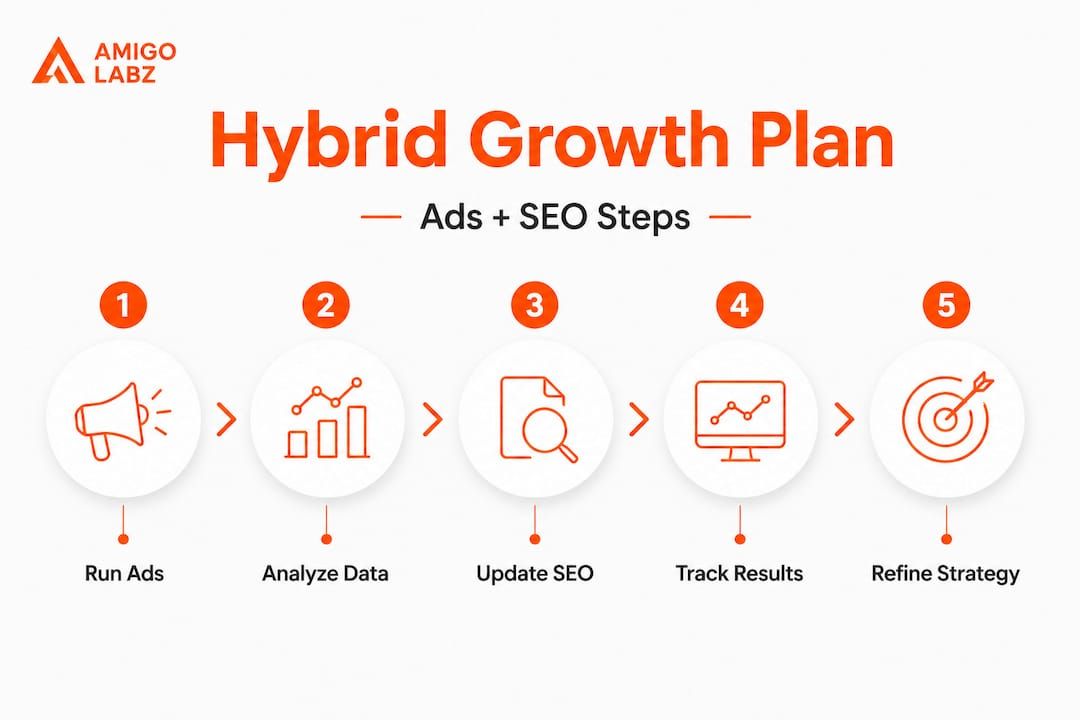
Start with keyword research using paid search. Run a small Google Ads campaign targeting 10 to 20 broad and phrase-match keywords relevant to your service. Spend $500 to $1,000 over 30 days. Your goal is data, not just clicks.
-
Analyze which keywords convert, not just which ones get clicks. A keyword that drives 100 clicks but zero phone calls is useless for SEO investment. Focus your content budget on the 3 to 5 phrases that led to actual inquiries or purchases.
-
Build dedicated landing pages and blog content around those converting keywords. If "emergency plumber Las Vegas" converts at a high rate in ads, create a detailed service page and two or three supporting blog posts around that exact topic.
-
Optimize your existing pages using what you learned. Update your H1 headings, meta descriptions, and page copy to reflect the language your actual buyers use. This is where content promotion strategies come into play to amplify the content you've built.
-
Set a monthly rhythm for review. Every 30 days, compare your ad performance data to your SEO traffic. Are the pages you optimized starting to rank? Are new organic visitors converting at similar rates to your paid traffic?
-
Adjust your ad spend as SEO gains traction. Once an organic page starts ranking on page one for a keyword, you can reduce or pause ad spend on that term and redirect budget to keywords where you still need visibility.
-
Track rankings and map visibility together. Ranking on Google Maps matters just as much as your website rankings for local businesses. Make sure your local SEO efforts include consistent citations, reviews, and Google Business updates.
Pro Tip: Hybrid campaigns that use ad data to shape SEO and vice versa now scale best for small business growth. Don't treat them as two budgets. Think of it as one marketing investment split across short-term and long-term returns.
If you want a deeper roadmap specific to your city or industry, our local SEO help team builds custom strategies based on what's actually working in your market right now.
Real-world examples: From ad data to SEO wins
Bringing it all together, let's look at some real-world outcomes to inspire your own approach.
New Jersey case: A home renovation contractor was running Google Ads for kitchen remodeling and noticed that one phrase, "kitchen remodel cost New Jersey," was generating a high click-through rate but expensive conversions. Rather than increasing the ad budget, they built a detailed blog post and FAQ page around that exact phrase. Within 90 days, the page was ranking on page two organically. By day 150, it hit page one. They cut their ad spend on that keyword by 60% and maintained the same number of leads. That freed up budget to test new ad keywords, which fed the next round of SEO content.
Las Vegas case: A boutique hotel noticed through their ad data that searches including "pet-friendly Las Vegas hotel" were converting at three times the rate of generic hotel searches. Their website had almost no content addressing that topic. They restructured their rooms page, added a dedicated pet policy page, and wrote two blog posts targeting pet-friendly travel in Las Vegas. Structured data for SEO was added to the new pages, making them eligible for rich results in Google. Within six months, organic traffic for pet-related searches increased by 210%.
Here's a quick comparison of what these businesses tracked before and after integrating their ad and SEO data:
| Metric | Before Integration | After Integration |
|---|---|---|
| Cost per lead (ads) | $85 | $52 |
| Organic traffic | 340 visits/month | 910 visits/month |
| Conversion rate (organic) | 1.8% | 3.4% |
| Total leads per month | 22 | 61 |
These numbers aren't magic. They're the result of using one channel to inform the other. Ad data can lead to faster ranking and higher ROI in organic channels when you treat the insights seriously.
Key metrics to monitor as you build your own hybrid strategy:
- Search impression share (how often your ads show vs. how often they could show)
- Organic click-through rate on pages you've recently updated
- Keyword position changes for terms you're actively running ads on
- Cost per conversion compared across paid and organic channels
- Bounce rate differences between paid and organic landing pages
You can layer in Facebook Ads insights to further refine your audience understanding. Sometimes what you learn about your customer through Facebook targeting tells you a lot about which Google search intent is actually tied to buying behavior.
Why ad-SEO integration will define local success in 2026
Here's the honest truth that most marketing blogs won't tell you: the businesses losing ground in Las Vegas and New Jersey right now are not failing because they don't know about SEO or ads. They're failing because they're managing them in silos with separate budgets, separate vendors, and separate reporting that never talks to each other.
We've worked with business owners who were spending $2,000 a month on ads managed by one agency and $1,500 a month on SEO managed by another. The two teams had never spoken. The ad agency was bidding on keywords the SEO team had already started to rank for organically. The SEO team was writing content about topics that had zero buying intent based on what the ads data clearly showed. This is not a rare situation. It's extremely common.
Experts warn that "set and forget" SEO is less effective as Google's systems use site quality for both ads and organic ranking. In other words, your website is now a single asset that serves both channels simultaneously. You can't let one team ignore what the other is doing.
The practical fix is surprisingly straightforward. Get your ad data and your SEO data into the same dashboard or at least the same monthly review meeting. Look at which paid keywords are converting and whether your organic pages target the same phrases. If they don't align, fix it. Make one person or one team responsible for both channels, or at minimum, make sure both vendors are talking every 30 days.
Integration doesn't have to be overwhelming. Start with one keyword. Run ads on it, build a strong organic page around it, and watch what happens. That single example will teach you more than any marketing course about how the two channels amplify each other.
For Las Vegas and New Jersey businesses specifically, local intent searches are where the biggest wins hide. Phrases like "near me," city names, and neighborhood references are often underused in SEO content even when they're clearly showing up in ad data. Our expert SEO support team helps you find exactly those gaps and close them fast.
The businesses that win in 2026 are the ones treating their website, their ads, and their organic presence as one connected system. That's not a prediction. That's already the reality for the brands growing fastest in competitive local markets.
Scale your growth with proven ad and SEO solutions
If reading this article made you realize your ads and SEO have been working against each other, you're not alone. Most small business owners discover this gap after already spending real money in the wrong direction.

At Amigo Labz, we help businesses in Las Vegas and New Jersey build integrated marketing strategies where every dollar in ads makes your SEO stronger, and every page you rank for reduces your paid search costs over time. Our SEO services in New Jersey and Google Ads for local businesses are designed to work together from day one, not as separate line items on your invoice. Whether you're starting from scratch or looking to fix a strategy that's been underperforming, we'll build a plan around your actual business goals. Book a free consultation and let's map out your next move together.
Frequently asked questions
How long before I see results from an ad-SEO hybrid campaign?
You can expect meaningful ad insights within 30 days if your budget is in the $500 to $3,000 range, while SEO results from content built on that data typically solidify between 80 and 270 days.
What is the minimum ad budget to get actionable data?
A minimum of $500 to $3,000 per month is necessary to generate enough clicks, impressions, and conversion signals to make confident decisions about your SEO content strategy.
Do I need technical skills to use both ads and SEO together?
No advanced technical skills are required, but you do need to review your data consistently. Hybrid campaigns work best when someone is actively connecting the dots between ad performance and content updates every 30 days.
Will local factors in Las Vegas or New Jersey affect my strategy?
Absolutely. Local competition levels, seasonal trends, and neighborhood-specific search behavior mean your local conditions should directly shape both your keyword targeting in ads and the geographic focus of your SEO content.
Recommended