Why SEO Matters for Your Business in 2026
Why SEO Matters for Your Business in 2026

TL;DR:
- Search is the primary gateway to the internet, generating the majority of online traffic and revenue.
- SEO builds long-term digital equity through optimized content, technical setup, and authority signals that rank higher in search results.
Search is the front door to the internet. 68% of online experiences begin with a search engine, and Google alone processes 8.5 billion searches daily. That means your customers are actively looking for what you sell right now. The question is whether they find you or your competitor. Understanding why SEO belongs at the center of your marketing strategy is not about chasing algorithms. It is about capturing demand that already exists and turning it into revenue that compounds over time.
Table of Contents
Key takeaways
| Point | Details |
|---|---|
| SEO drives the majority of traffic | Organic search accounts for over half of all website visits and nearly half of business revenue. |
| Paid ads stop, SEO compounds | Unlike ads that vanish when your budget runs out, SEO builds lasting digital equity. |
| AI search rewards quality content | In 2026, topical authority and trust signals determine who ranks and who gets cited by AI models. |
| Rankings directly impact clicks | The first organic result captures 27.6% of all clicks, making high rankings extremely valuable. |
| Execution beats theory | Audits, technical fixes, and consistent content creation separate businesses that grow from those that stagnate. |
Why SEO is the foundation of online visibility
SEO stands for search engine optimization. At its core, it is the practice of making your website more visible to people searching for products or services related to your business. But a more useful way to think about what SEO does is this: it tells search engines that your website deserves to be shown to the right people at the right moment.
Modern SEO operates across three main pillars:
- Content quality: Pages that answer real questions thoroughly, with depth and accuracy, rank above thin or generic content.
- Technical setup: Site speed, mobile responsiveness, clean code, and proper crawlability make it possible for search engines to index your pages at all.
- Authority signals: Backlinks from other reputable websites act as votes of confidence that signal your content is trustworthy.
When all three align, your pages climb in organic rankings without you paying per click. That distinction matters enormously. Paid search places you at the top of results instantly, but only while money flows into the campaign. Organic traffic costs no ongoing per-click spend after your SEO investment is made. For business owners who want growth that does not require doubling the ad budget every year, that difference is the whole ballgame.
Pro Tip: If you are new to SEO, start by reading the small business visibility guide from Amigolabz before touching any settings on your website.
Long-term ROI: why SEO outperforms paid ads over time
Here is the most important number you will read today. Organic search drives 53% of all website traffic and accounts for 44% of total revenue share across businesses. No other single channel comes close to that kind of consistent contribution.

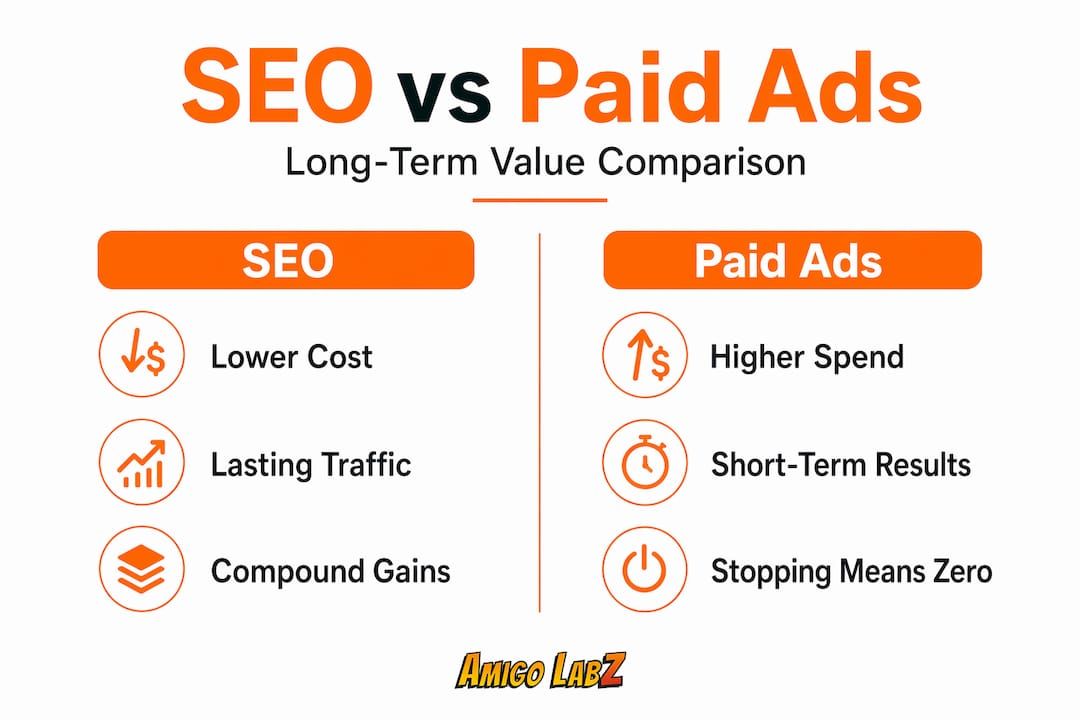
The comparison below shows why so many growth-focused companies treat SEO as a long-term asset rather than a short-term tactic.
| Factor | SEO | Paid Ads |
|---|---|---|
| Cost over time | Decreases as rankings hold | Increases as competition rises |
| Traffic when budget stops | Continues | Stops immediately |
| Customer trust level | Higher (organic results feel earned) | Lower (users know it's an ad) |
| Conversion quality | Higher conversion rates than outbound | Varies widely by campaign |
| Brand authority built | Yes, accumulates over time | No, resets with each campaign |
The math behind SEO's compounding value is straightforward. A well-optimized blog post published today can generate traffic in month one, more in month six, and even more by year two as it earns links and authority. SEO builds owned digital assets that appreciate in value, while paid ads are rented visibility that disappears the moment you stop paying.
There is also a click reality that too many business owners ignore. The top five organic results capture nearly 70% of all clicks, and pages that rank outside the first page receive almost none. Your website being on page two is functionally invisible. That is why the role of SEO in business is not optional for companies serious about growth. It determines whether you exist in your customer's world at all.
Pro Tip: Think of your SEO investment like real estate. The earlier you buy in, the more equity you build. Waiting means paying a higher price later to compete with businesses that started years ago.
For a side-by-side breakdown of how paid and organic strategies can work together, Amigolabz has published a detailed look at ads and SEO combined that is worth your time.
SEO and AI-powered search in 2026
The search experience your customers use today looks different than it did three years ago. Google's AI Overviews feature now appears in roughly 30% of queries, generating synthesized answers directly in the search results page. Tools like ChatGPT and Perplexity pull from indexed web content to answer questions in real time. This is not a threat to SEO. It is an expansion of what SEO can do.
Here is what that means in practice:
- Topical authority now outweighs keyword density. A website that covers a subject deeply across multiple related pages is more likely to be cited by AI models than one with a single optimized article.
- E-E-A-T signals are ranking factors, not nice-to-haves. Experience, Expertise, Authoritativeness, and Trustworthiness are the framework Google uses to evaluate content. Author credentials and verified bios now directly influence rankings in 2026.
- Content cited by Google gets cited by AI. Content ranking well on Google gets cited by AI models like ChatGPT and Perplexity, multiplying the reach of a single well-optimized page across multiple platforms simultaneously.
- Search intent must be satisfied completely. Thin answers no longer pass. Content must address not just the main question but the related questions a curious reader would naturally ask next.
The businesses that will win in AI-driven search are the ones investing in genuine depth today. For more on how this shift is playing out, this breakdown of AI-driven search strategies offers strong context for what marketers are doing right now.
How to put SEO to work for your business
Knowing why SEO matters is step one. Knowing what to actually do is where most business owners get stuck. Here is a practical sequence that works regardless of your current starting point.
- Run a technical site audit. Before creating any content, confirm that search engines can actually crawl and index your pages. Tools like Google Search Console are free and will flag crawl errors, mobile usability issues, and pages blocked from indexing.
- Research keywords aligned with buyer intent. The best keywords are not the ones with the highest search volume. They are the ones your ideal customers type when they are close to making a decision. Focus on specific, intent-driven phrases rather than broad terms that attract tire-kickers.
- Create content that answers real questions thoroughly. Each page should serve one clear topic with depth. Cover the subject completely enough that a reader has no reason to go back to Google for more.
- Fix the technical fundamentals. Page speed, mobile responsiveness, and secure connections (HTTPS) are table stakes. A slow site that looks broken on a phone will lose rankings regardless of how good the content is.
- Build backlinks through genuine relationships. Getting links from other reputable websites in your industry is still one of the strongest ranking signals available. Guest posts, partnerships, and earning coverage through quality content are all legitimate paths.
- Track the right metrics consistently. Organic sessions, keyword rankings, and conversion rates from organic traffic tell you whether your SEO effort is actually generating business outcomes. Vanity metrics like impressions mean nothing without clicks and conversions behind them.
Pro Tip: Ranking on Google Maps is often faster to achieve than organic website rankings and directly drives foot traffic and calls for local businesses. Do not overlook it.
For businesses already running paid campaigns, combining that paid visibility with structured data and SEO creates a much stronger overall presence in search results, particularly for local queries where competition for attention is fierce.
My take on why SEO is non-negotiable right now
I have worked with enough business owners to know that SEO often gets pushed down the priority list. You can see the results of a paid ad immediately. SEO takes months. That impatience is one of the most expensive mistakes I see growing businesses make.
What I have observed consistently is this: the companies that committed to SEO three years ago are now spending far less per customer acquired than competitors running purely paid campaigns. Their content is working for them 24 hours a day. Their paid ads, meanwhile, work only as long as someone is actively managing and funding them.
The businesses that ignored SEO are now trying to catch up in a more competitive market with higher content volume and smarter competitors. The entry cost is higher, the timeline is longer, and the results are slower. That gap between early movers and late arrivals compounds every year.
What I tell every business owner I work with is simple. SEO is not a channel you pick up and put down based on quarterly budgets. It is the permanent foundation your entire digital presence is built on. Social media trends change. Ad platforms change their pricing models. Search intent, however, has been consistent for two decades. People search for what they need, and you either show up or you do not.
The importance of SEO for your website is not theoretical. It is the difference between being found and being invisible.
— John
Ready to grow your organic presence?
If this article clarified why SEO belongs in your growth strategy, the next step is knowing whether your current setup is actually working for you. Most business websites have untapped ranking potential that a focused SEO effort can unlock within three to six months.

Amigolabz works with business owners across New Jersey, Nevada, and the rest of the country to build SEO strategies that produce measurable results. From technical audits to content creation, the team handles the complexity so you can focus on running your business. Explore the full range of SEO services to see what a targeted approach looks like. If you are running paid campaigns alongside organic efforts, Amigolabz also manages Google Ads, Facebook Ads, and social media management to create a fully integrated digital presence. Start with a conversation and book a call today.
FAQ
What does SEO actually do for a website?
SEO improves a website's visibility in search engine results by optimizing content, technical structure, and authority signals. The result is more organic traffic from people actively searching for what you offer.
Why is SEO important compared to paid ads?
SEO builds lasting visibility that continues generating traffic even when no money is being spent, while paid ads stop delivering the moment a campaign ends. Over time, SEO typically provides a lower cost per acquisition.
How long does SEO take to show results?
Most businesses see meaningful organic traffic improvements within three to six months of consistent SEO work, with stronger results building over twelve to twenty-four months as content and authority accumulate.
What is SEO marketing and how does it fit a broader strategy?
SEO marketing is the practice of increasing a website's organic search visibility to attract and convert customers. It works best alongside paid advertising and social media to create multiple touchpoints across the customer journey.
Does SEO still matter with AI-powered search tools?
Yes. Content that ranks well on Google is regularly cited by AI tools like ChatGPT and Perplexity, which means strong SEO now drives traffic from both traditional search and AI-generated answers simultaneously.
Recommended