What Social Media Marketing Does for Your Business
What Social Media Marketing Does for Your Business
TL;DR:
- Social media marketing is a strategic asset that builds brand recognition and generates qualified leads through intentional engagement.
- Effective success requires focus on audience-specific platforms, combining content, community management, paid ads, and analytics to achieve measurable results.
Social media marketing is one of the most misunderstood tools in a business owner's arsenal. Most people assume it means posting content and hoping someone likes it. The reality is sharply different. What social media marketing does, at its core, is give your brand a living, breathing presence where over 5 billion people already spend their time. People spend 143 minutes daily on social platforms. That is not a content channel. That is a strategic business asset, and treating it as anything less leaves real growth on the table.
Table of Contents
- Key Takeaways
- What social media marketing does: core roles explained
- What social media marketing involves: key services
- Choosing platforms without spreading too thin
- How social media marketing is evolving right now
- My take on where most businesses get this wrong
- Take your social media strategy further with Amigolabz
- FAQ
Key Takeaways
| Point | Details |
|---|---|
| More than posting content | Social media marketing is a strategic function that drives brand awareness, leads, and sales. |
| Platform focus beats volume | Concentrating on 1-2 platforms aligned with your audience outperforms spreading across every channel. |
| Paid ads are non-negotiable | Organic reach alone rarely meets business goals; paid social campaigns fill the gap. |
| Community beats follower count | Two-way engagement builds trust and loyalty faster than simply growing your audience size. |
| Strategy and execution are distinct | Defining goals and audience is strategy; scheduling and responding is management. Both are required. |
What social media marketing does: core roles explained
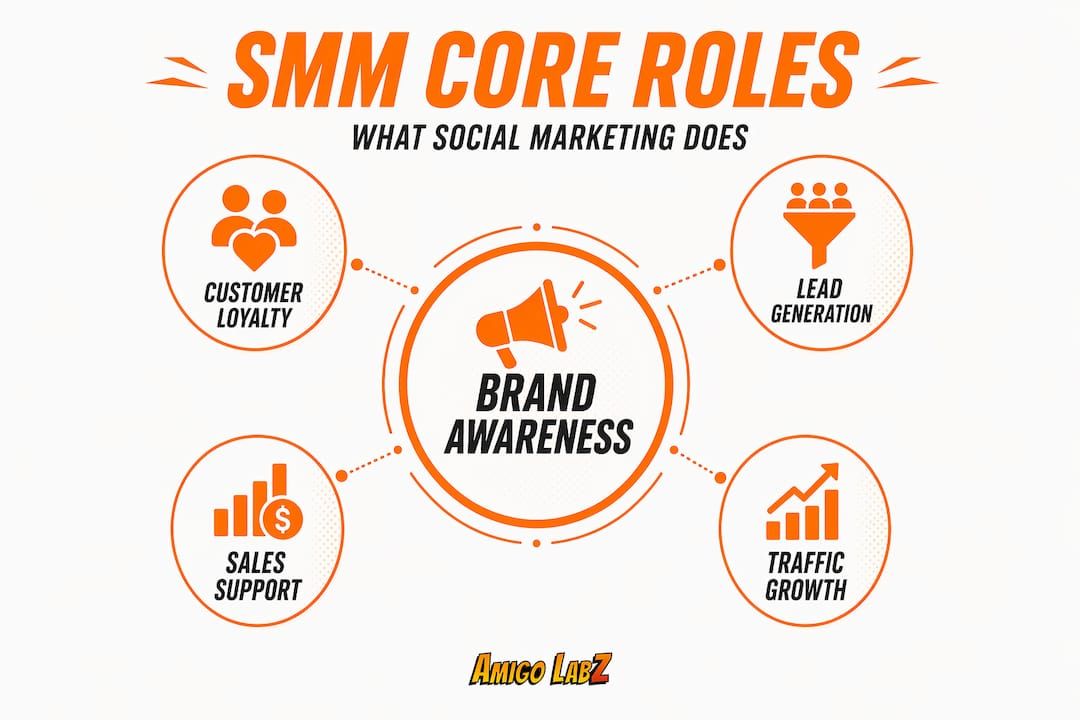
The standard industry term here is social media marketing (SMM), and it covers far more than most business owners realize when they first start exploring it. SMM functions as a multi-purpose engine inside your broader marketing strategy. Understanding its distinct roles helps you use it intentionally rather than reactively.
Brand awareness and recognition. Before anyone buys from you, they need to know you exist and trust what you stand for. Social platforms let you shape that perception through consistent visuals, messaging, and tone. A brand that shows up repeatedly in someone's feed with content they find useful or interesting earns recognition that no single ad campaign can replicate.
Driving traffic and qualified leads. Every post, story, or ad is an entry point back to your website, landing page, or product listing. When that content is targeted correctly, the people clicking through are not random. They already have some interest in what you offer.
- Building two-way community dialogue instead of broadcasting at customers
- Strengthening customer trust through transparent, responsive communication
- Supporting sales funnels through social commerce integrations (Instagram Shopping, TikTok Shop)
- Using platform analytics to understand which content performs and why
- Refining your messaging based on real-time audience feedback
63% of Gen Z and 49% of millennials say social media ads or influencer recommendations directly influence their purchasing decisions. That is not a soft metric. That is documented purchase intent sitting inside a platform you can advertise on today.
Pro Tip: Before creating any content, write down one clear business goal for social media. Whether it is leads, traffic, or reputation, your goal should shape every post, not the other way around.
The importance of social media marketing grows with your business because it compounds. A well-run account builds an audience over time that becomes progressively easier and cheaper to convert. That is the kind of asset traditional advertising never builds.

What social media marketing involves: key services
Social media marketing success increasingly demands a cyclical integration of content creation, community management, paid media, and analytics. Here is how those pieces actually break down in practice.
-
Social media strategy and planning. This is where you define your goals, choose your platforms, identify your audience segments, and establish your content pillars. Strategic planning and execution are distinct but complementary. Strategy without execution stays theoretical. Execution without strategy wastes budget.
-
Content creation. Writing captions, designing graphics, filming short-form video, and building out campaigns. Strong content balances your brand's creative voice with a message that serves the viewer's interest. Content that only talks about your products underperforms content that educates, entertains, or solves a problem.
-
Community and engagement management. Responding to comments, answering DMs, jumping into relevant conversations. Active two-way dialogue drives higher conversion and retention than passive posting. This is where trust is actually built.
-
Paid social advertising. Organic reach alone is rarely sufficient to meet business goals. Paid campaigns on platforms like Facebook and Instagram let you reach specific demographics, retarget website visitors, and drive direct conversions at scale. Managing Facebook ad campaigns correctly is a skill that directly affects your cost per lead.
-
Analytics and reporting. Every platform gives you data. The question is whether you are reading it to inform decisions or just looking at vanity metrics. Real reporting connects content performance to business outcomes like leads generated, revenue attributed, and audience growth quality.
| Service | Primary Goal | Key Metric |
|---|---|---|
| Strategy and planning | Direction and focus | Goal alignment |
| Content creation | Audience engagement | Reach, saves, shares |
| Community management | Trust and retention | Response rate, sentiment |
| Paid advertising | Reach and conversions | Cost per lead, ROAS |
| Analytics and reporting | Continuous improvement | ROI, conversion rate |
Pro Tip: Use audience segmentation to tailor your content to specific buyer personas instead of posting generic messages to your entire following. Niche content consistently outperforms mass messaging.
Choosing platforms without spreading too thin
One of the most common and costly mistakes in social media marketing is trying to be everywhere at once. Attempting to maintain presence on all platforms leads to platform dilution, where you end up producing mediocre content on five channels instead of excellent content on two.
Here is how to think about platform selection without overthinking it:
- Go where your audience already is. A B2B software company belongs on LinkedIn. A lifestyle brand belongs on Instagram or TikTok. A local restaurant belongs on Facebook and Instagram. The platform should match your audience's behavior, not your personal preference.
- Algorithms reward depth, not breadth. Platforms like Instagram and TikTok prioritize accounts with high engagement rates. A smaller account that generates strong comments and shares will consistently outperform a larger account with passive followers.
- Local vs. national strategy requires different approaches. Local social media marketing focuses heavily on community-specific content, local hashtags, and geo-targeted ads. Broader campaigns require wider creative testing and more sophisticated audience layering.
- Use platform-specific features. Instagram Reels, LinkedIn Articles, Facebook Groups, and Pinterest boards each serve distinct purposes. Brands that treat every platform identically miss the contextual opportunity each one offers.
Pro Tip: Start with one platform and get genuinely good at it before adding a second. Consistency on one channel builds more momentum than mediocrity across four.
How social media marketing is evolving right now
The version of social media marketing that worked five years ago looks almost unrecognizable today. The shift is not just tactical. It is philosophical.
"Brands will be built and destroyed on social media based on collective narratives and real-time engagement, not polished advertising messages." — Brands built and destroyed on social
The broadcast era is over. Brands that use social channels as a one-way megaphone are losing ground to brands that use social listening and two-way communication to shape their identity around real customer conversations.
Here are the most significant current shifts:
| Trend | What It Means for Your Brand |
|---|---|
| Brand community building | Engagement and belonging matter more than follower volume |
| Influencer and UGC trust | Peer recommendations outperform branded content in credibility |
| Social commerce integration | Customers buy without leaving the platform, shortening the funnel |
| AI content and social listening | Faster content production paired with real-time brand monitoring |
| Reputation management | Public perception on social media now moves faster than PR responses |
Influencer and user-generated content (UGC) deserve special attention. The impact of influencer recommendations on Gen Z and millennial purchasing behavior has made micro-influencer partnerships one of the most cost-effective tactics available to mid-size brands. You do not need a celebrity. You need someone whose audience trusts them and overlaps with your customer profile. Meanwhile, proven content promotion strategies ensure that great content actually reaches the right people rather than disappearing into the algorithm.
Social commerce is no longer experimental. Instagram Shopping and TikTok Shop have turned social platforms into direct sales channels, compressing what used to be a multi-step funnel into a single tap. If you sell products and you are not integrated with social commerce, you are adding unnecessary friction to the buying process.
My take on where most businesses get this wrong
I have watched countless business owners invest in social media marketing, get frustrated within 90 days, and either abandon it or hand it off without any strategic direction. The problem is almost never the platform. It is expectation management and understanding what community engagement actually requires.
What I have learned from working with brands at various stages is this: most businesses underestimate how much ongoing community engagement actually costs in time and attention. They budget for content creation. They forget to budget for the daily responses, the reputation monitoring, the community conversation that makes the content matter.
I have also seen brands go viral for the wrong reasons and recover beautifully, not because they had a perfect PR plan but because they had built genuine goodwill with their audience before the crisis hit. Brand perception on social often outweighs traditional advertising, and I believe that is only going to intensify. The brands winning right now are the ones that treat social media as a relationship channel, not a distribution channel.
The hard-won lesson I share with every business owner I work with: integrate your social media strategy with your product feedback and customer success processes. The signals your community sends you on social media are some of the most direct market research you will ever get. Ignoring them to focus purely on content output is one of the most expensive mistakes you can make.
— John
Take your social media strategy further with Amigolabz
Understanding what social media marketing does is the first step. Building a system that actually delivers results is a different challenge entirely, and that is exactly where most businesses stall.

Amigolabz works with business owners across New Jersey and Nevada to build social media strategies that go beyond posting. From content planning and community engagement to paid ad management and performance reporting, the team focuses on marketing that connects with real audiences and moves real numbers. Whether you are starting from scratch or looking to sharpen an underperforming presence, Amigolabz brings the creative strategy and hands-on execution your business deserves. Book a call and find out what a focused social media strategy can do for your brand.
FAQ
What does social media marketing actually do for a business?
Social media marketing builds brand awareness, drives website traffic, generates leads, and supports sales. It also creates direct communication channels between brands and customers, which strengthens loyalty and trust over time.
How is social media marketing different from just posting content?
Posting content is one tactic inside a broader strategy. Social media marketing involves audience research, goal setting, paid advertising, engagement management, and performance analysis. Without strategy, posting alone rarely produces measurable business results.
Which social media platforms should my business focus on?
Focus on 1-2 platforms where your specific audience is most active. Platform dilution from spreading across too many channels reduces content quality and engagement. Start where your customers already spend time.
How does paid social advertising fit into a social media strategy?
Paid ads extend your reach beyond what organic content can achieve on its own. They allow you to target specific demographics, retarget warm audiences, and drive conversions with measurable cost-per-result data.
How long does it take to see results from social media marketing?
Organic growth typically takes 3 to 6 months of consistent effort before producing reliable business results. Paid campaigns can generate leads and traffic faster, often within weeks, depending on budget and targeting quality.
Recommended