SEO AdWords Strategy for Small Business in 2026
SEO AdWords Strategy for Small Business in 2026
TL;DR:
- Most small business owners treat SEO and Google Ads as mutually exclusive, leading to wasted money and lost momentum. Combining both channels enables data sharing and long-term growth, with paid search providing immediate traffic and organic strategies building sustainable visibility. Proper integration, ongoing optimization, and patience can significantly improve overall marketing performance and ROI.
Most small business owners treat SEO and Google Ads like a fork in the road. Pick one, commit, and hope for the best. That thinking costs you money and momentum. The truth is that SEO AdWords strategies work best when they run together, each channel feeding data and strength to the other. This guide breaks down exactly how both channels work, what's changed heading into 2026, and how you can build a smarter, more connected marketing system without doubling your budget or your workload.
Table of Contents
- Key Takeaways
- How SEO AdWords Campaigns Actually Differ
- Modern Google Ads Techniques Worth Using Now
- How to integrate SEO with Google Ads
- Best practices for AdWords campaign optimization
- Measuring success and knowing when to shift strategy
- My take on where most SMBs go wrong
- How Amigolabz can help you put this into practice
- FAQ
Key Takeaways
| Point | Details |
|---|---|
| SEO and Ads complement each other | Treat them as two stages of the buyer journey, not competing budget lines. |
| Paid search data sharpens SEO | Use top-performing ad queries to build organic content that ranks and converts. |
| Negative keywords protect your budget | Adding too many negatives signals your targeting is off. Tighten match types first. |
| Enhanced Conversions improve bidding | First-party data fed into Smart Bidding makes automation significantly more accurate. |
| Measurement drives sustainable growth | Track CPC, conversion rate, and organic lift together to know when to shift spend. |
How SEO AdWords Campaigns Actually Differ
Before you integrate two channels, you need to understand what each one is actually doing for your business.
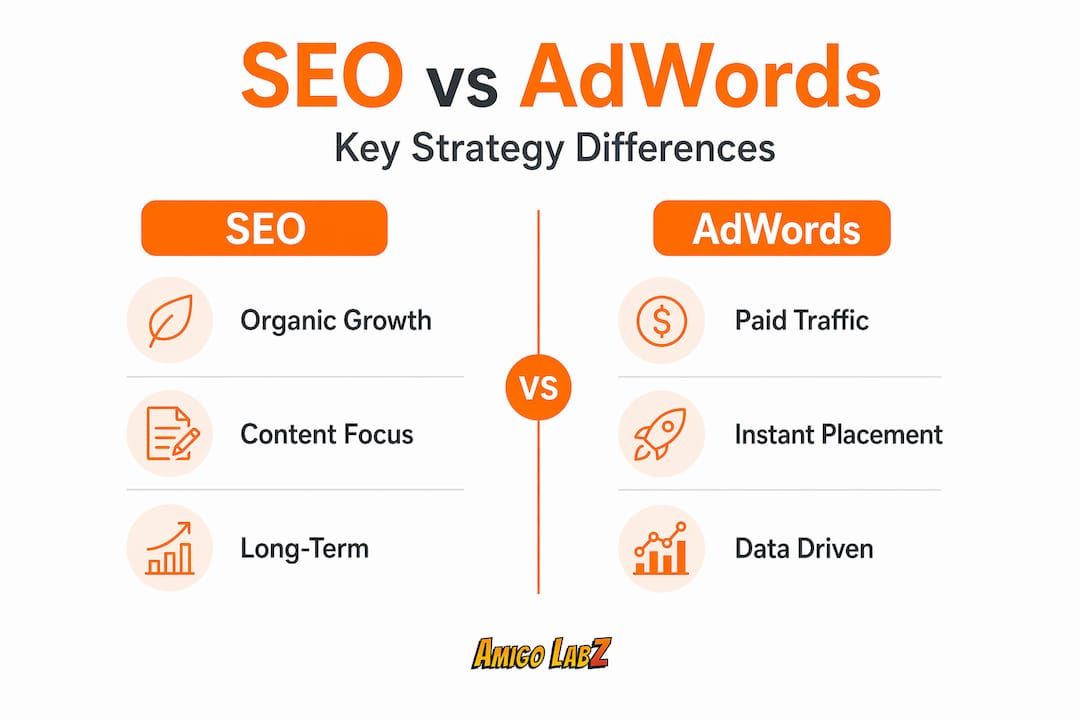
SEO builds organic visibility over time. It works by optimizing your content, site architecture, and overall authority so that Google sees your pages as the most relevant answer to a search query. There is no cost per click. The trade-off is time. A well-optimized page can take three to six months to rank competitively. Once it does, that traffic compounds.
Google Ads (still widely called AdWords, even after the rebrand) works the opposite way. You pay for placement at the top of search results on a cost-per-click basis. You can launch a campaign today and get traffic by tomorrow. The catch is that the moment you stop paying, the traffic stops too. Average CPC hit $5.42 in 2025, with 87% of industries seeing cost increases, making efficient targeting more critical than ever.
Here is a quick comparison to keep both channels clear:
| Factor | SEO | Google Ads |
|---|---|---|
| Cost model | Unpaid traffic, resource investment | Cost per click, bidding-based |
| Time to results | 3 to 6+ months | Days |
| Durability | Long-term compounding | Stops when budget stops |
| Data feedback | Slower, search console data | Fast, rich query-level data |
| Best for | Building sustainable demand | Capturing immediate intent |
Key terminology worth knowing before you go further:
- Match types: Control how closely a search query must match your keyword to trigger your ad.
- Negative keywords: Terms you block so your ads don't show for irrelevant searches.
- Quality Score: Google's rating of your ad relevance and landing page experience. Higher scores lower your CPC.
- Smart Bidding: Automated bid strategies that use machine learning to optimize for conversions or revenue.
Modern Google Ads Techniques Worth Using Now
The Google Ads platform has changed significantly. Running a static text ad with two headlines and hoping for the best is a 2018 strategy. Here is what actually works in 2026.

Responsive Search Ads (RSAs) are now the standard ad format. You provide up to 15 headlines and 4 descriptions, and Google dynamically assembles the best combinations based on the search query and user context. The practical implication: write headlines that each stand alone as a complete value statement. Don't write variations of the same thing. Google needs variety to find winning combinations.
Performance Max campaigns have become a major tool for reach. Performance Max allows up to 50 search themes per asset group, giving you directional targeting across Search, Display, YouTube, and more. The risk is over-expansion. Avoid overfilling theme lists and rely on conversion data to test which themes are actually working before you scale them.
Enhanced Conversions solve a real problem. As browser privacy restrictions and iOS changes erode cookie-based tracking, standard conversion data becomes less reliable. Enhanced Conversions use hashed first-party data from things like email addresses submitted on your site to match conversions more accurately. This directly improves Smart Bidding because the algorithm gets better signals to work with.
Pro Tip: Before enabling Smart Bidding, confirm you have at least 30 to 50 conversions per month in the account. Without that volume, automated bidding has too little data and will make poor decisions.
The bigger picture here is that automation and AI-powered bidding require quality data inputs to work. Bad data in equals bad decisions out. Your job as an advertiser is less about micromanaging bids and more about feeding the system clean, accurate conversion signals.
How to integrate SEO with Google Ads
This is where most SMBs leave real money on the table. Your paid and organic channels are sitting in separate dashboards, but they are competing for the same customers. Here is how to connect them intentionally.
-
Mine your search terms report for SEO content ideas. Your Google Ads search terms report shows you the exact phrases people typed before clicking your ad. Paid search data reveals winning queries that you can turn into SEO page topics. If a term converts well in ads, there is genuine purchase intent behind it. Build content around it and capture that traffic for free over time.
-
Test messaging in ads before committing to SEO. Writing a long-form SEO page takes weeks. Instead, test five different value propositions as RSA headlines. See which ones drive clicks and conversions. Then build your SEO content around the framing that actually resonates with real buyers.
-
Map queries to your content funnel. Awareness-stage queries belong at the top of your content structure (blog posts, guides). Comparison queries belong in the middle (service pages, comparisons). Purchase-ready queries belong on conversion-focused landing pages. Align your ad targeting and SEO pages to the same funnel stages rather than letting them conflict.
-
Reduce paid spend as organic strengthens. Once an organic page ranks in the top three positions for a high-volume keyword, consider pulling back ad spend on that term. Redirect that budget to keywords where you have no organic presence yet. This is how integrating Ads and SEO creates compounding efficiency over time rather than just compounding costs.
Pro Tip: Run a simple monthly audit: pull your top 10 converting ad keywords and check where each one ranks organically. Any keyword converting well in ads and ranking below position 10 organically is a priority SEO target.
Best practices for AdWords campaign optimization
Good campaign setup is not a one-time event. Here is what ongoing optimization actually looks like when you are also running SEO alongside your paid campaigns.
Keyword targeting and match types. Keywords are enhanced with intent signals, not replaced by them. Use phrase match and exact match as your defaults. Broad match has its place in testing, but run it with strong negative keyword lists. Adding more than 10% of search terms as negatives is a signal that your targeting is too loose and your match types need tightening.
Ad copy relevance and Quality Score. Write ad copy that mirrors the search intent of your target keyword. If someone searches "affordable HVAC repair in Newark," your headline should contain that specific framing, not a generic "We Fix HVAC Problems." High relevance improves Quality Score, which lowers your CPC and improves ad placement.
Landing page alignment. Your ad and your landing page need to tell the same story. If your ad promises a free quote, your landing page should lead with that offer. Misalignment causes visitors to bounce and tanks your conversion rate. It also signals to Google that your landing page experience is poor, which raises your costs. Build landing pages that also target your SEO keywords so you get dual value from a single page.
Conversion tracking with Enhanced Conversions. Set up Enhanced Conversions using first-party data like email addresses and phone numbers collected through your forms. This fills the gap left by third-party cookie deprecation and gives Smart Bidding the accurate signals it needs. Pair this with proven conversion strategies to maximize what happens after the click.
Pro Tip: Use Google's Ad Strength indicator as a creative guide, not a grade. "Excellent" ad strength does not guarantee performance. Let actual conversion data and click-through rate guide your creative decisions.
Measuring success and knowing when to shift strategy
With rising costs across the board, tracking the right numbers becomes non-negotiable. Conversion rates improved to 8.18% industry-wide in 2025, which means well-optimized campaigns are performing better even as budgets tighten.
Focus on these metrics together rather than in isolation:
- Cost per lead (CPL): The real number that tells you what it costs to generate a qualified inquiry, not just a click.
- Organic traffic growth: Track this monthly. As SEO compounds, your CPL from paid should decrease because you are capturing more intent without paying for it.
- Conversion rate by channel: Compare organic and paid conversion rates. If paid converts at 6% and organic converts at 2%, your landing pages for organic traffic need work.
- Search term report quality: Review weekly. Flag irrelevant queries and add negatives. Flag high-converting queries and build SEO content around them.
One important caveat on Enhanced Conversions: interpreting early results requires care because privacy consent gaps and match rate variability can create discrepancies in reported numbers. Give the system four to six weeks to stabilize before drawing conclusions.
Looking ahead into 2026, expect Google to continue expanding AI-driven features within both Performance Max and standard Search campaigns. The advertisers who win will be the ones who feed the algorithm better data, not the ones who fight automation.
My take on where most SMBs go wrong
I have seen this pattern play out dozens of times. A business owner runs Google Ads for six months, gets frustrated with rising costs, and either gives up or dumps everything into SEO hoping it will eventually replace paid traffic. Both responses throw away progress.
The real mistake is not in the channels themselves. It is in how they are set up. When I look at an underperforming account, the first thing I check is whether the ad messaging and the landing page are actually saying the same thing. They almost never are. The ad promises one thing, the page delivers something vague and generic, and the conversion rate is a predictable disaster.
The second thing I check is the search terms report. Most SMBs ignore it entirely and run broad-match keywords that waste half their budget on searches that will never convert. Tight use of match types and negatives is not optional. It is the difference between a campaign that teaches you something and one that just burns money.
My honest advice: give SEO at least six months before you judge it. Give your ad campaigns at least 60 days of clean data before you optimize them. Then use both together with a shared keyword strategy and aligned messaging. That patience, combined with data-driven integration of Ads and SEO, is the approach that actually builds something durable.
— John
How Amigolabz can help you put this into practice
Running two channels at once, SEO and Google Ads, while keeping them aligned is genuinely complex work. Amigolabz specializes in exactly this kind of integrated digital marketing for small and mid-sized businesses across New Jersey, Nevada, and nationwide.

Whether you need a Google Ads campaign built from scratch with proper conversion tracking and keyword strategy, or you want to strengthen your organic presence through SEO services that actually connect to your paid data, Amigolabz builds the strategy around your business goals, not a template. The team combines creative thinking with relationship-driven service to make sure you always know what is working and why. Book a consultation to audit your current setup and find out exactly where your budget is being wasted and where your biggest growth opportunities are hiding.
FAQ
What is the difference between SEO and Google Ads?
SEO builds organic search visibility over time through content and site optimization with no cost per click. Google Ads delivers immediate paid placement in search results on a cost-per-click model that stops when your budget does.
Can SEO and Google Ads work together?
Yes. Paid search provides fast keyword and messaging data that informs your SEO content strategy, while organic rankings reduce your dependence on paid traffic over time. They reinforce each other when aligned around shared keywords and landing pages.
How do I use Google Ads data to improve my SEO?
Pull your Google Ads search terms report and identify queries that convert well. Build SEO-optimized content pages around those exact queries to capture that intent organically without paying for every click.
What are Enhanced Conversions in Google Ads?
Enhanced Conversions use hashed first-party data like email addresses to improve conversion measurement accuracy when cookie-based tracking falls short. Better conversion data leads to smarter automated bidding and lower cost per lead.
How much should a small business spend on Google Ads?
There is no universal answer, but with average CPC now above $5, most SMBs need at least $1,000 to $2,000 per month to generate enough conversion data for Smart Bidding to function. Below that threshold, manual bidding is often more efficient.
Recommended