What Is SEO SEM: A Business Owner's 2026 Guide
What Is SEO SEM: A Business Owner's 2026 Guide

TL;DR:
- SEO builds long-term organic rankings through unpaid efforts, while SEM includes paid search and AI-driven visibility. Businesses should start with paid search for immediate results and gradually shift budget toward SEO as authority grows. Combining both channels enhances overall search visibility and maximizes return over time.
SEO is defined as the practice of improving a website's organic search rankings without paying per click, while SEM (search engine marketing) is the broader framework that includes both SEO and paid search advertising. Business owners and digital marketers often treat these as interchangeable terms, but they serve different functions with different timelines and cost structures. Understanding what is SEO SEM and how each channel works gives you a real advantage when planning where to put your marketing budget. In 2026, the definition of SEM has expanded further to include AI-driven visibility, making this distinction more important than ever.
What are the key differences between SEO and SEM?
SEO and SEM differ in four core areas: cost structure, speed, traffic type, and how long results last.

SEO focuses on earning unpaid rankings in search results. You invest in content, technical site improvements, and link building. There is no cost per click. The trade-off is time: SEO takes 3–6 months to show initial results and 6–12 months to build consistent growth. That timeline reflects how search engines evaluate authority and relevance before rewarding a site with top rankings.
SEM includes paid search campaigns, commonly called PPC (pay-per-click) or SEA (search engine advertising), alongside organic SEO. A paid campaign can generate traffic within hours of launch. The cost model is ongoing: you pay for every click, and traffic stops the moment your budget runs out.
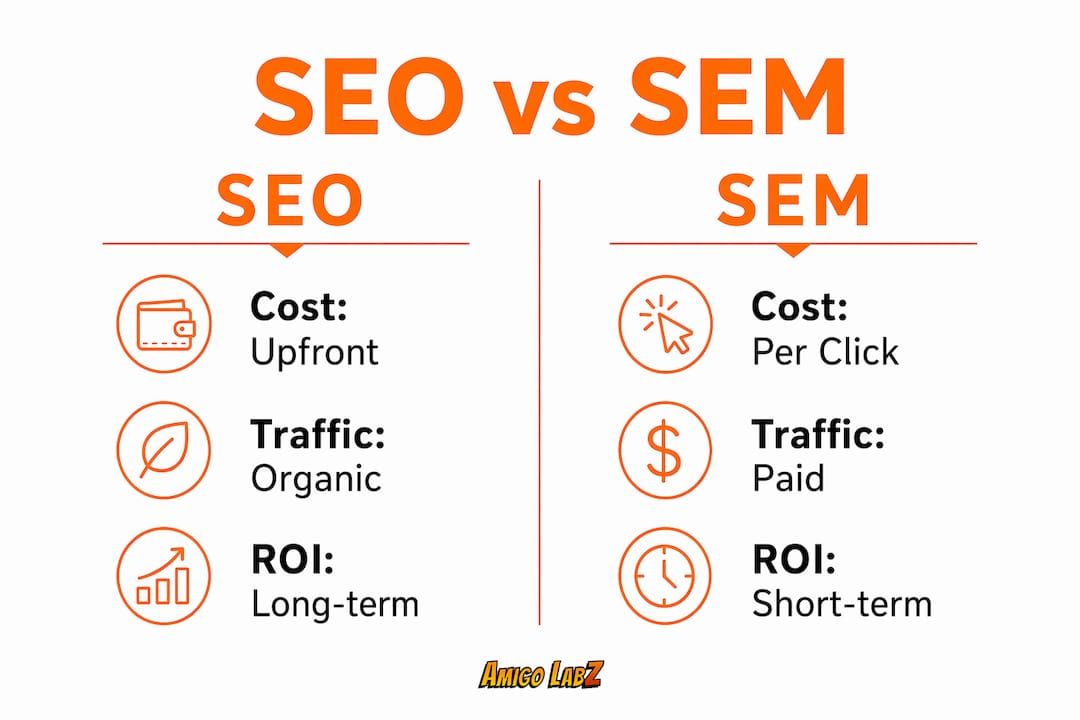
Here is a direct comparison of the two approaches:
| Factor | SEO | SEM (Paid Search) |
|---|---|---|
| Cost model | Upfront investment, no per-click fee | Ongoing cost per click |
| Speed to results | 3–6 months minimum | Hours to days |
| Traffic durability | Continues after investment ends | Stops when budget ends |
| Best for | Long-term authority building | Immediate leads and testing |
| ROI window | Strongest after 18 months | Strongest within 90 days |
The cost difference is significant. SEM budgets for 1,000 clicks monthly at an $8 cost per click can reach $96,000 annually, while a full SEO program typically costs $40,000–$60,000 per year with compounding returns. That gap widens over time as SEO content keeps ranking without additional spend.
Pro Tip: Run a quick audit before choosing your starting channel. If you need leads within 30 days, start with paid search. If you have a 6-month runway, invest in SEO from day one so the compounding effect starts earlier.
How do SEO and SEM strategies complement each other?
SEM is most accurately described as a strategic umbrella that covers SEO, paid search advertising, and now AI-driven generative search optimization. Viewing SEM as only paid ads leads to fragmented budgets and missed opportunities. The two channels work better together than either does alone.
Here is how a phased approach works in practice:
- Months 1–12 (early stage): Allocate roughly 70% of your search budget to paid search and 30% to SEO. Paid search delivers immediate traffic while your SEO foundation is being built.
- Months 12–24 (growth stage): Shift to a 50/50 split. Your SEO content is gaining authority and reducing your dependence on paid clicks.
- Month 24 and beyond (maturity stage): Shift to 30% SEM and 70% SEO. Organic traffic now carries the load, and paid search fills gaps for competitive terms or seasonal pushes.
PPC also serves as a testing lab for SEO. You can run paid ads on 10 keyword variations, see which ones convert, and then build long-form SEO content around the winners. This removes guesswork from content planning and focuses your SEO investment on proven demand.
"SEO and SEM should not be viewed as opposing tactics but as complementary tools in a holistic search strategy. PPC captures immediate demand and tests quickly, while SEO builds long-term, cost-effective visibility."
Marketing practitioners on combined search strategy
The 2026 addition to this picture is Generative Engine Optimization (GEO). AI-powered search tools like Google's AI Overviews now surface answers before users click any link. SEM in 2026 includes visibility in these AI-generated answers, which means your content strategy must account for how AI systems select and cite sources, not just how Google's traditional algorithm ranks pages.
Pro Tip: Use your PPC campaign data to identify which ad copy drives the highest click-through rates. Then mirror that language in your SEO title tags and meta descriptions. You get conversion-tested messaging without extra research.
What are the typical timelines and ROI considerations for SEO and SEM?
Timeline expectations are where most business owners make planning mistakes. They either expect SEO to deliver leads in weeks or they run paid ads for a month, see no profit, and quit before the data becomes useful.
The realistic SEO timeline breaks into three phases:
- Months 1–2: Technical groundwork. Site audits, keyword research, on-page fixes, and content planning. No ranking movement yet.
- Months 3–6: Initial rankings appear for lower-competition keywords. Traffic starts building slowly.
- Months 6–12: Consistent ranking improvements. Organic traffic compounds as more content earns authority.
Paid search operates on a completely different clock. A Google Ads campaign can send qualified visitors to your site within hours of going live. SEM wins on ROI within a 90-day window, making it the right tool when you need fast results. SEO wins on ROI after 18 months because there is no ongoing cost per visitor.
The long-term cost math favors SEO heavily. SEO has a compounding effect: content and technical improvements keep delivering traffic without further spend. SEM traffic stops the moment your budget ends. A business that builds strong organic rankings essentially owns that traffic. A business that relies only on paid search is renting it.
Budget scenarios also vary by industry competition. A local service business in a mid-size market might pay $3–$5 per click. A national e-commerce brand competing for high-volume terms can pay $15–$30 per click. Those costs make the SEO investment look far more attractive over a two-year horizon.
- High competition industries: prioritize SEO early to avoid escalating PPC costs
- New businesses with no domain authority: use PPC to generate revenue while SEO builds
- Seasonal businesses: use PPC for peak seasons, SEO for year-round baseline traffic
- Local businesses: local SEO strategies often deliver faster results than national campaigns
What practical steps should businesses take to implement SEO and SEM?
The starting point depends on your business stage and your most urgent goal.
For businesses that need revenue now: Launch a paid search campaign first. Set a defined test budget, target your highest-intent keywords, and track conversions from day one. Use this data to understand which terms actually drive sales, not just clicks.
For businesses with a 6-month runway: Start SEO immediately alongside any paid activity. Every month you delay SEO is a month of compounding value you never recover. PPC is ideal for fast market testing and validating keywords before you invest in long-form content.
Common mistakes to avoid:
- Ignoring SEO's compounding effect: Businesses that rely solely on paid ads face escalating costs, especially in competitive industries. Ignoring SEO long-term leads to short-lived gains and budget pressure.
- Treating SEM as only paid ads: SEM as a strategic framework now includes AI-driven generative search. Marketers who ignore GEO will lose visibility as AI Overviews capture more search real estate.
- Skipping keyword validation: Building SEO content around untested keywords wastes months of effort. Run PPC first, validate demand, then scale with SEO.
- Misaligning channel with timeline: SEM is the tool for immediate revenue and testing. SEO is the mandatory investment for long-term brand equity. Mixing up which channel serves which goal creates budget confusion.
For a practical starting framework, the SEO and Google Ads integration guide from Amigolabz walks through how to align both channels around shared keyword data and conversion goals.
Pro Tip: Set a 90-day review point for any new paid search campaign. If your cost per acquisition is trending down and conversion rates are up, that is your signal to start building SEO content around those same terms for long-term gains.
Key Takeaways
SEO and SEM are not competing tactics. The most effective search marketing strategy uses paid search for immediate results and SEO for compounding, long-term growth, with budget allocation shifting toward SEO as domain authority builds.
| Point | Details |
|---|---|
| SEO vs. SEM definition | SEO is organic optimization; SEM is the broader framework including paid search and AI-driven visibility. |
| Timeline expectations | SEO takes 3–6 months to show results; paid search delivers traffic within hours of launch. |
| Long-term ROI | SEO wins after 18 months because traffic compounds without ongoing per-click costs. |
| Budget allocation | Start at 70% paid / 30% SEO, then shift to 70% SEO / 30% paid after 24 months of authority building. |
| Common mistake | Relying solely on paid ads creates escalating costs and zero durable assets when budgets shrink. |
Why I think most businesses get the SEO vs. SEM question completely wrong
Most business owners frame this as a choice: SEO or paid search. That framing is the problem. After working with businesses across New Jersey and Nevada, I have seen the same pattern repeat. A company runs Google Ads, gets leads, and decides SEO is unnecessary. Then their ad costs double over 18 months as competition increases. They have no organic foundation to fall back on, and their cost per lead has quietly become unsustainable.
The businesses that grow consistently treat SEM as the umbrella and SEO as the long-term asset inside it. They use paid search to generate revenue and gather data in the short term. They use that data to build SEO content that eventually reduces their dependence on paid clicks. The shift happens gradually, but the compounding effect of organic traffic is real and measurable.
What I find most underappreciated in 2026 is the AI search factor. Generative Engine Optimization is not a buzzword. AI Overviews are already pulling answers from specific content and presenting them before any organic result. Businesses that structure their content to answer questions directly, with clear authority signals, are getting cited in those AI answers. That is a new form of search visibility that neither traditional SEO nor paid search fully captures.
My honest advice: stop asking whether to do SEO or SEM. Ask which channel serves your current business objective, then build a plan that uses both over a 24-month horizon. The benefits of PPC advertising are real in the short term. The compounding value of SEO is real in the long term. You need both.
— John
How Amigolabz helps businesses build a search marketing strategy that works
Amigolabz works with business owners across New Jersey and Nevada who want a clear, practical plan for search visibility, not just a vendor running ads in the background.

The team at Amigolabz builds Google Ads campaigns and SEO programs that are designed to work together from day one. That means your paid search data informs your SEO content, and your organic rankings reduce your long-term ad spend. For small and mid-size businesses, that coordination is the difference between a marketing budget that compounds and one that just keeps the lights on. Book a call to talk through your current goals and get a straight answer on where to start.
FAQ
What is the SEO SEM definition in simple terms?
SEO is the practice of earning unpaid search rankings through content and technical improvements. SEM is the broader term covering both SEO and paid search advertising, and in 2026 it also includes AI-driven search visibility.
How long does SEO take compared to SEM?
SEO requires 3–6 months for initial results and 6–12 months for consistent growth. Paid search within SEM delivers traffic within hours of a campaign launch.
Is SEM just paid advertising?
No. SEM is a strategic framework that includes organic SEO, paid search ads, and increasingly, generative AI search optimization. Treating SEM as only paid ads leads to fragmented budgets and missed visibility opportunities.
Which delivers better ROI, SEO or paid search?
Paid search wins on ROI within a 90-day window. SEO delivers higher ROI after 18 months because traffic continues without ongoing per-click costs. The best approach uses both channels together.
How should a small business split its budget between SEO and SEM?
A practical starting split is 70% paid search and 30% SEO in the first year, shifting to 50/50 in year two, then 30% paid and 70% SEO after 24 months as organic authority builds.
Recommended