What Is Online Marketing? A Guide for Business Owners
What Is Online Marketing? A Guide for Business Owners

TL;DR:
- Online marketing promotes products through internet channels and dominates global advertising spending.
- Focusing on multiple tactics, like SEO and social media, helps businesses reach target audiences effectively.
Online marketing is the practice of promoting products or services through internet-based channels such as search engines, social media, email, and paid advertising. Also called digital marketing, it has become the dominant force in global advertising. Digital channels captured approximately 73% of the $1.09 trillion spent on advertising worldwide in 2024. That number tells you where buyers are spending their attention. Unlike print or broadcast, online marketing gives business owners real-time data, precise audience targeting, and the ability to adjust spending on the fly. For any business owner building a growth plan, understanding digital marketing is no longer optional.
What is online marketing and what types exist?
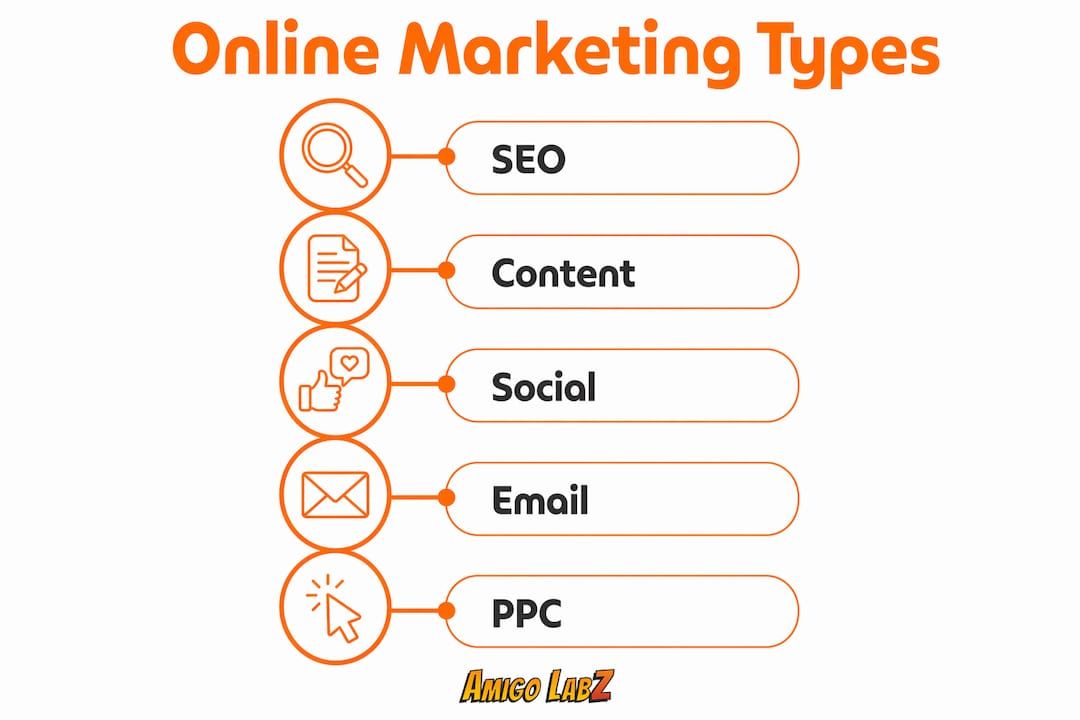
Online marketing covers every tactic that uses the internet to attract, engage, and convert customers. The core channel categories are SEO, content marketing, social media marketing, email marketing, and pay-per-click advertising. Each one serves a different role in the customer journey, and the most effective businesses use several together.

Search engine optimization (SEO)
SEO is the process of improving your website so it ranks higher in unpaid search results on Google and other search engines. Higher rankings mean more visitors without paying for each click. A local restaurant that ranks on page one for "best tacos in Newark" gets consistent foot traffic from people who are already looking to buy.
Content marketing
Content marketing means creating blog posts, videos, guides, and other media that answer your customers' questions. It builds trust before a sale happens. Content marketing works as a subset of the broader online marketing mix, distinct from paid channels, though it amplifies every other tactic you run.
Social media marketing
Social media marketing uses platforms like Instagram, Facebook, LinkedIn, and TikTok to build brand awareness and engage directly with customers. Organic posts build community. Paid social ads let you target users by age, location, interests, and buying behavior with a level of precision that no billboard can match.
Email marketing
Email marketing delivers messages directly to people who have already shown interest in your business. It consistently produces strong engagement and conversion rates because the audience is warm. A well-timed email sequence can turn a first-time buyer into a repeat customer.
Pay-per-click advertising (PPC)
PPC advertising places your business at the top of search results or across websites, and you pay only when someone clicks. Google Ads is the most widely used PPC platform. It works especially well for businesses with clear, high-intent search terms like "emergency plumber near me."
Emerging channels
Influencer marketing and affiliate marketing round out the modern mix. Influencer marketing pays creators to promote your brand to their audience. Affiliate marketing rewards third parties for sending paying customers your way. Both extend your reach without requiring you to build an audience from scratch.
| Channel | Primary goal | Best for |
|---|---|---|
| SEO | Organic visibility | Long-term traffic growth |
| Content marketing | Trust and education | Building authority |
| Social media | Engagement and awareness | Brand building |
| Email marketing | Retention and conversion | Repeat customers |
| PPC | Immediate traffic | Fast lead generation |
| Influencer/affiliate | Extended reach | New audience acquisition |
What are the key benefits of online marketing for businesses?
The benefits of online marketing go well beyond cost savings. The real advantage is control. You decide who sees your message, when they see it, and how much you spend.
-
Precision targeting. Digital platforms let you target customers by location, age, income, interests, and even past purchase behavior. A New Jersey gym can show ads only to adults within five miles who have searched for fitness classes.
-
Cost flexibility. You can start a Facebook Ads campaign for $10 a day and scale it up once you see results. Traditional media like TV or print requires large upfront commitments with no guarantee of performance.
-
Real-time feedback. Businesses can pivot strategies daily or weekly based on engagement data. Traditional media requires longer lead times. That speed advantage means you stop wasting money on what is not working much faster.
-
Broader reach. A small business in Nevada can sell to customers across the country without opening a second location. The internet removes geographic limits that once defined small business growth.
-
Measurable ROI. Every click, form submission, and purchase can be tracked back to a specific campaign. That level of attribution and tracking is impossible with a radio spot or a flyer.
Pro Tip: Set up Google Analytics and conversion tracking before you launch any paid campaign. Without it, you are spending money without knowing what is working.
The American Marketing Association confirms that consumer behavior now requires brands to maintain a strong online presence because buyers research and compare options long before they ever contact a business. If you are not visible online, you are invisible to a large portion of your potential customers.
How do you build an effective online marketing strategy?
An effective online marketing strategy starts with a clear business goal, not a channel choice. Too many business owners pick a tactic first and ask what they want to achieve second. That order produces wasted budgets.
Set measurable objectives
Define what success looks like before spending a dollar. "Get more customers" is not a goal. "Generate 50 new leads per month from Google Ads at a cost below $30 per lead" is a goal. Specific targets let you measure progress and make informed decisions.
Choose channels based on your audience
Different audiences live on different platforms. A B2B software company gets better results on LinkedIn than on TikTok. A local bakery builds more business on Instagram and Google Maps than through a blog. Match your channel selection to where your customers actually spend time.
Pro Tip: Start with one or two channels and master them before adding more. Spreading budget across five platforms too early produces mediocre results everywhere.
Build your campaign around content and data
Strong online marketing requires combining multiple tactics based on brand goals rather than relying on a single approach. A typical campaign might use SEO to drive organic traffic, retargeting ads to bring back visitors who did not convert, and email to close the sale. Each piece supports the others.
Reviewing your digital marketing strategy regularly keeps your campaigns aligned with business goals. Markets shift, platforms change their algorithms, and customer preferences evolve. A strategy that worked in january may need adjustment by april.
Monitor and optimize continuously
Track the metrics that connect to revenue, not just impressions and followers. Conversion rate, cost per acquisition, and customer lifetime value tell you whether your marketing is actually growing your business. Performance marketing practices built around real-time data use give businesses a clear edge over those still guessing.
What common mistakes should you avoid in online marketing?
Most online marketing failures come from a small set of repeatable mistakes. Recognizing them early saves significant time and money.
-
Chasing technology over outcomes. Digital marketing expert Dave Chaffey warns that results matter more than technology. Launching on every new platform because it is trending, rather than because your customers are there, drains budget without producing sales.
-
Relying on vanity metrics. Likes, followers, and page views feel good but do not pay bills. Tracking which spend drives actual results is the only way to know if your marketing is working.
-
Skipping audience research. Assuming you know what your customers want without asking them or studying their behavior produces generic campaigns that nobody responds to. Use surveys, reviews, and analytics data to understand your audience before you write a single ad.
-
Ignoring campaign data. Running a campaign for 90 days without reviewing performance is the equivalent of driving with your eyes closed. Check results weekly and make small adjustments rather than waiting for a large problem to appear.
-
Treating online and offline as separate. For businesses with physical locations, online and offline marketing should reinforce each other. A Google Ads campaign that drives people to a store should be paired with an in-store experience that matches the ad's promise.
Key Takeaways
Effective online marketing combines multiple digital channels, clear goals, and consistent measurement to produce results that traditional advertising cannot match.
| Point | Details |
|---|---|
| Online marketing definition | Promoting products or services through internet channels including SEO, social media, email, and PPC. |
| Channel diversity matters | Combining SEO, content, social, email, and paid ads produces stronger results than any single tactic. |
| Measurement drives ROI | Track conversions and cost per acquisition, not just impressions, to know what is actually working. |
| Strategy before channel | Set a specific, measurable goal before choosing which platform or tactic to use. |
| Avoid vanity metrics | Followers and likes do not equal revenue. Focus on metrics tied directly to business outcomes. |
Why most business owners get online marketing backwards
Here is what I have seen working with business owners across New Jersey and Nevada: most of them start with the tool and work backward to the goal. They hear that TikTok is growing fast, so they spend three months creating videos. They hear that SEO is important, so they publish ten blog posts. Then they look at their revenue six months later and wonder why nothing moved.
The businesses that actually grow from digital marketing do the opposite. They start with a specific customer problem, identify where that customer goes to solve it, and then build a presence there. That sounds obvious, but it requires discipline when every new platform is promising overnight results.
The other thing I have noticed is that business owners dramatically underestimate email. Social platforms change their algorithms constantly. Ad costs rise. But an email list you own is yours. A business with 5,000 engaged email subscribers has a more durable asset than one with 50,000 Instagram followers it cannot reach without paying for ads.
Online marketing in 2026 is not about being everywhere. It is about being exactly where your best customers are, with a message that speaks directly to what they need. That requires research, patience, and a willingness to let data override gut instinct. The businesses that commit to that process consistently outperform those chasing the next trend.
— John
How Amigolabz helps businesses grow online
Amigolabz works with business owners across the country, with offices in New Jersey and Nevada, to build marketing programs that produce real results. The focus is on creative strategies built around your specific goals, not generic templates.

The service lineup covers the full digital marketing mix. Facebook Ads management targets your ideal customer with precision on the platforms they use daily. Google Ads campaigns put your business in front of buyers who are actively searching for what you sell. SEO services build long-term organic visibility that compounds over time. Social media management keeps your brand active and engaging without consuming your time. If you want a team that treats your marketing budget like it is their own, reach out to Amigolabz for a conversation about what is possible for your business.
FAQ
What is the definition of online marketing?
Online marketing is the promotion of products or services through internet-based channels including search engines, social media, email, and paid advertising. It is also commonly called digital marketing or internet marketing.
What are the main types of online marketing?
The core types are SEO, content marketing, social media marketing, email marketing, and pay-per-click advertising. Influencer marketing and affiliate marketing are widely used complementary channels.
How is online marketing different from traditional marketing?
Online marketing offers real-time performance tracking, precise audience targeting, and flexible budgets. Traditional marketing such as print or TV requires larger upfront costs and provides limited data on what is actually working.
How do I start online marketing for my business?
Start by setting a specific, measurable goal, then identify which channel your target customers use most. Launch on one or two platforms, track your results weekly, and expand once you have a proven approach.
Why is online marketing important for small businesses?
Consumer behavior now requires brands to have a strong online presence because buyers research and compare options before making a purchase. A business without a digital presence is invisible to a large share of potential customers.
Recommended