SEO in Marketing: A Practical Guide for Business Owners
SEO in Marketing: A Practical Guide for Business Owners

TL;DR:
- SEO improves a website's visibility through technical optimization, relevant content, and authority building. It delivers long-term, cost-effective traffic by ranking higher in organic search results. Small businesses benefit most from consistent SEO efforts focused on foundation fixing and audience-targeted content.
Search Engine Optimization (SEO) is defined as the practice of improving a website's content, structure, and authority so it appears prominently in organic search results. For small and mid-sized business owners, understanding marketing and what SEO means is the difference between being found online and being invisible. SEO connects your business with customers at the exact moment they are searching for what you sell. The practice rests on three core pillars: technical optimization, content relevance, and authority building. Google's quality framework, known as E-E-A-T(Experience, Expertise, Authoritativeness, Trustworthiness), sets the standard for what ranks well. Unlike paid advertising, SEO builds compounding visibility over time without a cost-per-click.
What is SEO in marketing, and how does it work?
SEO is defined as the practice of optimizing digital content to increase visibility and brand authority across search engines and AI search interfaces. Search engines like Google crawl your website, index your pages, and rank them based on hundreds of signals. Those signals fall into three categories: how well your site is built technically, how relevant your content is to a searcher's query, and how much authority your site has earned from other sources.
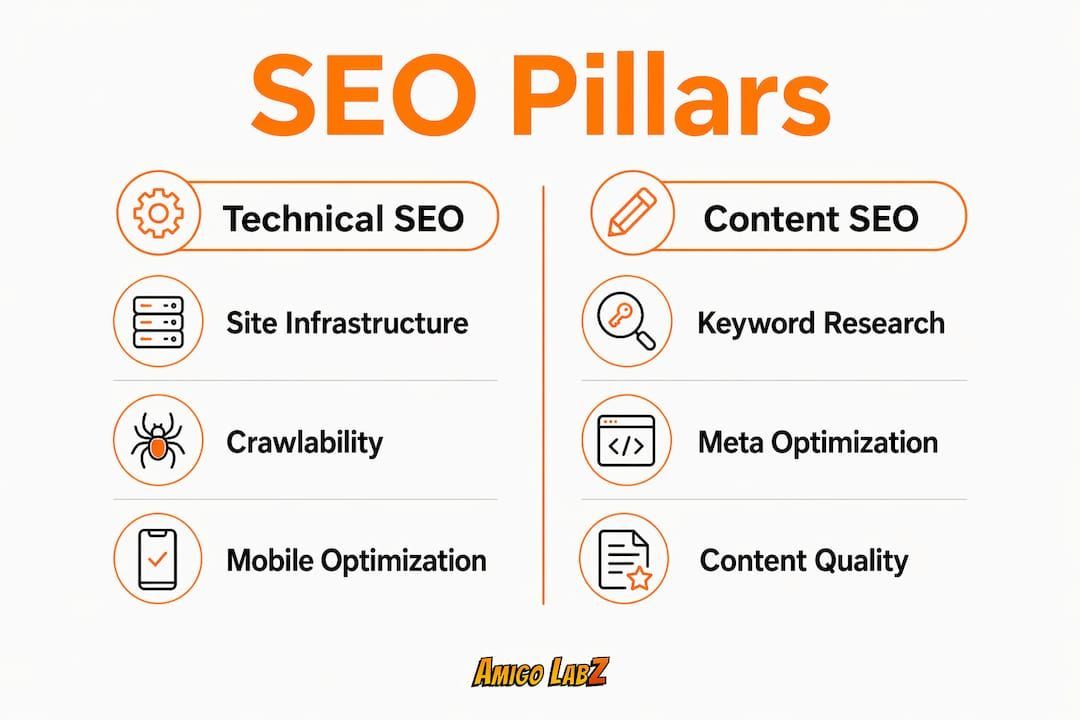
The technical layer covers site speed, mobile responsiveness, crawlability, and structured data. The content layer covers keyword targeting, topic depth, and formatting that answers real questions. The authority layer covers backlinks, brand mentions, and the trust signals your site accumulates over time. All three must work together. A beautifully written article on a slow, poorly structured site will not rank. A fast site with thin content will not rank either.
SEO also differs from Search Engine Marketing (SEM). SEM is the broader term that includes both organic SEO and paid search advertising such as Google Ads. When business owners ask what SEO stands for versus what SEM means, the short answer is: SEO earns traffic, SEM buys it. Both have a place in a complete marketing plan, but SEO is the foundation.
What are the foundational components of SEO?
Technical SEO must be resolved before content strategies generate meaningful ROI. If Google cannot crawl your pages, your content does not matter. Site speed, HTTPS security, clean URL structures, and a proper XML sitemap are the baseline requirements every business website needs before investing in content.

Content SEO focuses on matching your pages to what users actually search for. Keyword research reveals the specific phrases your customers type into Google. You then build pages that answer those queries better than anyone else. Topic cluster architecture with pillar pages and supporting satellite pages signals content depth to search engines far more effectively than a collection of disconnected blog posts. This approach also keeps visitors on your site longer, which is a positive ranking signal.
Authority SEO is about earning trust from outside your own website. Backlinks from credible websites act as votes of confidence. Brand mentions, local citations, and press coverage all contribute. Internal linking within your own site also transfers authority from strong pages to newer ones, a tactic that many small business owners overlook entirely.
| SEO Pillar | Core Focus | Key Tasks |
|---|---|---|
| Technical SEO | Site infrastructure | Fix crawl errors, improve page speed, add schema markup |
| Content SEO | Relevance and intent | Keyword research, E-E-A-T content, topic clusters |
| Authority SEO | Trust and credibility | Earn backlinks, build citations, use internal linking |
Pro Tip: Fix your technical SEO issues before writing a single new blog post. A site with crawl errors or slow load times will waste every content dollar you spend.
How does SEO differ from SEM, and why does it matter long-term?
SEO is ideal for long-term growth and cost-effective traffic, while SEM delivers immediate results through paid search. The distinction matters because each approach serves a different timeline and budget. SEM, specifically Pay-Per-Click (PPC) advertising, puts you at the top of search results the day your campaign launches. The moment you stop paying, the traffic stops. SEO takes longer to build but continues delivering traffic without an ongoing cost per click.
For small and mid-sized businesses with limited budgets, SEO provides a better return over a 12-to-24-month horizon. The content and authority you build compounds. A page that ranks well this year can keep generating leads next year without additional spend. That compounding effect is the core reason SEO belongs in every business owner's marketing plan.
Combining SEO and SEM gives businesses the best of both worlds. Use paid search to generate immediate leads while your organic rankings build. Once your SEO gains traction, you can reduce ad spend on terms where you already rank organically. This is the approach most effective marketing strategies follow.
SEO vs. SEM: Key differences at a glance
- SEO builds organic rankings over time with no cost per click
- SEM delivers immediate visibility through paid ads
- SEO has stronger long-term conversion rates for most industries
- SEM requires continuous budget to maintain traffic
- SEO requires ongoing content and technical investment
- Both can be run simultaneously for a balanced search presence
For a deeper look at how paid and organic strategies work together, the SEO and ads guide from Amigolabz breaks down the combined approach for small businesses.
What are practical SEO strategies for small business owners?
Keyword research is the starting point for every SEO effort. You need to know exactly what phrases your customers type into Google before you can create content that captures that traffic. Free tools like Google Search Console show you which queries already bring visitors to your site. From there, you build content that matches the intent behind each search.
On-page SEO in 2026 includes optimized meta titles, clear heading structures, keyword targeting, and formatting that helps AI search engines extract direct answers. Every page on your site should have a unique meta title under 60 characters, a meta description that summarizes the page, and headers (H1, H2, H3) that organize the content logically. Schema markup, a type of code that tells Google what your content is about, helps your pages appear in rich results like star ratings and FAQ boxes.
Google's E-E-A-T criteria set the quality benchmark for content. Pages that demonstrate genuine experience and expertise rank better than thin, generic content. For a local business, this means writing about your actual service area, featuring real customer reviews, and publishing content that reflects your hands-on knowledge of your industry.
Here is a step-by-step SEO checklist for business owners starting out:
- Audit your technical foundation. Run a crawl using Google Search Console to find broken links, slow pages, and indexing errors.
- Research your target keywords. Identify 10–20 phrases your customers search for and map each one to a specific page on your site.
- Optimize your existing pages. Update meta titles, add proper headers, and improve content quality on your top five most visited pages first.
- Build topic clusters. Create a main pillar page on your core service, then write supporting blog posts that link back to it.
- Earn backlinks. Reach out to local directories, industry associations, and relevant websites to get your site listed or mentioned.
- Optimize for local search. Claim and complete your Google Business Profile with accurate hours, photos, and service descriptions.
- Track and adjust monthly. Review Google Analytics and Search Console data every month to see what is working and where to improve.
For a detailed breakdown of each tactic, the SEO best practices guide from Amigolabz covers 2026 standards specifically for small business owners.
Pro Tip: SEO is not a one-time project. Treat it like a monthly business task, the same way you review your finances. Consistent small improvements compound into significant ranking gains over 6–12 months.
How can you measure SEO success and improve over time?
Measuring SEO success requires tracking organic traffic, ranking positions, click-through rates, backlinks, and conversions. Each metric tells a different part of the story. Organic traffic shows how many visitors arrive from search. Rankings show where your pages appear for target keywords. Click-through rate reveals whether your titles and descriptions are compelling enough to earn clicks even when you rank.
Google Analytics and Google Search Console are the two free tools every business owner should use from day one. Analytics shows what visitors do after they arrive. Search Console shows how Google sees your site, which queries trigger your pages, and which pages have technical issues. Together, they give you a complete picture of your SEO performance without spending a dollar on software.
| SEO Metric | What It Measures | Why It Matters |
|---|---|---|
| Organic traffic | Visitors from search engines | Shows overall SEO reach and growth |
| Keyword rankings | Page position for target queries | Tracks visibility for specific searches |
| Click-through rate | Clicks divided by impressions | Reveals title and description effectiveness |
| Backlink count | External sites linking to you | Indicates authority and trust signals |
| Conversion rate | Visitors who take a desired action | Connects SEO to actual business results |
SEO requires continuous monitoring and updates to stay competitive. Google updates its algorithm hundreds of times per year. A page that ranks well today can drop if a competitor publishes better content or earns more backlinks. Scheduling a monthly SEO review keeps you ahead of those shifts. The businesses that win in search are the ones that treat SEO as an ongoing channel, not a one-time setup.
Key takeaways
SEO is a three-pillar discipline requiring technical foundations, quality content, and earned authority to generate sustainable organic traffic for your business.
| Point | Details |
|---|---|
| Technical SEO comes first | Fix crawl errors and site speed before investing in content creation. |
| Content must match intent | Use keyword research to align every page with what your customers actually search for. |
| Authority builds over time | Earn backlinks and use internal linking to transfer trust across your site. |
| SEO outperforms SEM long-term | Organic rankings compound in value; paid traffic stops the moment budgets do. |
| Measure monthly | Track organic traffic, rankings, and conversions in Google Analytics and Search Console. |
What most small business owners get wrong about SEO
I have worked with business owners across New Jersey and Nevada, and the pattern I see most often is this: they treat SEO like a website launch task. They optimize a few pages, publish a handful of blog posts, and then wait. Six months later, they wonder why nothing moved.
The uncomfortable truth is that SEO rewards consistency more than any single tactic. I have seen businesses with average content outrank competitors with excellent content, simply because they published regularly and fixed technical issues every month. The algorithm does not care how good your best page is. It cares how trustworthy and relevant your entire site is over time.
The second mistake I see constantly is ignoring internal linking. Business owners spend money on blog content but never link those posts to their core service pages. That is leaving authority on the table. Every new piece of content you publish is an opportunity to send ranking signals to the pages that actually generate revenue.
The third mistake is chasing rankings before fixing the foundation. If your site loads slowly on mobile or has crawl errors, no amount of content will move the needle. I always start with a technical audit before recommending any content investment. The types of SEO that matter most depend on where your site currently stands, and that requires an honest assessment first.
SEO is not complicated. It is just consistent. The businesses that commit to it for 12 months almost always see results. The ones that quit after 90 days almost never do.
— John
How Amigolabz helps small businesses grow with SEO
Amigolabz works with small and mid-sized businesses across New Jersey, Nevada, and the rest of the country to build search visibility that lasts. The team handles technical audits, keyword strategy, content planning, and monthly performance reviews so business owners can focus on running their companies.

Every client starts with a full site audit to identify the technical issues holding their rankings back. From there, Amigolabz builds a content and authority plan aligned with real business goals, not just traffic numbers. If you want a clear picture of where your site stands and what it would take to rank for the searches that matter most to your business, the SEO services page is the right place to start. You can also book a call to talk through a customized plan directly with the team.
FAQ
What does SEO stand for in marketing?
SEO stands for Search Engine Optimization. It is the practice of improving a website's content, structure, and authority to rank higher in organic search results and attract relevant traffic.
How long does SEO take to show results?
SEO typically takes 3–6 months to show measurable ranking improvements, depending on your site's current authority and competition level. Consistent monthly effort accelerates results significantly.
What is the difference between SEO and SEM?
SEO focuses on earning organic rankings through content and technical improvements, while SEM uses paid advertising to appear in search results immediately. SEO builds long-term value; SEM delivers short-term traffic.
What are the most important SEO basics for beginners?
The three SEO basics every business owner should start with are fixing technical issues, researching target keywords, and creating content that matches what customers search for. Google Search Console is the best free tool to begin with.
Why is SEO important for small businesses?
SEO connects small businesses with customers at the exact moment of search intent, without paying for each click. Over time, strong organic rankings reduce dependence on paid advertising and build a more sustainable source of leads.
Recommended