Digital Marketing in Simple Words: A Business Owner's Guide
Digital Marketing in Simple Words: A Business Owner's Guide

TL;DR:
- Digital marketing involves using online channels like search, email, and social media to grow your business. Applying the 70/20/10 budget rule and focusing on a few core channels yields better results than spreading resources thin. Patience and consistent effort are essential, especially with SEO, which takes months to show significant benefits.
Digital marketing is defined as any online activity that promotes your products or services through digital channels such as websites, social media, email, and paid ads. Retail e-commerce sales reached approximately $1,192.6 billion in 2025, an 8.1% increase year over year. That number tells you one thing clearly: your customers are online, and reaching them requires a deliberate digital presence. Unlike traditional marketing, digital marketing lets you measure every dollar spent and adjust in real time. This guide breaks down what digital marketing means in simple terms, how to budget for it, and how to start without wasting money.
What is digital marketing in simple words?
Digital marketing is the practice of using online tools and platforms to attract customers and grow your business. The industry term is "digital marketing," and it covers far more ground than most business owners initially realize. Online platforms and tools such as websites, social media, and email all fall under this umbrella. The key difference from traditional marketing is measurement: you can see exactly how many people clicked your ad, opened your email, or visited your website.

What sets digital marketing apart is targeting. You can show a Facebook ad only to women aged 35–50 in New Jersey who have shown interest in home renovation. That level of precision is impossible with a newspaper ad or a billboard. Digital marketing also allows you to test two versions of an ad simultaneously and keep the one that performs better. That feedback loop is what makes it so powerful for business owners working with limited budgets.
What are the main components of digital marketing in simple terms?
The SES framework organizes digital marketing into three core channels: Search, Email, and Social. These three channels do most of the strategic work for the majority of businesses. Understanding each one helps you decide where to focus your time and money.
Search covers two areas. Search Engine Optimization (SEO) is the process of improving your website so it appears higher in Google results without paying for placement. Search Engine Marketing (SEM) is paid advertising on search engines, where you pay each time someone clicks your ad. Both methods put your business in front of people who are actively looking for what you sell.
Email is one of the most underrated channels in digital marketing. A well-built email list gives you direct access to customers without relying on a social media algorithm. Email campaigns can announce promotions, share useful content, or follow up with people who visited your website but did not buy.
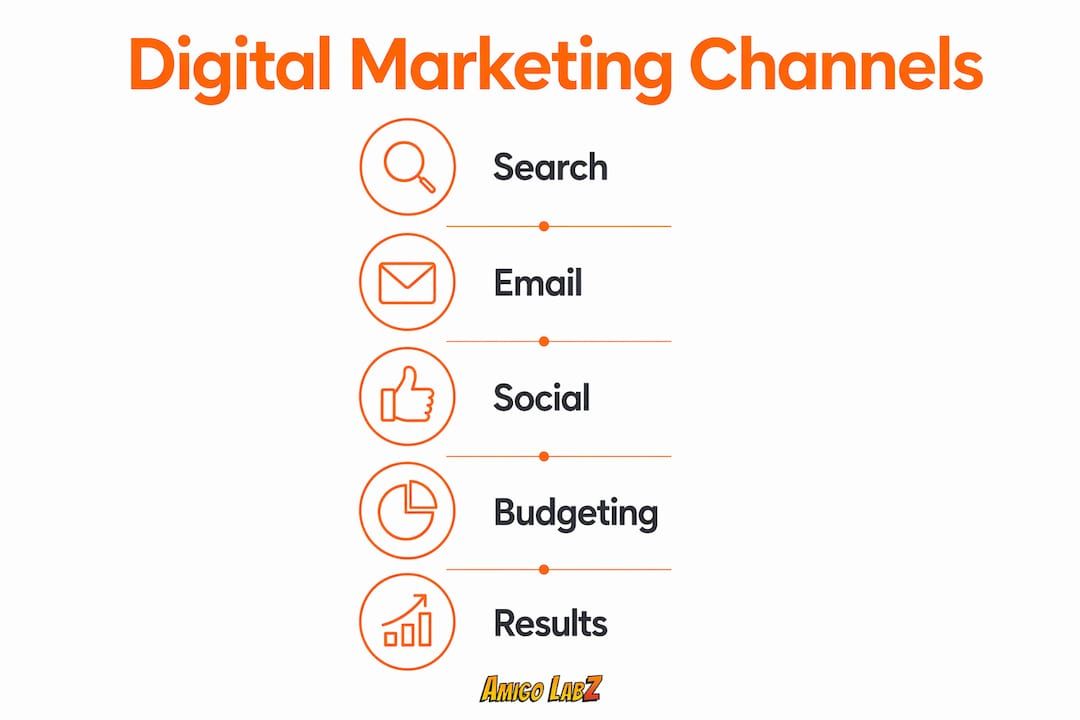
Social media covers platforms like Facebook, Instagram, LinkedIn, and others. Organic social means posting content without paying for distribution. Paid social means running ads to reach people beyond your existing followers. Content marketing and social media improve SEO visibility and reach, ultimately driving lead generation and sales. The two work together, not in isolation.
| Channel | Primary function | Best for |
|---|---|---|
| SEO | Organic search visibility | Long-term traffic growth |
| SEM (paid search) | Immediate search placement | Fast lead generation |
| Email marketing | Direct customer communication | Retention and repeat sales |
| Organic social | Brand awareness and community | Engagement and trust building |
| Paid social | Targeted audience reach | New customer acquisition |
| Content marketing | Education and SEO support | Authority and organic traffic |
Pro Tip: Pick one or two channels from the SES framework and build real depth there before adding more. Spreading thin across six platforms produces weak results on all of them.
How does digital marketing budgeting typically work?
The 70/20/10 rule is the most practical budgeting framework for digital marketing. It works like this:
- 70% goes to proven strategies. These are the channels and campaigns that already generate results for your business. Protect this budget first.
- 20% goes to promising new ideas. These are channels or tactics you have tested briefly and seen early signs of return. This is where you scale experiments that show potential.
- 10% goes to experimental approaches. This is your testing budget. Try a new ad format, a new platform, or a new content type. Most experiments fail, and that is expected.
This model matters because it prevents two common mistakes. The first mistake is spending everything on what worked last year without testing anything new. The second is chasing every new trend and spreading budget too thin to see results anywhere.
Cutting marketing budgets across the board during slow periods is counterproductive. Recapturing lost market share costs approximately $1.85 for every $1 saved by cutting. That means a $10,000 budget cut can cost $18,500 to recover. The smarter move is reallocating from underperforming channels to proven performers.
Companies that invest in marketing technology see 18% larger sales lift and 7% higher revenue growth compared to those that focus solely on ad spend. Investing in tools like analytics platforms, email automation, and CRM systems pays off beyond what raw ad dollars alone can produce.
Pro Tip: Review your marketing budget monthly, not quarterly. Monthly reviews let you catch underperforming campaigns early and shift budget before you waste a full quarter's spend.
For a deeper look at how to structure your budget from scratch, the SMB budget planning guide from Amigolabz walks through the full process with practical examples.
What are common misconceptions about digital marketing?
Several beliefs about digital marketing lead business owners to waste money or give up too early. Clearing these up saves you time and frustration.
- Social media is not all of digital marketing. Small business owners often confuse digital marketing with social media marketing. Social is one channel inside the broader SES framework. A business that only posts on Instagram is using roughly one-third of the available toolkit.
- SEO is not fast. SEO campaigns typically require 4–6 months before significant results appear, with full payback often taking 1–3 years. Business owners who expect page-one rankings in 30 days will be disappointed. SEO rewards patience and technical consistency.
- You do not need to be on every platform. Consistent presence on two or three well-chosen channels outperforms scattered activity across eight. Choosing the right channels for your audience matters more than being everywhere.
- Digital marketing is not inherently complex. The SES framework reduces the entire discipline to three manageable channels. Complexity comes from trying to do everything at once, not from the nature of digital marketing itself.
- Paid ads are not a substitute for strategy. Running Google Ads without a clear audience definition, a strong landing page, and a follow-up plan burns money. Ads amplify what already works. They do not fix a broken offer or a weak website.
How can business owners practically start and improve their digital marketing?
Starting digital marketing without a plan produces activity without results. The right sequence matters.
- Define your goal first. Are you trying to generate leads, sell products online, or build brand awareness? Each goal points to different channels and different metrics.
- Define your audience before selecting channels. Know the age, location, interests, and buying behavior of your best customers. That profile determines where you should spend time and money.
- Start with Search, Email, and Social as your core three. The SES framework gives you a focused starting point. Build a website that ranks for relevant searches, collect email addresses from day one, and choose one social platform where your audience actually spends time.
- Track results in real time. Digital marketing allows real-time measurement of key performance indicators like website traffic and conversions. Use Google Analytics, your email platform's open rate data, and your ad platform's cost-per-click reports to see what is working.
- Prioritize content quality over posting frequency. One well-written blog post that answers a real customer question outperforms ten generic social posts. Quality content builds trust and supports SEO simultaneously.
- Start small with paid ads. A $300 monthly test on Google Ads or Facebook Ads teaches you more about your audience than months of guessing. Scale what works, cut what does not.
For a detailed breakdown of how each channel fits together, the all digital marketing channels guide covers the full picture with 2026 strategy recommendations.
Key takeaways
Digital marketing is the use of Search, Email, and Social channels to attract and retain customers online, with budget discipline and real-time measurement determining whether it succeeds or fails.
| Point | Details |
|---|---|
| Simple definition | Digital marketing promotes your business through online channels like search, email, and social media. |
| SES framework | Focus on Search, Email, and Social as your three core channels before expanding further. |
| Budget with the 70/20/10 rule | Allocate 70% to proven tactics, 20% to promising tests, and 10% to experiments. |
| SEO takes time | Expect 4–6 months before SEO shows meaningful results; plan for a 1–3 year payback window. |
| Measure and reallocate | Review performance monthly and shift budget toward what works, not away from marketing entirely. |
What I have learned from watching business owners start digital marketing
Most business owners I have worked with come in thinking they need to be everywhere at once. They want a Facebook page, a TikTok account, a Google Ads campaign, a blog, and an email newsletter all running by next month. That instinct is understandable, but it is the fastest way to burn out and see zero results.
The businesses that grow steadily online share one trait: they pick a lane and stay in it long enough to learn. A local service business in New Jersey that commits to local SEO and a monthly email newsletter for 12 months will almost always outperform a competitor who tried six channels for two months each. The math is simple. Depth beats breadth.
The other pattern I have noticed is that business owners give up on SEO too early. They invest for 60 days, see no movement, and conclude it does not work. SEO is a 6-to-12-month commitment at minimum. The businesses that treat it as infrastructure, not a quick fix, are the ones that eventually stop paying for every single click.
My honest advice: start with the SES framework, set a 90-day goal for each channel, and review the numbers monthly. Digital marketing is not magic. It is a system that rewards consistency and punishes impatience. You do not need a massive budget or a marketing degree. You need a clear plan and the discipline to follow it.
— John
How Amigolabz helps you put digital marketing to work
Amigolabz works with business owners across New Jersey and Nevada to build digital marketing strategies that actually produce results. The focus is on the channels that move the needle: SEO services, Google Ads, and Facebook Ads built around your specific audience and budget. Every engagement starts with understanding your business goals, not with selling you a package.

If you are ready to stop guessing and start building a digital marketing plan that fits your budget and your market, the Amigolabz services page outlines exactly how the team approaches each channel. You can also book a direct call to talk through your situation before committing to anything.
FAQ
What does digital marketing mean for a small business?
Digital marketing means using online channels like Google, email, and social media to attract customers and grow revenue. For small businesses, it is the most cost-effective way to compete with larger brands in the same market.
How long does it take to see results from digital marketing?
Paid ads can produce results within days, while SEO typically takes 4–6 months before significant traffic appears. Building a full digital marketing system that runs consistently takes 6–12 months of steady effort.
What is the SES framework in digital marketing?
The SES framework organizes digital marketing into three channels: Search, Email, and Social. It helps business owners focus on what matters most instead of spreading effort across too many platforms.
How much should a small business spend on digital marketing?
Budget size varies by industry and goal, but the 70/20/10 rule provides a reliable structure. Allocate 70% to proven channels, 20% to emerging tactics, and 10% to testing new ideas.
Is social media the same as digital marketing?
Social media is one part of digital marketing, not the whole thing. A complete digital marketing strategy also includes search engine visibility, email communication, paid advertising, and website performance.
Recommended