What Is SEO in Business: A Small Business Guide
What Is SEO in Business: A Small Business Guide

TL;DR:
- SEO improves website visibility and attracts targeted traffic, with organic search driving over half of all site visits. It requires ongoing technical, content, and link-building efforts to build authority and achieve measurable results within months. Small businesses benefit most from local SEO, content creation, and consistent optimization, often faster with agency support.
SEO in business is defined as the practice of improving your company's website so it appears higher in search engine results, attracting customers who are already looking for what you sell. Search engine optimization, the formal industry term, covers everything from how your site is built to the words on your pages to how many other sites link to yours. Organic search drives approximately 53% of all website traffic, making it the single largest source of visitors for most businesses. That number rises to 64% in B2B markets. If your business is not showing up in search results, you are invisible to a massive pool of ready buyers.
What is SEO in business and why does it matter?
SEO is the process of earning visibility on Google and other search engines without paying for every click. When someone types "plumber near me" or "best accounting software for small business," the results they see are shaped by hundreds of ranking signals. Your job is to give Google enough evidence that your business deserves a top spot.
The financial case is clear. SEO delivers an average ROI of 748%, returning $7.48 for every $1 invested over three years. That makes it the lowest cost per acquisition channel in digital marketing. Compare that to paid ads, where traffic stops the moment you stop spending.
SEO also closes more sales. SEO leads close at a rate of 14.6%, versus 1.7% for outbound methods like cold calls and direct mail. Buyers who find you through search are already interested. They searched for a solution, found you, and arrived with intent.
The role of SEO in digital marketing extends beyond traffic. It builds brand credibility, supports content marketing, and compounds over time in ways that paid channels cannot replicate.
What are the main components of SEO and how do they work together?
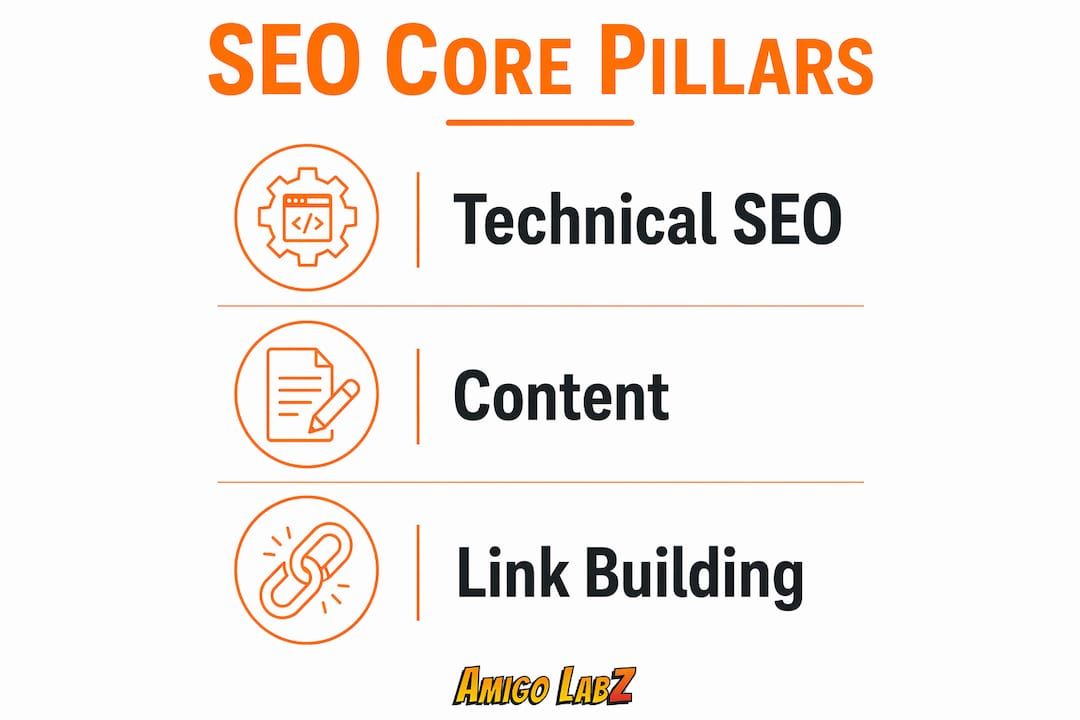
SEO has three core pillars: technical SEO, content optimization, and link building. Each one reinforces the others. A technically sound site with great content but no backlinks will struggle. A site with strong links but slow load times will lose rankings to faster competitors.

Technical SEO
Technical SEO covers everything that affects how search engines crawl and index your site. Top ranking factors in 2026 include Core Web Vitals and mobile-first optimization, meaning Google measures your site's speed, visual stability, and responsiveness on phones. A site that loads in under two seconds on mobile gives you a real competitive edge over slower local competitors.
Key technical elements include:
- Site structure: Clean URL paths and logical page hierarchy help Google understand what your site is about.
- Crawlability: A properly configured sitemap and robots.txt file tell search engines which pages to index.
- Mobile optimization: Google indexes the mobile version of your site first.
- Page experience: Core Web Vitals scores directly influence rankings.
Content optimization
Content is where you earn the trust of both Google and your customers. Google confirms that relevant, high-quality content remains a top three ranking factor. The E-E-A-T framework, which stands for Experience, Expertise, Authoritativeness, and Trustworthiness, guides how Google evaluates your content's quality.
Businesses that publish blogs increase visitors by 55% and inbound links by 97% compared to companies that do not blog. That is not a coincidence. Regular, useful content gives Google more pages to rank and gives customers more reasons to trust you.
Link building
Backlinks are votes of confidence from other websites. When a reputable local news site or industry publication links to your page, Google treats it as a signal that your content is worth ranking. Authoritative backlinks remain one of Google's top three confirmed ranking factors.
Pro Tip: Start link building by reaching out to local business associations, chambers of commerce, and industry directories. These links are easier to earn than national media placements and carry strong local relevance signals.
How long does SEO take to show results for small businesses?
Setting realistic expectations is the part most business owners get wrong. SEO is not a switch you flip. It is a process that builds momentum over months.
SEO results typically become measurable in 3–6 months, with consistent lead flow developing between 6 and 12 months. The first phase focuses on audits and foundational fixes, not traffic spikes. Technical audits normally take 1–2 weeks to complete and implement.
New businesses face an additional hurdle. New websites experience a Google sandbox phase lasting 3–4 months, during which visibility stays low even when SEO work is solid. Google is assessing whether your site is legitimate before rewarding it with rankings. This is normal, not a sign that your SEO is failing.
| Phase | Timeline | What happens |
|---|---|---|
| Foundation | Months 1–2 | Technical audit, site fixes, keyword research |
| Early growth | Months 3–4 | Content publishing, sandbox period for new domains |
| Measurable results | Months 4–6 | Rankings improve, organic traffic begins growing |
| Consistent lead flow | Months 6–12 | Traffic compounds, leads arrive regularly |
Pro Tip: Track keyword rankings and organic traffic in Google Search Console from day one. Even during the sandbox phase, you will see crawl data and impression trends that confirm your work is registering with Google.
Why topical authority is critical to SEO success
Google does not just reward websites that mention the right keywords. It rewards websites that demonstrate usefulness and expertise across a topic. This concept is called topical authority, and it is one of the most underused advantages available to small businesses.
A local HVAC company that publishes one generic "services" page will always lose to a competitor that answers 30 specific customer questions. "Why is my furnace making a clicking noise?" and "How often should I replace my air filter?" are the kinds of questions real customers type into Google. Answering them builds trust with both the reader and the algorithm.
The E-E-A-T framework reinforces this. Google evaluates whether the person or business behind the content has real experience with the topic. For a small business owner, that means writing from genuine expertise, citing credentials, and showing proof of work.
Practical ways to build topical authority include:
- Answer specific questions your customers ask in person or by phone.
- Create location-specific pages if you serve multiple cities or neighborhoods.
- Publish case studies that show real results from your work.
- Update older content when your services, prices, or processes change.
The importance of SEO in business grows directly from this principle. Businesses that treat their website as a living resource outperform those that treat it as a digital brochure.
How can business owners implement and maintain SEO effectively?
The biggest mistake business owners make is treating SEO as a one-time project. SEO is long-term infrastructure, not a campaign. Algorithms change, competitors publish new content, and your rankings will drift without ongoing attention.
A practical implementation plan for small to mid-sized businesses looks like this:
- Run a technical audit first. Identify broken links, slow pages, missing meta descriptions, and mobile issues before creating new content. Fixing these problems gives every future page a better foundation.
- Build a keyword list around customer intent. Use Google Search Console and Google's autocomplete feature to find the exact phrases your customers type. Group them by topic, not just by product.
- Publish content consistently. One well-researched article per week outperforms five thin posts. Quality signals matter more than volume.
- Claim and optimize your Google Business Profile. 58% of companies do not optimize for local search, which means local SEO is a wide-open opportunity for businesses that act on it.
- Measure monthly. Track organic sessions, keyword rankings, and conversion rates. If a page gets traffic but no inquiries, the content or call to action needs work.
On the question of doing SEO yourself versus hiring an agency: both paths work, but they have different timelines. Outsourcing SEO to agencies accelerates break-even points because agencies bring specialized tools and cross-client data that reduce trial and error. Businesses invest around $3,000 per month in SEO on average, though entry-level agency packages for small businesses often start well below that figure.
Pro Tip: If budget is tight, start with local SEO and your Google Business Profile. These two areas produce the fastest visible results for brick-and-mortar and service-area businesses.
For a deeper look at current standards, the SEO best practices guide from Amigolabz covers 2026-specific techniques worth reviewing.
Key Takeaways
SEO in business is a long-term investment that compounds over time, delivering measurable traffic, qualified leads, and sustainable revenue growth when applied consistently.
| Point | Details |
|---|---|
| SEO drives the most traffic | Organic search accounts for 53% of all website traffic, more than any other channel. |
| Results take 3–12 months | Expect measurable rankings in 3–6 months and steady lead flow by month 12. |
| Three pillars work together | Technical SEO, content quality, and backlinks each reinforce the others. |
| Topical authority wins long-term | Answering specific customer questions builds trust with Google and earns sustained rankings. |
| Local SEO is underused | 58% of businesses skip local search optimization, leaving significant traffic on the table. |
What I have learned after years of watching small businesses approach SEO
Most small business owners come to SEO expecting it to work like paid ads: spend money, see results immediately. When rankings do not appear in week two, they conclude SEO does not work. That conclusion is wrong, and it is expensive.
The businesses I have seen succeed with SEO share one trait: they commit to being genuinely useful online. Not keyword-stuffed pages. Not copied content. Real answers to real questions their customers ask. A roofing contractor who writes a clear, honest guide to spotting storm damage will outrank a competitor with a fancier website but nothing worth reading.
The other mistake I see constantly is treating SEO as a one-time fix. You cannot publish 10 articles, walk away for a year, and expect the rankings to hold. Algorithms shift. Competitors publish. Your content ages. The businesses that win are the ones that treat their website like a living part of their operation, not a set-it-and-forget-it asset.
My honest advice: if you are a small business owner with limited time, focus on local SEO first. Get your Google Business Profile right, earn a handful of local backlinks, and publish content that answers the five most common questions your customers ask. That alone will put you ahead of most competitors in your market.
— John
How Amigolabz helps small businesses grow with SEO
Growing a business through search takes consistent work across technical setup, content, and authority building. Amigolabz works with small to mid-sized businesses across New Jersey, Nevada, and nationwide to build SEO programs that fit real budgets and produce real results.

The team at Amigolabz starts with a full site audit, identifies the fastest-growth opportunities in your market, and builds a content and link strategy around what your customers actually search for. No generic templates. No one-size-fits-all packages. If you are ready to turn your website into a lead source, explore professional SEO services built for businesses like yours. For businesses also running paid campaigns, local SEO and Google Business optimization services are available to complement your broader digital presence.
FAQ
What is SEO in business, simply explained?
SEO, or search engine optimization, is the process of improving your website so it ranks higher in Google search results. Higher rankings bring more visitors who are already looking for your product or service.
How long does SEO take to work for a small business?
Most small businesses see measurable results in 3–6 months, with consistent lead flow developing between 6 and 12 months. New domains may experience a sandbox phase of 3–4 months with limited visibility even with solid SEO work in place.
Is SEO worth the investment for small businesses?
SEO delivers an average ROI of 748% over three years, making it one of the highest-return channels in digital marketing. SEO leads also close at 14.6%, far above the 1.7% close rate for outbound methods.
What is the difference between technical SEO and content SEO?
Technical SEO covers site speed, mobile optimization, and crawlability. Content SEO focuses on the quality, relevance, and depth of your written pages. Both are required for strong rankings; neither works well without the other.
Do small businesses need an agency for SEO?
Not always, but agency support accelerates results. Agencies bring specialized tools and cross-client experience that reduce the trial-and-error period most businesses face when starting SEO on their own.
Recommended