Marketing Promotional Strategy: A 2026 Business Guide
Marketing Promotional Strategy: A 2026 Business Guide

TL;DR:
- A structured promotional strategy aligns marketing efforts to achieve measurable business results and improves return on investment.
- Focusing on 2–3 core channels and setting clear, time-bound goals ensures deeper optimization and consistent messaging; avoiding campaign fatigue maintains brand strength.
A marketing promotional strategy is a structured plan that coordinates marketing efforts to increase brand visibility, drive customer engagement, and produce measurable business outcomes. Most businesses treat promotion as a series of disconnected tactics. That approach is costly. 44% of businesses cannot quantify their marketing's impact because they lack a structured promotional strategy. The industry-standard framework for building one covers seven steps: objectives, audience, budget, channels, messaging, scheduling, and optimization. Understanding where promotion strategy fits within your broader marketing plan is the first step toward spending smarter and growing faster.
Promotion strategy differs from overall marketing strategy in a specific way. Promotion strategy targets specific outcomes with deadlines, aligning teams and resources for measurable results. Marketing strategy is the long-term framework. Promotion strategy is the time-bound campaign that lives inside it.
What are the essential components of a marketing promotional strategy?
Every effective promotional plan shares six core building blocks. Skipping any one of them creates gaps that waste budget and reduce results.
-
Set SMART goals. Promotional goals must be specific, measurable, achievable, relevant, and time-bound. SMART criteria prevent vague objectives like "increase awareness" from consuming budget without accountability. A strong goal sounds like: "Generate 200 qualified leads from paid social in 60 days."
-
Segment your audience. Not every customer responds to the same message or channel. Audience segmentation by demographics, behavior, or purchase intent lets you match the right offer to the right person at the right time.
-
Reverse-engineer your budget. Start with your desired outcome, then calculate what it costs to achieve it. This approach, covered in detail in SMB budget planning, prevents the common mistake of setting a flat budget and hoping it stretches far enough.
-
Choose 2–3 core channels. Spreading resources across six platforms dilutes every one of them. Focusing on two or three high-impact channels allows deeper optimization and a stronger brand presence on each.
-
Craft a consistent message. Every ad, email, and social post in a campaign must carry the same core value proposition. Inconsistent messaging confuses potential customers and weakens brand recall.
-
Map your promotional calendar. Scheduling promotional activities prevents overlap, controls frequency, and protects brand equity. A calendar also makes it easier to spot gaps and plan around seasonal demand.
Pro Tip: Write your campaign goal before you choose a single channel. The goal determines the channel, not the other way around.
How does channel selection influence promotional strategy effectiveness?
Channel selection is where most promotional plans either gain traction or stall. The instinct to be everywhere at once is understandable, but it consistently underperforms focused approaches.

Push vs. pull: choosing the right direction
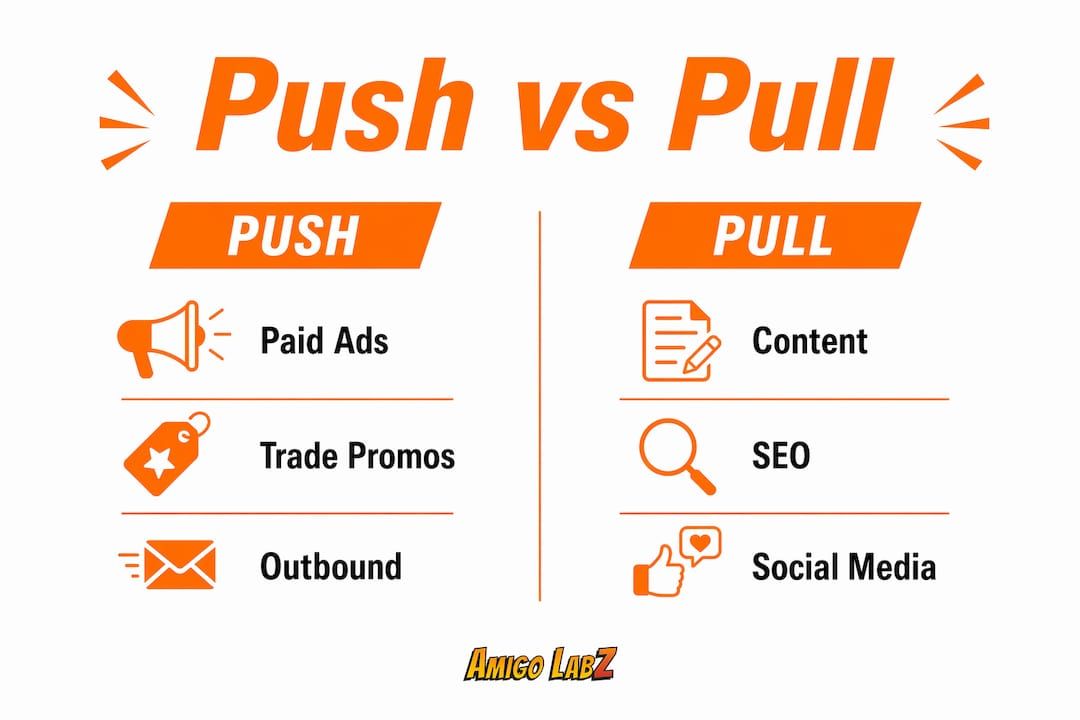
Push strategies place your product in front of buyers through paid placements, trade promotions, and outbound advertising. Pull strategies attract buyers to you through content, SEO, and organic social. Push strategies work best when purchase decisions happen at the point of distribution. Pull strategies outperform when you are selling directly to consumers who research before buying. Choosing the wrong one for your market wastes a significant portion of your budget before a single campaign launches.
Digital channels and their roles
Social media advertising delivers fast reach and precise audience targeting. Email marketing produces strong returns for nurturing existing customers and driving repeat purchases. Paid search through Google Ads captures buyers who are already looking for what you sell. Each channel serves a different stage of the customer journey, which is why web personalization across digital touchpoints increases the relevance of your message and lifts conversion rates.
Integrating offline and online channels
Offline channels like direct mail, events, and in-store promotions still perform well for local businesses and certain demographics. The key is integration. A direct mail piece that drives recipients to a landing page, or an in-store event promoted through paid social, creates a unified campaign experience. Disconnected offline and online efforts split your audience's attention and make performance tracking harder.
| Channel category | Strengths | Limitations |
|---|---|---|
| Paid social (Facebook, Instagram) | Fast reach, precise targeting | Requires ongoing spend to maintain results |
| Paid search (Google Ads) | Captures high-intent buyers | Competitive keywords drive up cost per click |
| Email marketing | Low cost, high return for existing lists | Limited reach for new audience acquisition |
| Organic search (SEO) | Compounding long-term traffic | Slow to produce results in new campaigns |
| Offline (events, direct mail) | Strong local impact, tangible touchpoint | Harder to track and measure precisely |
Pro Tip: Audit your last three campaigns and identify which one or two channels drove 80% of your results. Double down on those before adding new ones.
What are common pitfalls in promotional campaign planning?
Even well-funded campaigns fail when planning discipline breaks down. These are the four pitfalls that consistently damage results.
-
Campaign fatigue. Running promotions too frequently trains your audience to wait for the next discount instead of buying at full price. Campaign fatigue erodes brand equity and compresses profit margins over time. A strict promotional calendar with defined spacing between offers prevents this.
-
Inconsistent messaging. When your sales team, social media manager, and email marketer each describe your offer differently, customers lose confidence. Cross-team alignment on a single campaign brief before launch is not optional. It is the difference between a campaign that builds brand recognition and one that creates confusion.
-
Reporting raw numbers without context. A spike in website traffic means nothing without knowing whether it converted. Effective reporting combines data with the narrative of why performance happened and when to change course. Raw metrics without interpretation lead to the wrong decisions.
-
Isolated tactical actions. Running a paid ad without a matching landing page, or launching a social campaign without email follow-up, reduces the effectiveness of each tactic. Disconnected promotional efforts waste spend and prevent the compounding effect that integrated campaigns produce.
Pro Tip: Build a one-page campaign brief that every team member signs off on before launch. It should include the goal, the audience, the message, and the channels. Disagreements surface before they cost money.
How do you measure and optimize a promotional strategy?
Measurement is where most businesses either close the loop or lose the gains they worked to create.
-
Define KPIs before the campaign launches. KPIs must connect directly to business outcomes: revenue generated, leads captured, cost per acquisition, or engagement rate. Generic metrics like "impressions" tell you how many people saw your ad. They do not tell you whether the campaign worked.
-
Build narrative into your reports. Numbers alone do not drive decisions. Data storytelling in marketing reports explains why a metric moved, what caused it, and what the next move should be. A report that says "click-through rate dropped 18% in week three because ad frequency exceeded optimal exposure" is far more useful than a chart with a downward line.
-
Use scenario planning for budget decisions. Predictive scenario planning and live budget adjustments outperform static allocations. When one channel starts underperforming mid-campaign, reallocating that budget in real time to a higher-performing channel protects your return on investment.
-
Optimize weekly, not monthly. Monthly reviews miss the window to fix underperforming ads before they drain the budget. Weekly check-ins on cost per click, conversion rate, and audience engagement let you catch problems early and test new creative before the campaign ends.
-
Watch for channel saturation. Every channel has a point of diminishing returns. When your cost per result starts climbing without a corresponding increase in conversions, your audience has likely seen the campaign enough. Rotating creative, adjusting targeting, or shifting budget to a fresher channel restores efficiency.
Key Takeaways
A focused, measurable promotional strategy built on clear goals, tight channel selection, and consistent messaging outperforms any collection of disconnected tactics.
| Point | Details |
|---|---|
| Define goals first | Set SMART goals tied to revenue or lead outcomes before choosing channels or creative. |
| Focus channel selection | Limit campaigns to 2–3 core channels to allow deeper optimization and stronger brand presence. |
| Align messaging across teams | Every team member must work from the same campaign brief to prevent inconsistent communication. |
| Report with narrative | Combine data with explanation to understand why performance happened, not just what happened. |
| Prevent campaign fatigue | Use a promotional calendar with defined spacing to protect brand equity and profit margins. |
What I've learned about building promotional strategies that actually work
Most businesses I've worked with arrive with the same problem. They have tactics but no strategy. They have ads running, emails going out, and social posts scheduled, but none of it connects to a clear goal or a shared message. The result is activity without momentum.
The single most valuable shift I've seen is when a business stops asking "what should we post this week?" and starts asking "what outcome do we need in the next 60 days, and what is the most direct path to it?" That question forces a strategy. It forces you to pick a channel, define an audience, and write a message that serves a specific purpose.
Channel discipline is harder than it sounds. The pressure to be on every platform is real, especially when you see competitors active in places you are not. But focusing on fewer channels consistently produces better results than spreading thin. I have watched businesses cut from five channels to two and see their cost per lead drop significantly within a single campaign cycle.
The other thing I would push back on is the idea that measurement is just reporting. Reporting is what happened. Measurement is understanding why it happened and what to do next. The businesses that grow fastest treat their campaign data as a feedback loop, not a scorecard. They adjust mid-campaign, test new creative, and reallocate budget based on what the numbers are telling them. That mindset is what separates a promotional strategy from a promotional guess.
— John
How Amigolabz supports your promotional strategy execution
Amigolabz works with businesses across New Jersey and Nevada to build promotional campaigns that connect creative ideas with measurable results. The team specializes in Facebook Ads, Google Ads, social media management, and SEO, covering the core channels that drive the strongest returns for most businesses.

Every engagement starts with understanding your business goals, not just your ad budget. Amigolabz builds campaigns around the outcomes you need, tracks performance with real reporting, and adjusts strategy based on what the data shows. If you are ready to move from disconnected tactics to a coordinated promotional plan, book a call and start the conversation.
FAQ
What is a marketing promotional strategy?
A marketing promotional strategy is a structured plan that coordinates campaigns to increase brand visibility and customer engagement within a defined timeframe. It differs from overall marketing strategy by focusing on specific, time-bound outcomes.
How many channels should a promotional strategy use?
Focusing on 2–3 core channels outperforms spreading budget across many platforms. Fewer channels allow deeper optimization and a stronger brand presence on each.
What is the difference between push and pull promotional strategies?
Push strategies place products in front of buyers through paid placements and outbound advertising. Pull strategies attract buyers through content, SEO, and organic channels, and work best for direct-to-consumer sales.
How do you measure the success of a promotional campaign?
Define KPIs tied to business outcomes before the campaign launches, then track them weekly. Effective measurement combines raw data with narrative reporting that explains why performance moved and what to adjust.
What causes campaign fatigue and how can businesses avoid it?
Campaign fatigue occurs when promotions run too frequently, training customers to wait for discounts and eroding brand equity. A promotional calendar with defined spacing between offers prevents this from damaging margins.
Recommended