3–6 Month Lead Lift From SEO Content Writing for Small Businesses
3–6 Month Lead Lift From SEO Content Writing for Small Businesses

SEO content writing is the practice of creating web content designed to rank in search engines while genuinely helping the person reading it. The goal is organic traffic that converts, not just clicks. You can start tracking early signals in Google Search Console within days of publishing, and tools like Semrush help you find the right topics before you write a single word.
TL;DR:
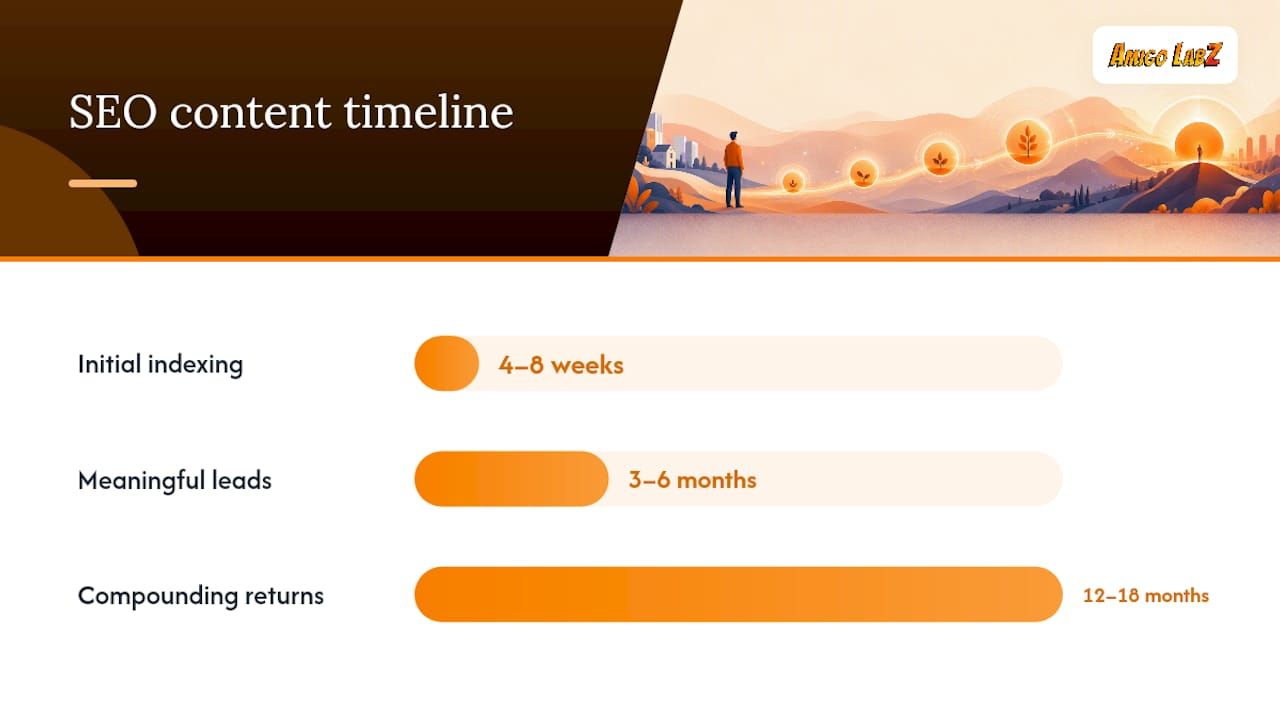
- Organic traffic from SEO content takes 4 to 8 weeks for initial indexing and can generate leads within 3 to 6 months, with full benefits appearing after 12 to 18 months.
- Successful SEO content requires thorough research of target keywords, matching search intent, and a logical heading structure to optimize both readability and search engine understanding.
- Combining internal and external links, accurate meta tags, optimized images, and a content brief streamlines production and improves page performance.
- Avoid keyword stuffing, covering too many questions at once, and neglecting regular updates to prevent content from losing relevance and ranking.
- Consistent publishing of focused, well-optimized pages over time builds domain authority and yields long-term organic visibility for small businesses.
What Does SEO Content Writing Actually Mean?
SEO content writing sits at the intersection of two goals that used to feel like opposites: writing for people and writing for algorithms. The old approach treated these as separate jobs. Write the article, then "SEO it" by cramming in keywords. That approach is dead, and Google killed it on purpose.
The current model is people-first, search-second. You research what your reader actually wants to know, answer it clearly, and structure the page so search engines can understand and surface it. Google's Helpful Content guidance makes this explicit: content that exists primarily to game rankings, rather than to serve someone with a real question, gets buried.
Here's where people get confused: SEO content writing is not the same as SEO copywriting. Copywriting is about the words themselves — the sentences, the persuasion, the tone that gets someone to click "buy" or "contact us." SEO copywriting is really a subset of the bigger job. SEO content writing includes copywriting, but it also covers research, structure, formatting, and technical setup.
A few distinctions worth keeping straight:
- General content writing aims for engagement or storytelling first, with SEO as an afterthought (or absent entirely).
- SEO copywriting focuses tightly on persuasive word choice within a page that's meant to convert.
- SEO content writing covers the whole pipeline: what to write about, how to structure it, and how to optimize it for both readers and search engines and AI-driven answers.
Understanding that distinction matters because it changes how you plan your time. A copywriter can polish a paragraph for an hour. An SEO content writer has to research first, structure second, and polish last.
Why SEO Content Writing Matters for Your Business
Organic search is one of the few marketing channels that keeps working after you stop actively promoting the page. A Facebook ad dies the moment you stop paying for it. A well-optimized blog post can pull in traffic for years.
That said, SEO content writing is not instant. Expect a rough curve: initial indexing and long-tail traffic within about 4 to 8 weeks, meaningful lead generation somewhere around 3 to 6 months, and real compounding returns by the 12 to 18 month mark. Domain age, competition, and how often you refresh the content all shift that timeline.
The metrics that actually tell you it's working:
- Impressions — how often your page shows up in search results at all.
- Click-through rate (CTR) — the percentage of people who see your listing and click it.
- Engaged time — whether people actually read the page or bounce immediately.
- Conversions — calls, form fills, purchases, whatever counts as a win for your business.
Impressions without clicks usually means your title tag or meta description isn't compelling. Clicks without engaged time usually means the content doesn't match what the searcher expected. Watching these four numbers together tells you more than any single vanity metric ever will.
The business case is straightforward once you see it in motion: content is one of the primary levers for organic visibility, and Google and major SEO platforms treat people-first content as the foundation of ranking, not a side effect of it.
Core Practices Every SEO Writer Should Know
Good SEO content writing follows a repeatable set of moves. Skip one and the whole page underperforms, even if the writing itself is sharp.
1. Keyword and topic research. Start with a primary keyword, the exact phrase your reader is likely to type. Then map out secondary keywords, the related terms and synonyms that show your page covers the topic thoroughly. Don't ignore long-tail phrases either. "Best plumber near me" gets searched constantly, but "how much does it cost to fix a leaking pipe under a sink" is a long-tail query with less competition and often higher buying intent.
2. Match the search intent. Every query implies a format. Someone searching "what is SEO content writing" wants an explainer. Someone searching "SEO content writing services" wants a page that sells something. Matching intent to format is one of the most overlooked steps in the entire process, and getting it wrong is why otherwise well-written pages never rank.
3. Build a logical heading structure. Your H1 states the topic. H2s break it into digestible sections. H3s go one level deeper when needed. This isn't just for readers skimming on their phones. It's how search engines and AI systems parse what your page actually covers.
4. Nail the on-page basics. Your title tag should include the primary keyword and stay under roughly 60 characters. Your meta description should sell the click in about 150 to 160 characters. Your URL should be short and readable. Your image alt text should describe the image accurately, which also helps accessibility.
5. Link with purpose. Internal links guide readers (and search engines) to related pages on your own site, which also spreads authority around. External links to trusted, relevant sources back up your claims and signal that you did your homework.
6. Work from a content brief. A brief typically includes the target keyword, secondary keywords, a suggested outline, sample meta tags, notes on image or video needs, links to competing content worth reviewing, and a target word count. A well-structured brief speeds up production dramatically because the writer isn't guessing what "good" looks like.
Pro Tip: Write your meta description like a mini ad, not a summary. A dry restatement of the page's content gets ignored in the results. A specific promise ("Get a five-minute checklist you can use today") earns the click.
None of these practices work in isolation. Skip the research and your outline is aimless. Skip the outline and your on-page optimization has nothing solid to attach to.

How to Write SEO Content Step by Step
Treat SEO content writing as a process, not a single sitting at the keyboard. Here's a workflow you can reuse for every page.
- Research and analyze intent. Scan the current search results for your target keyword. What format dominates? Lists, guides, comparison pages? Note the questions people are actually asking, using the "People Also Ask" boxes or a tool like Semrush's keyword research feature.
- Build the content brief. Lock in your primary keyword, secondary keywords, a working outline, and a target length based on what's currently ranking.
- Draft with answer-first paragraphs. Open each section with the direct point, then support it. This structure makes content far easier for both human skimmers and AI tools to extract the useful part of your answer.
- Run the optimization pass. Add your title tag, meta description, image alt text, and internal links once the draft is solid. Bolt these on too early and you'll end up rewriting them anyway.
- Publish, then monitor. Submit the URL through Google Search Console and watch the impressions and average position over the following weeks.
- Schedule a refresh. Mark a calendar reminder for 3 to 6 months out to revisit rankings and update anything outdated.
A few things worth double checking before you hit publish:
- Every heading actually answers a question or states a clear point, not a vague label.
- The primary keyword appears naturally in the title, the first paragraph, and at least one subheading.
- Every internal link points somewhere genuinely relevant, not just any page you had handy.
This isn't a one-and-done exercise. The content marketing checklist approach works because it turns a fuzzy creative task into a series of concrete checkpoints.
Common SEO Content Mistakes That Waste Your Effort
Most SEO content failures aren't writing failures. They're planning failures that show up after the fact.
- Keyword stuffing. Repeating your target phrase unnaturally doesn't help rankings anymore and it makes the page unreadable. Search engines have understood synonyms and context for years.
- Trying to cover everything at once. A page that tries to answer five loosely related questions usually answers none of them well, and it confuses both readers and search engines about what the page is actually for.
- Skipping evidence of real expertise. Pages with no sourced data, no named contributor, and no original examples read as generic. E-E-A-T signals like firsthand experience and cited sources carry real weight in how content gets evaluated.
- Publishing and forgetting. Content isn't a one-time project. Pages that never get revisited slowly lose ground to competitors who update theirs.
Fixing these isn't complicated. It just requires treating each page as something you'll return to, not something you finish and walk away from.
How to Measure Results and Know When to Refresh
Six metrics tell you almost everything you need to know about how a page is performing, and Google Search Console tracks four of them for free.
| Metric | What it tells you | Where to check it |
|---|---|---|
| Impressions | How often the page appears in search results | Google Search Console |
| Average position | Where the page ranks for its target queries | Google Search Console |
| Click-through rate | Whether your title and description earn the click | Google Search Console |
| Organic sessions | Actual visits from search | Analytics platform |
| Engaged time | Whether visitors stay and read | Analytics platform |
| Conversions | Calls, form fills, or purchases attributed to the page | Analytics platform or CRM |
On timing: check initial indexing and early impressions at the 4 to 8 week mark. Give a page 3 to 6 months before judging whether it's generating real leads. Compounding growth, where a page starts pulling in steady traffic without extra promotion, typically shows up between 12 and 18 months out.
Small experiments help you improve faster than a full rewrite. Try swapping a title tag or meta description and watch CTR over two weeks. Add two or three internal links from related pages and watch whether average position shifts. Notably, refreshing an existing high-performing page often produces faster gains than writing something new from scratch, since the page already has some authority built in.
Behind This Guide: Author Note and a Brief Template You Can Copy
This guide was written by John, a contributor at Amigolabz who works directly with small business owners across New Jersey and Nevada on SEO strategy, content planning, and website optimization. That hands-on client work shapes the practical framing throughout this piece rather than theory pulled from a textbook.
Here's a stripped-down brief template you can copy for your own content:
- Target keyword and 3 to 5 secondary keywords
- Search intent (informational, commercial, navigational)
- Suggested outline with H2/H3 structure
- Target word count based on top-ranking competitors
- Sample title tag and meta description
- Internal linking targets
- Notes on images or data needed
Keep this template in a shared doc. Every writer on your team should fill it out before drafting a single sentence.
Why Small Businesses Should Treat SEO Content as an Asset, Not an Expense
Sporadic publishing is the single biggest reason small business SEO content underperforms. One blog post a quarter never builds enough topical coverage to compete. Ten focused posts over six months, each answering a real question your customers ask, start reinforcing each other and pulling in steady traffic together.
DIY makes sense when you have the time to research properly and the patience to wait months for traction. Hiring makes more sense when you need consistent output, technical on-page work handled correctly the first time, or you simply don't have eight extra hours a week to dedicate to research and drafting.
A landscaping company that publishes one detailed, well-optimized guide on seasonal lawn care can watch that single page keep generating quote requests two years later, long after the initial writing time is forgotten. That's the compounding effect people underestimate. It's not glamorous, but it's real.
— John
Get SEO Content That Actually Works for Your Business
Amigolabz builds SEO content strategy the way this guide describes: research first, structured briefs, and a refresh plan baked in from day one, instead of a pile of blog posts nobody revisits. If writing and maintaining that pipeline yourself sounds like more time than your business has to spare, that's exactly the gap Amigolabz fills for small business owners across New Jersey and Nevada.

Amigolabz's SEO services cover keyword research, content briefs, on-page optimization, and ongoing monitoring, paired with tailored website solutions when your site itself needs work to support the content. If your business runs on visibility from paid channels too, Amigolabz also manages Google Ads and Facebook Ads campaigns alongside content strategy. The practical rule: DIY works if you have the hours; hire out when consistency matters more than saving a subscription fee. Book a call to talk through what your business actually needs first.
Sources
FAQ
What is SEO content writing in simple terms?
SEO content writing is creating web content that answers a real question people search for while following practices that help search engines find, understand, and rank it.
How is SEO content writing different from SEO copywriting?
SEO content writing covers the entire process, research, structure, and optimization, while SEO copywriting focuses specifically on the persuasive wording within that content.
How long does SEO content take to show results?
Initial indexing and early traffic often appear within 4 to 8 weeks, meaningful lead generation typically takes 3 to 6 months, and compounding returns tend to build by 12 to 18 months.
What tools do SEO content writers use?
Semrush and Ahrefs are common for keyword research and competitor analysis, while Google Search Console is the standard tool for monitoring impressions, rankings, and click-through rate.
Should a small business write SEO content itself or hire help?
DIY can work if you have consistent time for research and writing every week; hiring a team like Amigolabz makes more sense when you need steady output and correctly executed on-page optimization without the learning curve.
How often should SEO content be refreshed?
Plan a first review around 3 to 6 months after publishing, then revisit high-performing pages every 12 to 18 months to keep facts current and maintain rankings.
Recommended