Unlock Your Value Proposition: Guide for Small Businesses
Unlock Your Value Proposition: Guide for Small Businesses

TL;DR:
- A value proposition clearly explains why customers should choose your business over competitors.
- It should identify the customer problem, deliver benefits, and prove your reliability.
- Specific, tested, benefit-driven messages attract the right customers and differentiate small businesses.
Most small business owners think their value proposition lives on a flyer or in an elevator pitch. It does not. Your value proposition is the reason a customer picks you over the competitor two blocks away or one Google search down. It shapes every marketing decision you make, from how you run ads to how you write your website copy. A value proposition is a clear statement summarizing why a customer should choose your product or service over competitors, highlighting tangible and intangible benefits. If that statement is blurry in your head, it is blurry to your customers too.
Table of Contents
- Defining a value proposition and why it matters
- Core components of an effective value proposition
- How to craft your value proposition: Step-by-step guide
- Real-world examples and best practices for small businesses
- Our take: Breakthroughs and pitfalls in value proposition design
- Connect your value proposition to marketing success
- Frequently asked questions
Key Takeaways
| Point | Details |
|---|---|
| Clear definition | A value proposition is a concise statement explaining your unique customer benefits over competitors. |
| Essential components | Effective propositions address customer pain, present unique solutions, and offer credible proof. |
| Practical creation steps | Follow a structured approach to craft, test, and refine your value proposition for greater impact. |
| Local success examples | Examples from New Jersey and Nevada show how strong value propositions drive business growth. |
Defining a value proposition and why it matters
The term "value proposition" was first formalized by McKinsey consultants in 1988. The idea was simple: before you can sell anything, you need to clearly articulate what value you are delivering and to whom. That concept has not changed. What has changed is the competitive noise your customers face every single day.
"A value proposition is a clear statement summarizing why a customer should choose a company's product or service over competitors, highlighting tangible and intangible benefits." Wikipedia
Understanding value proposition origins helps you see why this concept is foundational, not optional. It is the filter through which all your marketing decisions should pass.
Here is where a lot of business owners get it wrong. They confuse a value proposition with a slogan. A slogan is a short, catchy phrase built for memory and brand recognition. Think "Just Do It." A value proposition, on the other hand, is a full explanation of the benefit you deliver, to whom you deliver it, and why you do it better than anyone else. It rarely fits on a bumper sticker.
Why does this clarity matter so much for small businesses in New Jersey and Nevada? Because you are competing against national brands with massive budgets. Your edge is not budget. Your edge is specificity. When you know exactly what problem you solve and exactly who you solve it for, your marketing stops being generic and starts being magnetic.
Here is what a clear value proposition does for your business:
- Shapes customer perception before they ever speak to you
- Guides your ad copy , so every dollar spent is pointed at the right person
- Trains your team to say the same thing you would say
- Reduces price objections because customers understand your worth
- Differentiates your business from competitors who all sound the same
Without this clarity, you are essentially asking customers to figure out why they should hire you. They will not do that work. They will just move on.
Core components of an effective value proposition
A strong value proposition is built from three core pieces working together. Get all three right, and your marketing becomes dramatically easier.
1. The customer problem you solve Be specific. "We help small businesses grow" is not a problem. "We help restaurant owners in Newark fill slow Tuesday nights using targeted social ads" is a problem. The more precisely you name the pain, the more your ideal customer feels seen.
2. The features and benefits you deliver Features are what you do. Benefits are what the customer gets. A value proposition must bridge both. Tangible benefits include measurable outcomes like faster delivery, lower costs, or guaranteed results. Intangible benefits include trust, peace of mind, or a better customer experience.

3. Proof that you deliver Testimonials, case studies, guarantees, and statistics all serve as proof. If you can show a Facebook Ads case study from a local business or a Google Ads result from a Nevada client, that proof makes your value proposition real instead of theoretical.
Pro Tip: Test your value proposition on someone who knows nothing about your business. If they cannot explain back to you what you do and who you help within 30 seconds, it needs to be simpler.
Here is a quick comparison to help you see the difference:
| Type | Example | Why it works or does not |
|---|---|---|
| Weak | "We offer great service at competitive prices" | Generic, applies to every business |
| Average | "Marketing agency serving small businesses" | Descriptive but not differentiated |
| Strong | "We help NJ restaurant owners fill slow nights with paid ads that average a 4x return" | Specific, benefit-driven, and proven |
Notice how the strong value proposition examples do three things at once: they name the customer, the problem, and the measurable outcome. That combination is what stops the scroll and starts the conversation.
How to craft your value proposition: Step-by-step guide
Building your value proposition does not require a consultant or a retreat. It requires honest answers to a few important questions. Here is a practical process you can work through this week.
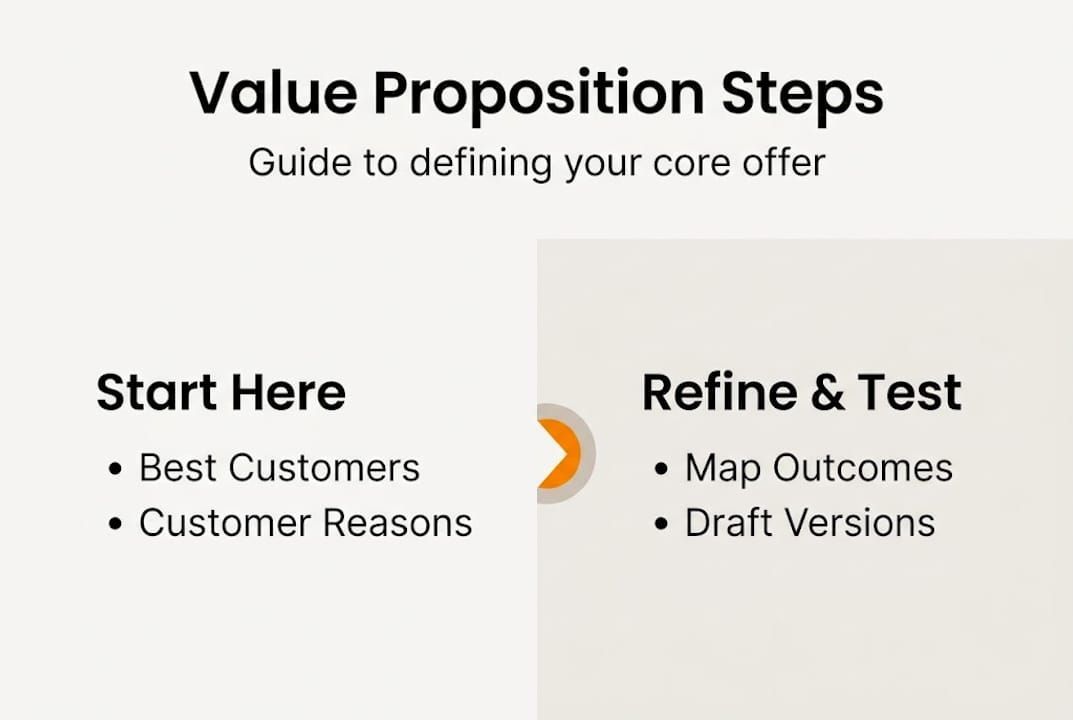
Step 1: List your best customers Write down the names of your three to five best customers. What do they have in common? Industry, size, location, problem? This is your target audience.
Step 2: Ask them directly Call or email and ask: "What was the main reason you chose us?" Their answers will be more accurate than anything you could dream up in a brainstorm session.
Step 3: Map features to outcomes For each service or product you offer, write one sentence that connects the feature to a customer outcome. A clear, customer-focused statement is your goal here, not a feature list.
Step 4: Draft three versions Write three different versions of your value proposition. Vary the language, the emphasis, and the specificity. One might focus on speed, one on results, and one on the relationship.
Step 5: Test for clarity and impact Share each version with a trusted contact outside your industry. Ask which one makes them most likely to reach out. Use that feedback to refine.
Here is what to include in your final version:
- Who you help (specific customer type)
- What problem you solve (named clearly)
- How you solve it differently (your unique approach)
- What proof supports your claim (even one data point helps)
If you use social media frameworks to distribute your message or website templates to present it, your value proposition becomes the foundation for all of it. The tools amplify the message. The message has to come first.
Pro Tip: Do not try to appeal to everyone. The more specific your value proposition, the more powerfully it speaks to the right customers.
Real-world examples and best practices for small businesses
Let's look at how this plays out for businesses in New Jersey and Nevada. These are not hypothetical scenarios. These are the types of situations we see regularly when working with local business owners.
| Business type | Weak proposition | Strong proposition |
|---|---|---|
| NJ HVAC company | "Reliable heating and cooling services" | "Emergency HVAC repair in Essex County in under 2 hours, guaranteed" |
| Las Vegas salon | "Best haircuts in the city" | "Color specialists for women over 40 who want natural-looking results, no guesswork" |
| NJ accounting firm | "Tax help for small businesses" | "We save freelancers in NJ an average of $3,200 per year in overlooked deductions" |
Effective value propositions help businesses stand out in a crowded market, especially when the message is this specific. You can see the pattern: name the person, name the problem, and name the measurable result.
Here are the best practices to keep in mind:
- Test it on real customers , not just your team or family
- Revisit it every six months as your market and customer base evolve
- Use it consistently across your website, ads, and social media
- Avoid jargon that your customer would never use themselves
- Lead with the benefit , not with your company history
Common mistakes to avoid include writing for yourself instead of your customer, focusing only on features, and trying to appeal to everyone at once. If you have used strong SEO strategies to drive traffic to your site, a weak value proposition is like a leaky bucket. You bring them in, but nothing holds them.
Our take: Breakthroughs and pitfalls in value proposition design
Here is something we rarely see discussed: most small businesses do not have a vague value proposition because they are bad at marketing. They have a vague value proposition because they are afraid to exclude anyone.
The fear sounds reasonable. "If I say I only work with restaurant owners, I might miss out on a retail client." But here is the uncomfortable truth: specificity is not a ceiling. It is a magnet. The restaurant owner reads your proposition and thinks, "These people get me." The retail client reads it and still calls because the clarity signals competence.
In our work with business owners across New Jersey and Nevada, the breakthrough moment almost always comes when an owner stops describing their service and starts describing their customer's transformation. That shift changes everything. It changes how they write ads, how they answer the phone, and how they price their work.
We have also seen the web design perspective side of this play out repeatedly: a beautiful website with a vague headline converts at a fraction of the rate of an average website with a sharp, specific value proposition front and center. Design supports the message. It never replaces it.
Connect your value proposition to marketing success
Your value proposition is the engine. Marketing is the vehicle. Without a clear, specific proposition, even the best ads and the most optimized website will underperform. You now have the framework to build a proposition that resonates, differentiates, and drives real decisions.

At Amigo Labz, we work directly with small business owners in New Jersey and Nevada to sharpen their message and connect it to marketing that actually works. Whether you are running Facebook Ads, scaling with Google Ads, or just getting started, your value proposition is where we begin every engagement. If you are ready to stop guessing and start growing, book a strategy call with our team today.
Frequently asked questions
What makes a value proposition different from a slogan?
A value proposition focuses on customer benefits and what sets you apart from competitors, while a slogan is a short phrase built for brand recall and memorability. One explains your worth; the other sticks in your head.
Can a value proposition improve advertising effectiveness?
Absolutely. When your ads reflect a clear, differentiated value proposition, they speak directly to the right customer's problem, which improves click rates, lowers ad costs, and drives better conversions.
How often should small businesses update their value proposition?
Review it at least twice a year. Value propositions need regular revisiting because customer needs, market conditions, and your own offerings all shift over time.
What are examples of tangible versus intangible benefits in a value proposition?
Tangible benefits are measurable, like saving money, faster delivery, or guaranteed results. Intangible benefits include things like trust, confidence, or a better overall experience. Both types belong in a strong value proposition.
Recommended