SEO in Digital Marketing: A Small Business Guide
SEO in Digital Marketing: A Small Business Guide

TL;DR:
- SEO improves website visibility in organic search results, building long-term, cost-effective traffic. It relies on content, authority, and technical factors, with strategies focusing on relevance and search intent. Effective SEO requires a sustained, strategic effort combining on-page, off-page, technical, and multi-platform optimization.
Search Engine Optimization (SEO) is the process of improving your website so search engines can find, understand, and rank it higher in organic search results, making your business visible to customers who are already looking for what you offer. Unlike paid ads through Google Ads or Meta, SEO builds traffic you do not have to keep paying for. Tools like Google Search Console, Ahrefs, and Semrush are central to how marketers measure and manage this work in 2026. Understanding what is the SEO in digital marketing is the first step toward building an online presence that compounds over time.
How does SEO work in digital marketing?
SEO works by aligning your website with the way search engines like Google and Bing discover, evaluate, and rank content. The process has three stages: crawling, indexing, and ranking. Search engines send automated programs called crawlers to scan your pages. Those pages then get stored in a massive index. When someone searches for a term, the engine pulls the most relevant, authoritative results from that index.

Search engines rank pages based on hundreds of factors including content quality, keyword relevance, backlinks, and user experience. That list matters because it tells you exactly where to focus your effort. A page with strong content but no backlinks will struggle. A page with backlinks but poor content will not hold its ranking.
SEO is fundamentally different from paid search marketing, also called SEM or PPC. Paid search puts your ad at the top of results immediately, but the traffic stops the moment you stop paying. SEO builds organic visibility that persists and grows. Think of paid search as renting traffic and SEO as buying the building.
Search intent is the factor most small businesses overlook. Google does not just match keywords. It tries to understand what the searcher actually wants. A page targeting "best running shoes" needs to serve someone ready to compare products, not someone looking for a history of athletic footwear. Matching your content to intent is what separates rankings that stick from rankings that bounce.
- Content quality: Original, specific, and helpful content outranks thin or copied material.
- Keyword targeting: Place your primary keyword in the title, first paragraph, and at least one subheading.
- Backlinks: Links from credible websites signal trust to search engines.
- User experience: Fast load times, mobile-friendly design, and clear navigation reduce bounce rates.
- Search intent alignment: Your content format should match what the searcher expects to find.
Pro Tip: Use Google Search Console's "Performance" report to find queries where you rank on page two. Those pages are your fastest wins. Update them with stronger content and internal links to push them onto page one.
What are the main types of SEO?
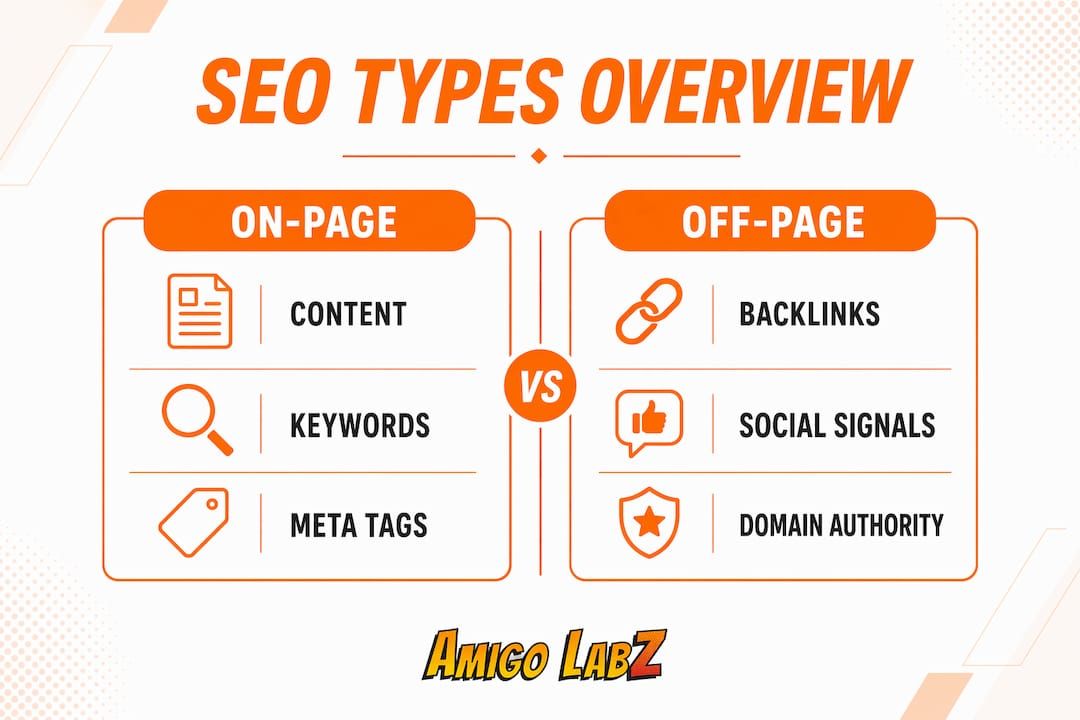
SEO involves three interconnected pillars: on-page SEO, off-page SEO, and technical SEO. Each one supports the others. Neglecting any single pillar limits what the other two can accomplish.
Here is how each type functions in practice:
-
On-page SEO covers everything you control directly on your website. This includes your page titles, meta descriptions, header tags, content depth, internal linking, and keyword placement. A well-optimized product page, for example, uses the target keyword naturally in the title and throughout the body while answering the specific question a buyer would ask.
-
Off-page SEO builds your site's authority through signals that originate outside your website. Backlinks from authoritative websites are the strongest off-page signal. A local New Jersey contractor who earns a link from a regional business journal gains more ranking power than one who collects dozens of links from low-quality directories.
-
Technical SEO covers the infrastructure that allows your content and authority signals to reach their full potential. Site speed, mobile-friendliness, and indexing are the core technical factors. A page that loads in five seconds loses visitors and rankings. Google's Core Web Vitals benchmarks make this measurable.
-
AI and multi-platform SEO is the emerging fourth consideration. SEO strategies in 2026 must expand beyond traditional Google optimization to include platforms like YouTube, Reddit, and AI-driven search tools like ChatGPT and Perplexity. Customers now discover businesses through multiple surfaces, not just a single search bar.
| SEO Type | Primary Focus | Example Action |
|---|---|---|
| On-page SEO | Content and keyword optimization | Rewrite title tags and add FAQ sections |
| Off-page SEO | Authority and backlink building | Earn mentions in industry publications |
| Technical SEO | Site infrastructure and speed | Fix crawl errors, compress images |
| AI and platform SEO | Multi-surface discoverability | Optimize for YouTube and AI answer engines |
For a deeper breakdown of each type, the types of SEO in digital marketing guide from Amigolabz covers each pillar with specific examples for small business websites.
What is an SEO marketing strategy that actually works?
An SEO marketing strategy is a documented plan that connects your content, technical improvements, and authority-building efforts to specific business goals. Without documentation, SEO becomes a series of disconnected tasks that never compound into results. SEO requires a persistent, documented strategy to produce compounding growth over months and years, not quick wins.
The most common mistake small businesses make is treating SEO as a one-time project. They hire someone to "do SEO," get a report, and move on. Rankings then slip because competitors keep publishing and updating content while the business stands still.
Updating declining content delivers better ROI than constantly producing new pages. A blog post that ranked on page one two years ago and now sits on page three can often be restored with a targeted update: fresher data, a stronger introduction, and a few added sections. That is faster and cheaper than writing an entirely new article from scratch.
- Build topical authority: Creating clusters of related content signals comprehensive expertise to search engines. A plumber who publishes ten articles covering drain cleaning, pipe repair, water heater installation, and emergency services ranks better across all those terms than one who publishes a single generic "plumbing services" page.
- Align SEO with business goals: Target keywords that reflect buyer intent, not just high search volume. "Emergency plumber Newark NJ" converts better than "what is plumbing."
- Avoid single-keyword obsession: Chasing one keyword ignores the dozens of related terms that bring qualified traffic.
- Combine SEO with paid campaigns: Use Google Ads to capture immediate traffic while SEO builds long-term visibility. The two channels reinforce each other.
Pro Tip: Set a quarterly content audit on your calendar. Pull your top 20 pages from Google Search Console, identify which ones have dropped in clicks over the past 90 days, and prioritize those for updates before creating anything new.
How does SEO fit into the broader digital marketing mix?
SEO does not operate in isolation. It connects directly to every other digital marketing channel you use, and the connections are worth understanding because they multiply results.
A balanced SEO and PPC approach produces higher conversion rates than relying on either channel alone. PPC delivers immediate traffic for high-intent searches while SEO builds the organic foundation that reduces your cost per acquisition over time. Running both together also gives you keyword data from paid campaigns that you can use to sharpen your organic content strategy.
| Channel | SEO Connection | Combined Benefit |
|---|---|---|
| Google Ads (PPC) | Keyword data and immediate traffic | Lower long-term acquisition cost |
| Social media | Content distribution and brand signals | Wider reach for SEO-optimized content |
| Email marketing | Traffic to updated content | Higher engagement signals for rankings |
| Content marketing | Core fuel for on-page SEO | Topical authority and organic traffic |
Social media does not directly influence Google rankings, but it amplifies your content's reach. A blog post shared widely on LinkedIn or Instagram earns more backlinks and brand mentions, which do influence rankings. Email marketing drives repeat visits to your content, which improves engagement metrics that search engines notice.
Voice search and AI-powered assistants like Siri and Google Assistant are now part of the discovery mix. These tools pull answers from well-structured, authoritative pages. Writing content that directly answers specific questions, using clear headers and concise paragraphs, positions your site to appear in both traditional search results and AI-generated answers. For small businesses, combining SEO with paid ads is the most practical path to covering both short-term and long-term traffic needs.
Key takeaways
SEO in digital marketing is a long-term investment in organic visibility that compounds over time when supported by consistent content updates, technical maintenance, and authority building.
| Point | Details |
|---|---|
| SEO drives organic traffic | Optimizing for search engines builds free, sustainable traffic without ongoing ad spend. |
| Three core pillars | On-page, off-page, and technical SEO each support the others and must work together. |
| Strategy beats tactics | A documented SEO plan aligned with business goals outperforms random content creation. |
| Update before you create | Refreshing existing content that has lost rankings delivers faster ROI than writing new pages. |
| SEO and PPC together | Combining organic SEO with paid search produces higher conversions than using either alone. |
Why most small businesses get SEO backwards
I have worked with dozens of small business owners who came to us at Amigolabz after spending months on SEO with nothing to show for it. The pattern is almost always the same. They focused on creating new content every week while ignoring the pages they already had. They chased high-volume keywords that national brands dominate. They treated SEO as a marketing expense rather than a business asset.
The shift that changes everything is thinking about SEO the way you think about a rental property. You do not buy a building and then ignore it. You maintain it, improve it, and let it generate returns over time. A single well-maintained, authoritative page on a specific topic will outrank ten thin pages targeting the same keyword.
The other thing I have seen consistently is that small businesses underestimate how much local and topical specificity matters. A Nevada-based HVAC company that publishes detailed content about desert climate HVAC maintenance will outrank a national competitor on local searches, even with a fraction of the backlinks. Search engines reward relevance and specificity. That is an advantage small businesses can actually use.
SEO in 2026 also means thinking beyond Google. Your customers are finding answers on YouTube, Reddit, and AI tools. The businesses that show up across those surfaces are the ones building real authority. That does not require a massive budget. It requires a clear strategy and the discipline to execute it consistently.
— John
Ready to turn SEO into a growth engine for your business?
Understanding SEO is one thing. Executing it consistently while running a business is another challenge entirely. Amigolabz works with small business owners across New Jersey and Nevada to build SEO strategies that match their goals, their market, and their budget.

Whether you are starting from zero or trying to recover lost rankings, our team builds plans around what your business actually needs, not a generic checklist. From full-service SEO to Google Business Profile optimization, we handle the technical and creative work so you can focus on running your business. Book a call with Amigolabz today and find out exactly where your biggest SEO opportunities are hiding.
FAQ
What is SEO in digital marketing?
SEO, or Search Engine Optimization, is the practice of improving a website's content, structure, and authority so it ranks higher in organic search results. It is a core component of digital marketing focused on driving sustainable, unpaid traffic from search engines like Google and Bing.
How long does SEO take to show results?
SEO is a long-term investment that typically takes three to six months to show measurable results, depending on competition and content quality. Businesses in less competitive markets or with existing domain authority may see movement sooner.
What is the difference between SEO and SEM?
SEO targets organic, unpaid search rankings through content and technical optimization, while SEM (Search Engine Marketing) refers to paid search advertising like Google Ads. SEO builds lasting visibility; SEM delivers immediate traffic that stops when the budget runs out.
Why is topical authority important for SEO?
Topical authority signals to search engines that your site comprehensively covers a subject, which improves rankings across all related keywords. Building clusters of related content around a core topic is more effective than targeting isolated keywords.
Do small businesses really need SEO?
SEO is one of the highest-return marketing investments available to small businesses because it builds traffic that does not require ongoing ad spend. Local and niche-specific SEO gives small businesses a real competitive edge against larger brands with bigger budgets.
Recommended