AdWords SEO: Boost ROI With Google Ads and SEO
AdWords SEO: Boost ROI With Google Ads and SEO

TL;DR:
- Combining Google Ads and SEO enhances website visibility and improves return on investment through integrated strategies. Businesses should allocate budgets based on their growth stage, focusing on immediate results with PPC while building long-term organic assets with SEO. Effective AI-driven campaigns and data sharing between channels lead to better performance, reduced costs, and sustainable growth.
AdWords SEO is the combined use of Google Ads and organic search optimization to increase your website's visibility and improve advertising return on investment. The industry standard term is "paid and organic search integration," but most business owners know it as the AdWords SEO strategy. Used together, Google Ads and SEO improve clicks by 25% and profits by 27% compared to running either channel alone. That number tells you something direct: neither channel is complete without the other. This article breaks down how both work, where they differ, and how to align your budget and campaigns for maximum results in 2026.
What are the core differences between AdWords and SEO?
Google Ads and SEO follow completely different economic models, and confusing them is one of the most expensive mistakes a business owner can make.
Google Ads delivers immediate visibility. You pay per click, your ad appears at the top of search results, and traffic starts the same day. Stop paying, and the traffic stops. SEO works the opposite way. It builds a compounding asset over time. Organic search leads convert at 14.6% compared to 10–12% for paid leads, and they cost roughly half as much to acquire. That conversion gap grows more significant as your SEO authority builds.
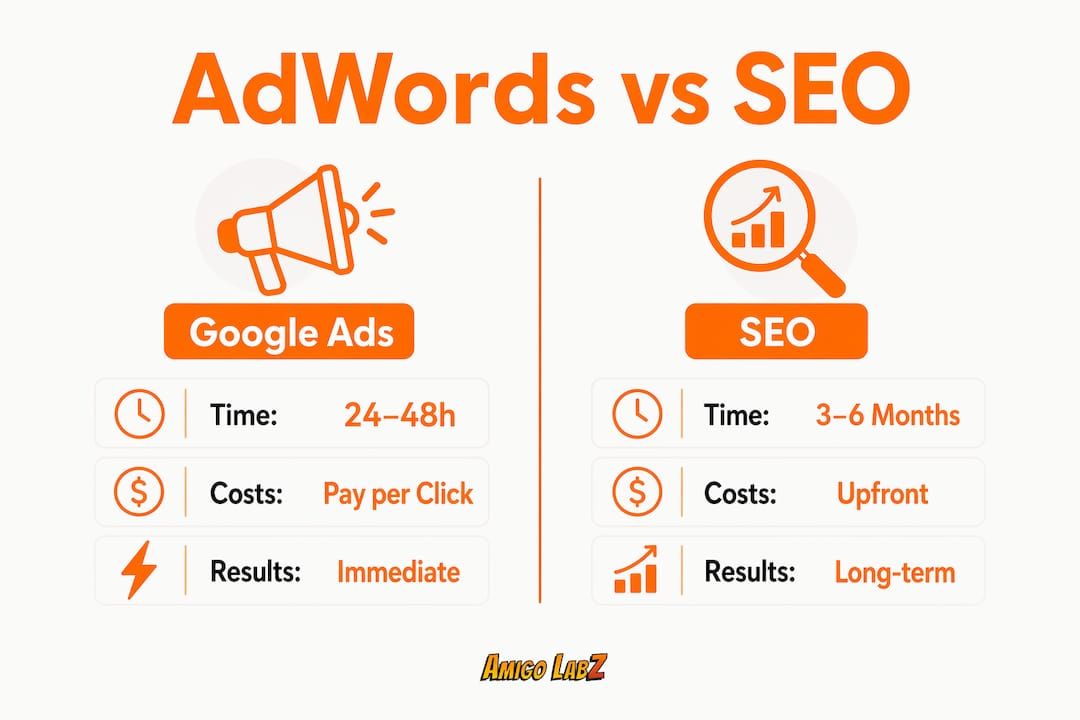
The timing difference matters just as much as the cost difference. A new Google Ads campaign can generate leads within 48 hours. A new SEO content strategy typically takes 3–6 months to show measurable ranking gains. This is not a flaw in SEO. It is the reason SEO delivers an average ROI of 22:1 over 24 months versus roughly 2:1 for PPC. You are building an asset, not renting visibility.
User behavior also differs between the two channels. Paid ads capture transactional intent well. Someone searching "buy running shoes size 10" is ready to purchase, and a Google Ads campaign can intercept that query immediately. Organic search tends to capture informational and research queries, where users are comparing options or learning before they buy. A strong AdWords SEO strategy covers both ends of that spectrum.
| Factor | Google Ads (PPC) | SEO |
|---|---|---|
| Time to results | 24–48 hours | 3–6 months |
| Cost model | Pay per click | Time and content investment |
| Traffic durability | Stops when budget stops | Compounds over time |
| Average conversion rate | 10–12% | 14.6% |
| Best for | Transactional queries | Informational and research queries |
Google Ads has also changed significantly in 2026. Smart Bidding now adjusts bids in real time based on conversion likelihood, device, time of day, and audience context. Smart Bidding delivers 15–25% better performance when paired with accurate audience data and location signals. Manual CPC bidding is no longer the standard. If you are still managing bids by hand, you are leaving performance on the table.
How can PPC data improve your SEO content strategy?
PPC data is a goldmine for SEO ideation because it shows you exactly which keywords drive profitable traffic before you invest months in organic content. This is the most underused advantage in the AdWords SEO playbook.

Here is how the process works in practice. Run a Google Ads campaign targeting a broad set of keywords in your niche. After 30–60 days, pull the search terms report. This report shows the actual queries that triggered your ads and, more importantly, which ones converted. Those converting queries are your SEO content priorities. You have paid to validate them. Now build organic content around them.
This approach works across industries. A New Jersey home services company might run Google Ads for "emergency plumber near me" and discover that "water heater replacement cost" drives a high volume of cheap clicks with strong conversion rates. That single insight shapes an entire SEO content cluster around water heater topics, reducing paid spend over time as organic rankings grow.
Pro Tip: Connect Google Ads and Google Search Console in your Google Analytics 4 account. This lets you compare paid keyword performance against organic impressions for the same queries, revealing gaps where you rank organically but do not convert, and vice versa.
Key steps to align PPC data with your SEO content roadmap:
- Export your top 20 converting search terms from Google Ads monthly.
- Cross-reference them against your current organic rankings in Google Search Console.
- Prioritize SEO content for high-converting terms where you rank below position 5.
- Use ad copy that performs well in Google Ads as the basis for your SEO title tags and meta descriptions.
- Track organic ranking progress for PPC-validated keywords quarterly.
This feedback loop between paid and organic search is what separates businesses that grow efficiently from those that spend more every year just to maintain the same results.
What is the right budget split between Google Ads and SEO?
Budget allocation between Google Ads and SEO depends on where your business is in its growth cycle. There is no universal split, but there are proven frameworks based on business maturity.
Pre-revenue startups should allocate roughly 70% of their search marketing budget to PPC to validate demand quickly. You need to know which keywords convert before you invest in long-term SEO content. Established brands with proven demand should flip that ratio, weighting 60–70% toward SEO to reduce acquisition costs over time. The logic is straightforward: once you know what converts, build the organic asset that delivers it for free.
Funnel stage also drives allocation decisions. The recommended split across the funnel is:
- Bottom-funnel keywords (60% of budget): These are high-intent, ready-to-buy queries. "Hire Google Ads agency New Jersey" or "SEO services near me" belong here. Conversion rates are highest, so this is where you protect spend first.
- Mid-funnel keywords (25% of budget): Comparison and evaluation queries. "Google Ads vs Facebook Ads for small business" or "best SEO tools 2026" fit this stage. Use a mix of paid retargeting and SEO content here.
- Top-funnel awareness (15% of budget): Educational and informational queries. These build brand familiarity and feed your remarketing audiences. SEO content is the most cost-effective tool at this stage.
As your SEO rankings grow, you can shift budget away from keywords where you rank in positions 1–3 organically. Redirect that freed-up paid budget toward new markets, new products, or bottom-funnel terms where competition is too strong for organic alone. This transition is not a one-time event. Review your allocation every quarter and adjust based on ranking progress and conversion data. For a detailed framework on setting these numbers, the marketing budget guide from Amigolabz walks through the process step by step.
What are the best Google Ads practices to support SEO in 2026?
Google Ads in 2026 is an AI-first platform. The businesses winning with paid search are the ones feeding Google's algorithms quality data, not the ones trying to outsmart them with manual controls.
Google's AI Max for Search automates ad copy assembly, keyword matching, and audience expansion. Your job shifts from writing every ad variation manually to providing strong creative inputs, accurate conversion tracking, and clear audience signals. The AI handles the rest. This is a fundamental change from how Google Ads worked even two years ago.
Campaign consolidation is the most important structural change you can make right now. Google requires 30–50 conversions per month per campaign for Smart Bidding to learn effectively. Most businesses fragment their campaigns into too many small ad groups, which starves the algorithm of data. Fewer, larger campaigns with consolidated conversion volume outperform highly segmented structures in 2026.
Pro Tip: When launching a new Smart Bidding campaign, set your initial target CPA bid 20–30% higher than your actual goal for the first two weeks. This gives the algorithm room to gather conversion data without restricting delivery. Then tighten the target once learning is complete.
AI-powered optimization delivers 25–40% performance improvements through continuous testing and iterative adjustments. That improvement compounds when your landing pages are optimized for the same keywords your ads target. This is where AdWords SEO integration pays off directly. An SEO-optimized landing page improves your Google Ads Quality Score, which lowers your cost per click and improves ad position simultaneously.
Negative keyword management remains a manual responsibility even in an AI-driven environment. Review your search terms report weekly and add irrelevant queries as negatives. Broad match with Smart Bidding is powerful, but it will spend on tangential queries if you do not actively prune. Pair your Google Ads management with a disciplined negative keyword process and you will see immediate efficiency gains.
Key takeaways
Combining Google Ads and SEO delivers better results than either channel alone, and the businesses that align their budgets, data, and campaigns across both channels consistently outperform those that treat them separately.
| Point | Details |
|---|---|
| Integration beats isolation | Running Google Ads and SEO together improves clicks by 25% and profits by 27% versus using one channel alone. |
| PPC data validates SEO content | Use converting search terms from Google Ads to prioritize your SEO content roadmap before investing in organic rankings. |
| Budget by business stage | Startups should weight 70% toward PPC; established brands should shift 60–70% toward SEO to reduce acquisition costs. |
| Consolidate campaigns for AI | Google's Smart Bidding needs 30–50 conversions per campaign monthly to learn. Fragmented campaigns degrade performance. |
| Landing page quality links both channels | An SEO-optimized landing page raises your Google Ads Quality Score, lowering cost per click and improving ad position. |
Why the SEO vs. PPC debate is the wrong conversation
I have worked with business owners across New Jersey and Nevada who come to us asking which channel they should choose. That question reveals the real problem. They are thinking about Google Ads and SEO as competing budget lines instead of as two parts of the same machine.
The SEO vs. PPC debate is genuinely outdated. The businesses I see growing consistently are not picking a side. They are using PPC to generate immediate revenue and data, then reinvesting that data into SEO content that reduces their paid spend over time. The cycle is self-funding when you run it correctly.
The most common mistake I see is over-fragmentation. A business owner or their agency builds 15 separate campaigns, each with its own small budget, and wonders why performance is flat. Google's AI cannot learn from 3 conversions a month per campaign. Consolidate, feed the algorithm, and let it work.
The second mistake is treating SEO as a cost center instead of an asset. Every piece of content that ranks in position 1 organically is a paid ad you never have to buy again. That framing changes how you think about the investment. Businesses that grow with ads and SEO together build equity in their marketing. Businesses that only run ads are renting it.
My honest advice: start with Google Ads to validate your market, use that data to build your SEO content strategy, and then gradually shift budget toward organic as rankings grow. Review the split every quarter. The goal is not to spend less. The goal is to get more from every dollar you spend.
— John
How Amigolabz can help you integrate Google Ads and SEO
Running Google Ads and SEO as a unified strategy takes more than good intentions. It takes consistent data review, campaign adjustments, and content development working in parallel.

Amigolabz manages both Google Ads campaigns and SEO services for businesses across New Jersey, Nevada, and nationwide. We build strategies where your paid search data directly informs your organic content priorities, and where your SEO rankings reduce your long-term ad spend. If you are ready to stop choosing between PPC and SEO and start using both to their full potential, book a call with the Amigolabz team. We will build a plan specific to your business, your market, and your budget.
FAQ
What does "AdWords SEO" mean?
AdWords SEO refers to the combined use of Google Ads (formerly Google AdWords) and search engine optimization to increase a website's visibility across both paid and organic search results. The goal is to maximize traffic and ROI by running both channels in coordination.
Is PPC or SEO better for a small business?
Neither is better on its own. PPC delivers immediate traffic and conversion data, while SEO builds long-term organic rankings that reduce acquisition costs over time. Most small businesses benefit from starting with PPC to validate demand, then investing in SEO as revenue grows.
How does Google Ads data improve SEO?
Google Ads search term reports show exactly which queries drive conversions. Those validated keywords become the priority for SEO content development, removing the guesswork from organic strategy and focusing effort on terms with proven commercial intent.
What is Smart Bidding in Google Ads?
Smart Bidding is Google's automated bid strategy that adjusts bids in real time based on conversion likelihood, device, location, and audience signals. It requires at least 30–50 conversions per campaign monthly to learn effectively and consistently outperforms manual CPC bidding when given sufficient data.
How much should I spend on Google Ads versus SEO?
Budget allocation depends on business maturity. Pre-revenue businesses should weight roughly 70% toward Google Ads to validate demand quickly. Established brands with proven keywords should shift 60–70% of their search budget toward SEO to build long-term organic traffic and lower cost per acquisition.
Recommended