Search Engine Optimization: What It Is and Why It Matters
Search Engine Optimization: What It Is and Why It Matters

Search engine optimization, or SEO, is the practice of improving your website so search engines can find it, understand it, and show it to people searching for what you offer. The goal is simple: appear higher in organic (unpaid) search results so the right people find you first. SEO works across three interconnected areas: technical site health, content quality, and the authority signals that come from other websites linking to yours.
Here is what SEO actually does for your site:
- Increases visibility in Google and other search engines without paying for every click
- Attracts qualified traffic from people already searching for your products or services
- Builds brand authority over time as your site earns trust from search engines
- Supports long-term growth at a lower cost per visitor than paid advertising
- Aligns your content with search intent , so visitors find exactly what they came for
SEO is not about tricking algorithms. As Moz explains, it is an art and a science centered on providing the best answer to what users are actually searching for. Get that right, and rankings tend to follow.
How search engines find, read, and rank your website
Before you can optimize anything, you need to understand what search engines are actually doing behind the scenes. The process runs in three stages: crawling, indexing, and ranking. Miss any one of them and your page will not show up, no matter how good the content is.
Crawling is where it starts. Search engines send out automated programs called bots, and Google's is called Googlebot. These bots follow links across the web, downloading page after page to bring back to Google's servers. Think of it like a librarian walking through every aisle, pulling books off shelves to catalog them.
Indexing comes next. Google analyzes the content it crawled and stores it in a massive database called the index. Not every crawled page makes the cut. Google Search Central is clear that indexing depends on content quality and metadata signals. A thin page, a duplicate, or one blocked by a robots.txt file may get crawled but never indexed.
Ranking is the final stage, and it is where the real competition happens. When someone types a query, Google's algorithms evaluate hundreds of signals to decide which pages to show and in what order. Key ranking factors include keyword relevance, backlink quality, content freshness, user experience signals, and even the searcher's location. Results are personalized, so two people searching the same phrase can see different pages depending on where they are and what they have searched before.
- Crawling: Googlebot discovers pages by following links
- Indexing: Pages are analyzed and stored (or excluded) based on quality
- Ranking: Algorithms score indexed pages against hundreds of signals per query
- Personalization: Location, language, and search history all shift what each user sees
Pro Tip: Use Google Search Console's URL Inspection tool to check whether a specific page has been indexed. If it has not, the tool tells you exactly why, whether it is a crawl error, a noindex tag, or a content quality issue.
Why SEO is one of the most cost-effective ways to grow your traffic
Paid ads stop the moment your budget runs out. SEO compounds. A page that ranks well today can keep pulling in visitors for months or years without additional spend, which is why organic search remains one of the highest-return channels in digital marketing.
The traffic SEO delivers is also different in quality. Someone who finds your site by searching "best plumber in Newark" is already in buying mode. That intent-driven traffic converts at a much higher rate than someone who saw a banner ad while scrolling through a news site.
SEO and paid search are not rivals. Integrating both covers the full user journey: SEO builds long-term visibility and trust, while pay-per-click advertising fills gaps immediately and tests which keywords convert before you invest months of SEO effort into them. For small businesses with limited budgets, SEO often delivers the better long-term return, but pairing it with even a modest Google Ads campaign accelerates results early on.
- Organic traffic is free per click , unlike paid ads that charge every time someone visits
- Higher purchase intent from users who searched a specific query before landing on your site
- Brand credibility increases when your site appears in top organic results consistently
- SEO compounds over time , while ad traffic disappears the moment spending stops
- PPC fills short-term gaps while SEO builds the long-term foundation
The bottom line on organic vs. paid: SEO builds an asset. Paid ads rent visibility. Both have a place, but only one keeps working after you stop paying.
The three core elements of SEO you need to understand
SEO breaks down into three pillars, and they are not independent. Weakness in any one of them limits what the other two can accomplish. A site with brilliant content but slow load times will lose rankings to a technically sound competitor. A technically perfect site with no backlinks will struggle to outrank established players in competitive markets.

Technical SEO
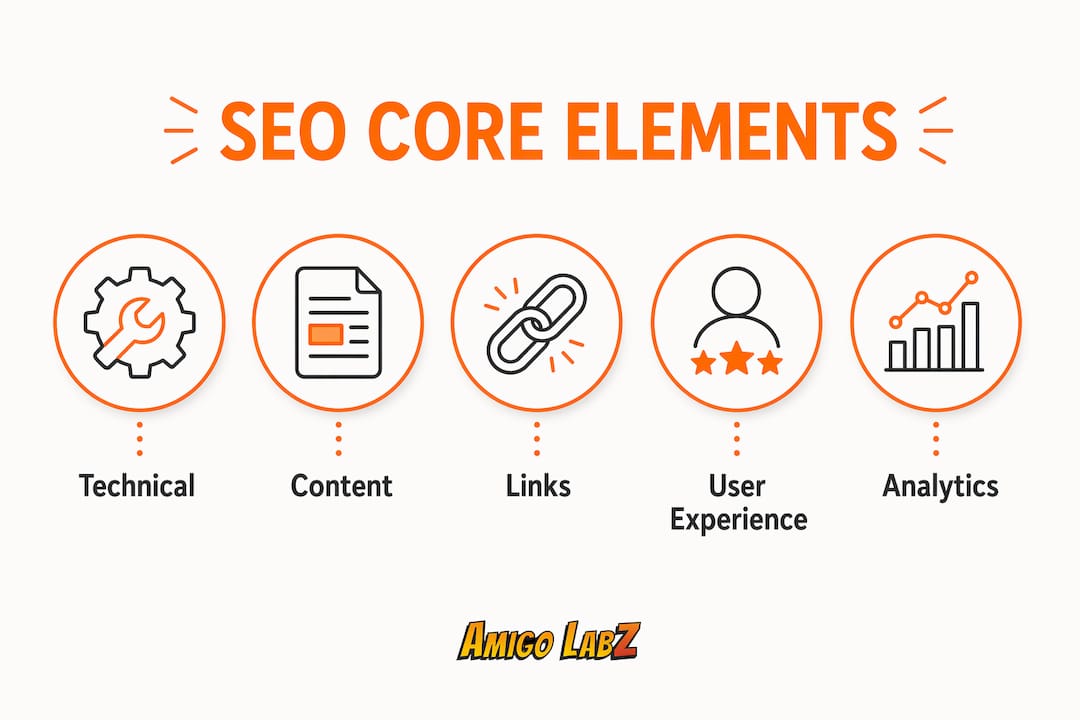
Technical SEO covers everything that affects how search engines access and process your site. Site speed matters here: Google uses Core Web Vitals as ranking signals, measuring how fast pages load, how stable they are visually, and how quickly they respond to user input. Mobile-friendliness is another technical requirement, not a bonus. Google indexes the mobile version of your site first. Structured data, clean URL structures, proper canonical tags, and an XML sitemap all fall under this category too.
Content optimization
Content is what search engines actually rank. But writing a lot of content is not the goal. Writing content that matches what users are searching for is. Yoast's SEO framework describes this as targeting search intent: understanding whether someone wants to buy, learn, compare, or find a specific page, and then building content that delivers exactly that. Keyword research identifies the phrases your audience uses. On-page optimization places those phrases in titles, headings, meta descriptions, and body copy in a way that reads naturally.
Link building
Backlinks are votes of confidence from other websites. When a reputable site links to yours, it signals to Google that your content is worth referencing. Not all links carry equal weight. A single link from a well-regarded industry publication outweighs dozens of links from low-quality directories. Building links takes time and usually requires creating content worth linking to, earning press coverage, or forming genuine partnerships.
- Technical SEO: Site speed, mobile-friendliness, crawlability, structured data
- Content optimization: Keyword targeting, search intent alignment, quality and depth
- Link building: Earning backlinks from authoritative, relevant sites
Pro Tip: Fix technical issues before scaling content. Publishing 50 new pages on a site with crawl errors or poor Core Web Vitals scores is like filling a leaky bucket. Audit your technical foundation first using Google Search Console.
Practical SEO strategies beginners can start using right now
You do not need to master everything at once. A handful of well-executed fundamentals will outperform a scattered attempt at every tactic simultaneously. Start here.

Do keyword research with intent in mind. Free tools like Google Search Console and Google's own autocomplete show you what real people are typing. Paid tools like Ahrefs and Semrush go deeper, showing search volume and how hard it is to rank for a given phrase. The key is not just finding popular keywords but understanding whether the person searching wants to buy, learn, or compare. Match your content to that intent.
Write for people, not algorithms. Google's own Search Essentials make this explicit: create content that serves users first. That means answering questions thoroughly, using clear headings, and avoiding keyword stuffing. A page that genuinely helps a reader will outperform a page that mechanically repeats a keyword phrase.
Get your technical basics right.
Run your site through Google's PageSpeed Insights to identify speed issues. Make sure every page has a unique title tag (under 60 characters) and a meta description (under 160 characters). Use descriptive URLs like /services/seo-new-jersey
rather than /page?id=42
. These are small changes with real impact.
Build internal links. Linking between your own pages helps both users and search engines navigate your site. A blog post about local SEO should link to your services page. A guide on keyword research should link to a related post on content strategy. Internal links distribute authority across your site and keep visitors engaged longer.
- Keyword research: Use Google Search Console, Ahrefs, or Semrush to find intent-driven phrases
- Content quality: Answer questions thoroughly; avoid thin or duplicate pages
- Site speed: Use PageSpeed Insights to identify and fix load-time issues
- Title tags and meta descriptions: Unique, descriptive, within character limits
- Internal linking: Connect related pages to spread authority and improve navigation
- URL structure: Use short, descriptive URLs that reflect page content
Pro Tip: Update your top-performing pages every 6–12 months. Refreshing statistics, adding new sections, and updating examples signals to Google that your content is current, which can lift rankings without building a single new link.
For a deeper look at how SEO fits into your broader marketing plan, the Amigolabz small business SEO guide walks through the process step by step.
How long does SEO take, and how do you know it is working?
This is the question every business owner asks first, and the honest answer is: longer than most people expect. SEO results typically begin showing after 3–6 months of consistent effort. In competitive niches, meaningful ranking gains can take 12 months, and in the most contested markets, up to 24 months is not unusual.
That timeline frustrates people who are used to the instant feedback of paid ads. But the growth curve for SEO is not linear. Rankings often fluctuate in the early months as Google recalibrates its understanding of your site. Then, once trust builds, traffic tends to grow faster than the effort you are putting in.
Early wins you can track before rankings move include improved crawl coverage in Google Search Console, more pages getting indexed, and local search visibility if you have a Google Business Profile. These are leading indicators that your work is taking hold.
Once traffic starts flowing, the metrics that matter most are:
- Organic sessions: How many visits come from unpaid search results
- Keyword rankings: Which positions your target pages hold for priority phrases
- Click-through rate (CTR): The percentage of searchers who click your result after seeing it
- Bounce rate: Whether visitors stay and engage or leave immediately
- Conversions: Form fills, calls, purchases, or whatever action your site is built around
On SEO timelines: Sites that stop updating content after an initial push often lose ground within months, even when early results looked strong. Sustained effort is what separates sites that plateau from those that keep climbing.
Ranking fluctuations during the first few months are normal, not a sign that something is broken. Google runs constant algorithm updates, and new content goes through a testing period before settling into stable positions. Track trends over 90-day windows rather than reacting to week-to-week swings.
SEO advice specifically for small business owners in the U.S.
Small businesses face a different SEO reality than large brands. You probably cannot out-publish a national competitor, and you do not need to. Your advantage is specificity: you serve a defined geography, a defined audience, and often a defined problem. SEO built around that specificity can outperform generic national content for the searches that actually matter to your business.
Start with your Google Business Profile. For any business with a physical location or a service area, this is the single highest-leverage SEO action you can take. Local SEO through a well-optimized Google Business Profile can produce visible results within weeks, far faster than general organic SEO. Fill out every field, add photos, collect reviews, and post updates regularly.
Target local and niche keywords. "Electrician" is a brutal keyword to rank for nationally. "Licensed electrician in Trenton NJ" is winnable. Build pages and content around the specific locations and services you actually offer. This is where small businesses consistently beat larger competitors who write generic content for broad audiences.
Treat SEO as an ongoing operation, not a one-time project. The businesses that win at SEO are the ones that publish consistently, fix technical issues as they arise, and keep their content current. Sites that stop updating often lose competitive standing even after strong early results. Budget time for SEO the same way you budget for payroll or inventory.
Integrate SEO with your other marketing. Social media posts drive traffic that signals engagement. Email newsletters bring repeat visitors. A well-run social media presence amplifies the content you have already invested in creating. None of these channels replace SEO, but they all feed it.
- Google Business Profile: Complete every field, add photos, and respond to reviews
- Local keyword targeting: Focus on city- and neighborhood-level phrases you can realistically rank for
- Consistent publishing: Regular content updates signal an active, authoritative site
- Technical maintenance: Fix broken links, update outdated pages, monitor Core Web Vitals
- Cross-channel integration: Use social media and email to drive traffic to your SEO-optimized pages
Pro Tip: Look at the "People Also Ask" boxes that appear in Google search results for your main keywords. Each question is a content opportunity. Write a clear, direct answer to one of those questions and you have the foundation of a page that can rank for featured snippets.
If you want a structured plan for putting these tactics into practice, Amigolabz's SEO services are built specifically for businesses that need real results without the enterprise-level price tag.
Ready to put SEO to work for your business?
Understanding SEO is one thing. Executing it consistently while running a business is another. Amigolabz works with small and mid-sized businesses across New Jersey and Nevada, building custom website and SEO solutions that connect your site to the customers already searching for what you offer.

Whether you are starting from scratch or trying to recover lost rankings, the team at Amigolabz brings the creative strategy and technical depth to move the needle. Book a call and get a clear picture of where your site stands and what it would take to grow.
Key Takeaways
SEO works when technical site health, content quality, and link authority all operate together, and results compound over months, not days.
| Point | Details |
|---|---|
| SEO definition | SEO improves website visibility in organic search results by aligning content and structure with how search engines work. |
| Three-stage process | Search engines crawl, index, and rank pages; a site must pass all three stages to appear in results. |
| Realistic timeline | Most sites see meaningful SEO results after 3–6 months of consistent effort; in competitive niches, ranking gains can take 12 months, and in the most contested markets, up to 24 months is not unusual. |
| Three core pillars | Technical SEO, content optimization, and link building each contribute to ranking potential. |
| Local SEO advantage | Google Business Profile optimization can deliver visible results for small businesses within weeks. |
FAQ
What is search engine optimization?
Search engine optimization is the practice of improving a website's content, structure, and authority so search engines rank it higher in organic (unpaid) results. The goal is to attract visitors who are already searching for what the site offers.
What is an example of SEO in practice?
A local bakery adding location-specific keywords to its website, completing its Google Business Profile, and earning a mention in a local food blog is practicing SEO. Each action helps Google connect the bakery to nearby searchers.
What is SEO and why does it matter?
SEO matters because organic search is how most people find websites, and higher rankings mean more visitors without paying for every click. Unlike paid ads, well-executed SEO continues delivering traffic long after the initial work is done.
How exactly does SEO work?
Search engines send bots to crawl web pages, store quality pages in an index, and then rank indexed pages using hundreds of signals including keyword relevance, backlink authority, and user experience. Optimizing for those signals is what SEO does.
Recommended