Rank on Google Maps: Your Local Business Visibility Guide
Rank on Google Maps: Your Local Business Visibility Guide
TL;DR:
- Your business's visibility on Google Maps depends on relevance, prominence, and location, which you can influence through optimization and reviews. Maintaining an active, complete, and consistent Google Business Profile is essential for ranking well and attracting customers. Regularly soliciting reviews, posting updates, and fixing profile discrepancies rapidly improve local search results and visibility.
You've built a solid business, your customers love you, and your service speaks for itself. But when someone nearby searches for exactly what you offer, your business is nowhere to be found on Google Maps. This invisible wall costs you real customers every single day. Understanding Google's local ranking system isn't optional anymore for business owners in New Jersey and Nevada. It's the difference between a full schedule and an empty one. This guide breaks down exactly what drives rankings and gives you a clear, actionable path to show up where it counts.
Table of Contents
- Understand Google's local ranking signals
- Prepare your Google Business Profile for success
- Step-by-step: Increase your prominence and relevance
- Verify your results and troubleshoot visibility issues
- Our hard-won take: What actually works for local ranking
- Boost your Google Maps visibility with expert help
- Frequently asked questions
Key Takeaways
| Point | Details |
|---|---|
| Master Google's ranking signals | Concentrate on relevance and prominence since you can't control proximity. |
| Optimize your profile | Keep your Business Profile complete, verified, and consistent everywhere online. |
| Earn and manage reviews | Encourage happy customers to review your business and respond promptly to build trust. |
| Watch for visibility issues | Service-area businesses should pay special attention to address privacy settings and their impact on ranking. |
| Professional help works | If optimizations aren't enough, specialized local SEO services can speed up results and solve edge cases. |
Understand Google's local ranking signals
With the problem defined, let's break down what Google genuinely values in local search results.
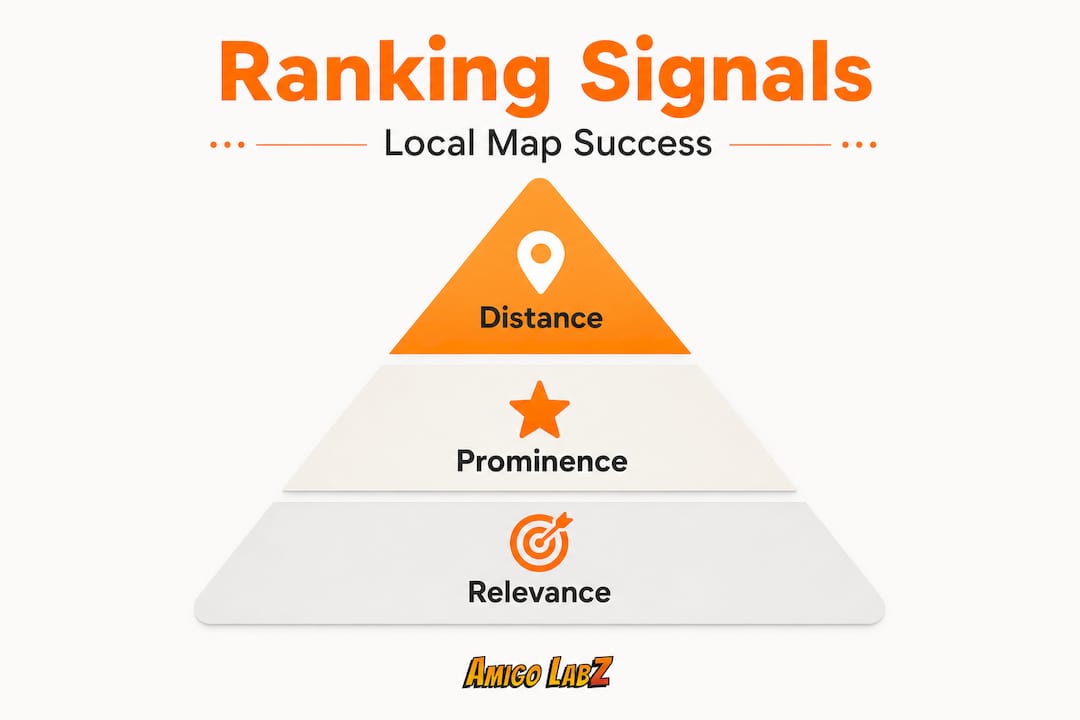
Google doesn't rank local businesses randomly. There's a well-structured system at work, and once you understand it, you can make strategic moves rather than guessing. Google uses relevance, distance, and prominence as the major pillars for local ranking. These three factors work together, but they don't carry equal weight in every situation.
Here's a quick look at each signal and what you can control:
| Ranking signal | What it means | Your control level |
|---|---|---|
| Relevance | How closely your business matches the search query | High |
| Distance | How close your business is to the searcher | None |
| Prominence | Your online reputation and digital footprint | High |
Relevance is about matching intent. When someone in Newark searches "Italian restaurant open late," Google wants to show the business that best fits that exact search. Your categories, keywords, and business description all feed into this signal.
Distance is largely out of your hands. Google factors in proximity, but this doesn't mean nearby businesses always win. A business a few miles away with strong prominence and relevance can outrank a competitor right around the corner.
Prominence is where the real game is played. Reviews, web mentions, photos, and overall activity on your profile all signal to Google that your business is popular and trusted. This is what separates high-ranking businesses from invisible ones.
"Proximity is just one piece of the puzzle. Businesses that invest in relevance and prominence consistently outperform competitors who rely on location alone." — Local SEO practitioners across multiple markets
For a deeper look at how the full ranking system works, our Google Maps ranking guide walks through advanced tactics beyond the basics. Google's own Business Profile information page also explains how they use your profile data to match you with local searches.
Understanding these pillars gives you a framework. Every action you take from here should move the needle on relevance, prominence, or both.
Prepare your Google Business Profile for success
Knowing what Google values, the next step is making sure your Business Profile is set up to maximize those signals.
Your Google Business Profile is your most powerful local SEO tool. It's free, it's visible, and it directly feeds all three ranking signals. The problem is most businesses treat it as a one-time setup rather than an active marketing asset.
Google uses information in Business Profiles, including owner-provided info and user contributions, to surface relevant local search results. That means every field you fill out matters.

Here's a side-by-side comparison of an under-optimized profile versus a fully optimized one:
| Profile element | Under-optimized | Fully optimized |
|---|---|---|
| Business name | Generic or keyword-stuffed | Accurate legal name |
| Categories | One generic category | Primary + multiple secondary |
| Description | Blank or vague | Keyword-rich, clear, 750 characters |
| Photos | 0-2 photos | 10+ high-quality photos updated regularly |
| Hours | Missing or outdated | Current hours including holidays |
| Reviews | None or unresponded | Active, with responses to all reviews |
| Posts | None | Weekly or biweekly updates |
Follow this numbered checklist to get your profile into top shape:
- Claim and verify your profile. An unverified profile can't rank well and leaves you open to unauthorized edits.
- Fill in every field completely. Business name, address, phone number, website, hours, and description should all be filled with accurate information.
- Select the right categories. Your primary category is the most important. Add specific secondary categories to capture related searches.
- Write a detailed business description. Use your actual services, your city, and natural language. Avoid keyword stuffing.
- Upload high-quality photos. Include your storefront, interior, products, and team. Google reports that businesses with photos get significantly more clicks and direction requests.
- Add your services and products. This helps Google match you to specific searches and adds depth to your profile.
- Enable messaging. This signals activity and gives customers a low-friction way to reach you.
- Keep information consistent across all platforms. Your name, address, and phone number (NAP) should be identical on Google, Yelp, Facebook, and any directories.
That last point about consistency is critical. Google's ecosystem pulls in multiple sources, so keep business facts consistent across platforms to avoid confusion that can hurt your rankings. A business listed as "ABC Plumbing" on Google but "ABC Plumbing Services LLC" on Yelp creates conflicting signals.
Pro Tip: Service-area businesses in New Jersey and Nevada that operate without a physical storefront should still complete every other field. Leaving fields blank weakens your profile significantly. Check out our guide on Google business optimization for a full walkthrough, or start from scratch with our post on how to create a Google Business page if you haven't set one up yet. Pairing your Business Profile with a strong website is also key. Our improve online presence resource covers how your site design connects to local visibility.
Step-by-step: Increase your prominence and relevance
Once your profile is strong, take these steps that actually improve the factors Google measures.
A polished profile is your foundation, but active effort is what pushes you up the rankings. Think of prominence as your business's reputation score in Google's eyes. The more signals pointing to your business as trusted, active, and relevant, the better your ranking.
Here's what you should prioritize as a New Jersey or Nevada business owner:
- Ask every customer for a review. This is the single most impactful thing you can do for prominence. Train yourself and your team to ask at the end of every transaction, whether in person, by text, or by email. A steady flow of new reviews tells Google your business is active and valued.
- Respond to every single review. Positive or negative, respond. Responding to reviews signals engagement and shows Google that your business is attentive. For negative reviews, respond professionally and offer to resolve the issue. This protects your reputation and can actually win back customers.
- Post photos consistently. Upload fresh photos at least twice a month. Show seasonal specials, completed work, team members, and your physical location. Businesses in visually driven industries like restaurants, salons, and home services benefit especially from this.
- Publish Google Posts weekly. Google Posts are short updates that appear directly on your Business Profile. Announce promotions, share news, highlight services, or post about local events. This signals ongoing activity and keeps your profile fresh.
- Add specific services and attributes. Don't just say you're a "cleaning service." List carpet cleaning, deep cleaning, commercial cleaning, and so on. The more specific your listed services, the more search queries you match.
- Build local citations. Get your business listed in local directories like the New Jersey Business Action Center listings, local Chamber of Commerce directories in Nevada cities like Las Vegas or Reno, and industry-specific platforms. Consistent mentions across the web boost prominence.
- Monitor and adjust based on competitor activity. Look at who is outranking you. What categories do they use? How many reviews do they have? How often do they post? This tells you where your gaps are.
Treat ranking as a system: you can't optimize distance, so strengthen relevance and prominence every week. Businesses that do this consistently almost always see improvement within 60 to 90 days.
Pro Tip: Ask for reviews right after a positive customer interaction, not days later. The moment a customer says "this was great," hand them a card with a QR code linking directly to your Google review page. Conversion rates are much higher in that moment than in a follow-up email. Our reputation management tips go deeper on building a sustainable review strategy. For a complete local search strategy, explore our local SEO services page.
Verify your results and troubleshoot visibility issues
With your optimization steps underway, it's vital to measure progress and avoid pitfalls that might undermine your visibility.
Optimizing without tracking is like driving without a dashboard. You need to know if your efforts are actually moving the needle before investing more time.
Here's a quick reference for tools and visibility checks:
| Tool or method | What it measures | How often to use |
|---|---|---|
| Google Business Profile Insights | Profile views, clicks, calls, direction requests | Weekly |
| Search term reports in Google Insights | What queries triggered your listing | Monthly |
| Manual search testing | Where you appear in local map pack | Bi-weekly |
| Third-party local rank trackers | Position for specific keywords in specific zip codes | Monthly |
A few common visibility problems and what to do about them:
- Profile not verified: Log in to your Google Business Profile and complete verification. Without it, your listing has very limited visibility.
- Duplicate listings: Search for your business name to check if duplicate profiles exist. Merge or report them through Google Business support.
- Inconsistent NAP information: Run a citation audit using a local SEO tool to find where your name, address, or phone number appears differently across the web. Correct each one.
- No recent activity: If your profile has gone months without updates, posts, or new photos, Google may deprioritize it. Resume activity immediately.
- Wrong or missing categories: Log in and compare your categories to those of businesses outranking you. Adjust accordingly.
"Visibility issues are rarely caused by one thing. They're usually the result of several small inconsistencies stacking up over time."
One specific issue worth calling out for New Jersey and Nevada service-area businesses: service-area businesses that hide addresses may lose visibility compared to those that display them. If you work from home and feel uncomfortable displaying your home address, consider using a registered business address or a co-working space in your service city. The visibility trade-off of hiding your address is significant.
When you're ready to rank first on Google Maps, verifying your data and fixing inconsistencies is often the fastest path to improvement. Most businesses see measurable changes within a few weeks of cleaning up their information.
Our hard-won take: What actually works for local ranking
After examining troubleshooting and verification, let's look at what truly shifts the needle from our real-world perspective.
Working with local businesses in New Jersey and Nevada has taught us something that most local SEO articles won't say plainly: ranking on Google Maps is not a sprint, and it's not a checklist. It's a system that rewards consistent, intentional behavior over time.
The biggest mistake we see business owners make is obsessing over proximity. We hear it constantly: "My competitor is right down the street, so they'll always outrank me." That's simply not true. We've watched businesses in Cherry Hill, NJ and Henderson, NV consistently outrank geographically closer competitors because they invested in their digital presence relentlessly while their competitors did nothing.
Proximity gives you a starting advantage, nothing more. A plumber in Trenton with 150 reviews, daily photos, active Google Posts, and a fully completed profile will outrank a plumber two blocks from the searcher who has 10 reviews and a half-filled profile. This plays out across every category and every market we've worked in.
The businesses that win long-term treat their Google Business Profile the way they treat their storefront. They update it, they keep it clean, and they actively invite people to engage with it. They respond to every review within 24 hours because they understand that responsiveness is a signal, not just good manners.
Another uncomfortable truth: most business owners set up their profile once and forget it. Then they wonder why their competitor who posts every week keeps climbing while they stay stuck. Google rewards activity. An active profile tells Google that your business is alive, relevant, and worth showing to searchers.
We also push our clients to think beyond Google and build local authority. Sponsor a local event in your city. Get mentioned in a local news article. Join your city's Chamber of Commerce and get listed in their directory. These offline actions create online signals that build prominence in ways pure digital optimization can't replicate alone.
The deeper Google Maps ranking tips on our site reflect what we've learned from real campaigns. The pattern is always the same: consistency beats cleverness every time.
Boost your Google Maps visibility with expert help
If troubleshooting isn't enough or you want rapid results, professional solutions are just a step away.
Getting your Business Profile optimized and keeping it active takes time, strategy, and ongoing attention. For many business owners in New Jersey and Nevada who are already juggling operations, it's one of the first things that falls behind.

At Amigo Labz, we work directly with local businesses to build and maintain the visibility that brings real customers through the door. Our Google Business Profile SEO service covers complete profile optimization from the ground up, including category selection, description writing, photo strategy, and citation building. For businesses looking to build long-term ranking strength, our local SEO strategies create a consistent presence that compounds over time. And when you need visibility fast, a well-targeted local Google Ads campaign can put you at the top of results while your organic rankings build. Reach out and let's talk about what your business actually needs.
Frequently asked questions
What is the most important ranking factor for Google Maps?
Relevance, distance, and prominence are all key factors, but you can directly influence relevance and prominence by optimizing your profile and encouraging reviews. Google uses all three pillars to determine which businesses appear for a given search.
Does hiding my business address affect Google Maps visibility?
Yes, significantly. Service-area businesses that hide their address may see lower visibility compared to listings that display a verifiable address within their target city.
How often should I update my Google Business Profile?
You should update your profile whenever key information changes, and add new photos and posts at least every two weeks to stay active. Google uses info and user contributions to display relevant results, so fresh activity helps your ranking.
What should I do if my business doesn't show up in local map results?
Start by verifying that your profile is complete and consistent, check your address privacy settings, and actively encourage customer reviews. Keeping business facts consistent across platforms is one of the fastest fixes for visibility issues.
Recommended