How to Set a Marketing Budget: Proven Steps for SMB Growth
How to Set a Marketing Budget: Proven Steps for SMB Growth

TL;DR:
- Establish a deliberate marketing budget to ensure efficient spending and measurable growth.
- Use benchmarking and the 70/20/10 rule to allocate funds across proven, emerging, and experimental channels.
- Regularly track KPIs and adjust spending quarterly to maximize ROI and stay competitive.
Most small business owners in New Jersey and Nevada face the same painful question every year: how much should we actually spend on marketing? Too little and you stay invisible. Too much in the wrong places and you burn cash with nothing to show for it. 66% of SMBs spend under $1,000/year on marketing, which rarely moves the needle. This guide gives you a practical, data-backed framework to set a budget that fits your business, your market, and your growth goals. No guessing. No generic advice. Just a clear process you can follow today.
Table of Contents
- Why marketing budgets matter for SMBs
- How much should you spend? Benchmarks and budgeting methods
- Allocating your budget: The 70/20/10 rule and channel selection
- Tracking, measuring, and optimizing your marketing spend
- Why most SMBs get marketing budgets wrong and how to avoid it
- Take your marketing further with expert help
- Frequently asked questions
Key Takeaways
| Point | Details |
|---|---|
| Budget with benchmarks | Use industry percentages—6-12% of revenue—for a competitive marketing budget. |
| Split smartly | Apply the 70/20/10 rule for proven, new, and experimental marketing channels. |
| Track and adjust | Review KPIs quarterly and reallocate funds to maximize return on investment. |
| Focus before scaling | Invest in a few high-impact channels first, then expand once you see results. |
Why marketing budgets matter for SMBs
Having a deliberate marketing budget is not just about spending money. It is about making sure every dollar you put in has a job to do. When you guess at your budget or skip the planning step entirely, you end up either under-spending and staying invisible or over-spending on channels that do not convert.
Think about a New Jersey café owner who decided to set aside 10% of monthly revenue specifically for marketing. Within six months, foot traffic doubled. Not because they spent more overall, but because they stopped randomly boosting social posts and started investing in local SEO and Google search ads. That kind of intentional allocation is what separates growing businesses from stagnant ones.
Here is what happens when you skip a real marketing budget:
- You miss growth opportunities because you react instead of plan
- You cannot measure ROI (return on investment) because there is no baseline
- You struggle to scale because you have no data on what works
- You waste money on tactics that feel right but perform poorly
The data backs this up. 56% of SMB marketing budgets now go toward digital channels, which means your competitors are already investing there. If you are not matching that shift, you are losing ground.
"A strategic marketing budget turns guesswork into a growth system. It tells you what to spend, where to spend it, and when to adjust."
For SMBs in New Jersey and Nevada, the local competitive landscape makes this even more important. Both states have dense markets with businesses fighting for the same customers. The website solutions for SMBs that work best are the ones built around a clear budget strategy, not last-minute decisions.
A deliberate budget also gives you predictability. You know what your marketing costs each month. You can plan campaigns around seasons, local events, or product launches. That kind of control is what lets small businesses grow without gambling their cash.
How much should you spend? Benchmarks and budgeting methods
Once you understand why budgeting matters, the next question is the practical one: how much? There are two main approaches most business owners use, and both have real merit depending on your situation.
Percentage-of-revenue method: You take a fixed percentage of your gross revenue and allocate it to marketing. It is simple, scales with your business, and keeps spending proportional to income.
Objective-task method: You define specific marketing goals first (like generating 50 new leads per month), then calculate what it will cost to achieve them. This is more precise but requires more data upfront.
Here is a quick comparison:
| Method | Best for | Pros | Cons |
|---|---|---|---|
| Percentage of revenue | Stable businesses | Simple, scalable | May underfund growth phases |
| Objective-task | Goal-driven businesses | Precise, measurable | Requires historical data |
B2B SMBs spend 6 to 7% of revenue on marketing while B2C SMBs typically spend 9 to 12%. The CMO Survey shows marketing budgets average 9 to 11% of firm revenues across industries. Use these as starting points, not hard rules.
Here is a simple step-by-step to calculate your budget:
- Pull your last 12 months of gross revenue
- Decide if you are B2B or B2C and apply the relevant percentage range
- List your top 3 marketing goals for the next year
- Use the objective-task method to estimate costs for each goal
- Compare both figures and choose a number that fits your cash flow
- Build in a 10% buffer for unexpected opportunities or tests
For a deeper breakdown of how to structure your spend, this marketing budgeting guide from Wise is a solid resource.
Pro Tip: Do not copy a competitor's budget blindly. A five-year-old business in Newark and a startup in Las Vegas have completely different needs. Adjust for your market, your growth stage, and your specific goals. Knowing where to invest, whether in trends in Google Ads or insights on Facebook Ads, makes all the difference.
Allocating your budget: The 70/20/10 rule and channel selection
Having a total budget number is only half the work. The real challenge is deciding where that money goes. The 70/20/10 rule is one of the most practical frameworks for this.
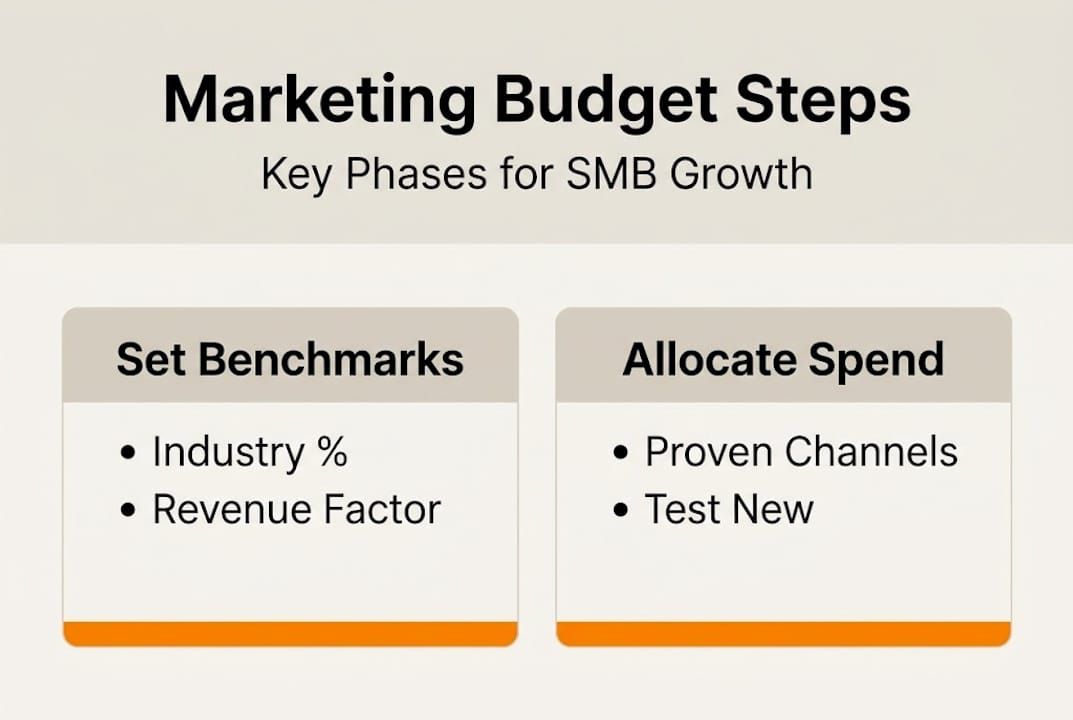
The 70/20/10 rule works like this: put 70% of your budget into proven channels that already deliver results, 20% into new or emerging channels you are testing, and 10% into purely experimental tactics. This keeps your core marketing stable while giving you room to grow.

Here is how that looks with a $50,000 annual marketing budget:
| Channel | Allocation | Annual Spend |
|---|---|---|
| Google Ads and SEO (proven) | 45% | $22,500 |
| Social media ads (proven) | 25% | $12,500 |
| Email and content marketing (emerging) | 20% | $10,000 |
| Experimental (influencer, events) | 10% | $5,000 |
For New Jersey businesses, local search is critical. Dense population centers like Newark, Jersey City, and Trenton mean people are searching for nearby services constantly. For Nevada businesses, especially in Las Vegas and Reno, tourism-driven foot traffic and event-based marketing can outperform pure digital spend.
Here are the best channels by market:
- New Jersey: Local SEO, Google Business Profile, neighborhood social media groups, targeted Google Ads
- Nevada: Google Ads for high-intent searches, Instagram and Facebook for visual businesses, event sponsorships, local partnerships
56% of SMB budgets already flow to digital, which confirms that search and social are your foundation. Lock those in before anything else. Your SEO channel allocation should be one of the first line items you protect.
Pro Tip: Secure your foundational channels before experimenting. A business that splits $5,000 across five untested channels will get weaker results than one that puts $4,000 into one proven channel and $1,000 into a single test.
Tracking, measuring, and optimizing your marketing spend
Allocating your budget is not a one-and-done task. The businesses that grow consistently are the ones that track performance and adjust every quarter. Without measurement, you are flying blind.
Start with these key KPIs (key performance indicators):
- Lead volume: How many new inquiries or leads did each channel generate?
- Cost per acquisition (CPA): How much did it cost to win one new customer?
- ROAS (return on ad spend): For every $1 spent on ads, how much revenue came back?
- Website traffic by source: Which channels are driving the most relevant visitors?
"A healthy marketing ROI for SMBs is a 5:1 revenue-to-spend ratio, meaning for every $1 you invest in marketing, you should aim to generate $5 in revenue."
Here is a quarterly review checklist to keep your budget on track:
- Pull performance data for every active channel
- Calculate ROAS and CPA for paid campaigns
- Compare lead volume this quarter to the previous one
- Identify your top two performing channels and your bottom two
- Shift 10 to 15% of budget from underperformers to top performers
- Set one new test for the next quarter based on what you learned
The most common mistakes SMBs make with tracking:
- Ignoring data because it feels overwhelming
- Not adjusting spend even when results are clearly declining
- Over-investing in channels that feel active but produce low ROI
Consider a Nevada gym that ran Facebook and Google Ads simultaneously for three months. After reviewing the data, they found Google Ads delivered a 6:1 ROAS while Facebook delivered 2:1. They shifted 20% of their Facebook budget to Google and saw a 30% increase in new memberships the following quarter. That is what track Facebook Ads performance data can reveal when you actually look at it.
According to quarterly KPI tracking guidance, reviewing and adjusting your budget based on real results is the single most impactful habit you can build as a business owner.
Why most SMBs get marketing budgets wrong and how to avoid it
Here is the uncomfortable truth we see working with business owners across New Jersey and Nevada: most SMBs do not fail because they picked the wrong channel. They fail because they never committed enough to any channel to get real data.
The fear of wasting money leads to tiny budgets spread across too many tactics. A little on Facebook, a little on flyers, a little on a website refresh. None of it gets enough fuel to actually work, and then the conclusion is that marketing does not work. That conclusion is wrong. The investment was just too thin.
The myth of testing with a tiny budget is particularly damaging. Running a $200 Google Ads campaign for two weeks does not tell you whether Google Ads works for your business. It tells you almost nothing. Real testing requires enough spend and enough time to generate statistically meaningful results.
New Jersey and Nevada business owners tend to be practical and skeptical, which is a strength. But that same risk-aversion can keep you from the consistent investment that builds visibility over time. Pick one or two high-impact channels, commit real budget to them for at least 90 days, measure the results, and then decide. That is a growth mindset in action, not reckless spending.
Take your marketing further with expert help
Setting a marketing budget is one thing. Making sure every dollar in that budget performs is another challenge entirely. At Amigo Labz, we work directly with SMB owners in New Jersey and Nevada to build marketing strategies that are focused, measurable, and built for real growth.

Whether you need professional Google Ads management to capture high-intent buyers, targeted Facebook campaigns to build brand awareness in your local market, or SEO strategies that bring in organic traffic month after month, we can help you allocate your budget where it actually counts. Reach out to our team and let us show you what a focused, creative marketing plan looks like for your business.
Frequently asked questions
What percentage of revenue should a small business in New Jersey or Nevada spend on marketing?
Most SMBs in the region should spend 6 to 12% of revenue on marketing. B2B businesses spend 6 to 7% while B2C businesses typically invest 9 to 12%, depending on their growth stage and competitive market.
How often should I adjust my marketing budget?
Review your budget at least every quarter and reallocate funds based on recent performance data. Quarterly KPI reviews help you shift spend away from underperforming channels before too much money is wasted.
Is a $1,000 annual marketing budget enough for a growing SMB?
For most SMBs, $1,000 per year is not enough to stay competitive, especially in digital channels. 66% of SMBs spending under $1,000 often find it insufficient to generate consistent growth or measurable ROI.
How do I choose the right channels for my marketing spend?
Start with proven channels like search and social media, then use the 70/20/10 rule to split your budget between proven tactics, emerging channels, and experimental tests. Build your foundation before you experiment.
Recommended