How to Manage Online Reviews for Business Growth
How to Manage Online Reviews for Business Growth

TL;DR:
- Managing online reviews boosts business growth by influencing customer decisions and increasing revenue. Effective strategies include monitoring platforms, responding promptly with personalized replies, requesting reviews tactfully, and analyzing feedback to improve operations. Consistent review management transforms reputation from a scoreboard into a powerful tool for continuous improvement.
Online review management is the proactive practice of monitoring, responding to, and leveraging customer feedback to build trust and drive business growth. Businesses that know how to manage online reviews gain a measurable edge: businesses managing reviews actively see an average of 18% more revenue growth than those that do not. That gap exists because reviews shape buying decisions before a prospect ever contacts you. The core components are straightforward: monitor the right platforms, respond with purpose, encourage authentic feedback, and analyze what customers are telling you. Get all four right, and your reputation becomes a growth asset.
How to manage online reviews: the tools and platforms you need
The foundation of any review management strategy is knowing where your reviews live. Google Business Profile is the highest-priority platform for most businesses because Google reviews directly influence local search rankings. Yelp matters for restaurants, home services, and healthcare. Industry-specific platforms like Houzz, Healthgrades, or TripAdvisor carry weight in their respective verticals.

Monitoring each platform manually is not realistic at scale. Centralized dashboards pull reviews from multiple sources into one interface, improving efficiency and consistency across locations. These tools also support CRM integration, which means customer feedback can inform your sales and support teams, not just your marketing team.
Automation features add another layer of efficiency. Real-time notifications alert your team the moment a new review posts, so you can respond before the conversation spreads. AI-drafted response templates speed up the process for high-volume businesses, though every AI draft needs a human review before it goes live.
Assigning clear ownership is non-negotiable. A review that sits unanswered for a week signals indifference. Assigning clear roles at both the local and corporate levels keeps response times consistent and prevents reviews from falling through the cracks. Define who responds, who escalates, and what the turnaround standard is.
| Platform type | Best for | Key metric to track |
|---|---|---|
| Google Business Profile | Local search visibility | Star rating, response rate |
| Yelp | Restaurants, home services | Review volume, sentiment |
| Industry-specific sites | Niche verticals | Category ranking, review recency |
| Centralized dashboard | Multi-location businesses | Response time, coverage rate |
How do you respond effectively to different types of reviews?
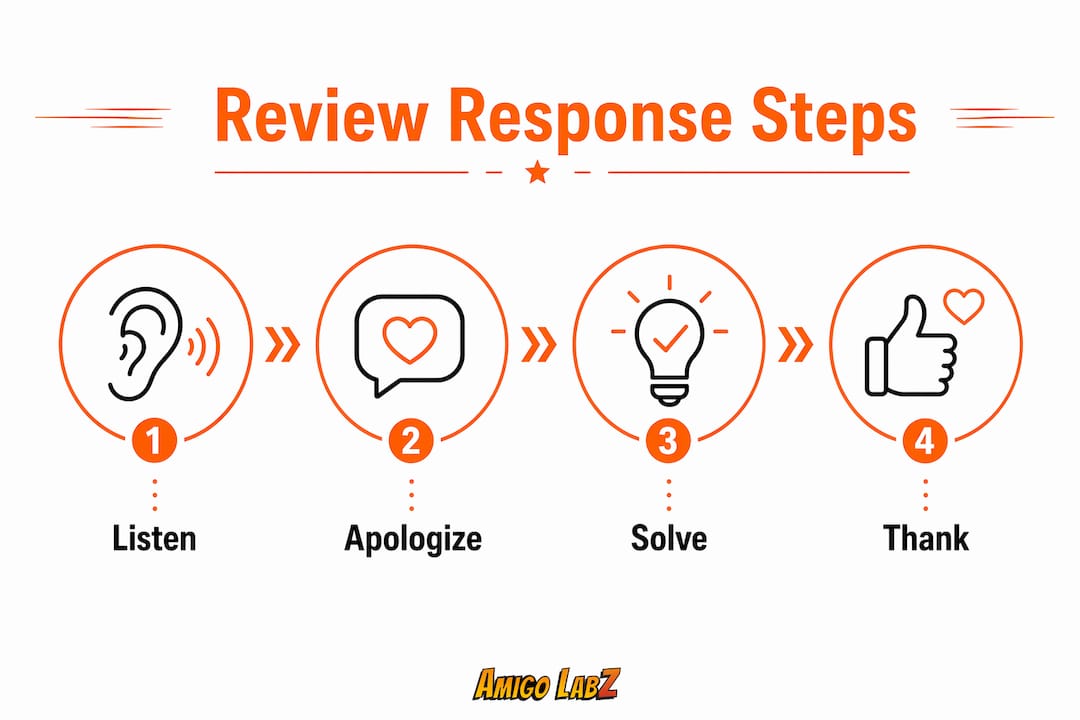
Responding to reviews is where most business owners either build trust or destroy it. The L.A.S.T. framework is the most effective structure for negative reviews: Listen, Apologize, Solve, and Thank. Using the L.A.S.T. framework improves ratings by 0.12 stars and increases positive reviews by 12%. Those numbers compound over time across hundreds of reviews.
Responding to negative reviews
Start by acknowledging the specific complaint. Generic openers like "We're sorry to hear about your experience" signal that you did not read the review. Name the issue directly. Then apologize in a way that takes ownership. Phrasing like "I'm sorry this happened" reads as genuine. "I'm sorry you feel that way" reads as dismissive, and customers notice the difference.
Offer a concrete next step, not a vague promise to "do better." Then close by thanking the reviewer for taking the time. Arguing publicly with a negative reviewer amplifies negative sentiment among prospective customers. If the situation requires detail, acknowledge the complaint publicly and invite the customer to continue the conversation by phone or email.
Keep responses to 3–5 sentences. Short replies read as confident and accountable. Long explanations read as defensive, even when the facts are on your side.
Responding to positive and neutral reviews
Positive reviews deserve more than "Thanks!" Mention the specific service or product the customer praised, and use the response to reinforce your brand voice. Neutral reviews, typically three-star ratings with mixed feedback, are an opportunity. Acknowledge what went well, address what fell short, and show that you take feedback seriously.
Pro Tip: Rotate your positive review responses so they do not all sound identical. Prospective customers read multiple reviews and will notice copy-paste replies, which undercuts the authenticity you are trying to project.
- Read the full review before drafting any response.
- Address the reviewer by name if it is available.
- Reference the specific product, service, or location mentioned.
- Apologize with ownership for negatives; celebrate specifics for positives.
- Invite further contact for unresolved issues, then close the loop privately.
What strategies encourage customers to leave more reviews?
The most common reason customers do not leave reviews is that no one asked them. Timely follow-ups via email or SMS, combined with direct links or QR codes, remove the friction that stops satisfied customers from sharing their experience. The ask should come within 24–48 hours of a completed purchase or service, when the experience is still fresh.
Your entire team plays a role in review generation. Front-line staff who deliver great service can mention the review request in person. A follow-up email from the business owner carries more weight than a generic automated message. Personalizing the ask, even slightly, increases the conversion rate from satisfied customer to published reviewer.
Avoid incentivizing reviews with discounts or gifts. Most major platforms prohibit it, and it skews your rating in ways that erode long-term trust. The goal is authentic volume, not inflated scores. Encouraging honest feedback from all customers, not just happy ones, produces a review profile that prospective customers actually trust.
Net Promoter Score surveys are a useful pre-screening tool. Send an NPS survey first. Customers who score you a 9 or 10 are your best candidates for a direct review request. Customers who score lower give you a chance to resolve issues privately before they become public one-star reviews.
Pro Tip: Add a QR code to your receipt, packaging, or service confirmation card that links directly to your Google review page. Reducing the number of steps between "satisfied customer" and "published review" is the single fastest way to increase review volume. You can find more proven review tactics in Amigolabz's dedicated guide on the subject.
How can review analysis improve your business operations?
Reviews are not just a reputation signal. They are a direct feed of customer intelligence. Regular review analysis surfaces recurring issues and unmet expectations that internal teams often miss because they are too close to daily operations.
Sentiment tracking identifies whether customer perception is improving or declining over time. If three consecutive months of reviews mention slow checkout times, that is an operations problem, not a marketing problem. Routing that insight to your operations team closes the loop between customer feedback and business improvement.
Metrics worth tracking go beyond your average star rating:
- Response rate: What percentage of reviews receive a reply?
- Response time: How quickly does your team respond, on average?
- Sentiment trend: Is the ratio of positive to negative reviews improving?
- Resolution rate: How often do negative reviewers update their rating after you respond?
- Recurring themes: What words or phrases appear most often across one and two-star reviews?
Automation handles the data collection side at scale. For multi-location businesses, automation combined with clear escalation workflows is the only way to maintain response quality without overwhelming your team. The analysis layer, deciding what the data means and what to change, still requires human judgment.
Aligning review insights with your customer experience and operations teams creates a feedback loop that continuously raises service quality. That loop is what separates businesses that manage reviews reactively from those that use reviews to get better. For a broader view of how this fits into your overall strategy, Amigolabz covers reputation management for SMBs in depth.
Key Takeaways
Effective online review management combines consistent monitoring, structured responses, proactive feedback requests, and data-driven analysis to build a reputation that drives measurable revenue growth.
| Point | Details |
|---|---|
| Revenue impact is real | Businesses that manage reviews actively see 18% more revenue growth on average. |
| Use the L.A.S.T. framework | Listen, Apologize, Solve, and Thank improves ratings and increases positive reviews by 12%. |
| Ask for reviews directly | Timely email, SMS, or QR code requests after a purchase are the most effective way to grow review volume. |
| Keep responses short | Replies of 3–5 sentences read as confident; longer responses read as defensive. |
| Analyze beyond star ratings | Track response rate, sentiment trends, and recurring themes to guide operational improvements. |
What I've learned after years of watching businesses handle reviews
Most business owners treat reviews as a scoreboard. They check the rating, wince at the bad ones, and move on. That approach leaves real money on the table.
The businesses I've seen grow fastest treat every review, positive or negative, as a conversation. A one-star review is a customer who cared enough to write something down. That is actually a gift, because most unhappy customers just leave and never come back. The ones who write reviews give you a chance to fix something and, if you respond well, to win them back publicly in front of every future customer reading that thread.
The automation question comes up constantly. AI-drafted responses are genuinely useful for high-volume situations, but overusing templates without personalization erodes customer trust fast. Prospective customers can spot a copy-paste response from three reviews away. The fix is simple: use AI to draft, then spend 30 seconds adding one specific detail from the actual review. That small edit makes the response feel human.
The other mistake I see constantly is no clear ownership. When everyone is responsible for responding to reviews, no one is. Assign one person or one team. Set a 24-hour response standard. Responding within 24 hours is the threshold that prevents negative reviews from compounding into a reputation problem. Build that into your process before you need it, not after a crisis forces your hand.
— John
How Amigolabz helps business owners take control of their reviews
Managing reviews well requires consistent effort across multiple platforms, and most business owners are already stretched thin running daily operations.

Amigolabz works with business owners across New Jersey and Nevada to build review management systems that actually hold up under pressure. From Google Business Profile optimization that increases your visibility in local search to social media management that keeps your brand voice consistent across every channel, Amigolabz handles the infrastructure so you can focus on running your business. If you want a clear picture of where your online reputation stands and what it would take to improve it, book a call with the team.
FAQ
How quickly should I respond to online reviews?
Respond within 24 hours. Timeliness prevents negative reviews from compounding and signals to prospective customers that your business is attentive and accountable.
What is the L.A.S.T. framework for review responses?
L.A.S.T. stands for Listen, Apologize, Solve, and Thank. Using this structure for negative reviews improves star ratings and increases positive review volume by 12%.
Can I ask customers to leave reviews?
Yes. Asking customers directly via email, SMS, or QR code after a purchase is the most effective way to grow review volume. Avoid incentivizing reviews with discounts, as most platforms prohibit the practice.
How do I handle a fake or unfair review?
Flag the review through the platform's reporting tool and respond calmly and factually without arguing publicly. Most platforms review flagged content and remove reviews that violate their guidelines.
What metrics matter beyond my star rating?
Track response rate, average response time, sentiment trends over time, and recurring themes in negative reviews. These metrics reveal operational gaps that a single star rating cannot show.
Recommended