How to Improve Online Reputation for Business Owners
How to Improve Online Reputation for Business Owners

TL;DR:
- Managing online reputation involves consistent engagement, responsive communication, and maintaining a secure digital presence.
- Businesses should respond promptly and personally to reviews while complying with legal standards to build customer trust effectively.
Your online reputation is the sum of every review, social post, and search result a potential customer sees before deciding to contact you. Knowing how to improve online reputation is no longer optional for business owners. 89% of consumers expect businesses to respond to reviews, and 81% expect a reply within a week. That means your response habits are visible, measurable, and directly tied to revenue. The industry term for this practice is online reputation management (ORM), and in 2026 it runs on consistent workflows, not occasional PR campaigns.
How to improve online reputation: tools and prerequisites
Before you execute any strategy, you need the right infrastructure in place. Trying to manage your reputation without centralized tools is like running a customer service team without a ticketing system.
| Tool | Purpose |
|---|---|
| Review monitoring platform | Tracks new reviews across Google, Yelp, and Facebook in one dashboard |
| Response templates | Speeds up replies while preserving a consistent brand voice |
| Social media management tool | Schedules posts and monitors brand mentions across channels |
| Google Business Profile | Controls your local search presence and review visibility |
| SSL certificate | Signals site security and professionalism to visitors and search engines |
Every business owner needs verified profiles on the platforms where their customers actually leave reviews. Google Business Profile is the starting point for most local businesses. Beyond that, your website needs a valid SSL certificate. Secure site infrastructure signals trustworthiness to both visitors and AI recommendation tools that increasingly influence purchase decisions.
Brand style guidelines for review responses are a prerequisite most owners skip. Without them, your replies sound different depending on who wrote them. Consistent tone, a standard sign-off, and a rule about when to take conversations offline all belong in a one-page document your whole team can follow.
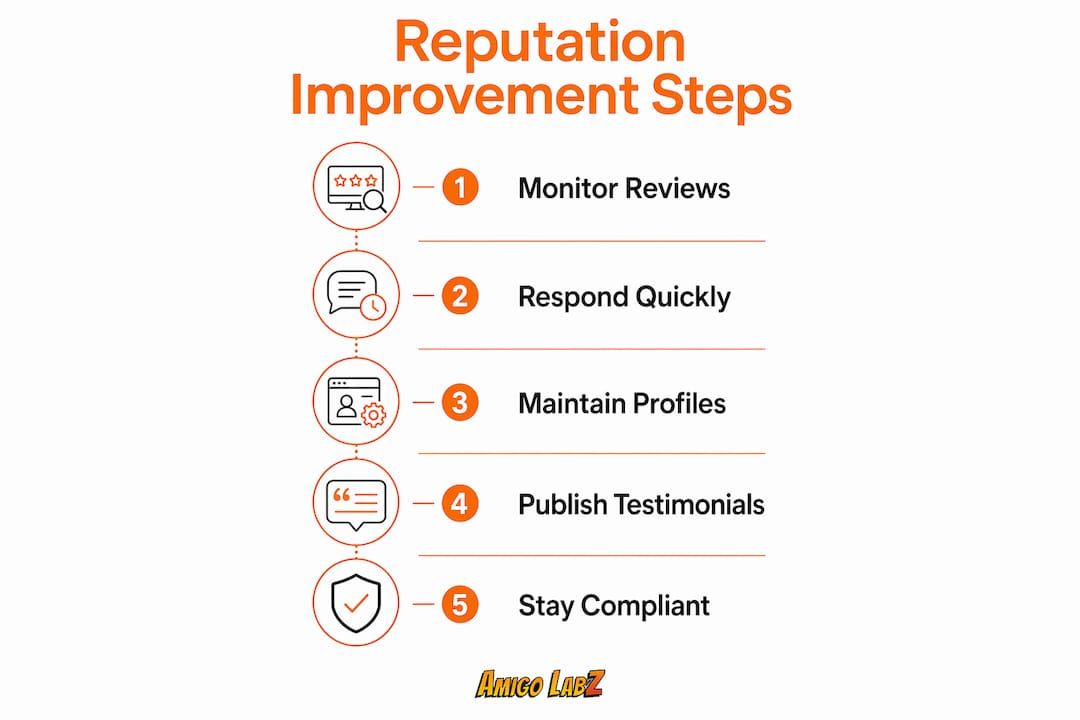
Pro Tip: Set up Google Alerts for your business name and your top products. Free, fast, and it catches mentions that review platforms miss entirely.
How can you build a strong review profile to boost digital reputation?
Reviews are the most visible signal of your reputation. A structured workflow turns review management from a reactive chore into a predictable system.
- Automate review requests. Send a follow-up email or SMS within 24 hours of a completed transaction. Timing matters. Customers are most willing to leave feedback when the experience is still fresh.
- Personalize every reply. Reference something specific from the review. If a customer mentions your staff by name, use that name in your response. Generic templated replies make 50% of consumers less likely to choose a business. That number alone justifies the extra 30 seconds per reply.
- Respond within one week. Response speed and personalization are both key drivers of consumer trust. Businesses that consistently hit this window are 80% more likely to earn repeat customers.
- Prioritize negative reviews. A one-star review left unanswered for two weeks does more damage than the original complaint. Respond calmly, acknowledge the issue, and invite the customer to resolve it offline.
- Track your performance. Treat review management like an SLA, tracking the percentage of reviews answered and your median response time. Set a weekly target and review it every Monday.
Google advises that review replies stay professional, avoid sharing private reviewer information, and invite offline resolution for complex complaints. That guidance protects you legally and keeps the conversation constructive.
A common mistake is treating positive reviews as less urgent than negative ones. Responding warmly to a five-star review reinforces the behavior and shows prospective customers that you value feedback at every level.

Pro Tip: Use a flexible reply template that combines a standard acknowledgment with one specific detail from the review. You maintain consistency without sounding robotic.
What digital presence strategies complement review management?
Reviews alone do not build a complete reputation. Your website, social media activity, and local search presence all contribute to how customers perceive your brand before they ever read a single review.
Your website is your most controllable asset. Publishing verified customer reviews directly on your brand domain boosts SEO and builds trust by keeping searchers on your site with positive content. A business that embeds real testimonials on its homepage gives Google fresh, relevant content and gives visitors a reason to stay longer.
Local citations and Google Business Profile optimization are equally important. An incomplete or inconsistent profile confuses both customers and search algorithms. Your business name, address, phone number, and hours must match exactly across every directory where you appear. For a deeper look at maximizing this channel, local visibility strategies cover the specific steps that move the needle for local search rankings.
Social media activity shapes brand perception in ways that review platforms cannot. Regular posts, prompt replies to comments, and sharing customer success stories all signal that your business is active and engaged. Social media marketing builds the kind of ongoing presence that turns casual followers into loyal customers.
Quick wins for digital brand enhancement:
- Complete every field in your Google Business Profile, including photos and business description
- Respond to social media comments within 24 hours
- Add an SSL certificate to your website if you have not already done so
- Publish at least two customer testimonials on your homepage
- Claim and verify your business on Yelp, Facebook, and any industry-specific directories relevant to your market
How to stay compliant with legal and ethical standards in reputation management
The FTC made the rules explicit in 2024, and enforcement is active. Cutting corners on review practices now carries real financial risk.
Legal warning: The FTC Consumer Review Rule bans false or materially misleading reviews, including reviews that were incentivized to be positive. Violations carry civil penalties and court orders. You may ask customers for reviews, but your request must be neutral. Asking only happy customers, or offering a discount in exchange for a five-star rating, crosses the line.
Review suppression is also prohibited. Deleting or hiding negative reviews without a legitimate platform-based reason exposes you to the same penalties as fabricating positive ones. The rule applies to your own website, third-party platforms, and any influencer or affiliate you work with.
Protecting reviewer privacy is a separate obligation. Google's own guidelines state that replies must never include personal information about the reviewer beyond what they shared publicly. That means no mentioning their address, order details, or any identifying information they did not volunteer in the review itself.
Transparency builds more trust than any manufactured five-star rating ever could. Customers who see a business respond honestly to a critical review are more likely to trust that business than one with a suspiciously perfect score. FTC compliance in digital marketing is a growing area of scrutiny, and staying ahead of it protects your brand long-term.
Key Takeaways
Improving your online reputation requires consistent review responses, a secure digital presence, and strict compliance with FTC guidelines on authentic customer feedback.
| Point | Details |
|---|---|
| Respond to every review | 89% of consumers expect a response, and 81% want it within a week. |
| Personalize your replies | Generic responses push away 50% of potential customers. |
| Secure your digital foundation | SSL certificates, complete Google Business Profile, and consistent citations build baseline trust. |
| Comply with FTC rules | Only request neutral reviews. Never incentivize positive ratings or suppress negative ones. |
| Track response performance | Monitor reply rate and median response time weekly to prevent reputation gaps. |
What I've learned after years of watching businesses manage their reputation
Most business owners treat reputation management like a fire drill. Something goes wrong, they scramble to fix it, and then they go back to ignoring their reviews for three months. That cycle is the problem.
The businesses I've seen build genuinely strong reputations treat it like an operational workflow, not a marketing campaign. They assign someone to check reviews every morning. They have a response template ready. They know their median response time because they track it. That consistency compounds over months and years into a reputation that is very hard for a competitor to replicate.
The other thing I'd push back on is the obsession with five-star averages. A business with 200 reviews and a 4.3 rating that responds to every single one looks more credible than a business with 20 reviews and a 5.0 that never replies. Customers are not naive. They know a perfect score is suspicious. What they trust is engagement.
For SMB reputation strategies, the biggest unlock is simply deciding that reputation management is a daily business function, not a quarterly marketing task. Once that decision is made, the tools and tactics fall into place quickly.
— John
How Amigolabz can help you build lasting digital trust
Amigolabz works with business owners across New Jersey and Nevada to build the kind of digital presence that earns customer trust before the first conversation happens.

The team at Amigolabz handles social media management, Google Business Profile optimization, and SEO strategies built specifically for local and national businesses that need real results. Every strategy is built around your specific market, not a generic template. If your online reputation needs a structured plan rather than a patchwork of fixes, book a consultation with the Amigolabz team and get a clear picture of where you stand and what to do next.
FAQ
What is online reputation management?
Online reputation management (ORM) is the practice of monitoring, responding to, and shaping how your business appears across reviews, search results, and social media. The goal is to build and maintain customer trust through consistent, authentic engagement.
How quickly should I respond to online reviews?
81% of consumers expect a response within one week. Responding faster, ideally within 24–48 hours, signals that your business takes customer feedback seriously.
Can I ask customers to leave reviews?
Yes, but your request must be neutral. The FTC prohibits asking only satisfied customers or offering incentives tied to positive ratings. A simple, unbiased request sent to all customers is fully compliant.
Does my website affect my online reputation?
A website with an SSL certificate, published customer testimonials, and accurate business information directly improves how both customers and search engines perceive your brand. A poorly maintained site undercuts even a strong review profile.
What is the biggest mistake businesses make with review management?
Ignoring positive reviews and only responding to negative ones is the most common mistake. Responding to every review, positive or negative, signals consistent engagement and builds more credibility than selectively managing complaints alone.
Recommended