90 Day Plan to Get Website Traffic That Converts for Small Businesses
90 Day Plan to Get Website Traffic That Converts for Small Businesses

Fix indexability and page speed first, publish one high-intent page tied to your top service, then run a small paid test to see which message actually converts. Expect early signals (clicks, calls, form fills) within a few weeks, but real organic growth usually takes 3 to 6 months to compound. None of it means anything without Google Search Console and GA4 running from day one.
TL;DR:
- Fix technical issues like indexability and page speed before creating new content to ensure search engines can crawl and rank your website effectively.
- Focus on one high-intent service page and run targeted paid tests to identify messaging that actually converts before investing heavily in additional content or traffic channels.
- Use Search Console and GA4 from day one to measure impressions, clicks, and conversions, enabling data-driven decisions and attribution for organic and paid efforts.
- Build content clusters around core services, optimize existing high-impression pages for better click-through rates, and refresh content regularly instead of producing many thin posts.
- Prioritize one or two traffic sources, such as social media or local backlinks, and measure which channels generate quality leads and sales rather than just traffic volume.
How to Get Traffic to Your Website: 9 Quick Wins This Month
You don't need a six-month strategy document to move the needle. You need nine things done in order, starting this week.
- Pick one money page. Choose the service or product that makes you the most profit and commit to optimizing it first.
- Match a paid test to that page. A $10 to $20 daily budget on Google Ads or Meta tells you fast whether your headline resonates.
- Verify Search Console and submit your sitemap. Check the Pages report for anything marked "excluded" or accidentally noindexed.
- Publish one high-intent blog post. Answer the exact question your best customers ask before they buy, then slice it into three social posts.
- Fix your slowest page. Run it through PageSpeed Insights and address the worst Core Web Vitals offender.
- Optimize your Google Business Profile if you serve local customers. Hours, categories, and photos all affect local pack rankings.
- Push a small ad budget toward the headline variant that's already converting best.
- Email your list and partners with a preview of your new content and a direct link.
- Add clear CTAs with UTM tracking so you know exactly which link drove which visit, and request two or three fresh customer reviews.
Pro Tip: Do steps 3 and 5 before anything else. A beautiful new blog post on a page Google can't crawl, or one that loads in six seconds on mobile, is wasted work.
What SEO Fundamentals Actually Move the Needle?
Most small business owners chase keywords before they've confirmed Google can even see their site. That's backwards.
Start with measurement. Install Google Search Console and connect GA4 before you touch a single page. Search Console's Performance report shows impressions versus clicks separately, and that gap tells you something specific: high impressions with low clicks usually means your title tag or meta description isn't earning the click, not that your rankings are bad.
From there, fix indexing problems. Submit your XML sitemap, check the Coverage report for pages marked "excluded by noindex tag" (a shockingly common accident after a site redesign), and confirm your important pages are actually indexed.
Core Web Vitals reality check: A small business SEO checklist recommends fixing technical foundations, including load speed, before investing in new content, because slow pages suppress both rankings and conversions no matter how good the copy is.
Practical fixes that move Largest Contentful Paint (LCP), Interaction to Next Paint (INP), and Cumulative Layout Shift (CLS):
- Compress and lazy-load images above 200KB
- Defer noncritical JavaScript so the page becomes interactive faster
- Use a content delivery network (CDN) if your audience is spread across regions
- Reserve space for ads and embeds so elements don't jump around as the page loads
- Reduce server response time, especially on shared hosting plans
Once the technical layer is clean, choose one keyword per page. Long-tail, high-intent phrases ("emergency plumber Jersey City" beats "plumbing services") are realistic targets for a site without decades of domain authority. Tools that map keyword discovery methods to actual search volume help you avoid chasing terms you'll never rank for.
Write title tags and meta descriptions that match search intent, use one clear H1 per page, keep URLs descriptive and short, and fill in image alt text (it helps accessibility and gives Google more context). Then link internally: every blog post should route at least one link to a relevant service page, because that's how you funnel authority toward the pages that actually make money. Basic schema markup for services, products, or local business details rounds out the technical work, and it's a lot less intimidating than it sounds. A deeper breakdown lives in this small business SEO guide.
Which Content Strategy Actually Converts Visitors?
Random blog posts don't build traffic. Topic clusters do.

Build one hub page around your core service, then support it with five to ten articles that answer adjacent questions your buyers actually search. A moving company's hub might be "Local Moving Services," supported by posts on packing timelines, insurance requirements, and moving-day checklists, each one linking back to the hub.
Search Console query data is your best free research tool here. It shows exactly which pages get impressions but low clicks, meaning Google already thinks you're relevant. Rewriting those titles and intros is often higher return than writing something new.
- Audit your top 10 pages by impressions. Sort by low click-through rate first.
- Rewrite titles to match the actual question behind the search, not what you assumed it was.
- Repurpose your best long-form post into a short video, a carousel, and a three-email sequence.
- Map every piece to a funnel stage. Top-of-funnel content educates, middle-of-funnel content compares options, bottom-of-funnel content pushes a quote request or booking.
- Refresh, don't just publish. An underperforming 18-month-old post often outperforms a new one once you update stats and add a stronger CTA.
Pro Tip: Give every piece of content one job. A blog post trying to educate, convert, and rank for five keywords at once usually fails at all three.
Quality beats frequency. One well-researched post that answers a real buyer question outperforms four thin posts published to hit a quota.
When Should You Use Paid Ads to Drive Traffic?
Paid search and social ads earn their keep in three situations: product launches, time-limited offers, and message testing. That third use case is the one most small businesses skip, and it's the most valuable.
Run small-budget experiments, a couple of headline variants against the same audience, on Google Ads or Meta. Whichever version gets more clicks and lower cost-per-lead tells you what language resonates before you commit to it in organic content. Feed that winning phrase straight into your blog titles and meta descriptions. This turns paid spend into free research for your entire organic strategy.
- Retarget visitors who came from organic search or social but didn't convert; these warm audiences convert at a lower cost than cold traffic.
- Track incrementality, not just clicks. A campaign that generates cheap clicks but zero marketing-qualified-lead-to-sales-qualified-lead (MQL-to-SQL) movement isn't working, no matter how good the click-through rate looks.
- Start with $300 to $500 monthly split across two or three ad sets, then scale whichever variant produces actual leads, not just impressions.
Full breakdowns of budget structures and creative testing live in this guide to PPC advertising for business growth.
Which Social Platforms Actually Send Traffic to Your Site?
Social media outperforms organic search as a traffic source for a lot of small businesses. One SMB trends report puts social at 64% of traffic sources, ahead of organic search at 52% and referrals at 51%, which tells you distribution deserves as much attention as rankings.
Pick one or two platforms where your actual customers spend time, not wherever competitors happen to post. A landscaper probably belongs on Instagram and Facebook; a B2B service provider probably belongs on LinkedIn.
- Turn every blog post into a short video, a carousel, or a direct answer to a question you see in a relevant group.
- Put a small dollar amount ($5 to $10 a day) behind whatever post is already organically outperforming the rest.
- Answer questions in niche Facebook groups or subreddits related to your industry without dropping a link on the first comment.
- Track which platform actually drives sessions in GA4's acquisition report, then double down on that one.
How Do Backlinks and PR Bring in Targeted Traffic?
Five relevant links from real sites beat fifty from link farms. Start by identifying five local outlets, industry blogs, or partner businesses that would plausibly feature you, then pitch a specific angle, not a generic "check out our business" email.
- Turn a happy customer into a case study, then ask permission to link back to their site or social profile.
- Claim listings on local directories, chamber of commerce sites, and industry associations; these are often overlooked but carry real local relevance.
- Skip paid link schemes entirely. A single contextual mention from a site your customers actually trust outweighs a dozen purchased links.
- Ask recent customers for reviews on Google and industry-specific platforms; these mentions feed both traditional SEO and the newer AI-driven citation patterns search engines are starting to favor.
Pro Tip: A review mentioning your service by name and city ("best plumber in Reno") does double duty. It builds trust with human readers and gives AI search tools a specific, quotable answer to surface.
What Metrics Actually Prove Traffic Is Working?
Traffic without conversion tracking is a vanity number. Set up conversion events in GA4, form submissions, phone calls, purchases, before you spend another dollar driving people to the site.
- Use Search Console's query report to find pages with strong impressions but weak click-through rates; those are your highest-return rewrite candidates.
- Track MQL-to-SQL by source in whatever CRM you use, because a channel generating cheap traffic that never converts to a sale is quietly wasting your budget.
- Test one CRO change at a time: swap the headline, move the CTA above the fold, cut a form field, or add a testimonial near the button.
A 2026 SMB trends report found that converting traffic, not generating it, is the biggest challenge most small businesses report. More visitors solve nothing if the page doesn't ask for the sale.
Report on 30, 90, and 180-day windows. At 30 days, look for early signals like impression growth. At 90 days, expect ranking movement on your priority keywords. At 180 days, judge success by pipeline, not sessions. Clear CTA examples that reduce friction are worth studying in this conversion-focused guide.
A 90-Day Traffic Growth Plan for Small Businesses
Trying to do everything at once is why most traffic plans stall by week three. Sequence the work instead.
- Week 1: Verify Search Console and GA4, submit your sitemap, fix any accidental noindex tags, and pick the one service page you'll optimize first.
- Weeks 2 to 4: Publish your hub content and its first two supporting articles, launch one small paid headline test, and fix your worst Core Web Vitals score.
- Month 2: Start outreach for backlinks and local mentions, keep publishing cluster content on a sustainable schedule, and launch retargeting ads for warm organic visitors.
- Month 3: Review MQL-to-SQL data by channel, scale whichever paid variant is actually producing leads, and refresh your two weakest-performing published posts.
Following this sequence, measurement and technical fixes first, then one high-intent page per service, then content clusters, then outreach, prevents the common mistake of building content on a foundation Google can't properly crawl or rank. A deeper walkthrough of this sequencing lives in this 2026 SEO guide for small businesses.
- Milestone check at day 30: indexing clean, one page optimized, first paid test running.
- Milestone check at day 60: hub content live, first backlinks secured, retargeting active.
- Milestone check at day 90: pipeline data by channel, at least one scaled paid winner.
If you hit day 60 without a clean indexing report or a single ranking movement, that's the signal to bring in outside help rather than keep guessing.
How Does Email Marketing Drive Repeat Website Visits?
Email remains one of the most direct traffic levers a small business owns, because you're not competing with an algorithm to reach your own list. Every new blog post, promotion, or service update deserves an email, not just a social post that might get buried in a feed within hours.
Segment your list at minimum into past customers and prospects who've engaged but haven't bought. Past customers respond well to referral asks and seasonal reminders; prospects respond better to educational content that nudges them toward a decision.
Keep a simple cadence: one email every two to three weeks beats a burst of five emails in one week followed by silence. Include one clear link back to your site in every send, whether that's a new blog post, a service page, or a limited-time offer, and track click-through rates so you know which subject lines and content types your list actually opens.
Compliance isn't optional. The FTC's CAN-SPAM guide spells out required elements for commercial email, including accurate sender information and a working unsubscribe link, and the penalties for ignoring it apply to small businesses just as much as large ones.
Pair email with UTM parameters on every link so GA4 attributes the resulting session and any conversion back to that specific send. Over a few months, this data tells you exactly which email topics turn into booked calls or purchases, not just opens.
How Can Influencer Marketing Increase Website Visits?
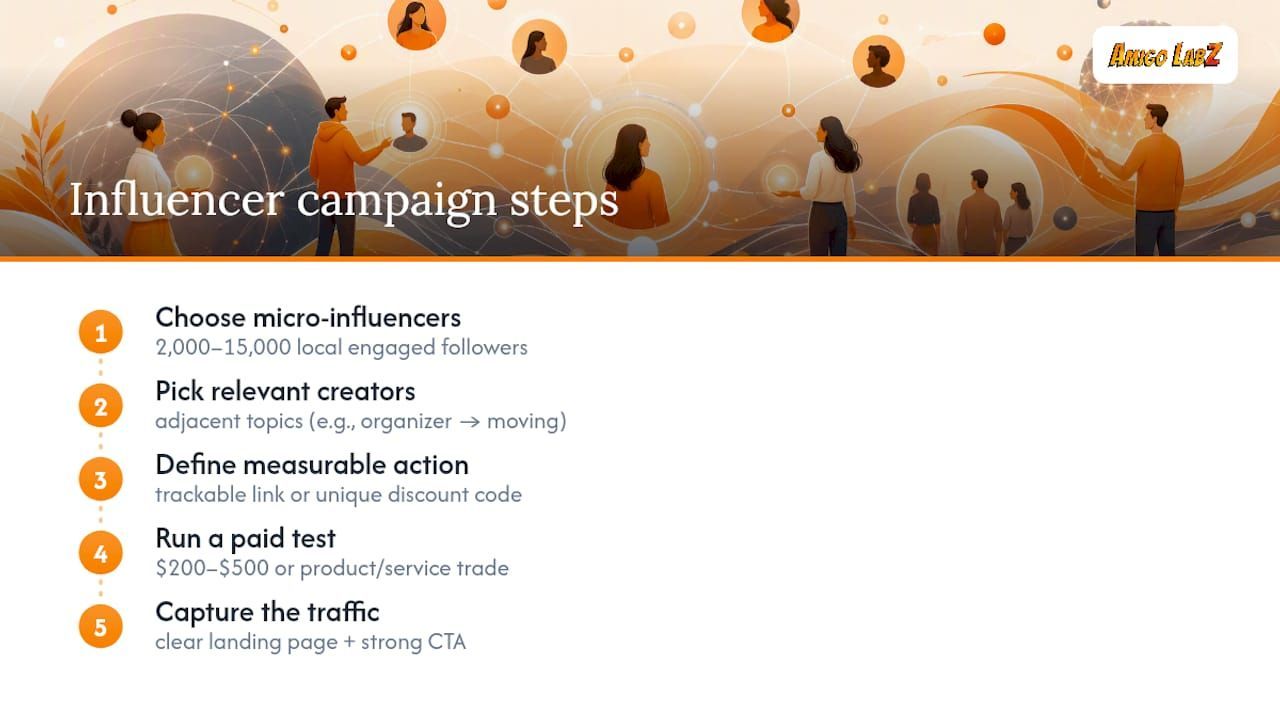
You don't need a celebrity endorsement to make influencer marketing work. Local micro-influencers, people with 2,000 to 15,000 engaged followers in your city or niche, often drive more qualified clicks than a national name with a huge but irrelevant audience.
Look for creators already talking about topics adjacent to your business: a home organizer for a moving company, a local mom blogger for a women's wellness practice, a car enthusiast page for a detailing service. Relevance matters more than follower count.
Structure the partnership around a specific action, not a vague mention. Ask for a trackable link or a unique discount code so you can measure exactly how many sessions and conversions the partnership generated, rather than guessing based on vanity engagement numbers.
Product or service trades work well for smaller creators; paid flat fees make sense once you're working with someone whose audience size justifies it. Either way, treat the first partnership as a test: a $200 to $500 investment that tells you whether this channel is worth repeating, similar to how you'd treat a paid ad test.
The traffic itself often behaves differently from search traffic. It arrives in a spike right after the post goes live, then tapers. Capture that spike with a clear landing page and a strong CTA, because an influencer sending 500 visitors to a generic homepage wastes most of that opportunity.
Can Forums and Q&A Sites Really Drive Niche Traffic?
Reddit threads, niche Facebook groups, and industry-specific forums are some of the most underused traffic sources for small businesses, largely because they require patience rather than budget.
The mistake most business owners make is dropping a link the moment they join a community. That gets you banned or ignored. Instead, spend two or three weeks actually answering questions with genuine expertise before you ever mention your business, and even then, link only when it's the most helpful possible answer to the exact question asked.
Platforms like Quora, industry-specific subreddits, and local Facebook groups tend to rank well in search results themselves, meaning a thoughtful answer you post today can keep generating impressions and profile clicks for years. Search your own services plus "reddit" or "forum" to find where these conversations are already happening.
Track referral traffic from these sources in GA4's acquisition report. It's usually a smaller number than social or organic search, but the visitors tend to be highly qualified. Someone who read a detailed forum answer about your specific service before clicking through is closer to a decision than someone who saw a random ad.
The Amigo Labz Take on Growing Small Business Traffic
Most traffic advice treats every channel as equally urgent, and that's exactly how small businesses burn budget without seeing results. We've found the businesses that grow fastest are the ones willing to ignore four channels and get obsessively good at one or two, at least for the first 90 days.
Working with businesses across New Jersey and Nevada, and increasingly nationwide, the pattern holds: the owners who ask "did this turn into a call or a sale" before "did my traffic go up" are the ones whose growth sticks. Traffic without a measurement plan is just a bigger number on a dashboard nobody checks after month two.
If your current setup can't answer which channel actually produced your last five customers, that's worth a conversation before you spend another dollar on ads or content.
— John
How Amigo Labz Can Help You Grow Traffic That Converts
Amigo Labz is the alternative to guessing which channel deserves your next dollar. We build the measurement foundation first, Search Console, GA4, and conversion tracking, so every SEO, ad, and social decision after that is based on what's actually driving calls and sales, not just clicks.

Our team manages SEO services, Google Ads, Facebook Ads, and social media management for small businesses across New Jersey and Nevada, and we build campaigns around the same sequencing outlined in this article: fix the technical foundation, build the pages that convert, then layer in paid and social to accelerate what's already working. If you'd rather have someone map out your specific 90-day plan than build it alone, request a free audit and we'll show you exactly where your traffic gaps are.
Sources
FAQ
How Long Does It Take to Get Traffic to Your Website?
Early signals like impressions and click-through improvements often show up within a few weeks, but meaningful organic growth typically takes 3 to 6 months once technical fixes and content are in place.
What's the Fastest Way to Increase Website Traffic?
Running a small paid ad test alongside one optimized high-intent page produces the fastest measurable traffic, while organic SEO and content build momentum in the background.
Do I Need Both SEO and Paid Ads?
Yes. Paid ads validate which messaging converts in days, and that winning language then improves your organic titles, meta descriptions, and content, making both channels stronger together.
Which Social Platform Drives the Most Traffic for Small Businesses?
It depends on where your customers spend time, but social media accounts for 64% of SMB traffic sources overall, ahead of organic search and referrals.
How Do I Know If My Website Traffic Strategy Is Working?
Track conversions, not just sessions, in GA4, and measure MQL-to-SQL by channel; a strategy that increases sessions without increasing leads or sales isn't actually working. Amigo Labz builds this measurement layer for clients before scaling any channel.
Recommended