How AI for SEO boosts local business results in NJ & NV
How AI for SEO boosts local business results in NJ & NV
TL;DR:
- AI in SEO does not reset search fundamentals; technical indexing, clear structure, and local relevance remain essential.
- Businesses should use AI as a research and content enhancement tool, not a substitute for original, well-reviewed local content.
Most business owners in New Jersey and Nevada have heard a version of the same pitch: "Use AI and your SEO will take care of itself." That's not just misleading, it's genuinely dangerous advice. The truth is that AI features in Google Search still rely on the same core SEO signals your site has always needed, which means a misguided AI strategy can waste your budget and stall your rankings. This guide cuts through the noise, explains exactly what AI changes (and what it doesn't), and gives you a practical roadmap for using these tools to grow your local visibility the right way.
Table of Contents
- What does AI actually change in SEO?
- How AI can supercharge your SEO workflow
- Avoiding common pitfalls: Quality, originality, and Google's policies
- AI for local SEO in New Jersey & Nevada: Real-world strategies
- The hard truths most guides miss about AI for SEO
- Take your local SEO further with expert support
- Frequently asked questions
Key Takeaways
| Point | Details |
|---|---|
| SEO basics remain crucial | AI tools make SEO faster but classic methods like strong content and structure still matter most. |
| AI aids, not automates | Smart business owners use AI to enhance workflows, not to replace strategic or local expertise. |
| Compliance is critical | Google's policies target low-value and manipulative content, so focus on quality and originality. |
| Local insight is key | AI helps with research and drafting, but knowing your community keeps your SEO unique and competitive. |
What does AI actually change in SEO?
With the confusion around AI in SEO addressed, let's dig deeper into what actually changes and which fundamentals still matter most.
The biggest misconception floating around right now is that AI Overviews and similar features represent a complete reset of how search works. They don't. According to Google Search Central, AI Overviews and AI Mode do not require any special new technical requirements beyond being indexed and eligible in standard Google Search. That's a big deal. It means you don't need to rip out your site structure or adopt some experimental new framework just to stay competitive.
What AI does change is how answers are surfaced and how searchers interact with results. AI-powered summaries pull from pages that are clear, well-organized, and genuinely useful. If your content is vague, keyword-stuffed, or thin, AI features will simply skip you. That's not a new penalty, it's just a stricter version of what Google's ranking systems have rewarded for years.
Here's a quick breakdown of what stays the same versus what shifts:
| SEO element | Before AI features | With AI features |
|---|---|---|
| Technical indexing | Required | Still required |
| Clear page structure | Important | Critical |
| People-first content | Recommended | Non-negotiable |
| Schema markup | Helpful | More impactful |
| Keyword stuffing | Penalized | Penalized even harder |
| FAQ-style answers | Useful | High-priority for AI citations |
The role of anchor text in SEO also becomes more nuanced with AI. When AI systems parse pages to generate summaries, they pay attention to how content is connected and labeled internally. Sloppy or generic anchor text signals weaker content organization.
As SEO analyst Lily Ray points out, GEO strategy pitfalls often stem from treating AI optimization as a replacement for core SEO rather than a layer on top of it. Your structured content, your FAQ sections, your using structured data correctly — all of that becomes your ticket into AI-generated answers. Skip it and no amount of AI-generated content will save you.
The core truth: AI changes the presentation layer of search, not the foundation. Businesses that already invest in clear, honest, well-structured content are already positioned to benefit from AI features without lifting a finger on the technical side.
What does this mean practically? Think of AI Overviews like a very sophisticated highlighter. It finds the clearest, most credible answer on a page and surfaces it. If your competitor has a clean FAQ section with schema markup and you have a wall of text, Google's AI will highlight them, not you. The fix isn't complicated. It just requires intentionality.
AI-driven content strategies in the advertising world have already proven this point: clarity and specificity beat volume every time.
How AI can supercharge your SEO workflow
Now that we understand what remains unchanged, let's look at how AI can make everyday SEO tasks faster, sharper, and more effective.
The best way to use AI in your SEO strategy is as a tireless research assistant, not a ghostwriter running unsupervised. When businesses try to fully automate content production, the output tends to be generic, repetitive, and disconnected from what actual local customers care about. But when you use AI to handle the grunt work while humans direct strategy, the results are genuinely impressive.
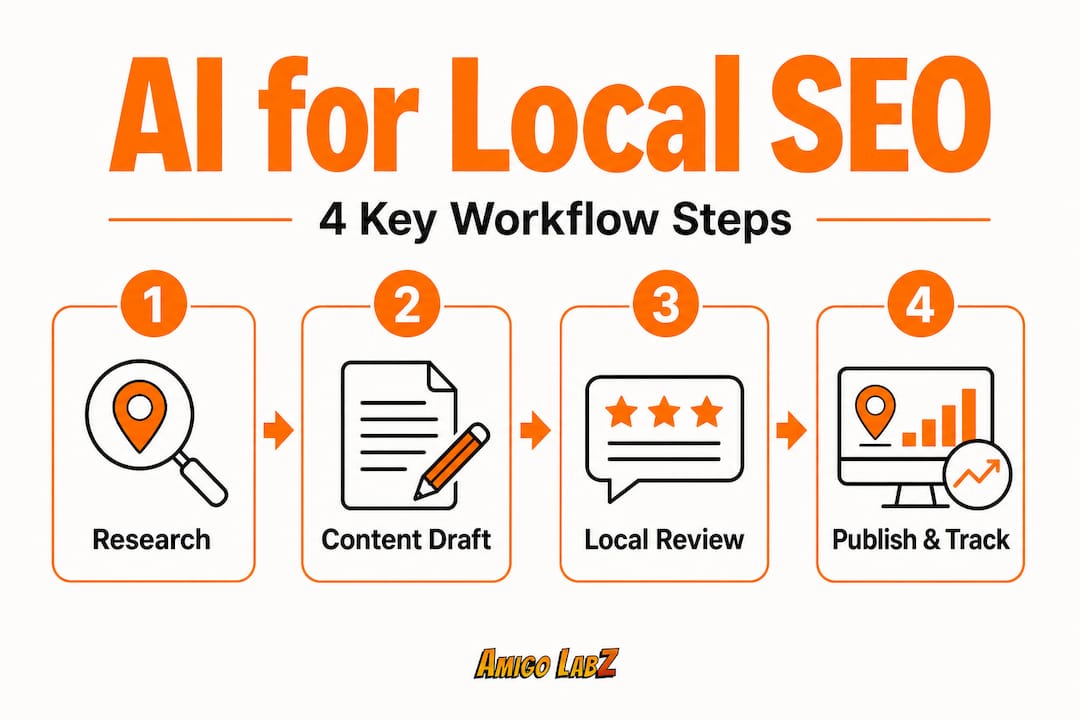
Here's a practical workflow that works well for a business in New Jersey:
- Define your target topics manually. Sit with your team and list the questions your customers ask most often in person or over the phone. These are your seed topics. No AI can replicate this step.
- Use AI to expand your topic clusters. Feed your seed topics into an AI tool to generate subtopics, related queries, and content gaps you may have missed.
- Generate a content brief with AI. Ask the AI to draft a brief including target keywords, suggested headings, and FAQ-style questions based on your topic. Review and refine the brief yourself.
- Draft with AI assistance. Let the AI write a first draft. This saves hours. But this draft is raw material, not a finished product.
- Edit for local relevance. A Newark restaurant, a Reno contractor, a Newark law firm — each has hyper-local context that no AI knows. Add real specifics: neighborhood references, local events, customer scenarios.
- Check against your content creation checklist. Confirm the content meets your quality bar before publishing.
- Add or verify schema markup. Use your explained structured data knowledge to make sure FAQs, reviews, and business info are properly tagged.
As Optimizely's research on AI for SEO confirms, AI should enhance workflow with clear human quality control rather than replacing editorial judgment and strategy.
Here's a simple comparison of time spent with and without AI assistance:
| SEO task | Time without AI | Time with AI + human review |
|---|---|---|
| Keyword and topic research | 3-4 hours | 45-60 minutes |
| Content brief creation | 1-2 hours | 15-20 minutes |
| First draft (1,000 words) | 3-4 hours | 45 minutes (review included) |
| Schema markup setup | 1 hour | 20-30 minutes |
| Internal linking review | 1 hour | 20 minutes |
Those time savings compound fast. A business publishing two blog posts per month can reclaim 10 to 15 hours monthly. That's time you can spend on customer relationships, service delivery, or developing genuinely unique local content.
You can explore AI marketing tool examples to see how specific tools perform across different workflow stages.
Pro Tip: Build a one-page quality checklist for every AI-assisted draft. It should include: Does this mention a real local detail? Has a human verified every factual claim? Does this answer a specific customer question clearly? Is the tone consistent with your brand? That checklist is the difference between content that ranks and content that wastes server space.
Avoiding common pitfalls: Quality, originality, and Google's policies
Using AI brings efficiency, but it's just as important to understand where business owners can go wrong and how to stay compliant and competitive.
Google does not penalize you for using AI. Full stop. What it does penalize is scaled-content abuse, which is the practice of flooding a website with low-effort, templated content that exists to game rankings rather than serve readers. The distinction matters enormously.
Search Engine Land reported that AI content quality ratings in Google's quality-rater guidelines flag pages created with automated or generative AI that show little effort, originality, or added value as "Lowest quality." Notice the qualifier: little effort, little originality, little added value. AI-assisted content that demonstrates real expertise, uses original local insights, and answers genuine customer questions does not fall into this trap.
Here's what to watch out for:
- Over-automating without review. Publishing AI drafts directly without editing is the fastest way to dilute your site's credibility and invite quality penalties.
- Generic location pages. Creating dozens of templated "best plumber in [city name]" pages with swapped city names is a classic scaled-content abuse pattern. Google recognizes it immediately.
- Ignoring accuracy. AI tools confidently produce incorrect information. If a fact is wrong on your site, it reflects on your business reputation, not on the AI tool.
- No human voice. AI tends to write in a flat, predictable tone. If every page on your site sounds like it was written by the same algorithm, readers and Google both notice.
- Skipping your quality content checklist. A repeatable review process is your insurance policy against all of the above.
Compliance baseline: Every piece of AI-assisted content should pass a simple test. Ask yourself: "Would I put my name on this and hand it to my best customer?" If the answer is no, it's not ready.
For New Jersey and Nevada businesses, originality has a local dimension. A piece about "roofing after winter storms" means something specific in Trenton or Hoboken compared to Las Vegas or Henderson. Adding that local layer is the work only you can do, and it's also what makes the content worth ranking.
You can see how AI content case studies document the specific failures and wins across industries.
Pro Tip: Set a firm policy in your business: no AI-generated content goes live without a human editor who has local knowledge reviewing it. Even a 15-minute review catches the issues that tank credibility.
AI for local SEO in New Jersey & Nevada: Real-world strategies
With the ground rules in place, here's how you can use AI for specific local search wins in New Jersey and Nevada.
Local search is where AI-powered strategy pays off fastest for small and mid-sized businesses. Think about how a potential customer in Hackensack or Henderson searches: they want answers fast, they want a business they can trust, and they want to know it's nearby. AI can help you craft content and optimize your presence to meet all three needs.

According to Lily Ray's research on GEO strategy, local SEO tactics work best when grounded in structured, findable content and FAQ-style clear answers. That's the foundation. Everything else builds on top.
Practical AI-powered local SEO moves for NJ and NV businesses:
- AI-generated FAQ answers. Use AI to draft answers to common local questions ("What permits do I need to renovate a home in Bergen County?" or "Do Las Vegas contractors require bonding?"), then verify accuracy and add local specifics before publishing.
- Google Business Profile optimization. AI tools can analyze your profile, suggest missing categories, and help write compelling business descriptions optimized for local keywords. Then you add your real story.
- Content gap identification. AI can scan competitor sites and surface topics your local competitors cover that you don't. That's low-hanging fruit for new content.
- Local schema markup. Proper structured data on your location pages, service areas, and FAQ sections dramatically improves your chances of appearing in AI-generated local answers. Your Google Business optimization strategy should include this step.
- Review response drafting. AI can draft personalized responses to Google reviews at scale. A human approves each one before posting.
📊 Statistic spotlight: Research shows that 46% of all Google searches have local intent, meaning nearly half of every search is someone looking for something nearby. For NJ and NV businesses with strong local SEO and AI-optimized content, that's a massive opportunity to capture customers already in buying mode.
Knowing how to structure your local presence matters as much as the content itself. If you're not sure where to start, learning about ranking first on Google Maps is one of the highest-leverage moves you can make. Combined with improving your online presence at the site design level, AI-powered content becomes significantly more effective.
The hard truths most guides miss about AI for SEO
Now that we've laid out actionable guidance, here's a candid perspective reflecting our hands-on experience.
We've worked with enough business owners in New Jersey and Nevada to know exactly how the "AI for SEO" conversation usually goes. Someone buys a subscription to an AI writing tool, publishes thirty pages in two weeks, and then wonders why rankings tanked instead of improved. The problem isn't AI. The problem is the assumption that speed equals strategy.
Here's what we've learned: AI has no idea what makes your business special. It doesn't know that your HVAC company in Montclair has been family-owned for three generations, or that your Las Vegas salon has built a reputation on a specific technique. That authentic local knowledge is your actual competitive edge, and no AI will discover it for you.
The "set it and forget it" approach is the single biggest mistake we see. Businesses treat AI content like a vending machine: put in a prompt, get out a page, move on. But content without ongoing attention decays. Search behavior shifts. Competitors update their pages. Google's own understanding of your topic evolves. AI can help you respond to all of that faster, but only if a human is watching.
The structured data essentials that make your content eligible for AI-generated answers also require periodic audits. Schema markup breaks. Business details change. Pages that once appeared in AI Overviews can drop out if the underlying data goes stale.
What the best local businesses we work with have in common is a clear commitment to originality and credibility. They use AI to move faster, not to think less. They review everything. They add their perspective, their local context, their real customer experiences. That's the combination that builds durable rankings, not a tool subscription alone.
AI is not a shortcut past the fundamentals. It's an accelerant for the businesses already committed to doing the fundamentals right.
Take your local SEO further with expert support
If you're ready to harness AI for your company's SEO, expert guidance can help you avoid mistakes and fast-track results.
At Amigo Labz, we work directly with business owners in New Jersey and Nevada to build SEO strategies that actually reflect how local customers search. We know the local markets, we understand how AI fits into a sustainable content strategy, and we stay current on Google's evolving policies so you don't have to.

Our expert SEO services are built for businesses that want real results, not vanity metrics. Whether you need help setting up a local content workflow with AI, auditing your current site for quality issues, or building out your Google Business Profile, we have tailored website solutions that fit your goals and your market. Reach out to book a strategy call and walk away with a concrete local SEO and AI plan built specifically for your business.
Frequently asked questions
Is using AI for SEO against Google's guidelines?
No, using AI is allowed as long as your content adds value, is people-first, and does not aim to manipulate rankings unethically. Google's guidance focuses on penalizing scaled-content abuse, not AI use itself.
Do I need special technical requirements for my site to appear in AI search features?
No special requirements are needed. Standard SEO practices and eligibility for standard Google Search features are sufficient for your content to appear in AI Overviews.
Can AI improve my business's ranking in local NJ or NV searches?
AI can speed up research and help produce local content more efficiently, but authentic local expertise remains essential. Structured, findable content with real local relevance still drives local rankings.
What risks should I avoid when using AI for SEO?
Avoid publishing AI content without human review and avoid templated, generic pages designed to target multiple locations with minimal original content. AI-generated pages with little effort or originality are rated as Lowest quality by Google's systems.
Recommended