Your Digital Marketing Strategy for Lead Generation
Your Digital Marketing Strategy for Lead Generation

A focused two-channel acquisition plan plus a tightly automated nurture engine is the fastest path to quality leads. Pick one primary acquisition channel (Google Search Ads or LinkedIn Ads for B2B; Meta Ads for B2C), add one retargeting channel (email or paid retargeting), attach a single high-value lead magnet, and route every captured lead into a 4-email automated nurture sequence. Measure cost-per-lead (CPL) and MQL-to-SQL conversion within 90 days. That is the whole program.
Start this week:
- Define your Ideal Customer Profile (ICP): industry, company size, job title, and the trigger that makes them ready to buy.
- Choose your channel pair: one acquisition channel and one retargeting channel.
- Build one landing page with a 2-field form (name + email for B2C; name + work email for B2B).
- Install conversion tracking before you spend a dollar on ads.
- Set a 60-minute lead response SLA from the moment a form is submitted.
What to watch at each milestone:
- Days 1–30: Landing-page visit-to-lead rate, CPL, and speed-to-first-touch.
- Days 31–60: Landing-page conversion rate trend, email open and click rates in the nurture sequence.
- Days 61–90: MQL-to-SQL rate, lead-to-customer rate, and cost-per-acquisition (CAC) by channel.
If both are flat, the problem is usually the lead magnet or the landing page, not the channel.
Key Takeaways
A focused two-channel acquisition plan, a single high-value lead magnet, and a 4-email automated nurture sequence is the fastest path to quality leads, measurable within 90 days.
| Point | Details |
|---|---|
| Start with two channels | Pick one acquisition channel and one retargeting channel; concentrate budget until CPL and MQL-to-SQL are stable. |
| Lead quality over volume | Measure MQL-to-SQL rate (target above 20%) and pipeline influenced, not raw lead count. |
| Speed-to-lead matters | Respond promptly to high-intent leads, ideally within an hour, and follow up with webinar or content leads within a day to maximize conversion chances |
| Landing pages convert 2%–10% | Shorter forms, message match, and mobile-first design are the three highest-leverage conversion levers. |
| Amigolabz 90-day pilot | Amigolabz offers a scoped pilot covering landing page, two-channel ads, nurture sequence, and weekly reporting. |
What does lead generation in digital marketing actually mean?
Lead generation is the process of attracting online prospects and capturing an identifiable contact or intent signal — an email address, a phone number, a demo request — so your sales team can follow up. It is distinct from demand generation, which builds awareness without necessarily capturing a contact. Lead generation in digital marketing relies on channels like SEO, paid search, webinars, and gated content to pull prospects into a capture surface where they exchange information for something valuable.
The format of the lead matters as much as the volume. That difference is what the MQL (Marketing Qualified Lead) and SQL (Sales Qualified Lead) distinction is built to capture.
Common lead capture surfaces:
- Landing page form (name + email, or name + company + work email for B2B)
- LinkedIn Lead Gen Forms (pre-filled from profile data, lower friction)
- Facebook Lead Ads (native in-app form, no redirect required)
- Gated webinar registration page
- Demo or consultation request form
Pipeline contribution, not raw lead count, is the right success metric.
Which digital channels work for lead generation, and when should you pick each?
High-performing teams combine at least three channels, sequencing outbound for near-term pipeline while inbound compounds over time. The practical starting point is simpler: pick the channel that matches your timeline and budget, then add a second only after the first is stable.

| Channel | Time to Pipeline | Typical CPL Range | Best For |
|---|---|---|---|
| Google Search Ads | 1–4 weeks | $30–$100 | High-intent buyers actively searching |
| Meta (Facebook/Instagram) Ads | 1–3 weeks | $15–$50 | B2C and broad B2B awareness |
| LinkedIn Ads | 2–6 weeks | $60–$200+ | Mid-market and enterprise B2B |
| SEO / Content | 6–18 months | Low long-term CAC | Compounding inbound at scale |
| Webinars | 3–6 weeks | $20–$100 | Mid-funnel education and qualification |
| Email (to existing list) | 1–2 weeks | Near zero | Re-engagement and upsell |
| Referral / Partner | 4–8 weeks | Low | Higher close rates, warm leads |
| ABM | 8–12 weeks | High per account | Enterprise, high-ACV deals |
Practical channel rules:
- Start with paid search when a rapid pipeline is needed, focusing on high-intent keywords that typically produce faster conversions
- Start with SEO and content when you have 6–18 months and want a lower long-term CAC. Organic content builds compounding value that paid ads cannot replicate.
- Use LinkedIn Ads for precise job title and company size targeting; although CPL tends to be higher, lead quality for mid-market and enterprise B2B is often superior
- Use Meta Ads with native Facebook Lead Ads forms for fast capture, which often improves conversion rates for B2C and early-stage B2B leads
- Reserve account-based marketing for high-value accounts where the investment in resources correlates with deal size Gartner recommends starting ABM programs with 20–50 accounts and measuring success by pipeline influenced, not MQL volume.
- Concentrate your budget on one acquisition channel plus one retargeting channel until performance stabilizes. Avoid distributing budget too thinly across many channels, as this can generate noisy data that is difficult to interpret effectively
Quick tests to run on each channel in the first two weeks:
- Google Ads: test two ad copy variants on 10–15 high-intent keywords; measure click-through rate and cost-per-conversion.
- Meta Ads: test one static image versus one short video with the same offer; measure CPL and form completion rate.
- LinkedIn Ads: test Sponsored Content against a Lead Gen Form on the same audience; compare CPL and lead quality downstream.
- Email: send a re-engagement sequence to dormant contacts with a new lead magnet; measure reactivation rate.
How do you build a digital marketing strategy for lead generation step by step?
This is the sequence that turns a blank slate into a working, measurable program. Skip a step and you will almost certainly revisit it after wasting budget.
-
Set revenue-backed goals. Work backward from your revenue target. If you need $500,000 in new revenue, your average deal size is $10,000, and your lead-to-customer rate is 5%, you need 1,000 leads. Divide by 12 for a monthly target, then price that against your expected CPL to size the budget.
-
Define your ICP precisely. Firmographic filters (industry, company size, revenue band, geography) plus behavioral signals (visited pricing page, attended a webinar, searched a competitor term) plus a buying trigger (new funding, new hire, regulatory change). Vague ICPs produce vague leads. The more specific your ICP, the tighter your ad targeting and the higher your MQL-to-SQL rate.
-
Build one lead magnet matched to buyer stage. A top-of-funnel blog reader needs a checklist or short guide. A mid-funnel prospect evaluating options responds to a webinar or comparison guide. A late-funnel buyer close to a decision wants an ROI calculator or a case study. Match the asset to the stage, not to what is easiest to produce.
-
Build one landing page with one job. Headline matches the ad or email that sent the visitor. One offer, one form, one CTA. No navigation links to distract. Landing-page conversion rates typically range from 2%–10% depending on offer and traffic source. A 2-field form (name + email) will almost always outperform a 6-field form at the top of the funnel. For U.S. audiences, include a brief privacy/consent note near the submit button referencing your data practices.
-
Plan your traffic. One paid channel for near-term leads, one owned/organic channel for compounding growth. For a minimum viable paid test, budget enough to generate at least 50–100 conversions before drawing conclusions. Anything less and the data is too thin to act on.
-
Build the nurture sequence before you launch traffic. Four emails minimum: a welcome/delivery email (immediate), a value-add email (day 2–3), a social proof email (day 5–7), and a soft CTA email (day 10–14). Set a 60-minute lead response SLA for high-intent leads like demo requests. Map nurture paths to buyer intent using fit, intent, and engagement signals to route leads to the right sequence or directly to sales.
-
Set up your tool stack. You need three tools at minimum: a form/capture tool (your landing-page builder or CRM native forms), a CRM (HubSpot, Salesforce, or Pipedrive), and an email service provider with automation (Klaviyo, ActiveCampaign, or Mailchimp). Connect them before leads start flowing.
-
Run a weekly signal check and a monthly outcome review. Weekly: CPL trend, landing-page conversion rate, email open rate. Monthly: MQL-to-SQL rate, lead-to-customer rate, CAC by channel, and pipeline influenced.
Pro Tip: When you need near-term pipeline and long-term scale simultaneously, run outbound (cold email or LinkedIn outreach) for the first 60 days while your inbound content gains traction. Outbound delivers leads in weeks; inbound SEO compounds over 6–18 months. Run both in parallel, measure separately, and shift budget toward whichever produces the lower CAC.
What landing page and form practices actually lift lead quality?
The landing page is where your digital marketing strategy for lead generation either pays off or leaks. Most conversion problems are not channel problems. They are landing-page problems.
Landing page anatomy that converts:
- Headline: mirrors the ad or email copy that brought the visitor (message match).
- Benefit bullets: three to five specific outcomes, not features.
- Social proof: a recognizable logo, a short stat, or a brief testimonial near the form.
- Single CTA: one button, one action. "Get the guide" beats "Submit."
- Short form: name + email for B2C; name + work email + company for B2B. Add fields only when they are genuinely required for routing.
For B2B programs, progressive profiling is worth the setup time. Capture name and email on the first conversion, then ask for company size and role on the second interaction. This keeps initial friction low while enriching the record over time.
Mobile-first is not optional. More than half of paid ad clicks land on mobile devices. If your form requires pinching to zoom or the CTA button is below the fold on a phone, you are losing leads before they convert. Test every landing page on a real mobile device, not just a browser simulator.
Consent language for U.S. visitors: include a brief, plain-English note near the submit button ("We respect your privacy. Unsubscribe anytime.") and link to your privacy policy. This is especially relevant if you are running retargeting pixels or collecting data for email marketing.
A 1-hour audit checklist:
- Does the headline match the ad that sent the visitor?
- Is there one and only one CTA?
- Does the form have more than three fields?
- Does the page load in under three seconds on mobile?
- Is there at least one trust signal (logo, stat, or short quote) near the form?
A 1-week experiment to run now: remove one form field and measure the change in conversion rate over 200 visits. If conversion rate rises without a meaningful drop in lead quality downstream, keep the shorter form.
Pro Tip: Gate high-value, unique assets — original research, ROI calculators, detailed benchmarks. Keep general educational content (blog posts, short how-to videos) open to maximize reach and SEO value. Gating the wrong content kills organic traffic without producing better leads.
What should you test first on Google, Meta, and LinkedIn paid ads?
Paid channels are the fastest way to generate leads, and the fastest way to burn budget without a plan. Here is what to test first on each platform.
Google Ads
Google Search Ads capture demand that already exists. Someone searching "B2B email marketing software for small business" is closer to a buying decision than almost any other prospect you can reach.
- Pick 10–20 high-intent keywords. Avoid broad match until you have conversion data.
- Build one landing page per ad group. Message match between keyword, ad copy, and landing page headline is the single biggest lever on Quality Score and conversion rate.
- Use callout extensions and structured snippets to add specificity without cluttering the headline.
- Set a target CPA as a guardrail once you have 30+ conversions. Before that, use manual CPC or maximize conversions with a daily budget cap.
- Install Google Tag Manager and connect Google Ads conversions to your CRM so you can see cost-per-qualified-lead, not just cost-per-form-fill.
Amigolabz runs Google Ads campaigns for regional SMBs across New Jersey and Nevada, typically starting with a tightly scoped keyword list and a single landing page before expanding.
Meta (Facebook and Instagram) Ads
Meta's strength is audience targeting and creative volume. The algorithm rewards creative variety, so test more than one format from day one.
- Start with a single offer. One lead magnet, one audience, two to three creative variations.
- Use Facebook Lead Ads for fast capture. The native form pre-fills from the user's profile, which removes the redirect step and typically lifts form completion rates.
- Test static image versus short video (15–30 seconds) with the same copy and offer. Video often wins for awareness; static often wins for direct response.
- Ensure message match between the ad creative and the landing page (or Lead Ad form) copy.
- Retarget website visitors and video viewers with a more specific offer or a testimonial-led creative.
LinkedIn Ads
LinkedIn CPL is higher than Meta or Google, but for B2B programs targeting specific job titles at specific company sizes, the lead quality is consistently better.
- Use narrow firmographic targeting: job title, seniority, company size, and industry. Broad LinkedIn audiences waste budget fast.
- Test Sponsored Content (drives to a landing page) against LinkedIn Lead Gen Forms (native, pre-filled). Lead Gen Forms typically produce more volume; landing pages give you more control over the experience.
- Expect a longer sales cycle. LinkedIn leads often need more nurture touches before they are SQL-ready.
- For mid-market and enterprise accounts, layer LinkedIn retargeting on top of your ABM account list.
Measurement checks across all platforms:
- Tag every ad URL with UTM parameters (source, medium, campaign, content).
- Match ad platform conversion events to CRM records, not just pixel fires.
- Report on cost-per-qualified-lead (CPQL), not just CPL. A $40 CPL that produces 5% MQL-to-SQL is worse than a $90 CPL that produces 35%.
Pro Tip: Start with a daily budget of $30–$50 per platform and run at least two to three creative variations for two to four weeks before optimizing. Cutting a campaign after three days of data is one of the most common and expensive mistakes in paid lead generation.
Which content formats capture the most leads at each funnel stage?
Content-led lead generation works because it trades value for attention before asking for contact information. Webinars, ROI calculators, original research, and case studies consistently outperform generic content as lead capture assets. The key is matching the format to where the buyer is in their decision process.
Content formats by funnel stage:
- Top of funnel (awareness): Blog posts, short videos, social content, and quick checklists. Keep these ungated to maximize reach and SEO indexing.
- Mid-funnel (consideration): Webinars, comparison guides, research reports, and email courses. Gate these behind a name + email form.
- Bottom of funnel (decision): ROI calculators, detailed case studies, product demos, and free consultations. Gate these and route responses directly to sales.
Gating strategy: gate assets that are genuinely unique and high-value. A 2-page checklist anyone could write in an afternoon does not justify a gate. A proprietary benchmark report or an interactive calculator that saves the prospect real time does.
Webinar playbook:
- Promote the webinar at least two weeks before the date across email, social, and paid ads.
- Send a three-part reminder sequence: one week out, one day out, one hour out.
- Follow up within 24 hours with the on-demand recording and a clear next-step CTA (book a call, download a related asset, or start a trial).
- Segment attendees from registrants who did not show. The no-show sequence should be shorter and lead with the recording link.
Repurpose one asset into multiple touchpoints:
- Record the webinar.
- Pull three to five short clips (60–90 seconds) for LinkedIn and Instagram.
- Write a blog post summarizing the key findings.
- Turn the key points into a 5-email nurture sequence.
- Extract quotes and data points for social posts.
- Package the slides and recording as a gated on-demand asset.
One webinar, executed well, can fuel six to eight weeks of content across channels.
Pro Tip: For AI-assisted content programs, AI-driven SEO techniques can lift lead volume when layered on top of a solid keyword strategy, but they work best when the underlying content is genuinely useful and specific to your ICP, not generic filler dressed up with keywords.
Attribution basics for content-led plays: use UTM parameters on every content link. In your CRM, track first-touch (which asset brought the lead in) and last-touch (which asset preceded the conversion). Multi-touch attribution is more accurate but requires a CRM with attribution modeling. At minimum, know which content assets appear most often in the paths of your closed-won deals.
How do you turn captured leads into qualified opportunities?
Speed and segmentation are the two variables that separate programs with strong pipeline from programs with full CRMs and empty sales calendars.
Speed-to-lead: for high-intent leads (demo requests, pricing page form fills, consultation requests), the first contact should happen within minutes, not hours. Responding quickly to high-intent leads dramatically increases qualification odds. For lower-intent leads like webinar registrants or content downloads, a 24-hour follow-up window is the practical standard.
Three nurture sequences every program needs:
-
Welcome sequence (content download or email opt-in): Email 1 delivers the asset immediately. Email 2 (day 2–3) adds a related tip or insight. Email 3 (day 5–7) shares a relevant case study or social proof. Email 4 (day 10–14) makes a soft offer (book a call, start a trial, see a demo).
-
Webinar follow-up sequence: Email 1 (within 24 hours) delivers the recording and a key takeaway. Email 2 (day 3) asks one qualifying question or links to a related resource. Email 3 (day 7) makes a direct offer tied to the webinar topic.
-
Demo-request path: Immediate confirmation email with calendar link. If no booking within 24 hours, a follow-up email with a different scheduling option. If no booking within 72 hours, a phone or LinkedIn outreach from a sales rep.
Sequences that lead with offers before establishing value tend to see high unsubscribe rates.
Lead scoring framework: combine firmographic fit (ICP match on industry, size, title) with behavioral signals (email opens, link clicks, page visits, webinar attendance). A simple point-based model works for most small teams:
- ICP industry match: +10 points
- ICP job title match: +10 points
- Opened 3+ emails: +5 points
- Clicked a pricing or demo link: +15 points
- Attended a webinar: +10 points
- Visited the pricing page: +20 points
Set a routing threshold (for example, 40+ points triggers a sales alert). Fit, intent, and engagement scoring is the modern standard for prioritizing which leads go to sales and which stay in nurture.
Enrichment after capture: rather than adding fields to your form, use a data append tool (Clearbit, ZoomInfo, or Apollo) to enrich minimal form submissions with company size, industry, and LinkedIn profile data after capture. This keeps form friction low while giving sales the context they need.
Pro Tip: In the first three to seven days after capture, use automated email touches for low-intent leads and reserve human outreach (a personalized LinkedIn message or a short phone call) for leads that score above your routing threshold. Effective lead nurturing blends automation with human judgment, not one or the other.
Which KPIs and dashboards actually matter for lead generation?
Tracking the wrong metrics is as damaging as tracking nothing. Here are the definitions and formulas for the numbers that drive real decisions.
Core KPI definitions:
- CPL (Cost Per Lead): total ad spend divided by total leads generated. Tracks channel efficiency.
- Landing-page conversion rate: leads divided by total page visits, expressed as a percentage. Benchmark: 2%–10% depending on offer and source.
- MQL-to-SQL rate: SQLs divided by MQLs, expressed as a percentage. A rate above 20% indicates strong ICP alignment.
- Lead-to-customer rate: customers acquired divided by total leads, expressed as a percentage. The ultimate quality signal.
- CAC (Customer Acquisition Cost): total sales and marketing spend divided by new customers acquired in the same period.
- Pipeline influenced: total pipeline value touched by a marketing asset or campaign, regardless of whether marketing was the first or last touch.
Channel-level dashboard:
Fill in your actual numbers weekly. The pattern across four to six weeks tells you where to shift budget.
Reporting cadence:
- Weekly: CPL by channel, landing-page conversion rate, email open and click rates, speed-to-first-touch. Owned by whoever runs the campaigns.
- Monthly: MQL-to-SQL rate, lead-to-customer rate, CAC by channel, pipeline influenced. Reviewed by marketing and sales leadership together.
Running experiments: for landing-page tests, you need at least 200 visits per variant before drawing a conclusion. For email subject line tests, 500 sends per variant is a reasonable minimum. Do not optimize on day three.
Pro Tip: Run a simple attribution sanity check monthly: compare your CRM's first-touch and last-touch attribution reports. If email nurture never appears in last-touch but shows up constantly in first-touch, you are likely undervaluing it in budget decisions. A basic multi-touch view, even a linear one, catches last-click bias before it distorts your channel mix.
What lead-generation mistakes kill ROI, and how do you fix them fast?
Most lead-generation programs fail for the same five reasons. Each one has a fix you can implement in a week.
Mistake 1: Spreading budget across too many channels Fix: Consolidate to two channels (one acquisition, one retargeting) until CPL and MQL-to-SQL are stable. Concentrating budget on one primary channel produces actionable data; spreading thin produces noise. Week 1 action: pause the lowest-performing channel and reallocate its budget to the top performer.
Mistake 2: Optimizing for lead volume instead of lead quality Fix: Add a fit-based lead scoring model and measure MQL-to-SQL rate, not just total leads. A program generating 300 low-quality leads per month is worse than one generating 50 high-quality ones. Week 1 action: add three ICP-fit questions to your lead scoring model in your CRM.
Mistake 3: Slow or no follow-up Fix: Enforce a 60-minute lead response SLA for high-intent leads. Speed-to-lead is one of the most reliable levers in the entire funnel. Set up an automated immediate-response email so the lead hears from you within seconds of submitting a form, even if a human follows up later. Week 1 action: build a triggered email that fires within five minutes of any form submission.
Mistake 4: No defined ICP Fix: Write a one-page ICP document that specifies industry, company size, job title, buying trigger, and disqualifying factors. Share it with both marketing and sales so targeting and qualification criteria match. Week 1 action: interview your three best current customers and identify the three traits they share.
Mistake 5: Weak message match between ad and landing page Fix: Audit every active ad. Does the landing-page headline use the same language as the ad that sent the visitor? If not, rewrite the headline. Message mismatch is one of the top causes of high bounce rates on paid traffic. Week 1 action: check your top three ads against their landing pages and align the headline copy.
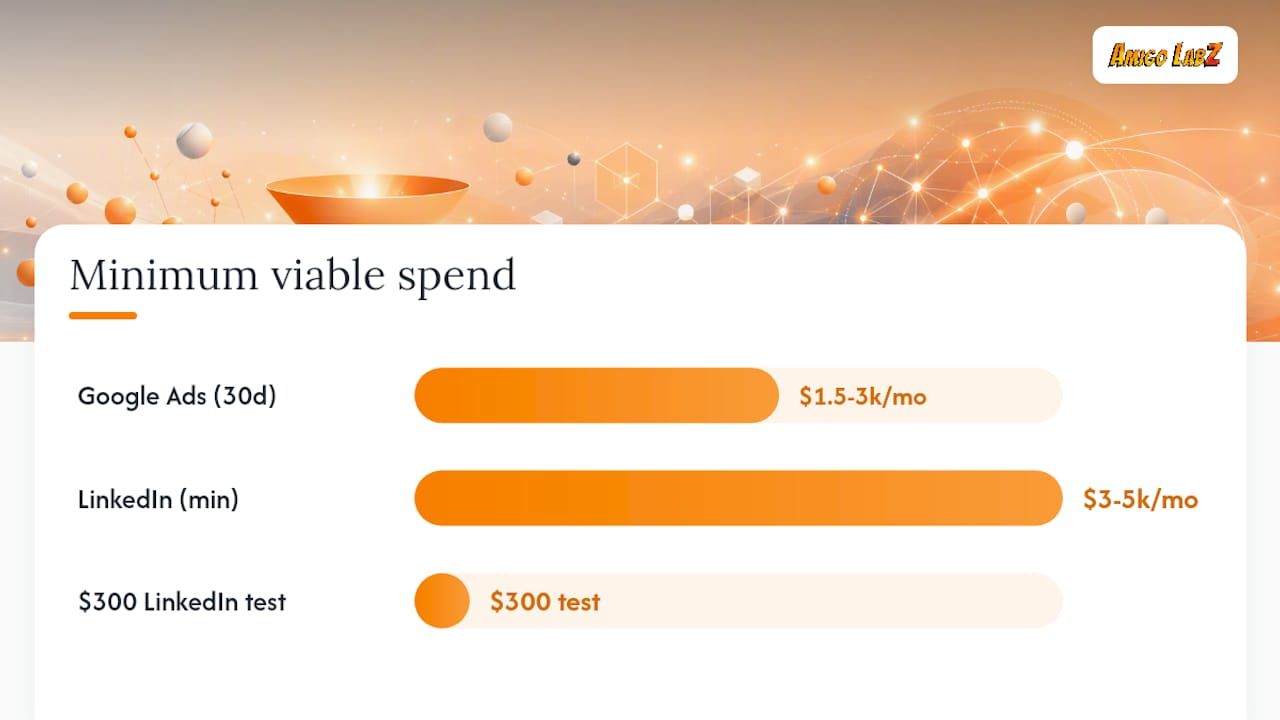
Budgeting mistakes and minimum viable spend: a test budget that is too small produces data you cannot act on. For Google Ads, a minimum viable test is roughly $1,500–$3,000 per month for 30 days, enough to generate 20–50 conversions at a $30–$60 CPL. For LinkedIn, budget at least $3,000–$5,000 per month given the higher CPL. Running a $300 test on LinkedIn and concluding "it doesn't work" is a common and expensive mistake.
Numbered fix checklist:
- Consolidate to two channels.
- Add ICP-fit scoring to your CRM.
- Build a 5-minute triggered response email.
- Write a one-page ICP document.
- Audit and align ad-to-landing-page message match.
- Set a minimum viable spend threshold before drawing channel conclusions.
How Amigolabz approaches lead generation for its clients
Amigolabz follows the same ICP-first sequence described throughout this article: define the ideal customer, build one high-converting landing page, drive traffic from one paid channel, and route leads into an automated nurture sequence before handing off to sales. For regional businesses in New Jersey and Nevada, that often means starting with Google Search Ads for high-intent local queries and pairing it with a Facebook Lead Ads retargeting campaign for prospects who visited but did not convert.
Services mapped to funnel stages:
- Top of funnel: SEO and content marketing to build organic reach and capture high-intent search traffic over time.
- Mid-funnel: Google Ads and Facebook Ads to drive qualified traffic to landing pages; LinkedIn Ads for B2B clients targeting specific job titles.
- Capture: Landing-page design and form optimization, including mobile-first builds and privacy-compliant consent language.
- Nurture: Email automation setup and email campaign strategy to move leads from first touch to sales-ready.
- Measurement: Weekly CPL and MQL-to-SQL reporting so clients see pipeline contribution, not just lead volume.
The team focuses on measurable outcomes: CPL, MQL-to-SQL rate, and pipeline influenced. Every client engagement starts with a discovery call to map revenue goals to lead volume targets, then builds backward to channel selection and budget.
Pro Tip: If you are a regional SMB in New Jersey or Nevada, local lead-generation strategies often outperform national campaigns at a fraction of the cost. Geo-targeted Google Ads and locally relevant landing-page copy consistently produce lower CPL for businesses serving defined geographic markets.
What Amigolabz sees working in 2026
Three things are producing the clearest results for clients right now.
First, speed-to-lead automation. The gap between programs with a 5-minute response time and those with a 24-hour response time is measurable in pipeline. Clients who set up a triggered SMS or email within minutes of a form submission consistently see higher qualification rates than those relying on manual follow-up, even when the manual follow-up is same-day.

Second, intent-layering on ABM programs. Layering third-party intent data (from tools like Bombora or G2) on top of a target account list lets you prioritize outreach to accounts that are actively researching your category right now, not just accounts that fit your ICP on paper. For clients running ABM with 20–50 accounts, this has meaningfully shortened the time from first touch to booked meeting.
Third, repurposed content cadence. Clients who treat each webinar or research report as a single asset are leaving most of its value on the table. The ones seeing the best results are running a structured repurpose plan: clips for social, a blog post, a nurture email, and a sales enablement one-pager, all from one original asset.
One caution: fully automated outreach without human personalization is producing diminishing returns. Prospects can identify a templated sequence in the first two lines. The programs that convert best in 2026 use automation for timing and sequencing, but inject a human-written first line or a specific reference to the prospect's business in the opening touch.
The operational takeaway is simple: start with a small, well-measured test before scaling. A $2,000 two-channel test with a single lead magnet tells you more than a $20,000 campaign spread across six channels with no clear attribution.
Amigolabz's lead-gen pilot: what you get in 90 days
For SMBs across the U.S. that need qualified leads without a six-month agency ramp-up, Amigolabz offers a 90-day lead-generation pilot built around the two-channel framework in this article.

The pilot is designed for B2B and B2C businesses that have a defined offer but are not yet generating consistent pipeline from digital channels. It is not a retainer with vague deliverables. It is a scoped, measurable program with a clear output.
What the pilot includes:
- One conversion-optimized landing page with a short form and mobile-first design.
- Two-channel paid campaign setup (Google Ads + Facebook/Instagram Ads or LinkedIn Ads, depending on your ICP).
- A 4-email automated nurture sequence connected to your CRM.
- Weekly CPL and MQL-to-SQL reporting with plain-English commentary.
The next step is a 30-minute discovery call where the team maps your revenue target to a lead volume goal and recommends the right channel pair for your market. Book a call with Amigolabz to get started, or review the Facebook Ads service page if paid social is your primary channel.
Sources
FAQ
What is the best digital marketing strategy for lead generation?
The most reliable approach is one primary acquisition channel (Google Search Ads for high-intent buyers, LinkedIn Ads for B2B, Meta Ads for B2C) paired with one retargeting channel, a single high-value lead magnet, and an automated nurture sequence. Measure CPL and MQL-to-SQL rate within 90 days and iterate from there.
What is lead generation in digital marketing?
Lead generation in digital marketing is the process of attracting online prospects and capturing an identifiable contact or intent signal, such as an email address or demo request, so sales can follow up. It differs from demand generation, which builds awareness without necessarily capturing a contact.
What are the most effective lead generation techniques?
High-performing teams combine at least three channels, typically pairing paid search or social ads with content-led capture (webinars, gated assets) and an email nurture sequence. Webinars, ROI calculators, and original research consistently outperform generic content as lead magnets.
What are the four L's of a lead generation strategy?
The four L's are Lead Capture (collecting contact information via forms, Lead Ads, or Lead Gen Forms), Lead Magnet (the high-value asset offered in exchange for contact details), Landing Page (the conversion-focused page where the exchange happens), and Lead Nurturing (the follow-up sequence that moves leads toward a sales conversation). Definitions vary slightly by source, but this framing maps directly to the ICP-to-pipeline sequence covered in this article.
How long does it take to see results from a lead generation campaign?
Paid channels like Google Ads and Meta Ads typically produce leads within one to four weeks. SEO and content-led programs take six to eighteen months to compound. A 90-day two-channel test gives you enough data to make confident budget decisions on paid channels while your organic program builds in the background.
Recommended