What is call tracking? The small business guide to ROI
What is call tracking? The small business guide to ROI
TL;DR:
- Most small businesses lack detailed insights into which marketing efforts generate phone calls, leading to wasted spending. Call tracking assigns unique numbers to campaigns, enabling precise attribution, outcome measurement, and smarter budget allocation. Proper implementation involves CRM integration, outcome tagging, and strategic use of static and dynamic methods to maximize marketing ROI.
Most small business owners have no idea which of their ads, campaigns, or channels are actually driving phone calls. You're spending money on Google Ads, Facebook, maybe a local mailer, and when the phone rings, you just answer it. You don't know if that caller found you from a $500 Facebook campaign or a $5,000 billboard. That blind spot is costing you real money. Understanding what is call tracking, and putting it to work, gives you the ability to connect every inbound call to the exact marketing source that produced it, so you stop guessing and start spending smarter.
Table of Contents
- What is call tracking and why small businesses need it
- How dynamic number insertion powers modern call tracking
- Inbound call tracking: tracking calls beyond just caller ID
- Common call tracking methods: static vs dynamic tracking compared
- Implementing call tracking: tips for small businesses to maximize ROI
- Call tracking isn't just data, it's a tool most small businesses underutilize
- Start optimizing your marketing ROI with expert call tracking integration
- Frequently asked questions
What is call tracking and why small businesses need it
Call tracking is exactly what it sounds like, but most people underestimate what it actually does. Call tracking is a marketing technology that measures the value of inbound phone calls by assigning unique phone numbers to specific marketing channels, campaigns, ads, or visitor sessions. When someone calls your business, the system knows which ad they saw, which keyword they searched, or which campaign triggered that call.
For a small business owner, this is a significant shift. Instead of treating every phone call as an anonymous event, you suddenly have data. You know that your Google Ads campaign drove 14 calls last month, your Facebook campaign drove 3, and your local mailer drove 1. That information changes how you allocate next month's budget.
Here's what call tracking actually does for your business on a practical level:
- Assigns unique phone numbers to each marketing channel, ad set, or campaign so calls are traced back to their origin
- Records call metadata including caller ID, call duration, time of day, and geographic location
- Integrates with advertising platforms like Google Ads to feed call data directly into your campaign reporting
- Tracks call outcomes so you can distinguish between a quick question and an actual sales lead
- Identifies your highest-performing marketing sources so you invest more in what works and less in what doesn't
The difference between businesses that grow their marketing ROI and those that spin their wheels often comes down to attribution. Understanding call tracking vs call analytics is a good place to start deepening that understanding.
How dynamic number insertion powers modern call tracking
Understanding call tracking basics leads us to explore how modern tools achieve this with dynamic number insertion. This is the technology behind the scenes that makes per-session tracking possible.
Dynamic number insertion uses a small JavaScript snippet to automatically swap the phone number displayed on your website based on visitor source, attributing calls to specific traffic sources and sessions. Translation: two different people can land on your website at the same time, and each one sees a different phone number depending on how they got there.
Here's how it works step by step:
- A visitor lands on your website from a Google Ad, an organic search result, a Facebook post, or a direct visit.
- The JavaScript snippet fires and detects the visitor's source data, including UTM parameters, referring URL, keyword, or ad ID.
- A unique tracking number is displayed on the page in place of your real business number, matching that visitor's traffic source.
- The visitor calls that number , and the call is routed to your actual business line while the system logs the full attribution data.
- The call record is stored with metadata including the source, keyword, session ID, and call outcome for later analysis.
This level of detail is what separates modern call tracking from the old-school approach of just buying one separate number for a print ad. DNI works at the individual session level, which means you can tie a specific call to a specific Google Ads keyword, not just a campaign.
Pro Tip: If you are running paid ads, add UTM parameters to every campaign URL. Without them, DNI can identify a visitor came from a paid channel but can't always capture the exact ad or keyword that triggered the click. UTMs and call tracking work together, not independently.
For a deeper look at integrating call tracking with marketing platforms, it helps to understand how these tools connect across your entire digital marketing stack.
Inbound call tracking: tracking calls beyond just caller ID
Now that you know how calls get attributed, let's dive deeper into what inbound call tracking systems offer beyond just attribution. Knowing a call came from an ad is useful. Knowing that call turned into a $2,000 sale is where it gets powerful.

Inbound call tracking attributes calls to marketing campaigns and keywords, can track call outcomes such as sales or inquiries, and supports agent performance and customer experience insights. That last piece matters more than most small business owners realize. If you have staff answering calls, their performance is now measurable.
What modern inbound call tracking systems actually give you:
- Call outcome tagging : Label calls as sales, quotes, appointments, wrong numbers, or existing customer inquiries so you measure lead quality, not just volume
- Keyword-level attribution : See exactly which search terms are driving calls, not just which campaigns
- Call recordings : Review actual conversations to understand what customers are asking, what objections come up, and how your team responds
- First-time vs repeat caller identification : Know whether you're attracting new leads or repeatedly hearing from existing customers
- Time-of-day and day-of-week data : Find out when your highest-value callers reach out so you can schedule staff accordingly
- Geographic call data : See which zip codes or cities are generating the most calls from specific campaigns
This moves the conversation from "how many calls did we get" to "how many qualified leads did we generate, at what cost, from which source." That's the kind of reporting that helps you walk into a budget conversation with real numbers. For a look at available call tracking integration options that connect to your existing tools, it's worth exploring what fits your setup.
Common call tracking methods: static vs dynamic tracking compared
To give you clarity, here's a side-by-side look at the main call tracking methods. The right choice depends on your business size, how many campaigns you're running, and how granular you need your data to be.
Static call tracking assigns a dedicated phone number per campaign or channel, while dynamic call tracking uses scripts to swap numbers based on visitor source, providing finer attribution detail.
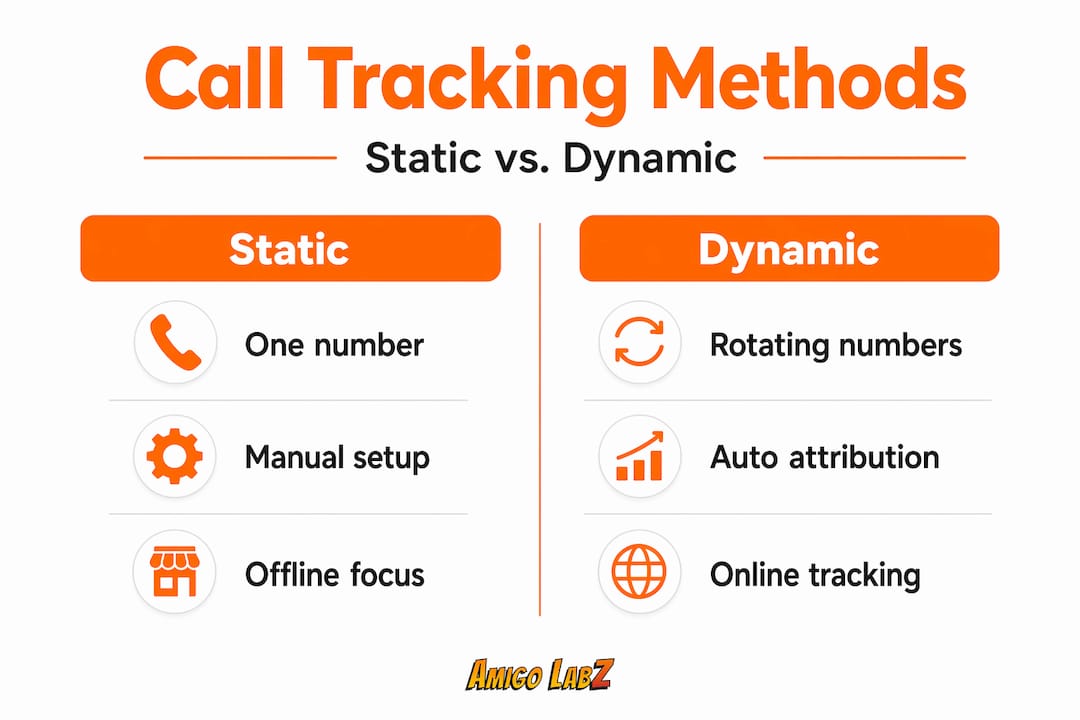
| Feature | Static call tracking | Dynamic call tracking |
|---|---|---|
| How it works | One unique number per channel or campaign | JavaScript swaps numbers per visitor session |
| Attribution level | Channel or campaign level | Session, keyword, and ad level |
| Best for | Offline campaigns, simple setups | Paid search, multi-channel digital |
| Setup complexity | Low | Moderate |
| Cost | Lower | Higher (more numbers in pool) |
| Data granularity | Basic | Detailed |
| CRM integration | Manual or basic | Automated and rich |
Static tracking is a solid starting point. If you're running a direct mail campaign and just want to know if it generated calls, one dedicated number tells you that clearly. It's simple, affordable, and effective for that purpose.
Dynamic tracking is the better choice when you're running paid search or social ads and need to know not just that someone called, but which specific keyword or ad they responded to. That granularity directly informs bid strategy and ad creative decisions.
Pro Tip: Start with static tracking for offline campaigns like mailers or billboards, and layer in dynamic tracking for your website and paid digital campaigns. You don't have to choose one or the other. Most call tracking methods comparison analyses show businesses get the most value by using both strategically.
Implementing call tracking: tips for small businesses to maximize ROI
With these options in mind, here are expert tips for setting up call tracking to deliver real results for your business. The tool itself is only as useful as the infrastructure around it.
For call tracking to be actionable, it must integrate inbound call records with your CRM and define call outcomes that align with your sales funnel to measure cost per qualified lead accurately. This is the step most small businesses skip, and it's why their call data sits in a dashboard but never actually improves their marketing decisions.
Here's how to implement call tracking the right way:
- Connect call data to your CRM immediately. Every call record should become a contact or lead entry with the source attached. This closes the loop between marketing spend and actual customer relationships.
- Define your call outcomes before you start. Decide what counts as a qualified lead call, what counts as a sales call, and what counts as a support call. Tag accordingly from day one.
- Keep your official business number consistent in Google Business Profile, Yelp, and local directories. Never swap that number with a tracking number or you'll damage your local SEO and confuse customers.
- Apply DNI only on your website's conversion-focused elements , such as headers, contact pages, and landing pages. Not in your footer NAP (name, address, phone) block.
- Tag every campaign URL with UTM parameters before it goes live. Source, medium, campaign, and keyword tags give your call tracking software the context it needs to attribute correctly.
- Review your call data weekly , not monthly. Trends show up quickly in paid campaigns, and catching a low-performing ad after one week beats catching it after four weeks of wasted spend.
"Mixing official business numbers used for listings with dynamically tracked numbers on your website requires careful management to avoid customer confusion and maintain consistent branding." Source: GBP, UTM & call tracking pitfalls for small business
This point is worth repeating because it trips up a lot of businesses. Your tracking numbers are internal tools, not public-facing identities. Protect your official number's consistency everywhere your business is listed publicly.
For using call tracking data in Google Ads and for improving Facebook Ads with call tracking, connecting these platforms to your call data turns passive reporting into active campaign optimization.
Call tracking isn't just data, it's a tool most small businesses underutilize
Here's the honest truth after working with small business owners across the country: most businesses that set up call tracking never actually use it the way it was designed to be used. They get the dashboard, they see the call counts, and then nothing changes in how they run their campaigns.
The problem isn't the tool. It's the mindset going in. Call tracking gets treated as a reporting feature when it should be treated as a decision-making engine. Call tracking is fundamentally an attribution and source-identification layer, distinct from call analytics, which measures conversation quality. Understanding this distinction helps you select the right tools to actually boost ROI instead of just measure it.
When you know call tracking handles the "where did this call come from" question and call analytics handles the "what happened on that call" question, you stop expecting one tool to do everything. You build a stack that answers both, and that's where real performance improvements happen.
The other miss: businesses define no call outcomes at all. They measure call volume and assume more calls means better marketing. But 50 calls from a campaign that never converts is worse than 10 calls that close at 60%. Volume without outcome data is noise.
The small businesses getting the most value from call tracking are doing three things consistently: integrating call data with their CRM, tagging every call with an outcome, and reviewing that data before making any budget changes. That process isn't complicated. But it requires discipline and a clear system, not just a software subscription. For a deeper look at how call tracking and call analytics difference shapes tool selection, that framing can change how you approach your entire attribution setup.
Start optimizing your marketing ROI with expert call tracking integration
You now have a clear picture of how call tracking works and where most businesses leave value on the table. The next step is making sure your setup is actually connected to your campaigns and producing data you act on.

At Amigo Labz, we work with small business owners across New Jersey, Nevada, and the rest of the country to build marketing systems where every channel pulls its weight. That includes connecting call tracking to your Google Ads campaigns and Facebook Ads so you see exactly what's working. We also build and optimize websites and marketing solutions that are designed from the ground up to capture and attribute leads accurately. If you're ready to stop guessing and start building a marketing operation that gives you clear answers, let's talk.
Frequently asked questions
What exactly does call tracking measure?
Call tracking assigns unique phone numbers to specific marketing channels and captures call data for attribution, measuring which campaigns, ads, or traffic sources generate inbound phone calls along with metadata like call duration and caller location.
How does dynamic number insertion improve marketing attribution?
DNI uses JavaScript to swap phone numbers by visitor source, enabling session-level attribution that ties each call back to the exact campaign, keyword, and session that brought that visitor to your site, rather than just identifying a broad channel.
Can call tracking track call outcomes like sales or appointments?
Yes. Inbound call tracking can track call outcomes and attribute them to campaigns for actionable insights, letting you measure true ROI by connecting each marketing source to the actual business result it produced, not just the call volume.
What are common mistakes small businesses make with call tracking?
Mixing official numbers with dynamic tracking can confuse customers, and skipping CRM integration and call outcome definitions leaves you with data you can't act on, which are the two most common reasons call tracking setups fail to improve marketing ROI.
Is call tracking useful for both online and offline marketing campaigns?
Yes. Call tracking assigns numbers to both online campaigns and offline sources, so whether you're running a Google Ads campaign or a direct mail piece, you can assign a unique number to each and know exactly which source drove each call.
Recommended