How to Get Online Reviews: Strategies That Work
How to Get Online Reviews: Strategies That Work

TL;DR:
- Effective online review collection relies on targeted channels like email, SMS, and QR codes, each suited for specific situations.
- Timing requests between 1 PM and 3 PM and personalizing messages with clear, direct links significantly improve response rates.
- Responding promptly to all reviews, especially negative ones, with personalized replies enhances trust and builds a strong reputation.
Online reviews are the single most visible trust signal a business controls, and knowing how to get online reviews effectively separates growing businesses from stagnant ones. Google Business Profile, Yelp, and Facebook are the primary platforms where customers form opinions before ever walking through your door. SMS review requests drive up to 66% higher conversion rates compared to email. That number alone tells you the channel you choose matters as much as the message you send. The strategies below cover every layer of a repeatable review system, from channel selection to response management.
How to get online reviews from the right channels
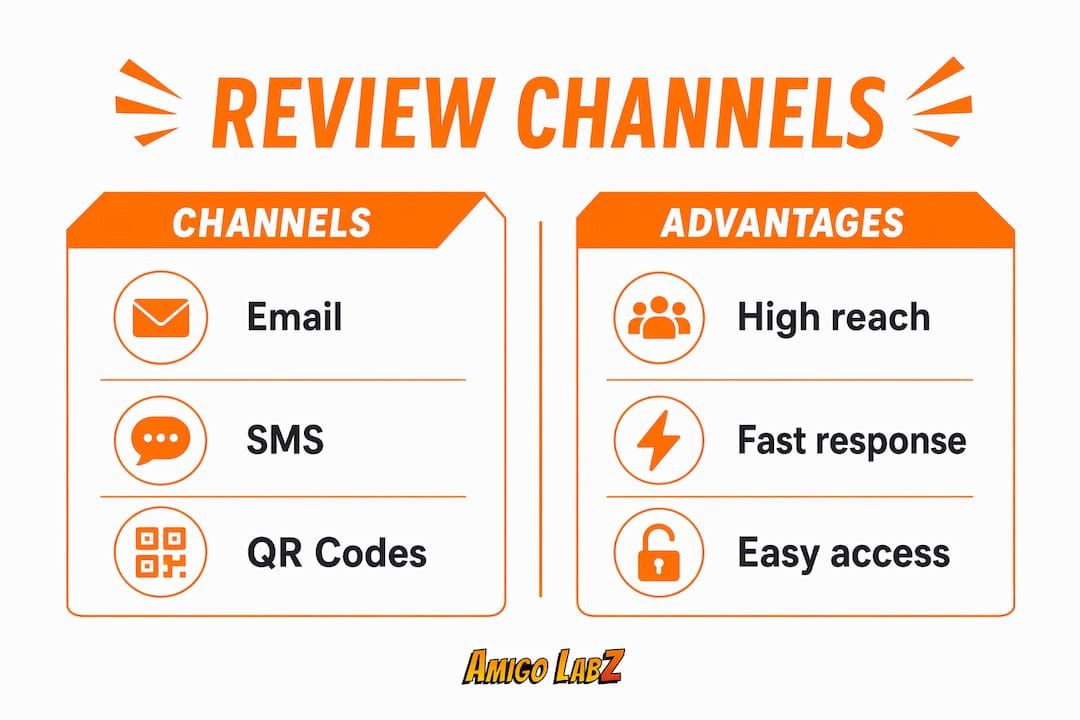
The channel you use to request a review determines whether a customer acts or ignores you. Each channel has a distinct use case, and mixing them strategically produces the best results.

Email remains the workhorse for review collection. AMP email technology lets customers submit reviews directly inside the email without clicking to an external page. Removing that extra step dramatically improves submission rates. For standard email requests, keep the message under 100 words and include a direct link to your review page. Well-crafted short email requests achieve 5–15% review completion rates, which is a realistic benchmark to measure your campaigns against.
SMS is faster and more direct. Open rates for SMS far exceed email, which is why SMS converts at a higher rate. The tradeoff is that customers tolerate fewer SMS messages before they feel annoyed. Use SMS for your highest-value customers or immediately after a completed service.
QR codes solve the in-person problem. QR codes on receipts or at your point of sale prompt customers to leave a review while the experience is still fresh. A restaurant, salon, or retail store can place a small QR code card on every table or checkout counter and see immediate results.
Here is a quick comparison of the three primary channels:
| Channel | Best Use Case | Key Advantage | Key Limitation |
|---|---|---|---|
| Post-purchase follow-up | AMP allows in-email submission | Lower open rates than SMS | |
| SMS | High-value or recent customers | High open and conversion rates | Alert fatigue if overused |
| QR Code | Physical locations | Captures in-moment feedback | Requires customer initiative |
Social media also plays a role. Facebook Reviews and Instagram story prompts reach customers who are already engaged with your brand online. These channels work best as a secondary layer after email or SMS has already been deployed.
Pro Tip: Set up a Google Business Profile automation that triggers a review request link via email within 24 hours of a confirmed purchase or appointment. This single step builds review volume without any manual effort.
What should your review request message say?
The message itself is where most businesses lose customers. A vague, generic request gets ignored. A short, personal, direct message gets results.
The formula is straightforward. Start with the customer's first name. State why you are reaching out in one sentence. Ask a specific question rather than a broad one. Include a direct link. Close in under 100 words total.
Here is what that looks like in practice for an email:
"Hi [Name], thank you for your recent visit. We would love to hear what you thought. Could you take 60 seconds to leave us a quick review? [Leave a Review Here]. Your feedback helps us serve you better."
For SMS, compress it further:
"Hi [Name], thanks for choosing us! Mind leaving a quick review? It takes less than a minute: [link]"
The principles behind effective review requests include:
- Personalization: Use the customer's name and reference the specific product or service they used.
- Brevity: Customers will not read a paragraph asking for a favor. Keep it tight.
- One clear action: Include a single direct link. Multiple links create confusion and reduce clicks.
- Honest framing: Ask for honest feedback, not just positive feedback. Customers trust that framing more, and it protects you from platform policy violations.
- Low time commitment: Phrases like "takes 60 seconds" reduce the perceived effort and increase follow-through.
Templates are useful starting points, but a robotic tone kills conversions. Have a real person review every template before it goes live. If it sounds like it came from a machine, rewrite it. For more guidance on crafting email requests that convert, Amigolabz has covered the fundamentals in detail.
When should you send review requests for best results?
Timing is one of the most underused levers in review collection. Sending a request at the wrong moment wastes the effort you put into the message itself.
The research on timing is specific. Review response rates increase nearly 20% when requests are sent between 1 PM and 3 PM. That window catches customers during a natural pause in their day, after lunch and before the late-afternoon rush.
Beyond time of day, milestone-based triggers produce the most relevant reviews. Follow this sequence:
- Trigger at the right moment. Send the request immediately after a delivery confirmation, a completed appointment, or the end of a 30-day subscription period. The experience is fresh and the customer is most likely to engage.
- Send one follow-up. If the customer did not respond to the first request, one follow-up message sent 48–72 hours later is acceptable. A single follow-up meaningfully increases total review volume without damaging the customer relationship.
- Stop after two attempts. Sending a third or fourth message crosses into harassment territory. Customers who receive too many requests associate that feeling with your brand, not the review platform.
- Adjust by customer segment. A loyal repeat customer may respond well to a more personal follow-up. A first-time buyer needs a lighter touch.
Automation workflows that trigger based on customer interaction patterns handle this sequencing without manual oversight. As your order volume grows, manual collection becomes impossible. Automation is the only way to maintain consistent review velocity at scale.
Pro Tip: Segment your customer list by purchase recency before launching a review campaign. Customers who bought within the last 14 days convert at a significantly higher rate than those contacted after 60 days.
How should you respond to reviews to build trust?
Responding to reviews is not optional. It is the part of the review process that most directly affects how new customers perceive your business.
The standard for responding to negative reviews is within one workday. A delayed response to a negative review signals indifference. A prompt, calm, and solution-oriented reply signals professionalism. The U.S. Chamber of Commerce confirms that publicly responding to negative reviews builds brand credibility more than deleting them. Deleting or ignoring criticism looks worse than the original complaint.
For positive reviews, a short personalized thank-you keeps the relationship warm. Do not use the same canned response for every five-star review. Customers notice, and it undermines the authenticity you are trying to project.
Best practices for review responses:
- Respond within 24 hours to all reviews, positive and negative.
- Never delete negative reviews unless they violate platform terms of service.
- Acknowledge the specific issue in negative responses rather than giving a generic apology.
- Invite the conversation offline by providing a direct contact method for unresolved complaints.
- Thank reviewers by name in positive responses to reinforce the personal connection.
AI can draft review responses at scale, which is useful when you are managing dozens of reviews per week. The requirement is human oversight. An AI-drafted response that sounds tone-deaf or misses the emotional context of a complaint does more damage than no response at all. Use AI to generate a first draft, then edit for voice and sincerity before publishing.
"A negative review handled well is often more persuasive to a potential customer than a wall of five-star ratings with no critical feedback at all." — Amigolabz
For a deeper look at reputation management for SMBs, Amigolabz has published a full breakdown of response frameworks and escalation protocols.
Key takeaways
Consistent review collection requires the right channel, the right timing, and a response strategy that treats every review as a public conversation with future customers.
| Point | Details |
|---|---|
| Choose channels strategically | Use SMS for speed, email with AMP for friction-free submission, and QR codes for in-person capture. |
| Keep requests under 100 words | Short, personalized messages with a direct link achieve 5–15% completion rates. |
| Send requests at 1–3 PM | Response rates increase nearly 20% during this window compared to other times of day. |
| Respond within one workday | Prompt replies to negative reviews build credibility more than ignoring or deleting them. |
| Automate at scale | Milestone-based automation maintains review velocity as order volume grows beyond manual capacity. |
What i've learned after years of watching review strategies fail
Most business owners treat review collection as a one-time campaign. They send a batch of requests after a slow month, get a handful of reviews, and then go quiet for six months. That approach produces a review profile that looks abandoned, not active.
The businesses I have seen build genuinely strong review profiles do one thing differently. They treat review collection as an always-on system, not a project. Automation is not a shortcut. It is the only way to maintain the kind of review velocity that signals to Google and to customers that your business is consistently delivering.
The other mistake I see constantly is vague requests. "Let us know what you think" is not a review request. It is a suggestion. Customers need a specific, low-friction path. A direct link, a time estimate, and a personal greeting are not optional extras. They are the difference between a 2% response rate and a 12% response rate.
One thing most guides skip entirely is the value of zero-party data collected during the review process. When a customer tells you which product they bought, how it fit, or what they would change, that information feeds directly into smarter marketing segments. Reviews are not just reputation signals. They are customer research you did not have to pay for.
Finally, do not be afraid of negative reviews. A business with 200 reviews averaging 4.3 stars is more credible than one with 12 reviews averaging 5.0 stars. The 4.5-star benchmark is where competitive businesses tend to cluster. Getting there requires volume, and volume requires a system.
— John
How Amigolabz helps you build a review system that scales
Building a review system from scratch takes time you probably do not have. Amigolabz works with business owners across New Jersey, Nevada, and the rest of the country to set up review collection workflows, optimize Google Business Profiles, and manage the response process so nothing falls through the cracks.

The team at Amigolabz handles Google Business Profile optimization to make sure your review page is visible and converting. Amigolabz also manages social media profiles to extend your review presence across platforms. If you want a tailored plan built around your specific business and customer base, book a call and the team will map out a strategy that fits your goals.
FAQ
What is the best platform for collecting online reviews?
Google Business Profile is the highest-priority platform for most businesses because Google reviews directly influence local search rankings and customer trust. Yelp and Facebook are strong secondary platforms depending on your industry.
How do i ask for reviews without sounding pushy?
Keep your request under 100 words, use the customer's first name, and frame the ask as a quick favor rather than a demand. Including a direct link and a time estimate like "takes 60 seconds" reduces friction and increases response rates.
When is the best time to send a review request?
Sending requests between 1 PM and 3 PM increases response rates by nearly 20% compared to other times of day. Timing the request immediately after a purchase or service completion also improves relevance and conversion.
Should i respond to negative reviews?
Yes. Responding publicly to negative reviews builds more credibility than deleting them. Respond within one workday, acknowledge the specific issue, and offer a direct contact method to resolve the complaint offline.
How many review requests should i send before stopping?
Send one initial request and one follow-up 48–72 hours later if there is no response. Sending more than two requests for a single transaction creates alert fatigue and damages the customer relationship.
Recommended