How to write blog posts that boost your small business
How to write blog posts that boost your small business

TL;DR:
- Blogging increases website traffic by 55 percent compared to not publishing content.
- Effective blogs use proper tools, structure, and human editing to optimize results.
- Consistent, reader-focused content over 2000 words over time yields better SEO and engagement.
You want more people finding your business online, but every time you sit down to write a blog post, you freeze. What do you write about? How long should it be? Will anyone even read it? These are real questions that small business owners in New Jersey and Nevada ask us all the time. Here's the thing: companies that blog get 55% more website visitors than those that don't. That's not a small edge. This guide walks you through everything from tools and structure to editing and measuring results so you can stop guessing and start publishing posts that actually work.
Table of Contents
- Essential blog writing tools and requirements
- Structuring your blog post: Frameworks that win
- Writing and editing for impact and clarity
- Common pitfalls and how to verify blog effectiveness
- What small businesses often overlook in blog writing
- Take your blog—and business—further with Amigo Labz
- Frequently asked questions
Key Takeaways
| Point | Details |
|---|---|
| Blog posts attract visitors | Businesses that consistently blog see up to 55% more website visitors than those that don't. |
| Use proven frameworks | Structuring your posts with PAS intros, summaries, FAQs, and author bios boosts both reader engagement and SEO. |
| Human oversight is essential | AI writing tools help, but human editing ensures content quality and trust. |
| Measure, refine, repeat | Use analytics to track visits and tweak your content strategy for best results. |
| Connect with local experts | Partnering with skilled SEO and digital marketing teams amplifies your business blog's impact. |
Essential blog writing tools and requirements
Before you write a single word, you need the right setup. Think of it like opening a restaurant. You wouldn't start cooking without a kitchen, the right equipment, and a menu plan. Blogging works the same way.
Platforms and software to get started
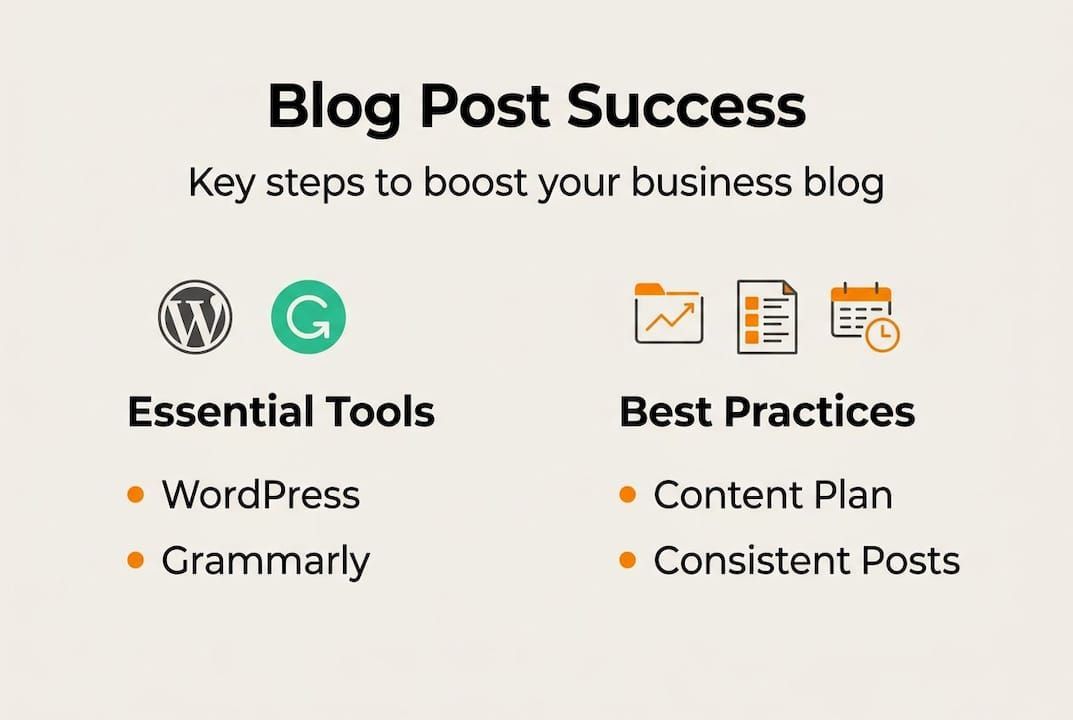
For most small businesses in New Jersey and Nevada, WordPress tools offer the best combination of flexibility, SEO features, and ease of use. Pair WordPress with a grammar tool like Grammarly and a keyword research tool like Google Keyword Planner. These three alone will handle most of what you need.
Here's a quick breakdown of what each tool does:
| Tool | Purpose | Cost |
|---|---|---|
| WordPress | Publishing and managing posts | Free (hosting extra) |
| Grammarly | Grammar and clarity checks | Free/paid |
| Google Keyword Planner | Finding search terms | Free |
| Yoast SEO | On-page SEO optimization | Free/paid |
| Google Analytics | Tracking post performance | Free |
Team roles that matter
You don't need a full marketing department. But you do need clear roles:
- Writer : Creates the draft, researches the topic, and writes with the reader in mind
- Editor : Reviews for clarity, tone, and accuracy before anything goes live
- SEO manager : Handles keyword targeting, meta descriptions, and internal linking
If you're a solo owner, you may wear all three hats. That's fine. Just don't skip any of the steps.
How long should your posts be?
Length matters more than most people realize. The optimal post length for competitive informational queries is 2,000 to 4,000 words. Shorter posts rarely rank well for anything competitive. Longer posts give you room to cover a topic thoroughly, which search engines reward.

Also, check out these local web design tips to make sure your blog fits into a website that converts visitors into customers.
Pro Tip: Build a content calendar before you write your first post. Plan topics three months out. This keeps you consistent and prevents the dreaded blank-page panic every time a publishing deadline rolls around.
Structuring your blog post: Frameworks that win
A well-structured post does two jobs at once. It keeps your reader engaged, and it signals to search engines that your content is organized and trustworthy. Most business owners skip the structure step entirely. That's a big mistake.
The frameworks you should know
Here's a comparison of the most effective blog post frameworks for small business blogs:
| Framework | Best used for | Reader benefit |
|---|---|---|
| PAS (Problem, Agitate, Solution) | Intros and service posts | Hooks attention fast |
| TL;DR summary | Long informational posts | Helps skimmers and AI crawlers |
| Author bio | All posts | Builds trust and E-E-A-T |
| FAQ schema | How-to and guide posts | Earns featured snippets |
E-E-A-T stands for Experience, Expertise, Authoritativeness, and Trustworthiness. It's how Google evaluates whether your content deserves to rank. These blog post best practices around PAS intros, TL;DR summaries, author bios, and FAQ schema all directly support your E-E-A-T score.
A step-by-step outline for a winning post
- Start with a TL;DR or summary at the top for readers and AI crawlers
- Open with a PAS intro that names the problem your reader faces
- Use clear H2 and H3 headings to organize your sections
- Include at least one table or list to break up dense text
- Add an author bio with your name, role, and relevant experience
- Close with a FAQ section that answers common questions
- Link internally to related pages on your site
Internal linking is one of the most underused SEO strategies for small businesses. When you link from one post to another relevant page, you help visitors find more content and help search engines understand your site structure. You can also use a PAS structure approach in your ad copy and social content, not just blog posts.
Pro Tip: Add FAQ schema markup to your blog posts. This is a small piece of code that tells Google your FAQ section is structured data. It increases your chances of showing up in the featured snippet box at the top of search results, which can dramatically boost your click-through rate.
Visit our services page to see how we help businesses build smarter internal linking strategies as part of a full digital marketing plan.
Writing and editing for impact and clarity
Now comes the part most people dread: actually writing the thing. Here's the truth. A mediocre post published consistently beats a perfect post that never gets finished. Start with a rough draft. Don't edit while you write. Get your ideas down first, then clean them up.
Drafting with clarity
Write like you're explaining something to a customer across the counter. Avoid stuffing your post with keywords. Keyword stuffing is when you repeat a search term so many times that the writing sounds unnatural. It used to work in 2010. Now it actively hurts your rankings.
Focus on answering the reader's actual question. If someone searches "how to market a small business in New Jersey," they want practical steps. Give them that. The keyword will appear naturally as you write.
Editing steps that make a difference
- Read your draft out loud to catch awkward phrasing
- Break up any paragraph longer than four sentences
- Replace vague words like "good" or "nice" with specific ones
- Check that every heading tells the reader what the section covers
- Confirm all facts are accurate and linked to credible sources
- Have a second person review before publishing
Human review is not optional. Pure AI content fails without human oversight because it tends to be predictable, generic, and low on E-E-A-T. AI can help you draft faster, but a real person needs to verify the facts, add real-world examples, and make sure the post sounds like your business.
"People-first content outperforms algorithm tricks every time. Write for your reader, and the rankings will follow."
You can find more blog writing insights on our site, along with examples of how we approach content for businesses across New Jersey and Nevada. If you're also managing social media, our social content editing services can help keep your messaging consistent across every channel.
Common pitfalls and how to verify blog effectiveness
Writing a great post is only half the job. You also need to know if it's working. Too many business owners publish posts and never check back. That's like running an ad and never looking at the results.
The most common blogging mistakes
- Skipping keyword research before writing
- Publishing posts under 500 words and expecting them to rank
- Ignoring meta descriptions and title tags
- Never updating old posts with new information
- Writing for search engines instead of actual people
- Forgetting to add internal links to related pages
- Not promoting posts on social media or email after publishing
Each of these mistakes costs you traffic. The good news is they're all fixable.
How to check if your blog is working
Start with Google Analytics and Google Search Console. Both are free. Analytics shows you how many people visited your post, how long they stayed, and whether they clicked to other pages. Search Console shows you which search terms brought people to your site.
Businesses that blog consistently see real results. 55% more website visitors come to companies that blog compared to those that don't. That gap compounds over time as older posts continue to attract traffic.
For paid traffic insights, our Google Ads support team can show you how organic blog traffic and paid campaigns work together to fill your pipeline. And for deeper analysis, explore our SEO measurement tools to track keyword rankings and organic growth month over month.
Pro Tip: Set a monthly reminder to review your top five blog posts in Google Analytics. Look at bounce rate, average session duration, and conversions. If a post gets traffic but no one stays, the content may need to be rewritten or the page design needs improvement.
What small businesses often overlook in blog writing
Here's something we see constantly working with businesses in New Jersey and Nevada. Owners treat blogging like a chore they squeeze in between everything else. They publish one post, see no immediate results, and quit. That's not a blogging problem. That's an expectations problem.
Blogging's real ROI shows up at the six to twelve month mark, not week one. The businesses that win are the ones that treat content as a core business process, the same way they treat payroll or customer service. They plan it, resource it, and review it regularly.
The other trap is chasing keywords instead of reader value. We've seen businesses rank on page one for a term that drives zero conversions because the post didn't actually help anyone. A post that solves a real problem for your reader will always outperform one written to game an algorithm.
Our website solutions are built around this exact philosophy. Strategy first, tactics second.
Take your blog—and business—further with Amigo Labz
You now have a clear picture of what effective blog writing looks like, from tools and structure to editing and measuring results. But knowing what to do and having the time and team to execute it are two different things.

At Amigo Labz, we work with small business owners in New Jersey and Nevada to build content strategies that drive real traffic and real leads. Whether you need SEO services to improve your rankings, Google Ads support to complement your organic efforts, or a full content plan built around your business goals, we're here to help. Ready to stop guessing and start growing? Book a call with our team today.
Frequently asked questions
What is the ideal blog post length for SEO?
Aim for 2,000 to 4,000 words to match or exceed top-ranking competitors on informational queries. Shorter posts rarely have enough depth to compete.
How often should I publish blog posts for my business?
Publishing at least once a month keeps your site active and helps build traffic over time. Businesses that blog consistently earn 55% more visitors than those that don't.
Can I use AI to write business blogs?
AI tools can speed up drafting, but pure AI content without human oversight tends to be generic and low in trustworthiness. Always have a real person review and refine before publishing.
How do I measure if my blogs are working?
Use Google Analytics to track visitor numbers and session duration, and use Google Search Console to see which search terms are driving traffic to your posts.
How important is the author bio for business blogs?
An author bio with real credentials directly supports your E-E-A-T score and builds trust with both readers and search engines. Don't skip it.
Recommended