What is SEO? A small business guide to online visibility
What is SEO? A small business guide to online visibility
TL;DR:
- SEO connects small businesses with targeted, relevant customers by focusing on helpful, trustworthy content rather than tricks.
- Building content relevance, technical optimization, and credibility together boosts local visibility, attracting more direct leads.
- Consistency and genuine helpfulness outpace shortcuts, making thoughtful SEO a long-term growth strategy for small businesses.
Most small business owners have heard that SEO matters, but the moment someone starts talking about algorithms, backlinks, and keyword density, eyes glaze over. Here's the truth: SEO has very little to do with tricks and everything to do with connecting real people to real answers. When someone types "plumber near me" or "best bakery in Trenton" into Google, they want help fast. SEO is the process that determines whether your business shows up with the right answer or disappears into page five where no one ever goes.
Table of Contents
- What is SEO and why does it matter?
- How SEO works: The 3 pillars explained
- Local SEO: The game-changer for service businesses
- SEO success: Tracking what matters (and avoiding common pitfalls)
- SEO for small businesses: What really works (and what doesn't)
- Ready to grow? Get expert SEO support tailored to your business
- Frequently asked questions
Key Takeaways
| Point | Details |
|---|---|
| SEO drives visibility | SEO helps your business appear when customers search for services you offer online. |
| Focus on local SEO | For service-based businesses, optimizing your local presence is crucial for being found by nearby customers. |
| Track real progress | Measure conversions and user experience, not just rankings or clicks, to see what actually grows your business. |
| Content and credibility matter | Quality, helpful content and trustworthy signals are essential for earning higher search rankings and gaining customer trust. |
| Avoid quick-fix traps | Chasing rankings with shortcuts rarely works long-term—sustainable SEO follows clear, customer-aligned strategies. |
What is SEO and why does it matter?
SEO stands for search engine optimization. At its core, it is the practice of making your business easy to find online by matching what your customers are already searching for with clear, accessible, and trustworthy information on your website.
Think of a search engine like Google as a matchmaker. Your potential customer has a problem or a need. Google's job is to connect that person with the most relevant, credible, and useful answer available. Your job is to make sure your business is that answer.
As Search Engine Land explains, SEO means matching searcher intent with useful content that search engines can access and recommend. That definition is worth sitting with for a moment. It is not about stuffing your website with keywords. It is not about gaming an algorithm. It is about being genuinely helpful to real people.
For small businesses, this matters enormously. Here is why:
- Visibility without a big ad budget. Paid ads stop the moment you stop paying. SEO builds momentum over time and keeps delivering traffic without a cost per click.
- Qualified traffic. People who find you through search are already looking for what you offer. That makes them far more likely to become customers than someone who sees a random ad.
- Credibility. Ranking on the first page of Google signals trust. Consumers associate high rankings with legitimacy, even if they do not consciously realize it.
- Compounding growth. Good SEO builds on itself. A well-optimized page from six months ago keeps earning clicks today.
Pro Tip: Pair your SEO efforts with a fully optimized Google Business optimization profile to capture both search results and the local map pack at the same time.
Small businesses often assume they cannot compete with large brands online. That is a myth. In fact, local and niche searches often favor smaller, more specialized businesses over national giants. A family-owned HVAC company in Henderson, Nevada can absolutely outrank a national chain for searches like "air conditioning repair Henderson" if the SEO fundamentals are handled well.
How SEO works: The 3 pillars explained
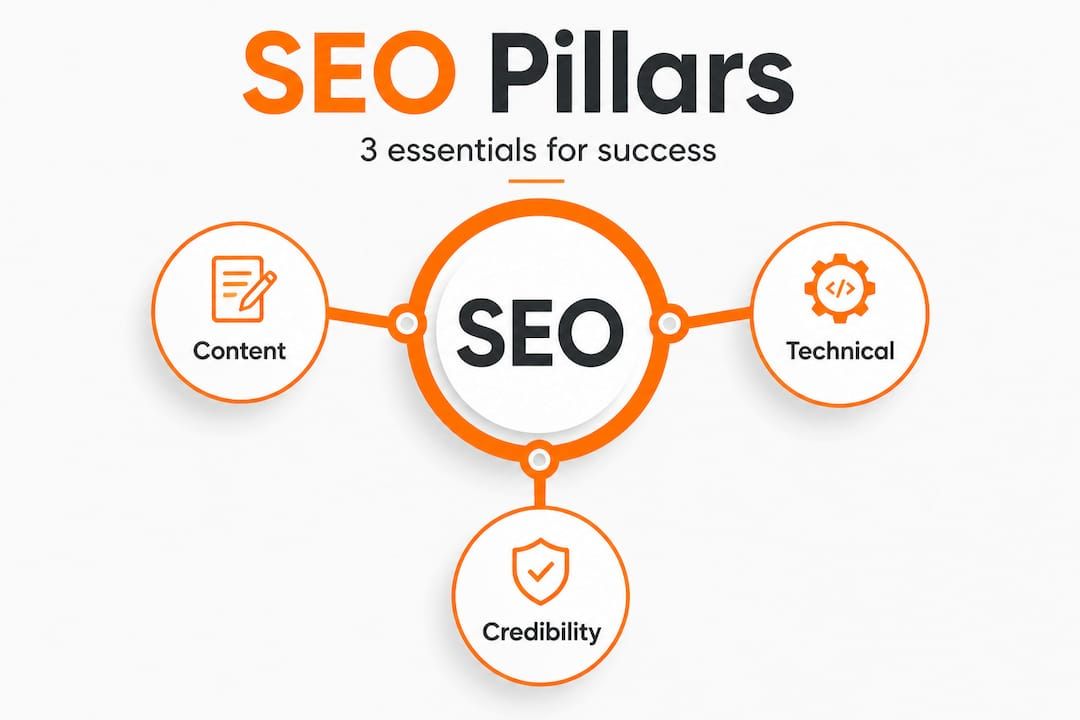
Understanding what SEO is will only take you so far. To actually improve your rankings and bring in more customers, you need to understand how it works under the hood. SEO is built on three core pillars: content, technical setup, and credibility.
"True SEO success involves aligning your content with searcher intent, making it accessible, and signaling trust." — Search Engine Land
Here is a quick breakdown of each pillar:
| Pillar | What it means | Simple action you can take |
|---|---|---|
| Content relevance | Your pages answer what people are searching for | Write blog posts and service pages that address real customer questions |
| Technical optimization | Google can crawl, read, and load your website properly | Make sure your site is mobile-friendly and loads in under 3 seconds |
| Credibility | Other sites and users vouch for your expertise | Earn links from local directories, partners, and news sources |
Let's look at each one in more depth.
1. Content relevance
Content is still the backbone of SEO. Every page on your website is an opportunity to answer a specific question or solve a specific problem for someone searching online. This does not mean writing for robots. It means writing for humans first, then making sure the structure is clean enough for Google to understand.

For example, if you run a landscaping business in Cherry Hill, New Jersey, a page called "Lawn care services Cherry Hill NJ" that describes your process, pricing range, and what makes you different will outperform a generic "Services" page every single time. Specificity wins.
2. Technical optimization
You could have the best content in the world, but if your website loads slowly on mobile or has broken pages, Google will not recommend it. Think of technical SEO as the foundation of a house. Without it, everything else crumbles.
When improving your local website, focus on mobile usability, page speed, clear navigation, and a secure HTTPS connection. These are non-negotiable basics in 2026.
3. Credibility
Google evaluates trust partly based on who links to you. When a respected local news site, a Chamber of Commerce directory, or a well-known industry blog links to your website, it signals that you are a legitimate source of information. This is called link building, and one of the most overlooked tactics within it is using anchor text smartly to help both users and search engines understand what a linked page is about.
Getting all three pillars working together is how you move from invisible to undeniable in your market.
Local SEO: The game-changer for service businesses
If you run a business that serves a specific city, region, or neighborhood, local SEO is where you will see the fastest and most meaningful returns. Local SEO is a focused version of traditional SEO designed to help your business appear when people nearby are searching for services you offer.
As the U.S. Chamber of Commerce notes, local SEO including business profiles and reviews is often the difference between being found and being invisible for location-dependent businesses. That statement captures the stakes perfectly.
Here are the most important steps to take for local SEO:
- Claim and optimize your Google Business Profile. This free listing shows up in Google Maps and the local "3-pack" results at the top of the page. It is often the very first thing a potential customer sees. Learn how to get started by setting up your Google Business Page correctly from the beginning.
- Keep your name, address, and phone number consistent. This is called NAP consistency. If your address appears differently on Yelp, your website, and Facebook, Google gets confused and your rankings suffer.
- Earn and respond to reviews. Online reviews influence both rankings and customer decisions. Businesses that actively respond to reviews, including negative ones, show professionalism and reliability. Managing your online reviews is a direct investment in your local SEO health.
- Build local citations. A citation is any online mention of your business name, address, and phone number, even without a link. Directories like Yelp, Angi, and your local Chamber of Commerce website all count.
| Local SEO action | Practical benefit | Estimated impact |
|---|---|---|
| Google Business Profile | Appears in map searches | High, especially for mobile users |
| Consistent NAP across directories | Builds Google's confidence in your listing | Medium to high |
| Responding to reviews | Improves click-through and conversion | Medium |
| Local citations | Strengthens geographic relevance | Medium |
| Location-specific content pages | Ranks for city-level searches | High for competitive areas |
Pro Tip: Learning how to start ranking in Google Maps can put you above organic results entirely, which means more visibility before a user even has to scroll.
One aspect many business owners miss is that local SEO is cumulative. Each review, each citation, and each piece of location-specific content adds to a growing body of trust signals. A business that has been consistently building these over 12 months will nearly always outperform a competitor who tried to do everything in a weekend and then stopped.
SEO success: Tracking what matters (and avoiding common pitfalls)
Many small business owners check their Google ranking once a week and use that number as a report card. If the ranking went up, they feel good. If it dropped, they panic. This approach misses the bigger picture almost entirely.
Rankings are a signal, not the destination. The destination is more customers and more revenue.
Here are the metrics that actually matter:
- Organic traffic. How many people are landing on your site from search? This is the real measure of whether your SEO is working.
- Click-through rate (CTR). This is the percentage of people who see your page in search results and actually click on it. A higher CTR means your title and description are compelling enough to earn attention.
- Conversions. Did the visitor call you, fill out a form, or make a purchase? This is the number that pays the bills.
- Bounce rate and time on page. These tell you whether people are finding what they expected when they clicked through. A high bounce rate often means there is a mismatch between what Google thinks your page is about and what is actually on it.
Click-through rate in organic search is position-dependent and can serve as a useful diagnostic tool, but CTR alone tells you very little about whether your SEO is actually growing your business.
Here is a pitfall that trips up even experienced marketers: ranking and click improvement do not always move together, especially because Google Search results now include featured snippets, answer boxes, and "People also ask" sections that can satisfy a user's question before they ever click your link. You might hold the top organic ranking and still see declining clicks because Google is answering the question above you.
The fix is to focus on conversion-oriented content. Instead of just targeting informational searches, build content that converts readers into leads. A well-structured service page with a clear call-to-action will always outperform a generic blog post in terms of actual business results.
Pro Tip: Use a content creation checklist to make sure every page you publish has a clear purpose, a target keyword, and a next step for the reader to take.
Avoid these common traps: checking rankings daily and changing strategy based on short-term swings, ignoring mobile performance, publishing content without a clear customer intent in mind, and treating SEO as a one-time task rather than an ongoing effort.
SEO for small businesses: What really works (and what doesn't)
After working with small business owners across New Jersey, Nevada, and beyond, we have seen a consistent pattern. Businesses that treat SEO as a long-term investment in genuine helpfulness win. Businesses that chase shortcuts lose, sometimes losing ground they spent years building.
The internet is full of guides that promise "5 ranking tricks" or "SEO hacks that Google doesn't want you to know." Most of these tactics either do not work or carry serious risk. Google's algorithm is sophisticated enough to detect low-quality content, bought links, and keyword stuffing. When it catches those patterns, it penalizes them, sometimes permanently.
What actually works is less exciting but far more durable. Publish content that genuinely answers your customers' real questions. Make your website fast, clean, and easy to navigate on a phone. Build relationships in your community that translate into real links and mentions online. Ask happy customers for reviews and respond to every one you receive.
Here is something most SEO guides will not tell you directly: small businesses have a structural advantage over big brands when it comes to local and niche searches. A national plumbing franchise cannot write a blog post that feels as authentic or as geographically specific as yours. You know your neighborhood. You know the specific problems your customers face. That local knowledge, when translated into content and trust signals, is something a generic national website simply cannot replicate.
The brands we have seen grow the fastest are not the ones who spent the most on SEO tools or hired the biggest agencies. They are the ones who committed to being genuinely useful online, for their specific customers, in their specific markets. That is where we focus our energy at Amigo Labz, and it is the philosophy that drives every strategy we build for clients.
Ready to grow? Get expert SEO support tailored to your business
Understanding SEO is one thing. Executing it consistently, while running a business, managing staff, and serving customers, is a different challenge entirely.

At Amigo Labz, we specialize in helping small businesses across the country turn SEO knowledge into measurable growth. Whether you need a full strategy built from scratch or just want someone to audit what you already have, our SEO services for small business are designed to move the needle without the jargon. From Google Business optimization to content strategy and local citation building, we handle the details so you can focus on your customers. Explore our full range of tailored website solutions and find the right starting point for your business today.
Frequently asked questions
How long does SEO take to show results for a small business?
SEO results for small businesses usually appear within 3 to 6 months, but the timeline depends on your competition, how often you publish content, and the current state of your website.
Is SEO necessary for service businesses with only local customers?
Absolutely. Local SEO including business profiles and reviews is often the deciding factor for whether nearby customers find you or your competitor when searching online.
What's the most important part of SEO for a new website?
Start by publishing content that directly addresses your customers' core questions. As Search Engine Land puts it, matching searcher intent with useful, accessible content is the foundation everything else is built on.
Can I do SEO myself or do I need to hire someone?
Many small businesses handle basic SEO in-house successfully, but working with a professional can save significant time and accelerate results, especially for competitive local markets or technical issues.
Does higher ranking always bring more customers?
Not automatically. While ranking higher increases visibility, CTR and conversion performance on your landing pages determine whether that visibility actually turns into paying customers.
Recommended
- SEO Services | New Jersey & USA
- Structured data explained: Boost your online visibility
- Online reputation management: Proven strategies for SMB success
- Content Creation Checklist for Small Business Success
- What is SEO in digital marketing? A guide for SMEs | Kickass Online
- Understanding Why Your Business Needs SEO for Growth | Ibrandmedia