How storytelling drives real business growth
How storytelling drives real business growth

TL;DR:
- Stories create emotional bonds that facts alone cannot achieve, boosting trust and loyalty.
- Effective storytelling frameworks like the three-act and Hero-Guide-Plan are simple and adaptable.
- Consistent, relatable stories from everyday moments build strong customer relationships and brand recognition.
Most business owners assume that a strong list of features, certifications, or data points will close the deal. The truth is that facts rarely move people to act. Stories do. Research consistently shows that narrative marketing builds emotional resonance that plain facts simply cannot replicate. This guide is built for business owners in wellness, services, and home improvement who want to use storytelling as a real, repeatable marketing tool. You will learn the frameworks, see industry-specific examples, and walk away with a clear strategy you can start using this week.
Table of Contents
- What makes storytelling essential for your business?
- Storytelling frameworks: From the three-act structure to Hero-Guide-Plan
- Examples of storytelling in action: Wellness, service, and home improvement
- Implementing a storytelling strategy for your business
- A fresh perspective: Why storytelling is your brand's true differentiator
- Take your storytelling further with expert support
- Frequently asked questions
Key Takeaways
| Point | Details |
|---|---|
| Stories boost loyalty | Authentic narratives help build stronger emotional connections and brand loyalty. |
| Frameworks guide success | Using clear structures like the three-act framework makes business stories more impactful. |
| Repurposing multiplies impact | Repurposing stories across channels increases your marketing effectiveness and efficiency. |
| Start with small steps | Begin storytelling on one platform to build confidence and measure results before scaling. |
What makes storytelling essential for your business?
To understand why storytelling deserves attention, let's clarify its impact on business results.
Think about the last time you remembered a brand. Was it because of a statistic on their homepage? Probably not. You likely remember a moment, a face, or a feeling. That is the power of narrative. For small and medium-sized businesses in wellness, services, and home improvement, storytelling is not a luxury reserved for big-budget brands. It is one of the most cost-effective tools available.
Stories build trust faster than credentials alone. A potential client for your massage therapy studio does not just want to know your training history. They want to know that someone like them walked in feeling burned out and walked out feeling human again. That one story does more for your conversion rate than a wall of diplomas.
Storytelling also improves how much your audience remembers about your business. Storytelling frameworks boost message retention and emotional engagement in ways that raw data cannot. When your audience connects emotionally, they are far more likely to share your content, return for repeat business, and refer others. That is the loyalty engine most businesses are missing.
Here is what effective storytelling consistently delivers for small businesses:
- Increased brand recall because stories create mental images that stick
- Emotional connection that shortens the path from "just browsing" to "ready to buy"
- Market differentiation in crowded industries where everyone offers similar services
- Clarity of message that makes it easy for customers to explain your business to others
- Consistent voice across platforms like social media management, email, and ads
"Your story is not just your marketing. It is your reputation before a customer ever speaks to you."
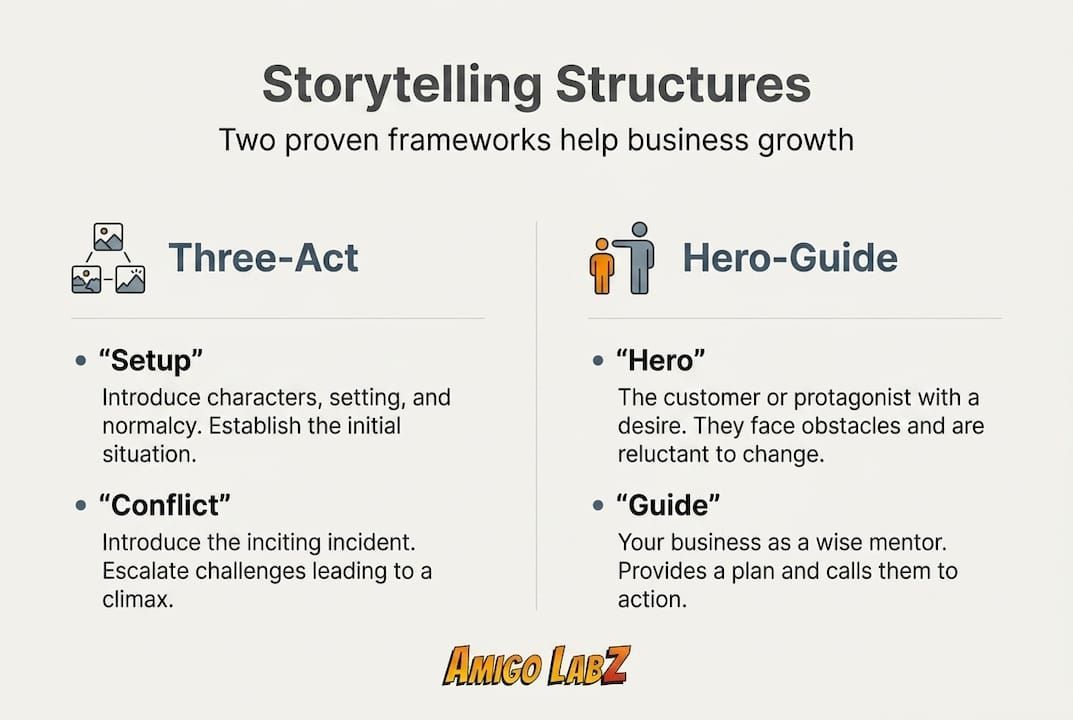
One of the most practical storytelling tools is the three-act structure. Setup, conflict, and resolution. In the setup, you introduce the customer's world before your service. In the conflict, you name the problem or frustration they face. In the resolution, your business becomes the bridge to a better outcome. This structure gives your audience a clear journey to follow, and it positions your brand as the solution they have been looking for.

For home improvement companies, this might sound like: "The Garcias had lived with a leaking basement for three years, afraid of what a full renovation would cost. One phone call changed everything." That sentence alone creates curiosity, empathy, and trust. And it cost nothing to write.
Storytelling frameworks: From the three-act structure to Hero-Guide-Plan
Now that we know why stories matter, let's dive into the most effective structures you can leverage.
Two frameworks rise above the rest for small business marketing: the three-act structure and the Hero-Guide-Plan . Both are simple enough to apply today and flexible enough to work across every platform you use. The three-act structure and Hero-Guide-Plan are especially effective for persuasive content that converts readers into buyers.
The three-act structure at a glance
| Act | Name | What it does | Business example |
|---|---|---|---|
| Act 1 | Setup | Establishes the customer's world | "Maria had tried every skincare product on the market." |
| Act 2 | Conflict | Names the tension or problem | "Nothing worked, and her confidence was taking a hit." |
| Act 3 | Resolution | Shows the transformation | "Six weeks with our esthetician changed everything." |
The Hero-Guide-Plan framework
This one flips the focus. In the Hero-Guide-Plan, your customer is the hero of the story. You are the guide, like a mentor who hands the hero the right tools. Many businesses make the mistake of putting themselves at the center of their marketing. When you make your customer the hero, your story becomes about their journey, their win, and their transformation.
Here is how to apply it step by step:
- Identify the hero. Who is your ideal customer? Name the struggle they face right now. Be specific. "Homeowners who dread calling a contractor because of past experiences" is a better hero than "anyone who needs a plumber."
- Position yourself as the guide. Share your experience and empathy briefly. You are not the star, but you are credible and trustworthy. This is where a short origin story or key result adds weight.
- Lay out the plan. Give your customer a simple, clear path to follow. Three steps work well. "Book a free consultation. Get a custom plan. See real results." Simple plans lower anxiety and increase action.
- Show what is at stake. Paint a picture of success if they work with you, and a picture of what they risk if they do not. Emotional stakes drive decisions.
- Call them to act. End with a clear, specific next step. Not "contact us." Something like "Text us before Friday and save 20% on your first service."
Pro Tip: Once you build one strong story using either framework, repurpose it everywhere. The same story can live as a social post, a Google Ads headline, a blog introduction, and a follow-up email sequence. One story, many touchpoints.
Consistency is what builds recognition. When your audience hears the same narrative across multiple channels, they start to trust that your brand knows what it is doing.
Examples of storytelling in action: Wellness, service, and home improvement
With frameworks in hand, it's helpful to see how storytelling actually plays out in businesses like yours.
Each sector in your industry has a natural story waiting to be told. The key is knowing what your customer cares about most and building your narrative around that.
Wellness businesses
A wellness client is almost always looking for transformation. They want to feel better, look better, or perform better. Your story should start where they are right now, not where you are. A yoga studio might share a story about a client who started coming in for stress relief and ended up discovering a community that changed her mental health. That is not a testimonial. That is a transformation story. It shows emotional depth, real results, and community value in a single narrative.
Stories tailored to your audience and repurposed across channels maximize your marketing efficiency and keep your message consistent without requiring you to create new content every week.
Service businesses
For service companies, before-and-after narratives are your most powerful asset. A cleaning company might share the story of a family getting ready to sell their home. The house was cluttered, stained, and showing its age. One deep-clean session later, the home sold in five days above asking price. That story speaks directly to the fear of loss and the desire for outcome. It works for Facebook Ads campaigns because it stops the scroll with a relatable tension.
Home improvement companies
Home improvement is deeply personal. People's homes are tied to their identity, their safety, and their finances. A well-told customer journey story in this sector can be remarkably powerful. Consider a story about an elderly couple who needed accessibility modifications after one of them had a fall. The story covers the fear, the search for a trustworthy contractor, the process, and the relief of watching a loved one move freely through their own home again. That narrative builds credibility through empathy, not just expertise.
Here is a look at how each sector can apply storytelling across marketing channels:
| Sector | Core story type | Best channels | Key emotion |
|---|---|---|---|
| Wellness | Client transformation | Instagram, blog, email | Hope and pride |
| Service | Before-and-after outcomes | Facebook Ads, Google reviews | Relief and trust |
| Home improvement | Customer journey | YouTube, SEO content, referrals | Safety and confidence |
Across all three sectors, the principles are the same. Start with the customer's reality. Name the problem honestly. Show the path through. Celebrate the result. Adapt the format for the platform, but keep the emotional core consistent.
- Use short-form video for the conflict and resolution (15 to 30 seconds works on social)
- Use long-form blog posts for the full customer journey with rich detail
- Use ad copy to tease the transformation and drive traffic to the full story
- Use email sequences to walk leads through the three-act structure over several days
Implementing a storytelling strategy for your business
Once you've seen what works, here's how to get started with your own storytelling approach.
The biggest barrier most business owners face is not a lack of stories. It is not knowing where to start. Here is a process that removes the guesswork and makes your storytelling repeatable.
Step 1: Identify your core stories. Start by collecting three to five real customer experiences that reflect the results you are most proud of. Ask past clients if they are willing to share their experience. Most are happy to, especially if you make it easy with a few simple questions.
Step 2: Tailor to your audience. A story that resonates with a 28-year-old looking for a fitness studio may not resonate with a 55-year-old recovering from surgery. Segment your best stories by the audience they speak to most directly. Different stories for different people, same brand voice throughout.
Step 3: Choose your channels intentionally. Repurposing stories across channels increases your marketing efficiency and impact, but only if you format them correctly. A Facebook story should feel different from a website case study, even if the underlying narrative is the same. Match the length and format to the platform.
Step 4: Build a simple content calendar. You do not need 30 new stories a month. You need three to five strong ones that you cycle, update, and reframe across different formats. A good story in January can become a testimonial post in March and a case study landing page in June.
Step 5: Measure what matters. Track engagement rates, time on page, and conversion actions tied to story-based content. Compare them to non-story posts. Most businesses find the difference is significant.
Pro Tip: Start with one platform before scaling your narrative. Pick the channel where your best customers already spend time and nail your story there first. Once it converts, expand to the next channel with the same core message.
Common pitfalls to avoid on your storytelling journey:
- Overcomplicating the message. If your story takes 500 words of backstory before anything interesting happens, you have lost your reader. Get to the conflict fast.
- Ignoring emotion entirely. A story without emotional stakes is just a timeline. Feelings drive action. Name them.
- Inconsistency across platforms. If your website tells one story and your social media tells another, customers notice. They lose trust. One voice, one narrative, adapted for each format.
- Making your brand the hero. Your customer should always be the one overcoming something. You are the trusted resource that helps them get there.
A fresh perspective: Why storytelling is your brand's true differentiator
Most guides on storytelling will tell you to craft a compelling origin story or document your customer's transformation. That advice is not wrong, but it misses something important.
The most effective brand stories we have seen across our work with business owners are not dramatic. They are ordinary moments told with care. A plumber who texted a client after a job to ask if everything was still working. A personal trainer who remembered a client's marathon goal a year later. A cleaning company that left a handwritten note. These small moments, when shared consistently, build the kind of trust that no ad budget can replicate.
The mistake most businesses make is waiting for the perfect story. They hold off until they have a dramatic before-and-after, a viral moment, or a Hollywood transformation. Meanwhile, they miss dozens of everyday interactions that their audience would love to hear about. Your web design expertise can showcase these moments beautifully, but the stories themselves come from paying attention to what already happens in your business every day.
Consistency and relatability will always outperform perfection in storytelling. Show up with real moments, told honestly, and your audience will reward you with loyalty.
Take your storytelling further with expert support
If you're ready to put these insights to work, here's how we can help you succeed.
At Amigo Labz, we work directly with business owners in wellness, service, and home improvement to turn their real customer stories into high-performing marketing campaigns. We have seen firsthand how the right narrative, placed on the right platform, can completely shift a business's growth trajectory.

Whether you need help running Facebook Ads services that lead with storytelling, building out a social media support strategy rooted in authentic narratives, or just figuring out where to start, our team is ready to work alongside you. We build relationships first, campaigns second. If you are ready to stop guessing and start connecting, book a strategy call with us today and let's map out your story together.
Frequently asked questions
What is the best storytelling framework for small businesses?
The three-act structure and Hero-Guide-Plan work best because they clarify your message and make stories relatable. Both frameworks are proven to be ideal for persuasive storytelling and can be adapted for any industry or platform.
How can I use storytelling across different marketing channels?
Repurpose your core stories for ads, blogs, and social posts to maximize consistency, reach, and impact. Repurposed stories drive efficiency and results across platforms without requiring you to constantly create new content.
Does storytelling really increase customer loyalty?
Yes, storytelling strengthens emotional connections, which leads to increased trust and long-term loyalty. Emotional engagement through storytelling creates the kind of bond that keeps customers coming back and referring others.
What common mistakes should I avoid with storytelling?
Avoid overcomplicating your message, being inconsistent across platforms, or stripping out emotional appeal entirely. Common pitfalls include overcomplicating and inconsistent stories, both of which erode the audience trust you are working to build.
Recommended