Boost Engagement with Audience Segmentation Explained
Boost Engagement with Audience Segmentation Explained

TL;DR:
- Audience segmentation targets smaller customer groups for more relevant messaging.
- Regularly updating segments ensures marketing remains aligned with changing customer behaviors.
- Starting with basic data and iterating improves campaign effectiveness and ROI over time.
Most businesses that struggle with marketing aren't making bad ads. They're making ads for everyone, and that's the real problem. When you try to speak to everyone, you end up resonating with no one. Audience segmentation changes that by letting you deliver the right message to the right people at the right time. In this article, we'll break down exactly what audience segmentation is, show you the main types with real examples, flag the mistakes that quietly kill campaigns, and give you a practical roadmap to put it all into action.
Table of Contents
- What is audience segmentation?
- Types of audience segmentation and real-world examples
- Common mistakes and how to avoid them
- Best practices for implementing and iterating audience segments
- The hidden truth: Audience segmentation is never 'done'
- Take your segmentation further with expert support
- Frequently asked questions
Key Takeaways
| Point | Details |
|---|---|
| Segmentation defined | Dividing your audience into smaller groups helps tailor your marketing for higher engagement and better ROI. |
| Behavioral focus | Focusing on customer actions and needs predicts results better than basic demographics alone. |
| Avoid common mistakes | Update your segments regularly, avoid siloed data, and always iterate your approach for lasting success. |
| Iterate for success | Treat segmentation as an ongoing process, refining your strategy as customer behaviors change. |
What is audience segmentation?
At its core, audience segmentation is dividing a broad market into smaller groups based on shared characteristics. Instead of blasting one message at your entire customer base, you create targeted messages for each group. Think of it like this: a bakery serving both wedding planners and college students wouldn't use the same pitch for both. Segmentation lets you speak each group's language.
This is different from basic audience targeting. Targeting says "I want to reach women aged 25 to 40." Segmentation goes deeper, asking: what do those women value, how do they behave, and what problem are they trying to solve? That extra layer of insight is what separates forgettable marketing from campaigns that actually convert.
Here's a quick overview of the four main types of audience segmentation :
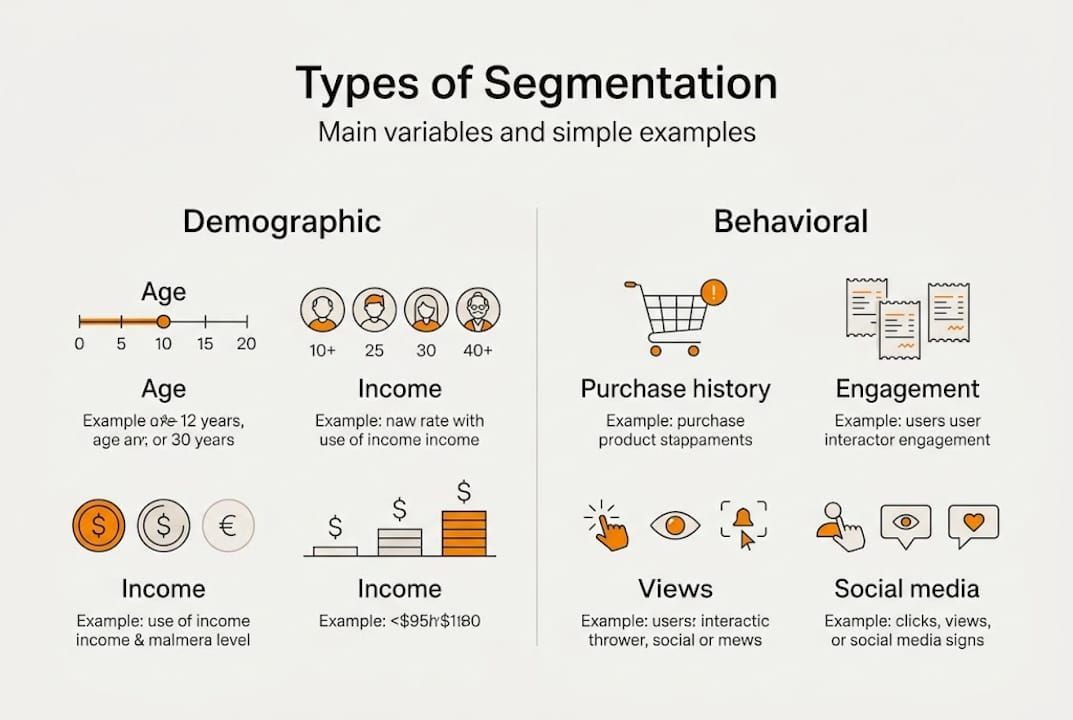
- Demographic segmentation: Groups people by age, gender, income, education, or occupation
- Psychographic segmentation: Groups people by values, interests, lifestyle, and personality
- Behavioral segmentation: Groups people by purchasing habits, product usage, and brand interactions
- Needs-based segmentation: Groups people by the specific problem or outcome they're seeking
| Segmentation type | Key variable | Practical example |
|---|---|---|
| Demographic | Age, income, gender | Senior discounts for customers 60 and over |
| Psychographic | Values, lifestyle | Eco-friendly messaging for sustainability-minded buyers |
| Behavioral | Purchase history | Loyalty rewards for repeat buyers |
| Needs-based | Problem to solve | Budget tier offers for cost-conscious customers |
The benefits for your business are real and measurable. Segmentation reduces wasted ad spend, increases message relevance, boosts engagement rates, and builds stronger customer loyalty. When customers feel like your message was written just for them, they're far more likely to take action.

Types of audience segmentation and real-world examples
Not all segmentation types deliver the same results. Let's compare them directly and then look at how businesses actually put them to work.
| Type | Strength | Limitation |
|---|---|---|
| Demographic | Easy to collect | Less predictive of behavior |
| Psychographic | Reveals motivations | Harder to measure accurately |
| Behavioral | Highly predictive | Requires solid data tracking |
| Needs-based | Precision targeting | Needs qualitative research |
Studies consistently show that behavioral and needs-based segmentation are more predictive of marketing success than pure demographics. Why? Because knowing someone's age tells you very little about why they buy. Knowing their purchase history or their specific frustration tells you almost everything.
Here are five real-world examples of segmentation working in practice:
- Repeat buyer rewards: An e-commerce store identifies customers who have purchased three or more times and sends them early access to new products. This rewards loyalty and increases lifetime value.
- Lapsed customer reactivation: A gym uses behavioral data to flag members who haven't checked in for 30 days and sends them a personalized offer to come back. This turns a potential cancellation into a retained member.
- High-intent cart abandoners: An online retailer targets shoppers who left items in their cart with a 10% discount email. They're already interested, so the conversion rate is naturally higher.
- New subscriber welcome series: A SaaS company identifies brand-new signups and sends a tailored onboarding sequence based on the feature they clicked first during setup.
- Budget-conscious first-timers: A home services company spots first-time visitors browsing entry-level services and serves them ads featuring affordable starter packages.
Pro Tip: Start with the data you already have. Your email open rates, purchase history, and website behavior are gold mines. You don't need a complex system on day one. Get comfortable with one or two segment types before layering in more.
Common mistakes and how to avoid them
Even the best segmentation strategy can fall apart in execution. The good news is that most mistakes are predictable and easy to fix once you know what to look for.
The most common pitfalls include:
- Using only demographics: Demographic data alone is thin. It tells you who someone is, not what they need or how they act.
- Building segments and never updating them: Customer behavior changes. A segment built on last year's data could be actively misleading you today.
- Siloed data across departments: When your sales team has one set of customer data and your marketing team has another, your segments never tell the full story.
- Too many micro-segments: Over-segmenting creates chaos. If you have 40 audience groups, you probably have zero good campaigns running for any of them.
- No testing or iteration: Setting up segments without running A/B tests means you're guessing instead of learning.
As research confirms, static segments, siloed data, and no iteration are the key pitfalls that undermine segmentation effectiveness. These aren't rare edge cases. They're the default for most small and mid-sized businesses.
"Segmentation is not a one-time project. It's a living framework that must evolve as your customers evolve. Businesses that treat it as a checkbox exercise will always be one step behind."
The fix isn't complicated. It starts with committing to a review cycle.
Pro Tip: Put a recurring calendar reminder every quarter to audit your audience segments. Ask: Are these segments still reflecting real customer behavior? Have purchase patterns shifted? Is new data available that wasn't before? Small, regular updates prevent your strategy from drifting out of alignment with reality.
Also, work on breaking down internal silos. When your CRM, email platform, and ad accounts are all sharing data, your segments become dramatically more accurate. Integration matters as much as the segments themselves.
Best practices for implementing and iterating audience segments
Ready to build a segmentation strategy that actually sticks? Here's a clear, step-by-step path forward.
- Gather your data: Pull together what you already have: CRM records, website analytics, email engagement data, purchase history, and any customer surveys. You may already have more than you realize.
- Choose your segmentation types: Based on your data and business model, pick one or two types to start with. Behavioral and needs-based are strong starting points for most businesses.
- Build your initial segments: Create three to five distinct groups. Give each one a clear profile: who they are, what they need, and how they typically behave.
- Develop tailored messaging: Write specific messaging for each segment. The tone, offer, and call to action should feel custom-built for that group.
- Test your campaigns: Run A/B tests within each segment to see what messaging, timing, and format performs best.
- Iterate based on results: Use performance data to refine your segments. Merge ones that overlap. Split ones that are too broad. Adjust continuously.
On the technology side, integrating AI and machine learning enables real-time refinement of your audience segments, which means your campaigns can adapt automatically as customer behavior shifts. This is especially valuable at scale, but even smaller businesses can benefit from basic automation tools.
Helpful tools to streamline your segmentation process:
- Google Analytics 4: Tracks behavioral and demographic data from your website
- Mailchimp or Klaviyo: Allows email list segmentation based on behavior and tags
- Meta Ads Manager: Offers robust audience building for refining audience segments on Facebook and Instagram
- HubSpot CRM: Centralizes customer data across sales and marketing
- Hootsuite or Buffer: Supports social media segment management across platforms
- Google Ads: Enables precise ad campaign segmentation based on search intent and behavior
Each iteration of your segmentation brings better ROI. The businesses that commit to ongoing refinement consistently outperform those that treat segmentation as a one-time task.
The hidden truth: Audience segmentation is never 'done'
Here's what most guides won't tell you: the moment you finish setting up your audience segments, they're already starting to go stale. Markets shift. Customer priorities evolve. New competitors change how people think about your category. If your segmentation isn't keeping pace, your messaging is slowly drifting away from reality.
We've seen this firsthand working with business owners across New Jersey and Nevada. The companies that get the best results aren't the ones with the most sophisticated initial setup. They're the ones that revisit their segments consistently, stay curious about new data, and aren't afraid to blow up a segment that's no longer working.
As research reinforces, audience segments need continual real-time refinement to deliver their best results. The mindset shift here is important: stop thinking of segmentation as a project you complete, and start thinking of it as a process you manage. Every refinement gets you closer to your actual customer. That's not extra work. That's compounding precision.
The businesses that lean into real-time audience methods consistently see better engagement, lower cost per acquisition, and stronger customer relationships over time. Iteration isn't a sign that you got it wrong the first time. It's a sign that you're paying attention.
Take your segmentation further with expert support
Understanding segmentation is one thing. Executing it well across your ads, emails, and social channels is where many business owners hit a wall.

At Amigolabz, we work hands-on with business owners to identify the right audience segments for their specific goals and build campaigns that actually reach those people. From managing your Facebook Ads services to building a consistent presence through Social Media Management, we bring the strategy and the execution together. If you're ready to stop guessing and start marketing with precision, book a call with Amigolabz and let's map out your segmentation strategy together.
Frequently asked questions
Why is audience segmentation important for small businesses?
Audience segmentation helps small businesses focus their marketing on the groups most likely to buy, which directly reduces wasted spend. Segmentation boosts marketing effectiveness by making every dollar work harder for you.
How often should I update my audience segments?
Review and update your segments at least quarterly or any time you notice significant shifts in customer behavior or engagement. Static segments and no iteration are among the fastest ways to kill your marketing results.
What is the difference between demographic and behavioral segmentation?
Demographic segmentation groups people by fixed traits like age or income, while behavioral segmentation focuses on what people actually do, such as their purchase history or engagement patterns. Behavioral segmentation is more predictive of actual marketing success.
Do I need advanced technology to start segmenting my audience?
No, you can start with simple tools and the data you already have in your CRM or email platform. Over time, integrating AI and ML improves your segmentation precision and campaign performance significantly.
Recommended