Online reputation management: Proven strategies for SMB success
Online reputation management: Proven strategies for SMB success

TL;DR:
- A negative Google review can cost up to 30 customers for local SMBs.
- Consistent online reputation management builds trust, improves search rankings, and turns critics into advocates.
- Responding promptly and empathetically to reviews is essential for long-term reputation growth.
One bad review at the wrong moment can quietly drain your customer pipeline. For small and medium-sized businesses in New Jersey and Nevada, a single negative Google review can cost up to 30 customers. That's not a small number when you're running a local business built on word-of-mouth and community trust. The good news is that online reputation management is a skill you can build systematically. This guide walks you through auditing your presence, generating real reviews, responding to criticism, and handling crises so your reputation becomes a competitive asset rather than a liability.
Table of Contents
- Understanding the fundamentals of online reputation management
- Preparation: Auditing your online presence and setting up monitoring
- Execution: Generating reviews and responding effectively
- Troubleshooting and crisis management for online reputation
- What most guides miss: Turning reputation risk into competitive advantage
- Your next step: Enhance your online reputation with Amigo Labz
- Frequently asked questions
Key Takeaways
| Point | Details |
|---|---|
| Prompt responses matter | Replying to reviews within 24-48 hours protects reputation and retains customers. |
| Audit regularly | Weekly audits of listings and mentions prevent surprises and uncover hidden issues. |
| No incentives for reviews | Request feedback authentically; incentives violate major platforms' policies and local laws. |
| Crisis plans are vital | A formal plan helps businesses manage fake or negative reviews and bounce back quickly. |
| Use automation judiciously | Automated alerts and AI draft responses save time, but final reviews should remain in your control. |
Understanding the fundamentals of online reputation management
Online reputation management, or ORM, is the practice of monitoring, shaping, and responding to what people say about your business online. It covers everything from Google reviews and Yelp ratings to Facebook comments and niche industry directories. For a local plumber in Newark or a boutique hotel in Las Vegas, what shows up on page one of Google when someone searches your name is your first impression.
74.5% of SMBs view ORM as critical for business success, yet most still approach it reactively. They respond to a bad review when it stings, then forget about it for months. That inconsistency is what costs businesses customers. 87% of consumers check reviews before making a purchase, which means your reputation is working for or against you before a potential customer ever walks through your door.
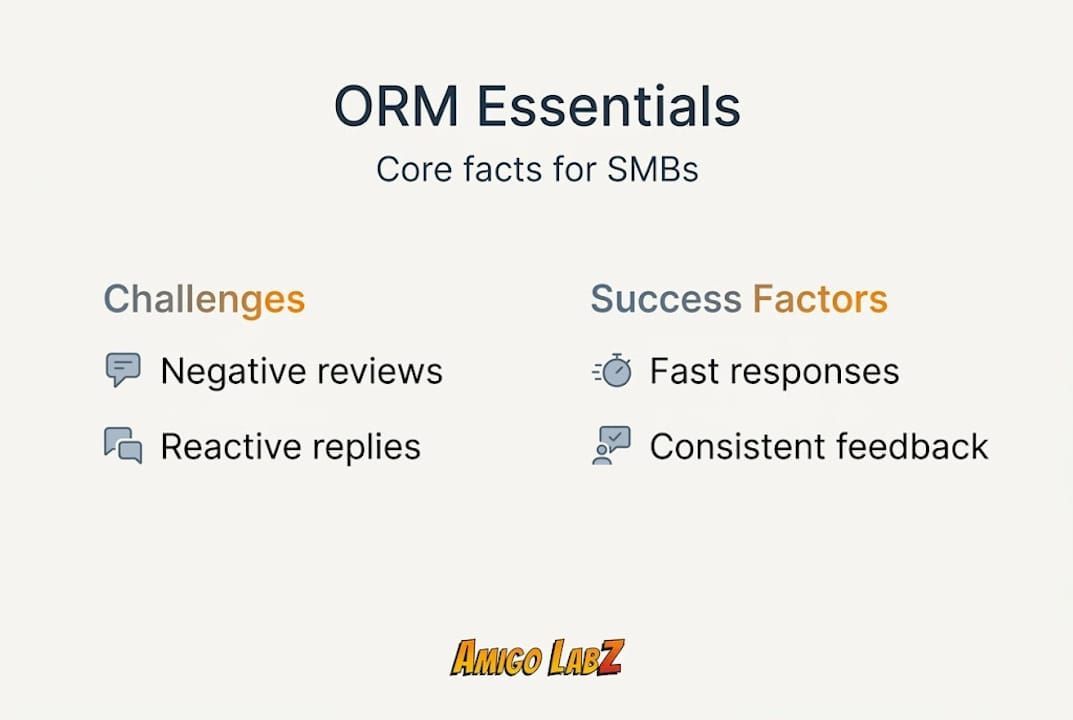
ORM is not just damage control. Done right, it amplifies your SEO strategies by feeding search engines fresh, trustworthy signals. It supports improving online presence across platforms where your customers are already spending time. And it connects directly with your social media management efforts to create a consistent brand voice.
Here are the core channels every SMB should be watching:
- Google Business Profile — the most influential review platform for local search
- Yelp — especially important for restaurants, contractors, and service businesses
- Facebook — where community conversation and recommendations live
- Industry-specific directories — Houzz, Healthgrades, Avvo, TripAdvisor, depending on your niche
- News mentions and blogs — less frequent but high-impact when they appear
| ORM channel | Primary audience | Review weight |
|---|---|---|
| Google Business Profile | All local buyers | Very high |
| Yelp | Service and dining | High |
| Community and referrals | Medium | |
| Industry directories | Niche buyers | Medium to high |
| News and blogs | General public | Situational |
For a deeper breakdown of best practices, this detailed ORM guide from Xero is worth bookmarking. The key takeaway is that ORM is not a one-time project. It's a system.
Preparation: Auditing your online presence and setting up monitoring
Before you can improve anything, you need to know what you're working with. Start by Googling your business name the way a new customer would. Look at the first page of results. What reviews show up? Are your listings accurate on Google, Yelp, and Facebook? Is your address, phone number, and website consistent everywhere? Inconsistencies in your listings hurt both trust and local search rankings.
Core ORM mechanics include monitoring mentions across platforms and optimizing your listings, yet most SMBs skip this step entirely. Use this numbered checklist to run your initial audit:
- Search your business name on Google and note all reviews and star ratings
- Check your Google Business Profile for accuracy and completeness
- Visit Yelp, Facebook, and any relevant industry directory to review your listings
- Set up Google Alerts for your business name to catch new mentions automatically
- Note any fake or suspicious reviews — fake reviews impact one in three businesses
Once you know where you stand, set up ongoing monitoring. Google Alerts is free and catches a lot. Paid tools like Birdeye, Podium, or ReviewTrackers give you a centralized dashboard. If you're already using a CRM, check whether it has a reviews feature built in.
Here's a quick comparison to help you decide how to manage monitoring:
| Approach | Pros | Cons |
|---|---|---|
| DIY monitoring | Low cost, full control | Time-intensive, easy to miss |
| Reputation software | Automated alerts, centralized | Monthly subscription cost |
| Agency management | Expert handling, strategy included | Higher investment |
Pro Tip: Set a five-minute daily routine to check your review inbox. Pair it with morning coffee. Businesses that respond within 24 hours consistently outperform those that batch their responses weekly.

If you want a full reputation audit checklist, that resource covers every platform worth checking. You can also explore website audit services to catch technical issues that undermine your credibility online. Keeping your site updated through WordPress management and following local SEO tips will make sure your listings and content work together.
Execution: Generating reviews and responding effectively
Asking for reviews feels awkward to most business owners. Here's the reframe: your satisfied customers want to support you. They just need a simple, frictionless prompt. The channels that work best are SMS (highest open rates), follow-up emails, and in-person requests right after a great experience.
Here's a step-by-step approach to review generation:
- Identify the moment of peak satisfaction (job completion, checkout, service call end)
- Send a personalized SMS or email within 24 hours thanking the customer
- Include a direct link to your Google Business Profile review page
- Keep the ask one sentence: "We'd love your feedback if you have a moment."
- Follow up once if there's no response, then stop
And a critical legal point: never incentivize reviews with discounts, gifts, or cash. The FTC and Google both prohibit this, and getting caught can result in your listing being penalized or removed entirely. Authentic reviews from real customers are the only kind worth building.
When negative reviews come in, how you respond matters more than the review itself. Respond within 24 to 48 hours for maximum impact. Follow these practices:
- Acknowledge the experience without arguing
- Apologize for the inconvenience, even if the fault is disputed
- Offer to resolve the issue privately (phone or email)
- Keep it brief, public, and professional
"The best review response strategy is simple: show empathy publicly, resolve privately. A critic who feels heard often becomes your loudest advocate."
For detailed review response best practices, that resource walks through sample phrasing for common scenarios. Pair this with improving local search ranking to make sure your positive reviews are showing up where they count most.
Troubleshooting and crisis management for online reputation
Even businesses that do everything right eventually face a reputation crisis. A disgruntled ex-employee, a viral complaint, or a wave of fake reviews can knock your rating down fast. The businesses that recover quickly are the ones that prepared before the crisis hit.
Common mistakes to avoid:
- Arguing with reviewers publicly — it always looks worse for you, even when you're right
- Over-relying on AI responses — 56.2% of SMB owners are comfortable with AI-generated responses only when they stay in control. Generic AI replies without review can feel robotic and dismissive.
- Having no crisis plan — only 33% of SMBs have a formal crisis plan, even though suppression takes 3 to 6 months once damage is done
Suppression is the process of pushing negative search results down by creating and optimizing positive content, earning new reviews, and building authoritative backlinks. You can't delete most reviews, but you can outrank them. Think of it as flooding the zone with accurate, positive signals.
Pro Tip: Build your crisis plan before you need it. Include who responds to reviews, what tone and language to use, how quickly you'll act, and when to escalate to professional help.
For a full breakdown of crisis management strategies, that resource covers suppression timelines and escalation triggers. If you're seeing coordinated fake reviews or a sudden drop in your rating, that's a signal to bring in an agency. Branding protection through paid channels can also help amplify your positive content while you rebuild.
What most guides miss: Turning reputation risk into competitive advantage
Here's what most ORM advice gets wrong: it treats negative reviews as problems to eliminate. We've seen something different working with business owners across New Jersey and Nevada. Negative reviews, handled smartly, are actually trust-builders.
Think about it from a buyer's perspective. A business with 200 five-star reviews and zero negatives looks suspicious. A business with 180 five-star reviews and 20 thoughtful, professional responses to critical feedback looks human. Buyers trust the second one more.
Public empathy and private resolution can genuinely turn critics into advocates. We've watched this happen repeatedly. The key is treating ORM as a daily discipline, not a quarterly cleanup. Owners who build review requests and response routines into their week create a reputation that compounds over time. They also gain a local reputation advantage that competitors who ignore ORM simply cannot replicate.
The businesses that win long-term are not the ones with zero bad reviews. They're the ones who respond so well that the bad reviews end up proving how good they are.
Your next step: Enhance your online reputation with Amigo Labz
Now that you have the full framework, the next question is whether you want to build it alone or with a team that already knows the terrain. At Amigo Labz, we work with SMBs in New Jersey and Nevada who want more than generic advice. We help you connect ORM with the rest of your digital strategy so the pieces reinforce each other.

ORM is foundational, but it multiplies when paired with strong website solutions, consistent social media management, and targeted SEO services. If you're ready to stop managing your reputation reactively and start building it intentionally, we'd love to talk through what that looks like for your business specifically.
Frequently asked questions
How often should I check my business reviews online?
47% of SMBs check reviews daily, and that frequency leads to faster responses and better outcomes. Set up automated alerts so you're notified the moment a new review posts.
Is it legal to offer incentives for customer reviews?
Offering incentives for reviews is prohibited by Google and the FTC; always request reviews without attaching any reward or discount to the ask.
What's the best way to respond to negative reviews?
Respond quickly with empathy, keep your reply public and brief, and invite the customer to resolve the issue privately. Responding empathetically without arguing is the single most effective approach.
Can AI tools help with reputation management?
AI tools can draft responses and flag new mentions efficiently, but 56% of owners are comfortable with AI replies only when they review and approve each one before it goes live.
How long does it take to improve a damaged online reputation?
Suppressing negative content typically takes 3 to 6 months of consistent effort before it moves off the first page of search results.
Recommended