Build thought leadership: 7 strategies for authority
Build thought leadership: 7 strategies for authority

TL;DR:
- Thought leadership requires original viewpoints, demonstrated expertise, and ongoing evolution.
- AI saturation has increased the need for testable reasoning and original data.
- Building influence depends on quality, testability, and transparent public testing of ideas.
Build thought leadership: 7 strategies for authority
Most business owners think thought leadership means posting on LinkedIn or writing a blog. That assumption is costing them credibility. Real thought leadership is about having a distinct, original point of view that others find genuinely useful, and then building systems to communicate it consistently. In an era where AI can generate thousands of articles overnight, the bar for what counts as "leadership" has been raised dramatically. If your ideas look and sound like everyone else's, you are not leading anything. The strategies below will help you cut through the noise and build real authority.
Table of Contents
- Defining thought leadership in business
- Actionable ideas: Frameworks and guidance
- AI's impact: Is thought leadership at risk?
- Avoiding pitfalls: Common mistakes and critiques
- Our take: Thought leadership beyond content creation
- Accelerate your thought leadership with professional support
- Frequently asked questions
Key Takeaways
| Point | Details |
|---|---|
| Distinct perspective matters | Showing unique insight and credibility is more valuable than publishing generic content. |
| Actionable frameworks win | Ideas packaged as practical systems are what audiences can use—and remember. |
| AI requires human reasoning | Standing out in an AI-saturated market means focusing on quality and originality. |
| Avoid common mistakes | Being overly promotional or generic undermines authority and risks credibility. |
| Support accelerates growth | Expert help transforms effective thought leadership into real business influence. |
Defining thought leadership in business
Thought leadership gets thrown around constantly in marketing conversations, but few people stop to define it precisely. Here is the clearest way to think about it: thought leadership is the practice of sharing original, well-reasoned ideas that influence how others think and act within your industry. It is not the same as content marketing, even though both involve publishing material.
Content marketing is designed to attract and convert customers. Thought leadership is designed to shift perspectives and earn trust at scale. The two can overlap, but confusing them is a serious strategic error. A business owner who only publishes content aimed at selling their services will eventually be tuned out, because audiences recognize promotional intent quickly.
What separates a true thought leader from a content creator? Three things:
- A distinct point of view. You must have an opinion that not everyone shares, and you must be willing to defend it with evidence.
- Demonstrated expertise. Claims need to be backed by real experience, data, or original research, not just rephrased conventional wisdom.
- Evolution over time. Your thinking must develop publicly. Static opinions signal that you stopped learning.
"Thought leadership requires commitment to ongoing ideation, experimentation, and evolution. Credibility depends on more than polished ideas."
That last point is underrated. Many business owners publish a sharp insight once and then repeat it forever. That works briefly, but it stalls authority growth. The thought leaders who gain long-term influence keep refining their positions as markets change, new data emerges, and their own experience deepens.
Another risk worth naming directly: generic thought leadership. If your ideas could be attributed to any expert in your industry, they are not really yours. Generic content fills a content calendar but does not build authority. The goal is for your audience to recognize your perspective before they see your name on the piece.
One overlooked channel where distinct thinking can shine is social media management. Consistently applying your unique framework across social platforms reinforces recognition and trains your audience to associate a specific lens with your brand. Thought leadership is not a one-time publication. It is a pattern of reasoning that becomes recognizable.
Actionable ideas: Frameworks and guidance
A brilliant insight that sits in your head helps no one. Thought leadership only creates influence when it is packaged so that your audience can actually use it. This is where frameworks come in, and most business owners skip this step entirely.
A framework is a repeatable system for thinking about or solving a specific problem. It takes your expertise and structures it in a way that others can apply without you in the room. Think of it as the difference between giving someone a fish and teaching them to fish using your specific method.
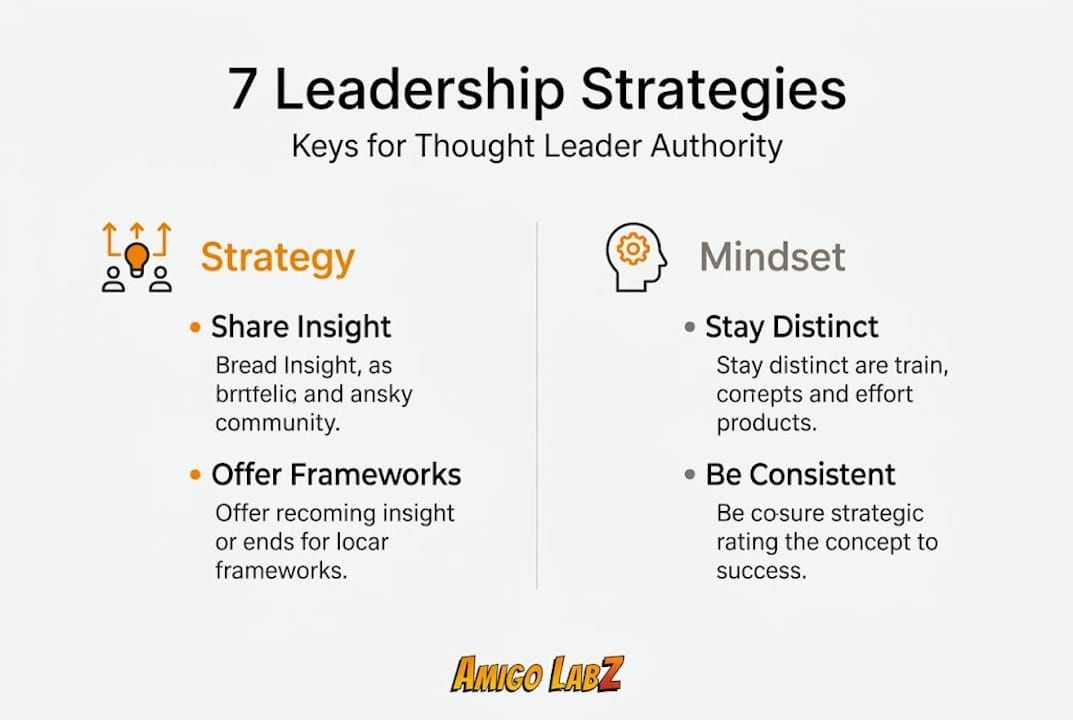
For example, imagine a business owner who has spent a decade helping retail brands recover from slow seasons. Instead of just sharing tips, they develop a "90-Day Revenue Reset" framework with three clearly labeled phases: diagnose, activate, and measure. Now their insight is teachable, memorable, and attributable. That is thought leadership with leverage.
Effective thought leadership involves turning expertise into useful, original content and packaging insights with repeatable systems or frameworks. The packaging is not decoration. It is what makes the insight travel.

Here is a comparison of how generic advice stacks up against framework-driven thought leadership:
| Approach | What it looks like | Audience impact |
|---|---|---|
| Generic advice | "Focus on your customers" | Easily forgotten |
| Framework-driven | "Use the 3-Listen Method: hear, replay, act" | Actionable and memorable |
| Data-backed insight | "Brands that respond within 1 hour see 3x retention" | Credible and shareable |
| Story-first teaching | Case study with named stages and outcomes | Engaging and instructive |
The methods that stick are the ones that give audiences a new vocabulary or a new mental model. When your audience starts using your terms in their own conversations, your influence has compounded.
Practical ways to package insights for application:
- Name your process. Give your unique approach a title that sticks.
- Use numbered stages. People remember sequences better than abstract concepts.
- Show before and after. Demonstrate the transformation your framework creates.
- Invite experimentation. Encourage your audience to test and adapt your method.
Pro Tip: If you struggle to turn expertise into a framework, try this exercise. Write down the five questions your best clients always ask you. Your answers to those questions, structured in sequence, are the skeleton of your first teachable framework.
If you need SEO guidance on how to publish these frameworks so they reach the right audiences organically, that part of the strategy matters just as much as the content itself. Great ideas that no one finds do not build authority. Explore website solutions designed to get your frameworks in front of decision-makers actively searching for your expertise.
AI's impact: Is thought leadership at risk?
This is the uncomfortable conversation most thought leadership articles avoid. Artificial intelligence can now produce polished, well-structured content on almost any topic in seconds. This has flooded the internet with material that looks authoritative but lacks original reasoning. So what does this mean for business owners trying to build genuine authority?
The short answer is that AI has raised the cost of entry for real thought leadership while lowering the cost of fake thought leadership. Anyone can now publish something that sounds intelligent. The result is a credibility crisis across industries.
AI-generated content saturates attention and challenges traditional thought leadership, pushing the need for testable human reasoning. That phrase, "testable human reasoning," is the key differentiator going forward.
"The thought leaders who will survive the AI era are not the ones who publish the most. They are the ones whose reasoning can be challenged, tested, and verified."
Here is a snapshot of how the content landscape has shifted:
| Factor | Before AI | After AI |
|---|---|---|
| Content volume | Scarce, expensive | Abundant, cheap |
| Audience trust | Default moderate | Default skeptical |
| Differentiation | Ideas alone | Ideas plus verified reasoning |
| Authority signals | Publication count | Depth and testability |
For business owners, the practical response to AI saturation involves several shifts in strategy:
- Publish original data. Surveys, client outcomes, and proprietary research cannot be fabricated by AI. Original data instantly separates you from generic content.
- Take clear positions. Vague, balanced takes are the safe play for AI. Bold, defensible opinions are the human play.
- Show your reasoning process. Walk your audience through how you arrived at a conclusion, not just what the conclusion is. Transparency builds trust.
- Engage publicly. Respond to critiques. Participate in debates. AI cannot do that authentically, but you can.
Businesses investing in paid visibility through Google Ads insights can also amplify original thought leadership content to reach audiences before AI-generated results capture their attention. Similarly, Facebook Ads case studies can be built directly from your original frameworks and data, creating a feedback loop between authority-building and lead generation.
The AI era has not ended thought leadership. It has actually created the best environment in years for business owners willing to do the harder work of reasoning out loud, sharing original data, and holding genuine convictions.
Avoiding pitfalls: Common mistakes and critiques
Even experienced business owners fall into patterns that quietly destroy their credibility. Knowing the most common mistakes is half the battle. The other half is building habits that prevent them.
Thought leadership is commonly challenged by the risk of becoming generic, overly promotional, or "content" rather than credible leadership. Let's break down what that looks like in practice and how to avoid each trap.
-
Going generic. The most frequent mistake is publishing ideas that could come from anyone. This happens when business owners mirror industry trends instead of analyzing them through their own experience. Generic thought leadership has zero memorability and even less influence.
-
Becoming a sales pitch. When every piece of thought leadership ends with a push toward your product or service, audiences disengage fast. The tacit agreement with your audience is that you are here to teach, not to sell. Breaking that agreement even once can erode months of trust.
-
Publishing too early. Half-formed ideas presented with confidence damage credibility more than silence does. If you are not sure whether an insight holds up under scrutiny, test it privately with peers or clients before broadcasting it.
-
Failing to evolve. Repeating the same insight for years signals that your thinking has stalled. Markets change. New research emerges. If your thought leadership from three years ago is identical to what you publish today, something is wrong.
-
Chasing topics, not depth. Many business owners jump on trending topics because they want visibility. But surface-level takes on popular subjects add nothing. Depth on a narrower topic creates far more authority than breadth on everything.
Here are habits that protect against these pitfalls:
- Schedule a quarterly review of your published ideas to check for relevance and accuracy.
- Ask a trusted critic to challenge your most important positions before you publish them publicly.
- Set a personal rule: never publish a piece without at least one specific, practical takeaway.
- Separate content for lead generation from content meant to build genuine authority.
Pro Tip: Keep a private "idea incubation" list. When you have a bold but unproven insight, write it down and let it sit for 30 days. If it still holds up after you have lived with it and tested it informally, it is probably worth publishing.
You can also track which ideas perform best through your marketing pitfalls review process on social channels. Audience engagement data often reveals which of your frameworks actually resonate versus which ones you just thought were smart.
Our take: Thought leadership beyond content creation
Here is what most conversations about thought leadership miss entirely: volume is not the same as influence. We have watched business owners publish three times a week for years and never build real authority, while others publish monthly and become the first name their industry thinks of. The difference is not frequency. It is the quality and testability of the reasoning.
At Amigo Labz, we work with business owners across very different industries, and the pattern we see consistently is this: the ones who build lasting authority are the ones who are willing to be wrong in public and correct course transparently. That kind of intellectual honesty is rare, and it is exactly what earns trust.
AI-era thought leadership may shift from generating content to demonstrating reasoning quality and originality. We believe this shift is already happening. Business owners who can show their work, not just their conclusions, will lead their industries in the next five years.
The practical lesson is straightforward. Build fewer, stronger ideas. Make those ideas testable. Share the failures alongside the wins. Your audience does not need more content. They need a voice they can trust.
Accelerate your thought leadership with professional support
Building thought leadership takes strategy, consistency, and the right infrastructure. Most business owners have the expertise. What they lack is a system to turn that expertise into visible authority across the right channels.

At Amigo Labz, we help business owners across New Jersey, Nevada, and the rest of the country build the kind of authority that actually moves markets. Whether you need tailored website solutions to showcase your frameworks, social media management services to distribute your ideas consistently, or a clear digital strategy that positions you as the go-to voice in your space, we have the tools and experience to get you there. Ready to build authority that lasts? Book a call with our team and let's map out your thought leadership strategy together.
Frequently asked questions
What makes someone a thought leader?
A true thought leader offers valuable, original insights that are practical and distinctly credible, moving beyond generic content or self-promotion. Credibility depends on ongoing ideation and the willingness to evolve publicly.
How does AI affect thought leadership?
AI-generated content challenges traditional thought leadership by requiring higher reasoning quality and originality to stand out. AI saturation pushes the need for testable, human-driven reasoning as the real differentiator.
Can thought leadership be developed by any business owner?
Yes, any business owner can build thought leadership by sharing actionable frameworks and maintaining a distinct, evolving point of view. Turning expertise into repeatable systems is the key starting point.
What are the most common mistakes in thought leadership?
Common mistakes include being too generic, overly self-promotional, or relying on unproven, incomplete ideas. Becoming generic or purely promotional undermines credibility faster than publishing nothing at all.
Recommended