Niche Marketing Explained: Target Small Business Growth in NV & NJ
Niche Marketing Explained: Target Small Business Growth in NV & NJ

Most small business owners believe casting the widest net brings more customers. The reality? Focusing on smaller segments often fuels bigger business growth. When you try to market to everyone, you dilute your message, waste budget, and compete on price alone. The best ROI comes from specializing in a defined audience that values exactly what you offer. This guide shows Nevada and New Jersey business owners what niche marketing is, how it works, and how to apply it locally for measurable results.
Table of Contents
- What is niche marketing?
- Niche marketing vs. mass marketing: What's the difference?
- How niche marketing works: The core steps for local SMBs
- Common pitfalls and how to avoid them
- Tactics for local success: Nevada and New Jersey case studies
- Next steps: Ready to own your niche?
- Accelerate your results with specialized local marketing
- Frequently asked questions
Key Takeaways
| Point | Details |
|---|---|
| Niche marketing defined | It means targeting a focused group with specialized messaging and solutions. |
| SMB advantages | Niche marketing reduces competition and marketing costs, increasing loyalty and margins. |
| Step-by-step action | Success comes from identifying gaps, defining your best client, and using targeted local channels. |
| Avoid mistakes | Too-small niches or broad messaging can stall growth—keep your audience viable but targeted. |
| Local tactics matter | Nevada and New Jersey SMBs can win fast by focusing locally and leveraging geo-targeted marketing. |
What is niche marketing?
Niche marketing means targeting a defined group with shared traits or needs rather than broadcasting to the masses. Instead of selling to everyone, you identify a specific segment, craft solutions for their unique challenges, and speak directly to their priorities.
Core mechanics include market segmentation, tailored products or services, and niche-specific channels. You segment by demographics like age or location, psychographics like values or lifestyle, or behaviors like buying patterns. Then you focus your offerings and outreach on that group alone.
Why does this work better for SMBs? When you specialize, you become the obvious choice for a specific audience. You stop competing on price and start competing on expertise. You build trust faster because your messaging resonates deeply.
Key elements of niche marketing:
- Identifying a specific audience segment with shared needs
- Developing specialized solutions that address those needs
- Using targeted channels like local SEO, community groups, or industry forums
- Creating messaging that speaks directly to that audience's priorities
"The riches are in the niches. When you try to be everything to everyone, you become nothing to anyone."
For Nevada and New Jersey business owners, this approach lets you dominate a local segment without the budget required for mass marketing. You can own a category in your town or region by being the go-to expert for a specific type of customer.
Niche marketing vs. mass marketing: What's the difference?
Understanding the strategic difference between these approaches helps you choose the right path for your business. Each has distinct advantages, but for most SMBs, niche marketing delivers better returns.
Niche marketing leads to lower customer acquisition costs, premium pricing, and loyalty. Mass marketing aims for scale but faces intense competition and commoditization. When you specialize, you attract customers who already want what you offer. When you broadcast widely, you fight for attention against bigger budgets.
| Factor | Niche Marketing | Mass Marketing |
|---|---|---|
| Target audience | Specific segment with shared needs | Broad, general population |
| Competition | Lower, specialized | High, commoditized |
| Customer acquisition cost | Lower, targeted | Higher, broad reach |
| Pricing power | Premium, value-based | Competitive, price-sensitive |
| Customer loyalty | High, deep connection | Lower, easily switched |
| Budget required | Modest, focused | Large, sustained |
Why experts recommend niche strategies for SMBs:
- You can charge more because you solve specific problems better than generalists
- Marketing spend goes further when targeting a defined audience
- Customer lifetime value increases due to stronger relationships
- Word-of-mouth spreads faster within tight-knit communities
Many business owners fear missing out on potential customers by narrowing their focus. This FOMO trap keeps them stuck in the middle, neither specialized enough to command premium prices nor big enough to compete on volume. Avoiding this fear and committing to a niche often unlocks growth that seemed impossible before.
73% of successful small businesses attribute growth to focusing on a specific market segment rather than trying to serve everyone.
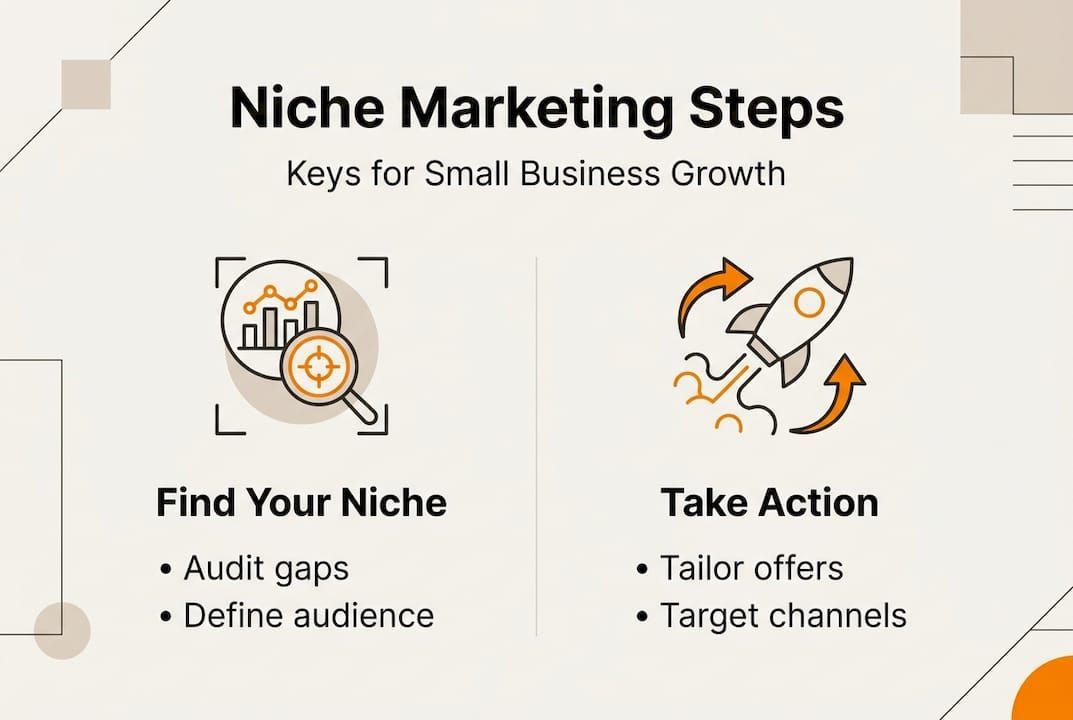
How niche marketing works: The core steps for local SMBs
Finding and winning your niche requires a systematic approach. These steps guide you from identifying opportunities to dominating your chosen segment.
1. Audit what competitors are overlooking
Look for underserved segments in your market. Which customer types struggle to find specialized solutions? What complaints appear repeatedly in reviews of competitors? Where do existing providers fall short?

2. Define your smallest viable audience
Identify your minimum viable audience with enough buyers to sustain growth but narrow enough to dominate. Aim for 1,000 to 100,000 potential customers in your geographic area.
3. Specialize products or services for that group
Adapt your offerings to solve the specific problems your niche faces. This might mean building tailored solutions, adjusting service packages, or creating specialized expertise.
4. Craft exclusionary messaging that repels those outside your niche
Your marketing should attract your ideal customers while clearly signaling who you don't serve. This feels counterintuitive but builds authority. When you say "we specialize in X," people who need X trust you more.
5. Use niche-specific channels
Focus on platforms where your audience already gathers. This might include local SEO strategies, industry forums, community Facebook groups, running targeted Facebook Ads, or local events. For legal services, consider marketing to local legal niches through specialized directories and referral networks.
6. Expand only after initial niche success
Once you dominate your core niche, scale to adjacent markets that share similar characteristics. This reduces risk while building on proven expertise.
Pro Tip: Start with the smallest viable niche you can profitably serve. It's easier to expand from a strong position than to narrow focus after spreading too thin.
Common pitfalls and how to avoid them
Even with the right framework, many SMBs stumble. Recognizing these traps helps you stay on track.
Choosing too tiny a niche
Niches too small cap growth; aim for 1,000 to 100,000 potential buyers. Less than 1,000 limits your ability to scale. You might build authority quickly, but revenue plateaus fast.
Staying in a saturated niche
If ten competitors already serve your target segment well, differentiation becomes difficult. Look for underserved niches where you can be the clear leader.
Letting FOMO derail your focus
The fear of missing potential customers outside your niche tempts you to broaden your message. Resist this. Specialization builds trust and commands premium pricing. Trying to serve everyone dilutes both.
Failing to expand after dominating your core
Once you own your initial niche, staying there forever limits growth. Expansion to adjacent markets is a proven path. If you dominate pet grooming for small dogs, expand to cat grooming or premium pet products.
Key avoidance strategies:
- Validate niche size before committing resources
- Research competition thoroughly to find gaps
- Set clear criteria for when to expand
- Track metrics that show niche dominance before scaling
"The biggest mistake is abandoning your niche before you've truly owned it. Most businesses expand too early, not too late."
Pro Tip: Improving your local web presence with niche-specific content helps you dominate search results for your target audience.
Tactics for local success: Nevada and New Jersey case studies
Seeing niche marketing in action makes the strategy tangible. Here's how local businesses in Nevada and New Jersey apply these principles.
Nevada tourism micro-niches
A Las Vegas tour operator stopped competing for generic "Vegas tours" and specialized in photography-focused experiences for Instagram influencers. By targeting Nevada's tourism micro-niches via geo-targeted SEO, they ranked first for "Instagram tour Las Vegas" and charged 3x the standard rate.
New Jersey local services
A Newark pet care provider focused exclusively on senior dog care, offering specialized services like mobility assistance and medication management. They dominated local search for "senior dog care Newark" and built a waiting list through referrals.
| Business Type | Niche Focus | Primary Channel | Result |
|---|---|---|---|
| Nevada tour operator | Instagram influencer tours | Local SEO, social media | 3x pricing, 85% booking rate |
| NJ pet care | Senior dog services | Google Maps, referrals | 6-month waiting list |
| Nevada legal | Small business formation | Google Ads, content | 40% conversion rate |
| NJ cleaning | Post-construction cleanup | Email, local partnerships | 90% repeat business |
Best channels for local niche marketing:
- Dominating Google Maps locally for geo-specific searches
- Using Google Ads with tightly targeted keywords
- Hyperlocal email campaigns to neighborhood segments
- Community engagement through local events and partnerships
These businesses succeeded by identifying underserved segments, specializing completely, and using high-ROI channels. They didn't need massive budgets, just clear focus and consistent execution.
Next steps: Ready to own your niche?
You've seen the framework, pitfalls, and real examples. Here's your roadmap to implement niche marketing in your business.
1. Identify your niche
Analyze your current customers to find patterns. Which segments are most profitable? Which have the least competition? Which align with your expertise and passion?
2. Validate market size
Research whether your niche has 1,000 to 100,000 potential buyers in your service area. Use local demographic data, industry reports, and competitor analysis.
3. Specialize your offerings
Adapt your products, services, and messaging specifically for your chosen niche. Remove or de-emphasize anything that doesn't serve this audience.
4. Build niche authority
Create content, case studies, and testimonials that demonstrate expertise in your niche. Building a social channel plan focused on your niche helps establish credibility.
5. Optimize for niche channels
Focus marketing spend on platforms where your audience gathers. Prioritize local SEO, targeted ads, and community engagement over broad campaigns.
6. Measure and refine
Track customer acquisition cost, conversion rates, and customer lifetime value. Adjust your approach based on what works.
7. Scale strategically
Scale to adjacent markets only after dominating your initial niche. Look for segments with similar characteristics or complementary needs.
Accelerate your results with specialized local marketing
Implementing niche marketing requires specialized skills in local SEO, targeted advertising, and conversion-focused web design. Many Nevada and New Jersey business owners find that partnering with experts accelerates results while they focus on serving customers.

We help small businesses identify profitable niches and dominate them through strategic marketing. Our local website solutions are built specifically for businesses targeting defined segments in Nevada and New Jersey. Whether you need SEO services to rank for niche keywords or Google Ads for SMBs to capture high-intent searches, we build campaigns that turn focus into revenue. We've helped dozens of local businesses move from competing on price to commanding premium rates through strategic positioning.
Frequently asked questions
How do I know if my niche is too small?
Aim for 1,000 to 100,000 potential buyers in your service area. Less could stall growth, while more might indicate insufficient specialization.
Do I need a large budget to succeed with niche marketing?
No. Focused campaigns using SEO and email yield high ROI even with modest spend because you target only qualified prospects.
How long does it take to see results from niche marketing?
Many SMBs see initial traction within 2 to 3 months as targeted messaging resonates. Building true authority typically takes 6 to 12 months of consistent effort.
Can I expand to other niches once successful?
Yes. After establishing your initial niche, scaling to adjacent markets with similar characteristics is a proven growth strategy that reduces risk.
Recommended