Grow your logistics business with content syndication
Grow your logistics business with content syndication

TL;DR:
- Content syndication strategically shares your expertise on trusted industry platforms to reach decision-makers.
- Proper SEO safeguards like canonical tags prevent duplicate content issues and protect your site's ranking.
- Regular measurement of traffic, leads, and engagement ensures continuous optimization of your syndication efforts.
Most transportation and logistics business owners hear "content syndication" and picture someone copying their articles and pasting them across random websites. That assumption is costing you real growth. Content syndication is a deliberate, strategic marketing method that places your brand's expertise in front of decision-makers you'd never reach through your own website alone. Done right, it builds authority in supply chain circles, drives qualified traffic, and generates leads without the guesswork of cold outreach. This guide breaks down exactly what content syndication is, how to execute it safely, and how to measure whether it's actually working for your logistics operation.
Table of Contents
- Understanding content syndication in logistics and transportation
- How the content syndication process works step by step
- SEO safeguards: Protecting your site and brand
- Measuring results and optimizing your syndication strategy
- Our take: Why logistics firms often overlook smart syndication
- Expand your reach with expert content syndication support
- Frequently asked questions
Key Takeaways
| Point | Details |
|---|---|
| Strategic distribution | Syndication extends your logistics content to high-value audiences beyond your website. |
| SEO must-haves | Canonical tags, careful partner selection, and delays help protect your authority in search. |
| Measure and adapt | Regularly track and refine your syndication campaigns to maximize leads and ROI. |
| Tailored content wins | Supply chain-focused pieces earn more industry traction than generic blog posts. |
Understanding content syndication in logistics and transportation
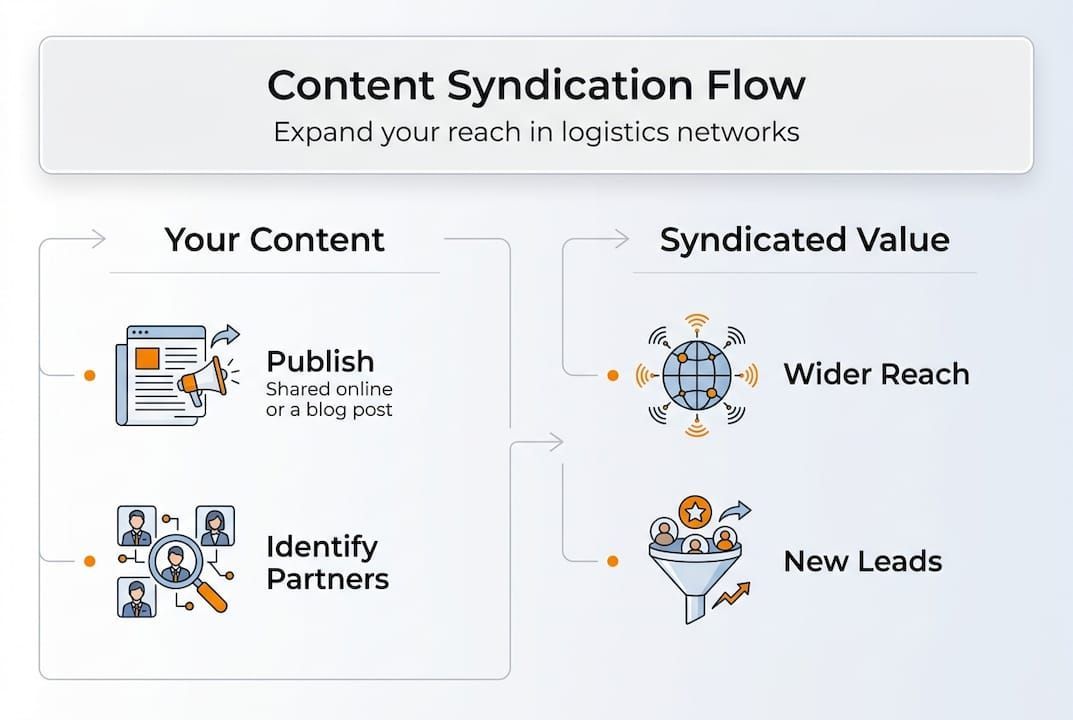
Content syndication is not random reposting. It's a planned process where your original article, case study, or how-to guide gets republished on a third-party platform, with proper attribution and technical signals pointing back to your site as the source. Think of it like licensing your expertise. You create the content once, and it appears on supply chain news sites, freight industry portals, or business publications that already have the audience you want.
For transportation and logistics firms, this matters more than most industries realize. Your buyers, whether they're procurement managers, fleet operators, or warehouse directors, are reading industry publications regularly. Getting your content onto those platforms puts your brand in their line of sight at exactly the right moment.
It helps to understand how syndication differs from other content tactics:
| Method | What it is | Content ownership | SEO impact |
|---|---|---|---|
| Content syndication | Republishing existing content on third-party sites | You retain ownership | Managed with canonical tags |
| Guest posting | Writing exclusive new content for another site | Shared or site's ownership | Backlink benefit |
| Social sharing | Distributing links to your content on social platforms | You retain ownership | Indirect traffic boost |
The mechanics involve creating evergreen content, identifying syndication partners, publishing with SEO safeguards, and measuring performance consistently. That's the framework that separates strategic syndication from careless duplication.
The types of content that work best for syndication in this sector include:
- Evergreen educational pieces (how freight brokerage works, what affects fuel surcharges)
- Problem-solution articles (reducing detention time, managing driver shortages)
- Industry trend breakdowns relevant to logistics decision-makers
- Case studies showing measurable outcomes for shippers or carriers
Your key syndication partners should be industry publications covering supply chain and freight, business portals targeting operations managers, and high-authority content networks. Exploring logistics web solutions can help you identify which platforms align best with your specific audience and service area.
The goal is relevance. A trucking company's article on last-mile delivery challenges belongs on a supply chain publication, not a general lifestyle blog. Partner selection is where most businesses either win or waste their effort.
How the content syndication process works step by step
Knowing what syndication is only gets you so far. Here's how to actually run a campaign that produces results for your logistics business.
- Create high-quality, evergreen content. Write articles that stay relevant for at least 12 to 18 months. Topics like carrier vetting, load board strategies, or compliance basics age well and attract consistent search interest.
- Identify relevant syndication partners. Research publications your target buyers actually read. Look for sites with real editorial standards, engaged audiences, and content that matches your subject matter.
- Implement SEO safeguards before publishing. Add a rel=canonical tag pointing back to your original URL on every syndicated version. This tells search engines which version is the source.
- Choose your distribution method. You can pitch partners directly, use free platforms like Medium or LinkedIn Articles, or invest in paid syndication networks that guarantee placement on specific sites.
- Track every placement with UTM parameters. Append unique tracking codes to your links so your analytics platform can tell you exactly which syndication source is driving traffic and conversions.
- Measure and optimize. Review performance monthly. Drop underperforming partners, double down on placements that send qualified leads, and refresh content that starts to lose traction.
The create, identify, safeguard, distribute, measure cycle is not a one-time event. It's an ongoing process that compounds over time as your content appears in more places and your brand recognition grows.
Pro Tip: Before pitching any syndication partner, wait at least five to seven days after publishing your original article. This gives search engines time to index your version first, protecting your site's authority as the original source.
Pairing your syndication efforts with strong social media management amplifies reach even further. When a syndicated piece goes live on a major freight publication, sharing it across your social channels creates a second wave of visibility that reinforces your brand in multiple channels at once.

Before you launch, prepare these essentials: your canonical URLs confirmed, UTM parameters built for each partner, a list of at least three to five vetted syndication targets, and a simple tracking spreadsheet to log placements and results.
SEO safeguards: Protecting your site and brand
Here's where many logistics businesses hesitate, and understandably so. Republishing your content elsewhere sounds like it could confuse search engines or split your ranking power. The risk is real but entirely manageable with the right technical steps.
Google's position on duplicate content is nuanced. It doesn't automatically penalize syndicated content, but it will choose one version to rank. Without proper signals, it might choose the third-party site over yours, which means you do the work and someone else gets the search traffic.
SEO risks include duplicate content, but they're mitigated by canonical tags, noindex instructions, delayed republishing, and careful partner vetting. Here's a practical breakdown:
| Safeguard | How it works | Impact |
|---|---|---|
| Rel=canonical tag | Points search engines to your original URL | Preserves your ranking authority |
| Noindex tag | Tells search engines not to index the syndicated version | Prevents duplicate ranking competition |
| 5 to 7 day delay | Lets your site get indexed first | Establishes your content as the source |
| Partner vetting | Ensures placement on relevant, reputable sites | Protects brand reputation |
Brand dilution is the other risk that doesn't get enough attention. If your logistics company's content appears on a low-quality or completely off-topic site, it signals to readers and potential partners that you don't control your brand carefully. That perception is hard to reverse.
Pro Tip: Build a simple publishing checklist that includes confirming canonical tags, checking partner domain authority, and logging the live URL of every syndicated piece. Running this checklist takes five minutes and prevents costly mistakes.
Applying solid SEO best practices from the start means you won't need to undo damage later. And if you want to understand how your overall web presence connects to syndication performance, reviewing web presence tips gives you a broader picture of how these tactics reinforce each other.
The bottom line on SEO safety: syndication done with technical discipline is not a threat to your rankings. It's a multiplier.
Measuring results and optimizing your syndication strategy
A syndication campaign without measurement is just publishing with extra steps. To know whether your effort is paying off, you need clear metrics and a system for reviewing them regularly.
Start with these key performance indicators:
- Reach: Total impressions and unique visits driven from each syndication source
- Engagement: Click-through rates, average time on page, and scroll depth
- Lead generation: Form fills, demo requests, or quote inquiries traced back to syndicated traffic
- Cost per lead: Total spend on paid syndication divided by leads generated
- Brand mentions: How often your company name appears in industry conversations after a placement
Measure performance through traffic, leads, and cost per lead from each source, and compare those numbers against what you're investing in each partnership.
Your tools for this work include Google Analytics with UTM-tagged URLs, your CRM to track lead sources, and direct reports from paid syndication platforms. Some industry publications will share basic performance data if you ask. Always request it.
Optimization happens in cycles. After 30 days, review which placements sent the most engaged traffic. After 60 days, assess whether any of those visits converted into actual leads or sales conversations. By 90 days, you should have enough data to cut weak partners and reinvest in what's working.
Common signals that a syndication placement is performing well include above-average time on page, multiple page visits per session, and a measurable uptick in branded search queries after the piece goes live. These tell you the content is resonating, not just getting clicks.
Optimizing your website performance solutions alongside your syndication tracking ensures the traffic you earn actually converts once it lands on your site. Driving visitors to a slow or unclear website wastes the reach you worked hard to build.
Syndication is rarely perfect on the first attempt. Expect to refine your content angles, update your partner list, and test different formats before you find the combination that consistently delivers results for your specific logistics niche.
Our take: Why logistics firms often overlook smart syndication
We've worked with transportation and logistics businesses that dismissed content syndication before giving it a real shot. The reasoning is usually the same: "Our industry is too niche" or "Our buyers don't read articles." Both assumptions are wrong, and they're expensive to hold onto.
Freight decision-makers are some of the most information-hungry buyers in any sector. They're researching vendors, comparing solutions, and consuming industry content constantly. The question isn't whether they're reading. It's whether they're reading your content or a competitor's.
Tailored syndication on the right industry platforms consistently outperforms generic digital ads for logistics firms because it reaches buyers in a context where they're already in learning mode. An ad interrupts. A well-placed article educates and builds trust.
The real ROI comes from treating syndication as one layer of a broader strategy, not a standalone tactic. Combining it with strong SEO strategies for logistics creates a compounding effect where your brand keeps showing up in the right places over time. The risk of brand damage is genuinely low when you control partner selection and apply proper technical signals. The risk of staying invisible in a competitive market is much higher.
Expand your reach with expert content syndication support
You now have a clear picture of how content syndication works and why it's worth pursuing for your transportation or logistics business. The next step is putting that knowledge into action with the right support behind you.

At Amigo Labz, we specialize in building custom logistics marketing strategies that combine content syndication, SEO, and analytics into one cohesive plan. We identify the right syndication partners for your niche, handle the technical implementation, and track results so you can focus on running your operation. Our team also offers dedicated SEO for logistics to make sure every piece of syndicated content strengthens your site's authority rather than competing with it. Let's build a content strategy that puts your brand in front of the buyers who matter most.
Frequently asked questions
How is content syndication different from guest posting?
Content syndication republishes existing articles on third-party sites for wider reach, while guest posting involves writing exclusive new content for each individual placement. Syndication saves time by reusing what you've already created.
Will content syndication hurt my logistics website's SEO?
Not if you apply the right safeguards. Using rel=canonical tags and noindex instructions, combined with choosing trusted syndication partners, keeps your original content protected as the authoritative source.
Which platforms work best for syndicating supply chain content?
Industry-specific sites and business portals focused on supply chain and freight are your strongest options, along with professional networks like LinkedIn Articles for reaching operations and procurement decision-makers directly.
How do I measure the success of a logistics content syndication campaign?
Track traffic, leads, and cost per lead from each syndication source using UTM parameters and your CRM, then compare those numbers against your investment in each partner relationship.
Recommended