Structured data explained: Boost your online visibility
Structured data explained: Boost your online visibility

TL;DR:
- Structured data helps search engines understand your content but does not guarantee rich results or higher rankings.
- Proper implementation and accurate, up-to-date schema are crucial for unlocking the full potential of structured data.
- Common errors include missing required fields and invalid formats; regular validation ensures schema effectiveness.
You add structured data to your website, wait for those eye-catching rich results to appear in Google, and nothing happens. Sound familiar? Many business owners and marketers in New Jersey and Nevada run into this exact wall. The truth is, structured data is one of the most misunderstood tools in digital marketing. It is not a magic switch, and it does not guarantee anything. But when you use it correctly, it can dramatically improve how search engines understand your business and how customers find you. This article breaks down what structured data actually does, where most people go wrong, and how to use it to your real advantage.
Table of Contents
- Understanding structured data: Definition and why it matters
- How structured data drives search engine features and online visibility
- Common structured data errors and how to avoid them
- Debunking myths: The truth about structured data and SEO
- Our take: Why most businesses overlook structured data's real opportunity
- Take the next step to boost your online presence
- Frequently asked questions
Key Takeaways
| Point | Details |
|---|---|
| Structured data defined | It's code that explains your page content to search engines for enhanced display features. |
| No guaranteed results | Schema increases eligibility for rich features but doesn't guarantee appearance in search results. |
| Common error pitfalls | Mistakes like missing fields or invalid formats can block rich result eligibility. |
| Ongoing strategy | Review and update your structured data regularly for best digital marketing outcomes. |
Understanding structured data: Definition and why it matters
Structured data is a standardized format of code you add to your web pages to help search engines understand what your content means, not just what it says. Think of it as a label on a product box. Without it, a search engine has to guess what your page is about. With it, you are telling Google directly: "This is a local business. This is a product. This is an event."
The most widely used framework is Schema.org, a shared vocabulary developed by Google, Bing, Yahoo, and Yandex. You can apply it to almost any type of content:
- Local business listings with hours, address, and phone number
- Product pages with price, availability, and reviews
- Events with dates, locations, and ticket information
- FAQs with questions and answers formatted for quick display
- Articles with author, publish date, and headline
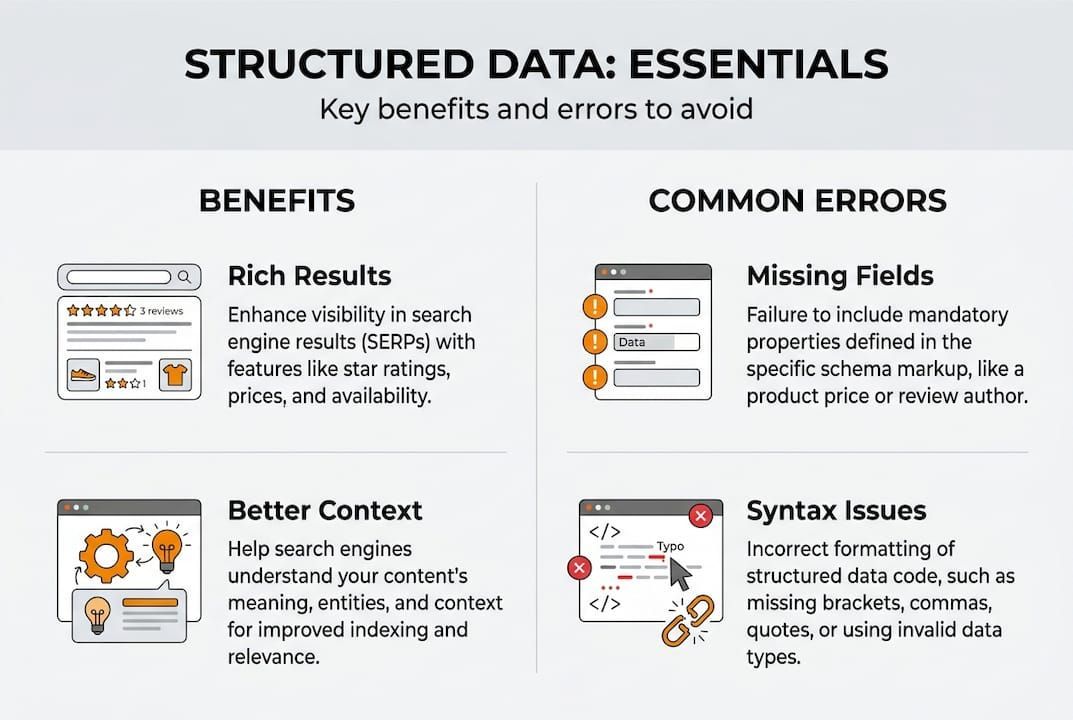
This code does not change how your page looks to visitors. It works behind the scenes, giving search engines the context they need to potentially display your content in enhanced formats called rich results. These include star ratings, product carousels, event listings, and more.
Here is the critical point most marketers miss: structured data is not a direct ranking factor but it enables rich results and AI-powered search features. Adding schema does not push you to page one. It makes you eligible for features that can increase your visibility and click-through rate. There is a big difference.
For businesses running Google Ads campaigns or Facebook Ads strategies, structured data works as a complementary layer. It strengthens your organic presence while your paid efforts drive immediate traffic. Both work better together.
Pro Tip: Start with Google's structured data guidelines and focus on the Schema.org types most relevant to your business first. A local restaurant should prioritize LocalBusiness and Menu schemas before anything else.
How structured data drives search engine features and online visibility
With the basics defined, let's explore the real advantages structured data brings to your search presence.
When structured data is implemented correctly, it makes your pages eligible for rich results, which are visually enhanced listings in Google Search. These can include:
- Star ratings and review counts on product or service pages
- FAQ dropdowns that expand directly in search results
- Event dates and ticket links displayed under your listing
- Recipe details like cook time and calorie count
- Breadcrumb navigation paths shown below your URL
These enhanced listings stand out visually and tend to attract more clicks. But eligibility is not automatic. Quality schema outperforms basic or missing schema in Google AI tests, meaning the more accurate and complete your markup, the better your chances of being featured.
Here is a comparison of what local businesses typically experience with and without structured data:
| Feature | Without structured data | With structured data |
|---|---|---|
| Search listing appearance | Standard blue link | Potentially rich with ratings, hours, FAQs |
| Voice search compatibility | Limited | Improved eligibility |
| AI search feature inclusion | Unlikely | More likely with quality schema |
| Click-through rate | Baseline | Often higher with rich results |
| Local pack visibility | Standard | Enhanced with LocalBusiness schema |
Structured data also plays a growing role in Google's AI-powered search experiences. As search evolves, rich result eligibility becomes more tied to how well your markup communicates your content's value and relevance.
For businesses managing social media management alongside SEO, the visibility gains from structured data reinforce your brand presence across multiple touchpoints. A customer who sees your rich listing in search is more likely to recognize your brand when they encounter it on social platforms.

The key takeaway: structured data does not create visibility on its own. It creates the conditions for visibility. Your content still needs to be high quality, relevant, and accurate.
Common structured data errors and how to avoid them
Understanding errors is key. Here is what to watch out for when working with structured data.
Even experienced developers make mistakes with schema markup. The most frustrating part is that a single error can disqualify your entire markup block from being considered for rich results. Syntax errors like missing commas or brackets cause full block failure, meaning all the work you put into your markup counts for nothing.
Here are the most common structured data mistakes, in order of how often we see them:
- Missing required fields. Every schema type has required properties. Skipping even one can block eligibility entirely.
- Invalid date formats. Dates must follow ISO 8601 format (YYYY-MM-DD). A date written as "March 5, 2026" will not be recognized.
- Price without currency. Product schema requires a currency code alongside the price value. Listing "29.99" without "USD" is incomplete.
- Content mismatch. Your schema must reflect what is actually visible on the page. If your markup says a product is "In Stock" but the page says "Sold Out," Google will likely ignore or penalize the markup.
- Outdated information. Event dates that have passed or business hours that no longer apply create trust issues with search engines.
A single missing required field can disqualify your entire markup block, no matter how accurate the rest of your schema is. Google's systems evaluate the full block, not just the parts you got right.
Fixing these common errors is not complicated, but it requires attention to detail. Our website solutions include structured data audits that catch these issues before they cost you visibility.
Pro Tip: Use Google's Rich Results Test tool to validate your schema before and after every update. It takes two minutes and can save you weeks of wondering why your markup is not performing.
Debunking myths: The truth about structured data and SEO
After covering avoidable errors, let's clarify what structured data really does and does not do for your SEO.
There is a lot of noise around structured data, and some of it is flat-out wrong. Believing these myths can lead you to waste time, set unrealistic expectations, or worse, implement schema incorrectly trying to game a system that does not work that way.
Here are the biggest myths versus the actual facts:
- Myth: Adding schema will boost my Google ranking. Fact: Structured data is not a direct ranking signal. It supports eligibility for features, not position.
- Myth: Once I add schema, rich results will appear immediately. Fact: Eligibility is not automatic; Google decides when and whether to show rich results.
- Myth: More schema types mean better results. Fact: Irrelevant or inaccurate schema can hurt more than help.
- Myth: Plugins handle everything automatically. Fact: Plugins generate generic markup that often needs customization to be accurate.
- Myth: Structured data is only for e-commerce. Fact: Local businesses, service providers, and content publishers all benefit significantly.
| Structured data effect | Reality |
|---|---|
| Direct ranking boost | No |
| Rich result eligibility | Yes, when implemented correctly |
| Voice search readiness | Yes, improved |
| Click-through rate improvement | Often yes, with rich results |
| AI search feature inclusion | Increasingly yes |
Smart marketers focus on eligibility and user experience, not promises of ranking boosts. When you align your SEO strategies with accurate, well-maintained structured data, you build a stronger foundation for long-term visibility. The businesses that win are the ones that treat structured data as part of a broader strategy, not a one-time checkbox.
Clear expectations are not just helpful, they are necessary. When you know what structured data can realistically deliver, you can measure it properly and make better decisions about where to invest your marketing budget.
Our take: Why most businesses overlook structured data's real opportunity
After helping dozens of local businesses implement structured data, we have seen a clear pattern. Most business owners install a plugin, check a box, and move on. They assume the work is done. It is not.
The real opportunity in structured data is not in having it. It is in having it right. Quality and context matter enormously. A schema block that accurately reflects your current offers, hours, and services does far more than a generic template that has not been touched in two years.
Most competitors overlook the benefit of aligning structured data with actual business goals. Your markup should reflect your strongest selling points, your most searched services, and the exact information your customers need to choose you over the competition.
Here is what we have learned the hard way: always check that your visual content matches your schema, update your information every time your business changes, and never rely solely on plugins. Plugins are a starting point, not a finish line.
The real power of structured data lies in earning trust, both from search engines and from users who see your listing. Integrating it with enhanced social strategies and custom website solutions creates a consistent, credible presence that compounds over time.
Pro Tip: Make structured data a standing agenda item in your quarterly digital strategy reviews. Small, regular updates outperform big one-time overhauls every time.
Take the next step to boost your online presence
You now understand what structured data does, where it fails, and how to use it with realistic expectations. The next step is making sure your implementation is actually working for your business.

Whether you are based in New Jersey or Nevada, the Amigo Labz team can audit your current structured data, fix errors, and align your schema with your real business goals. We combine expert SEO help with technical precision and website solutions that go beyond generic templates. If you want to understand how structured data fits into your local search strategy, start with our local search ranking insights to see the full picture. Let's build something that actually shows up.
Frequently asked questions
What exactly is structured data?
Structured data is code on your site that helps search engines better understand your page content and highlight it in search results. It uses standardized vocabulary from Schema.org to label your content clearly.
Does adding structured data improve my Google ranking?
It is not a direct ranking factor but it makes your pages eligible for rich results and better visibility in search. Think of it as opening a door, not pushing you through it.
Why didn't my structured data show rich results?
The most common reasons are syntax errors or missing fields that disqualify the markup block, or schema that does not match the visible content on your page. Validate your markup using Google's Rich Results Test to diagnose the issue.
Can I use plugins to generate structured data?
Yes, but always validate and customize the plugin output to match your specific business details. Generic plugin output is a starting point, not a complete solution.
Recommended